
Published
- 04:00 am
Demand for Resolve’s platform grows as new marketplaces emerge and businesses look to ease supply chain challenges by removing friction from B2B transactions
Resolve announced today that it has raised an additional $25 million in strategic equity funding to meet rising demand from business-to-business (B2B) companies seeking to simplify their net terms payments and embed B2B buy now, pay later (BNPL) solutions into their payment workflows. Launched as a spinout from Affirm in 2019, Resolve previously announced a combined $60 million asset and equity financing in early 2021.
These new funds will be used to further expand its platform and team to serve the growing list of B2B companies using Resolve to facilitate net terms payments overall and throughout their supply chains. The funding round was led by New York-based global venture capital and private equity firm Insight Partners, with participation from existing investors Initialized Capital, KSD Capital, Haystack VC, Commerce Ventures and Clocktower Ventures.
“The market for simplifying net terms payments and embedding BNPL payment options is exploding as companies work to mitigate the pain of payments caused by overextended and snarled supply chains,” said Chris Tsai, Resolve’s CEO. “With this infusion of funds, we can capitalize on our market leadership position and rapidly scale to serve the many new types of companies looking to offer net terms and BNPL to their business customers, while unlocking cash flow and growing with minimal risk and effort.”
Resolve simplifies and automates the notoriously complex and risk-laden process of billing and purchasing on a credit account. Its digital 30-, 60-, or 90-day net terms-as-a-service and embedded BNPL payment solutions free up B2B sellers and buyers to focus on growing their businesses. Throughout the pandemic, manufacturers, distributors, wholesalers and their purchasers increasingly turned to Resolve for help modernizing their B2B payment methods and net terms billing workflows.
Increasingly, a wider range of companies have also begun to embrace digital B2B BNPL as an easier, less-risky way to offer net terms to customers who expect to pay later. Further, buyers and sellers are relying on modern, convenient credit options like B2B BNPL to extend payment terms while navigating global supply chain disruptions.
“The demand for embedded B2B payment options with net terms has skyrocketed as businesses must universally cater to customers accustomed to consumer-style payment and credit options, and to a new supply chain reality dominated by extended or delayed delivery times,” said Rebecca Liu-Doyle, principal at Insight Partners. “Resolve provides an elegant, embeddable net terms payment experience that simplifies the complexity of meeting those customer needs with minimal risk and hassle.”
Resolve’s net terms-as-a-service and embedded BNPL platform integrates seamlessly into a B2B company’s existing financial technology stack to facilitate growth, increase sales revenue and optimize cash flow while eliminating risk for the company. This removes the complexity and risk of offering extended payment terms, enabling hassle-free customer billing and payments.
Buyers pay no interest or fees if accounts are repaid within the agreed-upon terms. Merchants receive full payment, less fees, as soon as an order is placed. This automated, embedded approach puts merchants back in control of their customer relationships and cash flow.
- 06:00 am
Private Equity FinTech Lender continues to excel with expanding real estate market in the United States
Legion Capital Corporation (OTCQB:LGCP), a FinTech enabled, specialized business lender, was named in Global Business Leaders Magazine 20 Companies Who Are Escalating Innovation In The Market in 2021 Listing.
Legion Capital funds acquisition, early-stage development and growth capital needs for small and medium sized business owners, real estate developers and entrepreneurs, addressing a market segment that has gone largely unserved by banks and conventional lenders. The company has core holdings in real estate development, construction, infrastructure, materials and other business segments, along with a substantial pipeline of transactions that will provide exponential growth over the next several years.
“We are pleased to be recognized as one of the 20 Companies Who Are Escalating Innovation In The Market in 2021 By Business Leaders Magazine,” explained Chairman James Byrd. It is a testament to the hard work that is put in every day by the incredible Legion team. We are all excited about what the future holds for Legion Capital – we believe our ability to innovate and stay at the forefront in terms of technology, business plan and operational model will continue to fuel our growth in the coming months and years.”
As a specialized lender and private equity firm, Legion Capital continues to be focused on small and emerging companies we look to acquire ownership stakes, on either a controlling or non-controlling basis, in select companies and projects in growth industries.
- 04:00 am

PayU has announced that its patented technology, which will look to revolutionise payments and improve customer experience, has been approved by the United States Patent and Trademark Office.
PayU, the fintech and e-payments business of Prosus, has today announced that its patent for technology, which will improve payments routing and approval, has been accepted.
As disruptors in the payments space, the multi-payment processor optimisation concept was first developed by Zooz, which applied for the patent with the United States Patent and Trademark Office in 2015. As Zooz was acquired by PayU in 2018, the patent stipulates that PayU owns the rights to this technology, which simplifies the end-user experience and optimises each transaction on PayU’s payments hub.
Since the patent was filed, more companies have begun to develop similar technology, demonstrating the value of this solution in the payments space. However, despite the increasing number of other companies developing similar types of products, the patented innovation developed by PayU remains the most mature in the market. The technology has been available on PayU's platform since 2016, with a significant number of customers already using it in the company's key markets
Now that the patent has been approved, it positions PayU as one of the most cutting-edge digital payments platforms, facilitating global businesses to ensure high approval rates for both local and cross-border transactions. The technology will further enable PayU to develop competency in payment optimisation, and the filing of the patent is one of the many ways that PayU has sought to innovate its end-to-end payment solution.
The smart routing engine offers more than 100 routing configurations to ensure that every possible scenario a merchant may face is accounted for. Merchants can route payments according to credit card issuer, the geographical location where the payment was made or a card was issued, and more. Payment A/B testing for routing configurations is also an option.
The accumulated data that the solution records provide the base for its smart intelligent routing, which routes payments to their optimal end-destination and thus ensures the best approval rates possible. The engine’s flexibility allows merchants to re-configure routing rules in real-time, so that they can see the immediate effect on their revenue.
PayU’s customers benefit from the solution’s flexibility, by adding and removing payment methods and changing transaction routing configurations. That flexibility and the unlimited routing options allow for on-the-go adjustment of payment stacks, and maximisation of ROI and approval rates. If certain configurations do not work, changes are easily performed, and a data dashboard helps businesses to see the effect in real-time.
Commenting on the patent, Ronen Morecki, PayU’s CTO said: “PayU has set out to create the most cutting-edge solutions for payment optimisation and performance. our patented routing engine brings together top innovation that allows merchants to enjoy the highest approval rates thanks to an intelligent routing mechanism that gives merchants utmost control and flexibility to adapt their payment stack to their dynamic needs”
- 07:00 am
Horizon Software (Horizon), the world’s leading SaaS provider of electronic trading solutions and algorithmic technology, has appointed Sebastien Cathelin as Global Head of the Presales team. With over 20 years of vast experience in the financial markets, Sebastien brings with him a deep understanding of both market making and algorithmic trading.
In his new role as Global Head of Presales at Horizon, Cathelin will help to grow Horizon’s global client base and expand the footprint that Horizon’s trading services already have in the APAC, EMEA and US regions. The vast expertise gathered from his background in trading will enable him to identify and understand the specific needs of Horizon customers, and to match them with the appropriate solutions. This process is key to ensuring the best onboarding experience for our new clients.
Cathelin began his career on the trading desk at Société Générale before moving to Korea Investment & Securities in Seoul as their Senior Equity Derivatives Trader & Manager, among the first warrant traders when the market first opened in 2005. Subsequently, he led on building the Equity Derivatives Trading desk for BNP Paribas and led on automating the market making side of the business. He has also held the position of Head of Listed Products trading at Vontobel before returning to Paris to join Horizon Software.
Sebastien Cathelin says “I am extremely excited to join the growing Horizon team at this specific point of rapid growth and expansion on a global scale. At this stage of my career, I am looking forward to applying my experience in electronic trading to a different role, helping Horizon customers to find the best solution for their business. I look forward to working with a great team to deliver the best service and support to clients”.
Vincent Dumontoy, Head of Client Solutions Services at Horizon Software adds: “Sebastien’s appointment is a valuable addition to Horizon. His extensive background in the financial industry, most notably on market making, will bring significant expertise and commitment to our team as we continue to engage with our prospects & clients globally. This will strengthen our position as a leading cross-asset electronic trading platform across agency & principal business models”.
- 02:00 am
In 56 percent of corporate legal departments (CLDs), including banks and other financial services firms, the top 10 biggest legal matters account for between 20 percent to 40 percent of spend. But according to Wolters Kluwer ELM Solutions, which published its third LegalVIEW Insights reports today, there are still a variety of simple cost-saving tech enabled measures a department can implement in order to reduce the budgetary impact of these matters over the long-term.
Insights into CLD spend are sourced from ELM Solutions’ LegalVIEW database which recently crossed the $150 billion threshold. The wide scope of that data bolsters ELM Solutions’ ability to continue identifying key trends - and provide expert guidance - within an ever-changing legal industry.
Megamatters, or legal matters that accrue more than $1 million USD in lifetime costs, account for much of the volatility found in corporate law firm spend. However, the ELM Solutions report indicates that some organizations are still not taking full advantage of technology and managed services that can help reduce spend. For example, the use of alternative legal service providers (ALSPs) can drive significant improvements in cost control. But the most recent LegalVIEW Insights report showed that ALSPs have still captured only a small percentage of megamatters overall, fielding just 2.2 percent of the available megamatter work coming out of CLDs.
“There is always low-hanging fruit in every type of legal matter, and the scope of these matters means that the simple effort of picking the low-hanging fruit from a single matter could save millions,” said Nathan Cemenska, Director of Legal Operations and Industry Insights for Wolters Kluwer ELM Solutions.
Additional highlights from the third LegalVIEW Insights report include:
- Megamatters are bellwethers for the trajectory of a department’s overall legal spend. If annual megamatter spend rises or falls by even $1 USD, there is an 89 percent chance that the direction of total outside counsel spend will follow accordingly. The connection between megamatter and total outside counsel spend necessitates ongoing communication between all stakeholders.
- Legal departments may find that the number of megamatters on their docket can vary widely over even a six-year period. During a “high” year, megamatters as a percentage of overall outside counsel spend will be at least double what they were during a “low” year inside 38 percent of corporate legal departments. Some CLDs have previously used “low-touch” tactics such as creating matter-specific discounted rates for megamatters and enforcing outside counsel billing guidelines to manage the resulting costs.
- CLDs that refuse to engage regional law firms on megamatters could be forfeiting significant cost savings in the form of reduced hourly rates. Unranked law firms outside of the Am Law 200, for instance, appear to be playing a central role in how some corporate legal departments are handling their megamatters. Together, unranked firms account for about 28 percent of megamatter spend, which remains less than the 40.3 percent of spend they capture in matters accruing less than $1 million USD in lifetime costs.
ELM Solutions, part of Wolters Kluwer’s Governance, Risk & Compliance division, is the market-leading global provider of enterprise legal spend and matter management, contract lifecycle management and legal analytics solutions. The company provides a comprehensive suite of tools that address the growing needs of corporate legal operations departments to increase operational efficiency and reduce costs. Corporate legal and insurance claims departments trust its innovative technology and end-to-end customer experience to drive world-class business outcomes. It counts some of the world’s largest financial institutions among its clients.
Last month ELM Solutions announced the winners of its fifth annual Legal Innovator Awards at its virtual premier user conference ELM Amplify 2021. The awards are designed to celebrate clients who have transformed legal operations. Citi, the leading global bank, was recognized for its continued efforts to enhance its Legal data quality and controls, productivity and spend management, and reduce technology risks. After a strategic review of its organization, processes, systems and controls, Citi was able to make significant progress on key priorities like the centralization and optimization of internal and external spend, risk-based management of its law firm network and enhancing its third and fourth party information security controls by moving to the centralized ELM Solutions’ Passport platform.
Equitable, a leading financial services organization, won its accolade for developing a modernization strategy and technology roadmap which has resulted in significant operational improvements in its law department. Judges noted how Equitable has shown itself to be a forward thinking and cutting-edge partner, looking to explore and utilize new processes and functionality with a keen eye on the possibility of developing new processes or features.
Swiss Re, one of the world's leading providers of reinsurance, was also recognized as an ELM Solutions Legal Innovator Award winner. The accolade acknowledges the company’s strategy around operational excellence and for using Artifical Intelligence to assist with invoice review in capturing anomalies and billing pattern changes that would not be realized in a standard eBilling platform.
- 04:00 am

Worldline, the European leader in the payments and transactional services industry and number 4 worldwide, today announced it has partnered with ‘social ecommerce’ platform Joom, to manage payments in multiple European countries.
Joom is the first marketplace to offer European merchants access to the Russian market. European online businesses and their Russian customers will benefit from the cooperation with Worldline through an optimised choice of payment methods, tailored to the specific needs of the 42 billion euro ecommerce market.
Joom wanted its Russian shoppers to have the widest choice of payment options possible, so that they are comfortable with the platform and return for new experiences. This means allowing customers to choose a payment mean that suits them best, therefore improving checkout conversation rates, as well as customer engagement and loyalty. Additionally, the Russian market, with its dynamic financial ecosystem and specific customer preferences, can be challenging to navigate for international merchants. Joom has been using Worldline’s Russian Payments Solution, a suite of products created in 2018, to respond to the unique opportunities of the country’s digital commerce and local payment preferences.
Yuri Ivanov, Co-founder & CMO at Joom, commented: “Russia is a key market for us with 144 million potential customers. Working with Worldline made what could have potentially been a difficult process extremely easy, and we are confident that we will be able to thrive in a new marketplace.”
Raymond Cui, Head of Marketplaces at Worldline’s Digital Commerce division, added: “Joom has a fascinating and unique business model – ‘social ecommerce’ is very different from other large, more traditional online shopping sites and it allows small businesses to gain worldwide exposure. Russia can be a challenging market to enter but Worldline has made it a priority to allow our clients to smoothly transition into this high growth market, and we are thrilled of our collaboration with Joom.”
- 04:00 am

- Complete environment ready for customer testing
- Available 12 months before migration period begins
- Suite of test services includes network-based ISO 20022 to MT (‘in-flow’) translation
- Production services will support the industry’s adoption of the new standard
SWIFT today announces the availability of its new In-flow Translation service and confirms that it now offers a full ISO 20022 customer testing environment for cross-border payments. In-flow Translation will enable financial institutions to realise the benefits of rich data when they migrate to ISO 20022, even if their counterparts have not yet adopted the standard. The availability of a test environment means that customers can now prepare for ISO 20022 a year before it goes live.
The service translates rich ISO 20022 messages into the existing MT format for banks that are not ready to process ISO 20022 messages immediately – and it ensures both message formats are delivered so customers always have complete data. This ensures that all financial institutions on the SWIFT network can continue to transact as normal during the industry’s migration, which starts in November 2022 and runs to November 2025.
SWIFT has made In-flow Translation available for testing early to help banks familiarise themselves with ISO 20022 and gain experience in the new operational environment. Early adopters will be able to start using the service from August 2022 on an opt-in only basis. All banks will be automatically enrolled in the service in November 2022 to coincide with the mandatory start of cross-border migration and the go-live of ISO 20022 for high-value payments in the Eurozone.
Stephen Lindsay, Business Lead, SWIFT Platform, said: "One of the guiding principles behind our strategy for instant and frictionless payments is to ensure that nobody is left behind and that institutions are able to migrate in a way that suits them and their customers. We are delivering on this promise through the launch of In-flow Translation and the completion of the customer testing environment for ISO 20022, ensuring our community has plenty of time to prepare for the new standard. The move to ISO 20022 is a key component of our strategy that will unlock significant business benefits for banks. In-flow Translation will be vital to making the transition as smooth as possible by supporting interoperability between messages types.”
By enabling richer, better-structured data to be carried in payments messages, ISO 20022 will provide for an improved end-user experience and forms a key building block on which the future of the financial industry will be built.
Leveraging its unrivalled global network of more than 11,000 institutions and 4 billion accounts in 200 countries, SWIFT is taking action to minimise disruption and ensure that its community is ready for the start of migration, including those banks that will not initially adopt ISO 20022 in the back-office. The completion of the test environment, including In-Flow Translation, means banks will have a full year to familiarise themselves with the mandatory changes that are coming.
- 08:00 am
French intermediaries now able to meet new EC regulatory requirements under SRDII
Global Fintech leader Broadridge Financial Solutions, Inc., and SLIB, a leading-edge software vendor in electronic voting and securities services based in France, have announced the live operational running of their joint cross-border proxy voting solution. Unique in the French market, the solution enables intermediaries - including banks, brokers and wealth managers that serve France-based investors - to meet their new, mandatory obligations to support voting for European shareholder meetings under the updated Shareholder Rights Directive (SRDII).
“The collaboration with SLIB, together with l’Association Française des Professionnels des Titres (AFTI), the French industry association, has been meticulously designed and implemented by experienced and deeply knowledgeable experts from all relevant stakeholders,” said Demi Derem, General Manager of Broadridge’s International Investor Communication Solutions. “Financial Intermediaries in France can now meet their regulatory obligation to provide cross-border electronic meeting notifications and end-to-end proxy voting services to their French investors, while helping to transform corporate governance standards across Europe through increased levels of shareholder democracy and stewardship.”
“SRDII has mandated a pronounced change in European corporate governance practices, requiring careful planning at a market level to enable the compliance of all actors,” said Philippe Cognet, CEO of SLIB. “By partnering with Broadridge, we have combined their market leading global proxy voting infrastructure with our best-in-class Votaccess platform (used by the majority of listed companies) for French intermediaries and investors resulting in a robust, market-ready operational solution that delivers significantly higher rates of cross-border processing efficiency and governance automation.”
- 03:00 am

Not for profit organization announces 10th iteration of innovation model
BIAN, the independent not-for-profit association, is today announcing the availability of Service Landscape 10.0 (SL 10.0). The Landscape was created in 2010 and is a reference structure that categorizes and organizes BIAN’s Service Domains. These represent the unique business functions that BIAN has defined as a standard for the banking industry. The Landscape aims to help the industry modernize core infrastructure as they attempt to align their services to the needs of the modern customer.
The updated Service Landscape has 57 additional APIs, bringing the total to 243. The new APIs cover the outstanding banking specific functions that have not been included in BIAN’s library to date. These include the likes of account reconciliation, corporate payroll services, and hedge fund administration. In addition to this, the Service Landscape has been updated so that there is a clear and straightforward link between the BIAN models and the derived technical implementations of BIAN APIs. BIAN is also aligning the APIs with prevailing technical standards, such as OAS 3x, an open-source development standard that is widely used across the industry to ensure the APIs are easily adopted.
“BIAN is well known as the backbone of the industry when it comes to providing a common framework for banking services”, said Shanker Ramamurthy, BIAN board member and Global Managing Partner- Banking at IBM. “The updates to its service landscape will prove extremely valuable, especially during these uncertain times, as we attempt to navigate the new normal. Joining BIAN has allowed us to have a say in the future of banking; this is something we’re truly proud of.”
“We’re excited to announce the availability of Service Landscape 10.0, which has been driven by the needs of our members,” said Hans Tesselaar, Executive Director, BIAN. “As we look to the new year, the financial services sector must focus on becoming more agile and aligned to the needs of the customer. The availability of Service Landscape 10.0, combined with the results of our Coreless banking platform, will allow the industry to do this through innovation and their ability to bring new services to market more quickly and efficiently.”
- 03:00 am
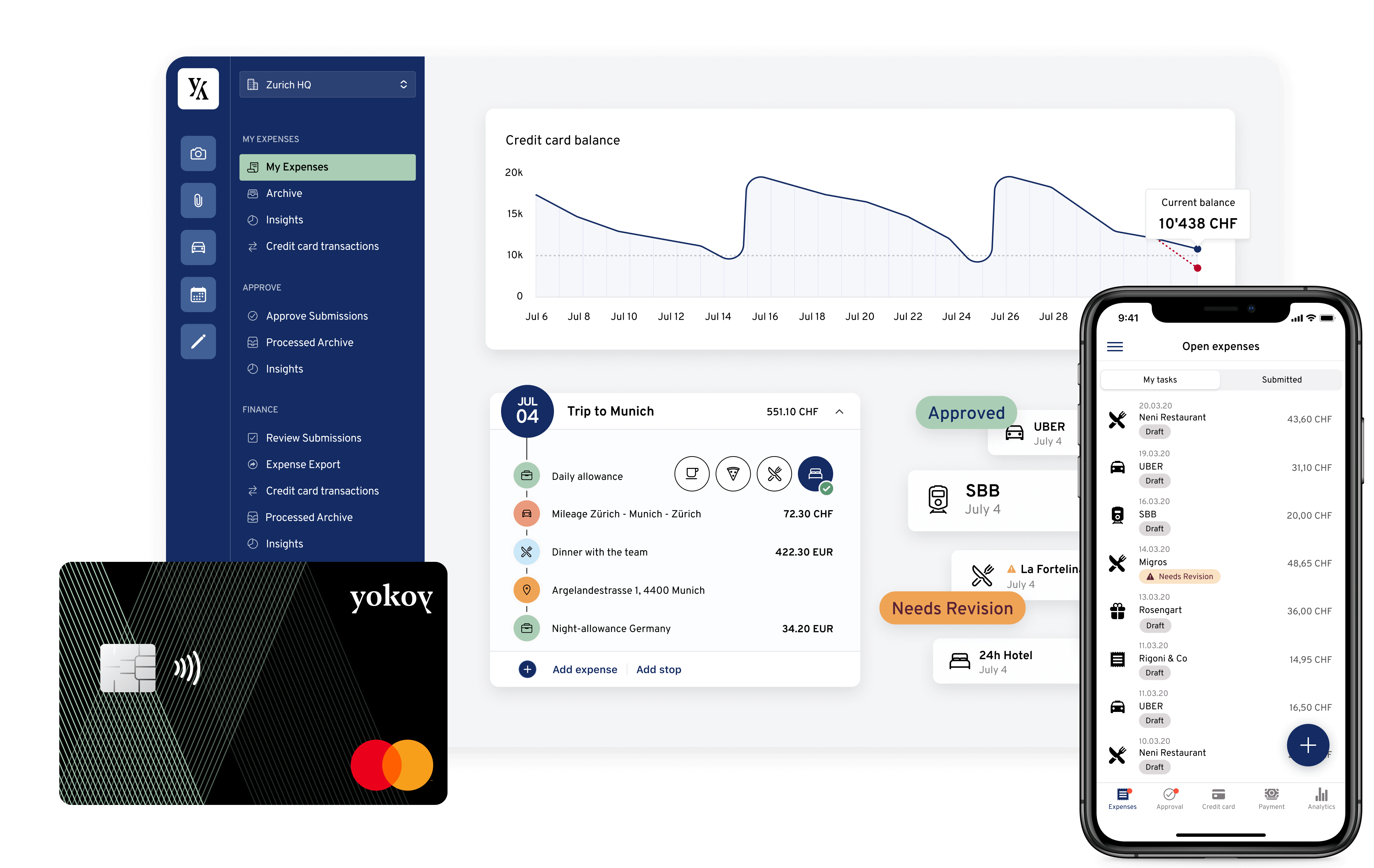
Yokoy and Visa have teamed up to develop a debit card that integrates automated payment transactions into a comprehensive spend management solution. Thanks to its versatility and attractive fee structure, the Yokoy Visa Business Card is an ideal debit card solution for companies whose employees operate across Europe.
Zurich-based fintech Yokoy has partnered with Visa to deliver a business debit card that digitizes and automates transactions. Yokoy's software works as an integration platform connecting the card to spend management software and existing enterprise resource planning systems. Designed for all commerce-related expenses, the Yokoy Visa Business Card is available as both a physical card and a virtual product. It can be used worldwide and attracts no card fees, card account fees, transaction fees or foreign currency surcharges when used within the EU.
"The classic payment card in the B2B sector, which is typically offered in isolation, is increasingly seen as an outdated solution. But the landscape is changing, thanks to our platform, which seamlessly integrates corporate cards into customers' ecosystems. The result is complete automation from payment to accurate and rapid booking in the financial system without any manual steps. The new Yokoy card can not only be managed completely digitally, but also scores points by waiving any fees that would otherwise be charged for comparable cards. We’re confident that the Yokoy Visa Business Card offers companies a truly great solution in the area of spend management," explains Philippe Sahli, CEO and co-founder of Yokoy.
When ordering their cards, customers can opt for a virtual or physical product. Virtual cards are delivered within a few seconds, and all information relevant to their use is directly available in the Yokoy platform and the cards can be used immediately. Companies can also define the application scope for specific payments or specific individuals. And both virtual and physical Yokoy cards can be fully integrated into the Yokoy spend management system, with data exchange working in real time. The debit card is powered by Marqeta, the global modern card issuing platform, whose partners include tech giants like Klarna and Uber.
“From freelancers to large corporations, businesses of all sizes are now realising the capabilities of modern payment card platforms, which allow companies to manage spending and expenses much more efficiently with real-time functionality. Marqeta’s European team is delighted to support Yokoy’s exciting roadmap and we’re certain this is an innovator to watch. By choosing to work with Marqeta, Yokoy has many of the tools it needs to build and iterate additional features quickly, and expand seamlessly into new territories and markets if it wishes. We look forward to being a part of their success story in the coming months and years,” said Ian Johnson, SVP/Managing Director Marqeta (Europe).
The Yokoy software is designed to work with common financial and HR systems. Transactions are automatically transferred into the Yokoy platform and reconciled with stored receipts. As a result, a company's finance team is able to maintain control over the entire card portfolio and all associated transactions. Yokoy's debit card offers companies maximum flexibility, due to its ability to be customized to meet individual needs.
"The Yokoy card is our vision of the European ideal: business activities across borders should be as easy and affordable as possible," Yokoy CEO Philippe Sahli continued.
Among the first customers of the new debit card are Doodle Germany and Austria's Bitpanda. Peter Grausgruber, CFO of Bitpanda says: "We chose the Yokoy card as our corporate card because thanks to the zero-fee model, we not only enjoy the ideal solution on the cost side, but at the same time it allows us to avoid a lot of manual administrative work as well as making our spend management much clearer and more efficient." Julia Schulze, Financial Controller of Doodle, added, "using payment cards offered by traditional banks might have some advantages in terms of flexibility and fees, but there are also quite a few disadvantages. For example, reporting proves to be difficult, because you usually only receive transaction data at fixed points in the month. That's why we chose Yokoy's cards, which allow you to see and manage transactions in real time. In addition, with Yokoy, we have full control over the spending of our individual departments. And the fact that Yokoy does not charge any foreign currency fees and does not require a credit line were further points that convinced me."
Ute König-Stemmler, Head of Business Development Central Europe at Visa, explains, "We are very pleased to announce the joint pan-European launch of the Yokoy Visa Business Card. With Yokoy, we have a fast-growing partner and innovation driver on our side, offering businesses in Europe a modern and comprehensive spend management solution. This includes a card with direct connection to the company account, which employees can use both contactlessly and on the go at the point of sale, as well as online or in-app at 80 million acceptance points worldwide."








