
Published
- 06:00 am
· Mobile banking tops the way most consumers bank today (71%), compared to just 15% in 2014
· 2021 marked the highest number of over 60s using mobile and Internet banking (83% combined)
· 85% of over 60s still carry cash with them, compared to just 25% of under 21s – the biggest difference between age groups
The release of a new UK banking and payments industry report has revealed how consumer habits have changed since 2014.
The research was carried out by Compass Plus, an international provider of retail banking and electronic payments software to processors and financial institutions, which uncovered how the generational age gap in banking habits has gradually closed in recent years.
Rewind to 2014 and the preferred banking method for the majority of over 60s (46%) was to visit a branch. In 2021, this has now seismically shifted, with the analysis revealing that 50% of over 60s prefer to use Internet banking as their primary banking method, compared to just 9% in 2014. 33% of over 60s now also turn to their mobile devices for everyday banking, whereas in previous years, it was only the younger age groups who led the way in using such technology for banking.
Although the over 60s are now more comfortable using mobile and Internet banking than in previous years, today, there is still an overwhelming number (85%) of over 60s who carry cash with them, compared to just 25% of under 21s. Over 60s were also less likely to use mobile payments to pay for goods and services compared to those under 60.
Ash Dhindsa, Head of Marketing & PR at Compass Plus, said: “Our state of banking and payments 2021 report shines a light on how the UK industry has changed during recent years. The research shows there has been a gradual change in consumer behaviour as the majority of people move away from cash and look for convenience in everyday banking. In terms of the future, of course, we expect the strong growth in mobile banking and payments to continue but no one truly knows what is around the corner as the pace of innovation in the sector has ramped up significantly in recent years. Traditional retail banks now find themselves trying to keep up with changing consumer habits and the nimbler fintechs with the conversation changing from what might happen in the future to what is happening now.”
To read the full report – the state of banking & payments 2021 – click here.
For more information, please contact either Declan Kinsella or Ash Dhindsa PR@compassplus.com / +44 115 753 0120.
- 04:00 am

WhaleFin represents the next generation digital asset platform that grows in lockstep with investors, as they embark on their digital wealth journey in a decentralised future |
Amber Group, a global leader in digital assets, today announced the launch of WhaleFin, its flagship digital asset platform that is uniquely positioned to empower mainstream investors to build wealth in the digital era and further democratize access to the world of crypto finance. Built with the deep expertise that Amber Group has developed serving both institutional and retail markets, WhaleFin is an all-in-one platform that bridges the demands from both markets, serving as the preferred gateway to crypto for users, regardless of their experience. The launch of WhaleFin marks an important milestone for Amber Group, delivering on its mission to unlock the value of crypto finance for individuals and organizations, at a time when digital assets are gaining mainstream acceptance and adoption across global financial ecosystems. Designed with universality in mind, the WhaleFin combines institutional-grade features of the Amber Pro, launched in 2019, with the intuitive user interface and features of the Amber App, launched in 2020. "The concept of wealth has changed radically over the last few years and there is an urgent need for investors to rethink the way they build wealth in a future that is increasingly digital and decentralized", said Michael Wu, CEO and Co-founder of Amber Group. "WhaleFin represents the gateway into the new world of finance, one that will be underpinned by the growth of the metaverse and the rising prominence of digital assets. At Amber Group, we are incredibly excited to help shape this decentralized future, as we onboard investors at all levels into the world of crypto finance." With WhaleFin, all users can now access institutional-grade digital asset trading tools through a seamless interface on both web browser and mobile app. The platform comes in two versions to cover the full spectrum of investing needs - the 'pro' version lends comprehensive trading features for diversified investing activities, while the 'lite' version enables crypto beginners to buy, earn and swap digital assets simply and securely. Long-term value generation, next generation algorithmic trading, investment flexibility and state-of-the-art security are at the core of WhaleFin's product offering. Key features of WhaleFin include:
Beyond empowering users with the best tools to make sound investment decisions, WhaleFin also empowers users with the opportunity to invest in a sustainable future. WhaleFin plans to harness resources from across the industry to support public education campaigns on the climate crisis as well as to mobilise communities to take action for our planet. "The launch of WhaleFin is a landmark moment for us. At Amber Group, we want to continue developing the digital assets ecosystem by empowering everyone with institutional-grade tools and new touchpoints for people to easily access their digital assets. As the ecosystem matures and becomes increasingly sophisticated, it is important that we help facilitate a connected and inclusive global market and uphold the democratic spirit of DeFi. Not only does this critically drive innovation for the advancement of our global economy, it is also the spirit of opportunity and the seed to create a better world for everyone," Wu added. For more information about WhaleFin, please visit https://www.whalefin.com. Due to regulatory reasons, WhaleFin does not currently support or provide services to customers from some jurisdictions.
|
- 08:00 am

Anti-fraud and verification platform, Sumsub, is sharing the results of its identity fraud research to help businesses protect themselves from cybercriminals
Sumsub, a tech company fighting money laundering and online fraud, today announces the results of its identity fraud study while making predictions for the upcoming year. The research took place between 2020 and 2021 and focused on identity fraud in various industries, including banking, crypto, trading, and gambling. Over 6,000 document types from 220+ countries and territories were analyzed.
The study reveals that over 65 percent of identity fraud occurs during ID checks. Other fraud-prone verification stages include biometric checks (7 percent of fraud), proof of address checks (5 percent), and selfie checks (1 percent). Over 60 percent of fraudsters use physical fakes to trick the verification system, while digital forgeries are used by less than 15 percent. In a third of cases, fraudsters forge physical documents from scratch; whereas in 22 percent of cases, they tamper with a valid document.
“Fraud rates aren’t going to decline. This is an eternal game of cat-and-mouse: criminals come up with new fraud techniques, and we learn to catch them. The biggest danger is deepfakes. At present, it’s difficult for an ordinary person to make a high-quality deepfake—but soon, I'm afraid, technologies will reach the point where everyone can make a realistic deepfake on their phone in 2 seconds. We must not lose our vigilance and work ahead of fraudsters,” — says Vyacheslav Zholudev, Sumsub’s co-founder and Chief Technical Officer.
The report also highlights the prevalence of fraud in the banking, crypto, trading, and gambling sectors. In the banking sector, more fraud was committed during the winter holidays. The crypto fraud rate spiked in November 2020 and then gradually decreased, while the trading sector saw a double peak in late 2020/early 2021. In the gambling sector, the fraud rate remained stable overall.
It also turns out that fraudsters are becoming more skilled. Sumsub’s data suggests that 35 percent of all fraud attempts are initiated by fraudsters using advanced forgery techniques, and the company expects this figure to rise in the future.
Sumsub concludes with several recommendations to help companies avoid identity fraud. Accordingly, the most effective way for businesses to stay safe is to screen for complex fraud schemes at different onboarding stages. It's also essential to consider specific red flags, including suspicious email domains and IP addresses.
To get full access to the Sumsub Identity Fraud Study 2021, please follow this link.
- 05:00 am

- Fintech start-up spurned on by launch of next generation payment gateway and with acquirers on the quest to lower operational risk, cut costs and optimise payments flow
- xpate offers clients more than 70 payment methods in 17 currencies across the globe
- Company headcount tops 100 – a sevenfold increase in the space of two years
xpate, the leading payment service provider, is celebrating a successful end to 2021 and its continued commitment to simplicity, speed and user experience.
In what’s been a year rich in opportunities as much as challenges, with more than 2.14 billion people worldwide expected to buy goods and services online in 2021, and the value of cross-border payments anticipated to hit $250 trillion by 2027, xpate has reached the 100 employee milestone and announced Mastercard principality membership – less than two years after the company’s launch.
This strategic partnership has allowed xpate to enhance its platform, offer innovative solutions to new clients, bolster its merchant acquiring portfolio, and take advantage of an extended range of products and services to strengthen market offering.
Further streamlining the management of card payments, 2021 also marked the launch of xpate Links – a fast, single and unified solution designed to meet growing demand from acquirers amid soaring ecommerce volumes and an ever-increasing range of touchpoints. Among those already utilising the pioneering technology is Latvian-based, Industra Bank, with the financial institution (FI) predicting two thirds of acquiring growth will come from ecommerce channels next year alone.
The past 12 months have also witnessed a significant increase in team headcount, with xpate employees now topping the 100 mark – a huge psychological barrier and a sevenfold increase in the space of two years. What’s equally impressive, is xpate’s continued focus on diversity, with the company having assembled a workforce made up of 58 per cent female personnel.
Mike Shafro, CEO of xpate, commented: “We’ve been fortunate to attract talent to xpate who not only offer unrivalled expertise and experience across the financial sector, but understand how important our people culture is to our business.
“The foundations of any successful business, I believe, are built on its people. There is a lot to be said for surrounding yourself with people who are equally experienced and passionate about what they do.
“Ultimately, xpate has entered the payments industry at a unique point in history when cash is on its way out and alternative forms of payments are increasing exponentially. This is exactly the kind of payments revolution xpate is designed for and that’s why we’ve seen such significant growth in such a short space of time.
“After such a strong start in business, we are incredibly ambitious for the future and have plenty more in store for our customers to be announced throughout 2022.”
For more information on xpate, go to: www.xpate.com.
- 08:00 am
Temenos working with Microsoft on SaaS and Green Cloud initiatives in financial services built on Microsoft Azure
Temenos, the banking software company, announces it is expanding its strategic relationship with Microsoft to meet the growing demand from banks for SaaS and banking services delivered by The Temenos’ Banking Cloud.
Temenos is collaborating with Microsoft to develop financial services offerings in the cloud to drive scalability, operational efficiency, and innovation. The Temenos Banking Cloud is hosted on Microsoft Azure.
Temenos is seeing tremendous growth in SaaS and its open banking platform, as banks increasingly turn to composable banking solutions – built on microservices and accessible via APIs – to modernize and address the challenges of their current IT landscapes.
Furthermore, Temenos will collaborate with Microsoft on Green Cloud initiatives to help banks see an immediate and significant reduction in their carbon footprint and support them in achieving their ESG goals. Research commissioned by Microsoft estimates businesses using their infrastructure are up to 93% more energy-efficient and can result in up to 98% lower carbon emissions than operating their own datacenter. These savings are attributable to four key features of the Microsoft Cloud: IT operational efficiency, IT equipment efficiency, datacenter infrastructure efficiency, and renewable electricity.
Max Chuard, CEO, Temenos, commented: “This agreement cements Temenos’ and Microsoft’s shared commitment to providing banks with an optimal path to cloud adoption. The cloud is essential for banks to reduce their time to market and operational complexity, as well as elastically scale and deliver outstanding digital customer experiences. It also gives business agility in the new world of open banking and banking as a service. We see an acceleration in our SaaS business, and this landmark agreement will assist our clients in embracing the cloud for mission-critical banking services and taking advantage of emerging new business models with more certainty, predictability and at a lower cost.”
Bill Borden, Corporate VP of Worldwide Financial Services, Microsoft, said: “We are thrilled to continue our collaboration with Temenos to build out its Temenos Banking Cloud on Microsoft Azure to address the industry’s rigorous security, regulatory and privacy demands. We also look forward to putting our combined strengths to work to expand the possibilities of the cloud for banks and financial institutions worldwide, helping them create differentiated customer experiences, accelerate time to value, and drive innovation for responsible growth.”
According to a recent Economist Intelligence Unit report, the take-up of SaaS and cloud infrastructure has accelerated since the start of the pandemic, as banks seize an opportunity to cut costs and ramp up their digital transformation projects.
Temenos powers the banking services for over 3,000 financial institutions serving the banking needs of more than 1.2 billion people worldwide. Temenos delivers its software across all major public cloud providers. With The Temenos Banking Cloud, banks can self-provision complete front-to-back banking services with localized functionality from over 150 countries. It gives banks the freedom to innovate faster, move from a CapEx to an OpEx model and benefit from a lower total cost of ownership.
- 09:00 am

Colin Neil, UK Managing Director of Adyen
With Christmas around the corner, most shops and businesses have dusted off their decorations and braced themselves for the busiest time of year. While many bemoan how Christmas seems to come earlier every year, for some businesses it couldn’t come soon enough.
Shoppers have already taken to the streets earlier than they would normally with 52% buying gifts earlier than normal, due to fears of shortages. And for many businesses this will be somewhat of a relief – in research commissioned Adyen 53% of retailers described this Christmas shopping period as “make or break” for them. The golden period will have even more pressure on it after months of supply chain disruption, staff shortages and the continuing effects of the pandemic.
Against this backdrop, UK retailers also face an additional threat, with half anticipating a spike in fraud attacks on their businesses in the upcoming quarter, threating to dampen their Christmas cheer. For example, a recent cyberattack on Spar convenience stores, forced the retailer to accept cash only, or close their doors altogether.
So how do retailers prepare and protect themselves against this challenge?
The real risk to retailers online
The impact of the past 18 months cannot be overstated. With shop doors open only for a limited time and supply chain issues, the total retail sales volumes in 2020 fell by 1.9% compared with 2019 – the largest annual fall on record. As lockdowns eased and retailers could trade more freely once again, businesses quite literally could not afford the risk presented by fraudulent ecommerce payments and data leaks which could damage their bottom lines and reputations further in an increasingly competitive marketplace.
Retailers depend on Black Friday, Christmas and even the January sales to boost annual retail revenues, meaning any fraud attacks – whether via transactions or data breaches - can be even more catastrophic. Unfortunately, many are already feeling the pinch, with more than a third (37%) reporting an increase in fraud attempts on their business during the pandemic. Not only that, a quarter (26%) admit that they have fallen victim to fraud or data leak over this period previously, Adyen data revealed.
And with individuals and organisations reporting losses of £1.3bn to fraud and cybercrime during the first half of 2021, businesses have a responsibility to protect themselves and customers as best as possible in the lead up to the festive period.
Christmas customers are coming in-store
Fortunately for the retail industry, there remains an appetite for high street shopping to prepare for the Christmas season – forming a strong part of festive traditions and planning for the big day. This is motivating the majority of customers to carry on and not be perturbed from shopping in-store, with just less than a third planning to avoid shopping in person.
While this should be heartening for the industry, this support does not come without its underlying expectations. Wherever they are shopping, customers demand stand-out experiences in terms of being protected against fraud themselves. Not only that, but they will use it as a differentiator between competitors, as almost two-thirds (65%) said they will not shop with a retailer again if they have a bad experience. Fraud presents a real risk to both businesses’ profits and also how they fare when compared to their rivals – but it’s such a quick win for retailers to keep customers’ loyalty and trust through good customer experience.
Tech tools of the trade
With so much riding on the back of this festive season, and beyond, there is more pressure than ever on retailers and their payment providers to protect against fraud.
As fraudsters become smarter, so has the necessary technology to protect data and ensure safe transactions. Harnessing and effectively applying payments technology will be key to keeping payments experiences on track.
However, understanding the fraud landscape and the security solutions available can be a daunting aspect for retailers, especially when many of these solutions are offered in a multi-vendor, siloed approach. This leaves retailers with a number of different security platforms for their in-store, online and mobile solutions. With many retailers looking at delivering a unified commerce approach, a siloed approach can make things even more complicated as each channel brings its own risks.
Luckily, there are modern technologies that help retailers by providing a single, unified risk solution across all channels, while ensuring customers enjoy the smoothest, quickest possible payment experience. For example, AI and machine learning, featured in Adyen’s payment processing platform, are just two means to effectively help customers authenticate themselves quickly and easily. What’s more, using a single solution, payments data and customer purchase history can be taken into account across multiple platforms – ultimately helping to determine if a transaction is fraudulent.
- 09:00 am

Specialist advisory firm extends license of PFaroe™ DB platform
Moody’s Analytics today announced that Cartwright, the independent privately-owned pension actuarial, investment consulting, administration and consultancy firm, has extended its license of the PFaroe DB solution, a risk analytics platform for DB pensions.
Sam Roberts, Director of Investment Consulting at Cartwright, commented: “Our objective as an organisation has always been to help small and medium schemes achieve opportunities that otherwise would not be available to them. Large schemes have historically benefitted from scale and access to more sophisticated technology, but smaller schemes and their members no longer need to miss out! We ensure we are always investing in best of breed to make sure our clients can quickly access the best opportunities for them – real-time analytics and risk modeling is a key part of this.
“We began using the PFaroe DB solution in 2017 to provide holistic pension analytics with a focus on asset liability modeling. It was a no brainer to extend our license for the platform. The proven quality of its robust analysis and real-time useability allows us to access new opportunities, and a get a better understanding of the associated risks, quickly and efficiently. “
In addition, Cartwright will be taking advantage of the integrative capabilities of the PFaroe DB platform by adding its own data sets to effectively tailor its offering to specific client needs.
Matthew Seymour, Head of Buy-Side Solutions at Moody’s Analytics, said: “As the industry navigates its way out of the global pandemic, a holistic view of risk will be vital to capitalize on new opportunities. We’re pleased to continue to support Cartwright in meeting the needs of its DB clients and offer them the opportunity to tap into a broader reach of risk intelligence.”
- 09:00 am

We are delighted to announce that Path Solutions was ranked highly and named a winner in three categories among top firms worldwide at the recently held Fintech Prize 2021 on December 1st via a virtual ceremony over YouTube:
- Path Solutions was named Best Islamic Fintech Solution Provider Of The Year, for second time in a row.
- IFIN Services, a joint venture between IFAAS and Path Solutions was selected Islamic Fintech Startup Of The Year.
- And the Fintech Leader Of The Year category was secured by the former Group Chairman & CEO of Path Solutions, Mohammed Kateeb.
Path Solutions is a global Islamic banking software firm dedicated to providing pioneering, fitting, relevant and world-class Islamic banking solutions that uphold and comply with Sharia principles and with the ongoing rise of digital banking services. The company has recently been acquired by tech giant Azentio Software.
“This triple recognition is indeed an honor and a tribute to a team that prides itself in developing unique and innovative Islamic banking software unlike any other in the market today”, commented Mohammed Kateeb. “We look forward to continuing to empower Islamic banks with breakthrough technologies enabling them to reap the benefits of the digital age”.
Mustafa Kugu, Founder of Faster Community said, “Path Solutions has been a cornerstone of the Islamic financial services sector with a remarkable thought leader such as Mohammed Kateeb at the helm of this institution, which makes it truly deserving of this triple recognition. Congratulations on this achievement, and I am looking forward to seeing the incredible opportunities that lie ahead now that they are key part of Azentio Software”.
Launched in 2020 by Faster Community, Fintech Prize is a tribute to excellence in the Islamic banking and finance sector. It aims to recognize fintech leaders, startups and top-performing software providers for their ground-breaking solutions in transforming experiences, with adherence to Sharia rules and commitment to Islamic finance.
View the 2021 winners here https://www.youtube.com/watch?v=kRJs1MzVkVk
- 09:00 am

Global fintech MODIFI today announced 145m USD in debt financing with existing bank partners Silicon Valley Bank and Solarisbank. The funds will be used to address increasing demand and help more small and medium-sized enterprises trade internationally on MODIFI's digital platform.
COVID-19 has negatively impacted SME exporters and importers, with the trade finance gap widening to 1.7 trillion USD, 15% higher than 2 years ago. As global trade is booming and consumer demand is on the rise, they are unable to capitalize on new opportunities and navigate through supply chain disruptions.
"2021 has been a challenging year for SMEs, who had to cope with logistics issues and skyrocketing freight rates amid a strong rebound in consumer demand. We were able to step in and help our clients get additional liquidity and risk protection, thus enabling them to fulfil extra orders and grow their business. We are excited to continue our partnership with Silicon Valley Bank and Solarisbank and are honored by their commitment to our mission" says CEO and Co-Founder Nelson Holzner.
Increase in the facility amount will help address growing demand for the MODIFI products in the company's markets worldwide. MODIFI has quadrupled its business year on year with India remaining the largest single market, and Greater China, UAE and Germany actively picking up pace. 2021 started off with MODIFI's launch in the Netherlands, the US and Bangladesh.
"We are incredibly excited at Silicon Valley Bank to build on our existing relationship with MODIFI as it continues on its trajectory to become a leading provider of trade financing products. With trade severely affected by the restrictions resulting from COVID-19 and other macroeconomic issues, trade financing has been instrumental in reducing the adverse effects to businesses relating to both exports and imports. Our continued partnership showcases the ability of SVB's warehouse financing platform to play a pivotal role in the growth of cutting edge fintechs like MODIFI", says Conor Sheehy, Head of Fintech Warehousing at SVB EMEA.
"We are excited to take our partnership with MODIFI to the next level and help more SMEs manage their liquidity and emerge as winners from the current supply chain crisis. There is a growing need for innovative solutions that remove barriers, increase transparency and enable small and midsize businesses to trade on a par with larger corporates. At Solarisbank, we are committed to empowering our partners to scale quickly and serve more customers through our API-based lending platform", says Nicolas Knecht, Managing Director Lending of Solarisbank.
MODIFI is the only digital trade finance platform for SMEs that spans the three major trading regions of Europe, Asia and North America - a cluster which encompasses approximately 80% of global imports and exports. It provides SMEs with simple digital solutions to finance and manage their trades, protect them from counterparty risk, and easily track their shipments. Having raised its Series B round in September, the company is now working on major upgrades to its digital platform, which will expand the product offering beyond trade finance and allow MODIFI customers to take care of all trade-related activities in one place.
MODIFI currently operates out of 9 offices in Berlin, Amsterdam, New York, Delhi, Mumbai, Shenzhen, Hong Kong, Dubai and Dhaka.
- 08:00 am
JCB Co., Ltd. Japan's only international payment brand, and Keychain GK implement offline payments using near-field communication (NFC), self-sovereign identity, and blockchain technology.
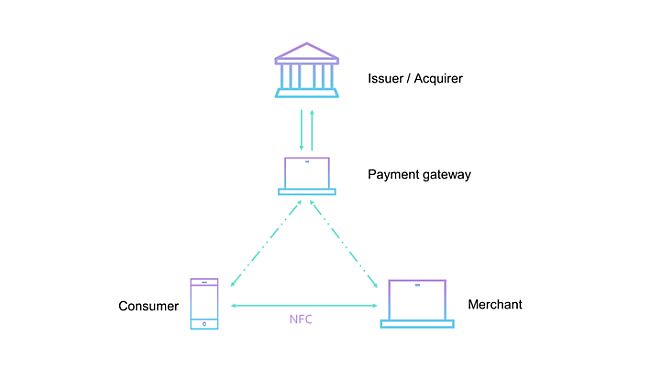
| Figure 1. Offline Payment Concept |
With the spread of 5G and the development of Internet of Things (IoT) devices, machine-to-machine payments will automatically execute contracts and make payments without human intervention, and possibly without network connectivity.
JCB and Keychain have developed the first payment infrastructure for machine-to-machine transactions that supports offline payments using NFC. Leveraging Keychain's blockchain and self-sovereign identity technology, the system addresses challenges related to the risks of operating through network outages and distributed attacks.
Overview
The new infrastructure allows payments to be conditionally accepted by merchants, even in the event that both the payer and the merchant are disconnected from the network, a scenario known as double offline. Notably, the shoppers' experience is as easy as swiping a smart watch at the store payment terminal with this system.
Under the collaboration with JCB, Keychain implemented the payment processing system using IoT devices, mobile phones, and smartwatches, and demonstrated the following:
1. Payments may be conditionally processed even during a double-offline scenario.
2. Payment processing consensus may be done over mixed networks simultaneously.
3. Upon network restoration, the offline transactions may be securely repatriated to online in batches.
The system uses NFC network protocol and leverages Keychain Core to support small IoT devices with, in principle, as little as 32 megabytes of memory.








