
Published

Lee Jones
Managing Director Northern Europe, GSV at Worldline
Like so many other sectors, the franchisee industry – and quick service restaurants (QSRs) in particular – has been significantly impacted by the Covid pandemic and is see more
- 02:00 am
Geetika will implement innovative people strategy that will build ZebPay into an organisation for the future
ZebPay, India’s most trusted and oldest crypto asset exchange, has announced the appointment of Geetika Mehta as its Chief Human Resources Officer (CHRO). Geetika will take the lead on designing and implementing the people strategy, culture transformation, talent management initiatives, and building ZebPay into an organisation for the future. ZebPay has tripled its headcount in the past year and is planning to hire more engineers to continue building industry-first products.
In her last role, Geetika was the Chief People Officer at Jubilant Industries and has held leadership roles in OYO, Urban Ladder, and PUMA prior to that. With a career spanning 15 years across Consumer Goods, Retail, and E-Commerce, Geetika possesses rich and progressive HR leadership experience from both premier multinational companies and start-ups. She is passionate about the start-up ecosystem in India and has worked extensively with business leaders in scaling up organisations at various stages of evolution.
At ZebPay, Geetika will work closely with the leadership team on business transformation and change management projects. As ZebPay scales, the focus continues to remain on building a culture that encourages innovation and personal and professional growth — a focus that Geetika will drive.
On this appointment, Avinash Shekhar, Co-CEO, ZebPay, said, “I am glad to have Geetika on board the ZebPay Ohana (family). We are growing as an organisation and Geetika’s expertise will support ZebPay’s path towards the next phase of development. As we build and launch new industry-first products, I look forward to Geetika’s support towards team expansion and business transformation.”
Geetika Mehta, CHRO, ZebPay, said, “This is an exciting time for the crypto ecosystem in India and we’re seeing a dynamic set of talent becoming interested in driving its progress. We aim to recognise the budding talent in nascent fields that still largely lack specialised expertise, mainly in blockchain development, and hone their skills. I’m looking forward to building an inclusive and supportive culture at ZebPay that encourages upskilling and personal development to align with its overarching objectives.”
- 04:00 am

Finance & Innovation for Good competition encourages students to ideate and develop a project which promotes sustainable finance
Finastra and Sia Partners invite entrepreneurial students to tackle a major challenge in sustainable finance as part of the Finance & Innovation for Good competition, which will run until May 2022. The initiative is being carried out with support from partners, Google Cloud, HSBC Continental Europe, Pépite France and Manaos, who will all help students complete their projects from ideation to development.
The winners will be rewarded with varying prizes from the partners of 7000€, 5000€ and 3000€, as well as six other special prizes worth 1000€. Winning projects will be selected based on the degree of completion of the project, their financial viability and their capacity for disruption and innovation, and all will have the potential to be implemented by the partner companies.
Thomas Rocafull, Partner at SIA Partners said, “We believe that fostering an environment for innovation should extend beyond business and into education. We recognized a need to give students a voice on the future of financial services, as well as the importance of harnessing the expertise of financial players like Finastra. We’re delighted to host the Finance & Innovation for Good competition and look forward to seeing the finished projects.”
Sustainable finance is no longer a future vision, but a challenge that needs to be tackled today. Finance & Innovation for Good gives students the opportunity to imagine the bank of tomorrow and develop solutions to future-proof financial services. Participants will benefit from material resources, including access to Finastra’s open developer platform, FusionFabric.cloud, and weekly training with nearly a hundred coaches from a variety of industries.
Chirine Ben Zaied, Head of Innovation at Finastra said, “Supporting this programme is a logical initiative for Finastra as it fits perfectly with our Environment, Social and Governance (ESG) commitments to collaborative finance. The impact on society and the environment is an increasingly important criterion when choosing a job, and this competition shows students that financial innovation can help to serve both people and the planet. We’re excited to work alongside our partners to inspire new ideas from the next generation, for the benefit of an ever more sustainable and responsible financial sector.”
The competition is open to all students or recent graduates of less than two years, individually or in teams of up to three people. Students can register at www.finance-and-innovation-for-good.com until January 16, 2022. Terms and conditions apply.
- 05:00 am
The joint project of Sovcombank and Diasoft for automation of the Bank’s corporate and investment business has been awarded with the international Banking Tech Awards in the nomination Best Use of IT in Treasury and Capital Markets.
The large-scale project implemented on Diasoft’s Digital Q.FinancialMarkets platform has beaten its global competitors having demonstrated significant advantages for business and technological development of the Sovcombank group.
The project was implemented in several stages. At the first stage, the partners created a new technological platform for support of the Group’s investment business and migrated all accounting operations for financial market deals to the new, enterprise-grade platform Digital Q.FinancialMarkets. As a result of the project, Sovcombank and its subsidiaries migrated to the single database, consolidated financial markets accounting for the whole Sovcombank Group, which in turn reduced operational risks associated with regulatory requirements.
Other project stages involved automation of more than ten LOBs of the financial group and integration with the largest Russian stock exchanges and clearing centers, with allowed Sovcombank to quickly launch popular investment products. The modern platform provided the bank with flexible tools for quick support of new business tasks and launch of modern financial instruments and services. Setup of new and non-standard products now takes only 2–3 days, ensuring quick launch of new LOBs and helping to attract new customer groups and flexibly support changes in the Group’s business strategy.
Today, the bank successfully expands its market share in securities trading, brokerage and custodian services, develops wealth management services, and launches popular financial instruments, such as high-yield Eurobonds, structured notes with capital protection, derivatives, proprietary financial instruments, investment deposits, precious metals.
The software products composing the Digital Q.FinancialMarket platform are built on the microservice architecture with the use of the most advanced technologies. This architectural approach enables gradual business development without suspension of current business processes and operations, and provides multiple technological benefits, such as continuous update and development, linear scalability, reliability and fault tolerance.
“For Sovcombank, the year 2021 has become a year of rapid growth. The bank has been developing its business through M&As and by exploring new markets and LOBs. Such an active business strategy requires a flexible and high-performance technological platform that is capable of supporting the explosive growth. The solution based on the Digital Q.FinancialMarkets platform allowed us to successfully automate our corporate and investment business and provided a reliable platform for our future development, both through expansion to new market segments and through business growth”, commented Mikhail Avtukhov, Deputy Chairman of the Board, Head of the Corporate and Investment Business at Sovcombank.
“For Diasoft, the large-scale project for automation of the investment business of Sovcombank, the largest Russian financial group, is an important milestone. We are proud that our expertise in financial business processes and technology has allowed us to build a reliable platform the technological development of the group and quickly implement the project despite risks associated with changing environment and pandemic restrictions. The success of the project and the international recognition have proven the benefits of the selected technological strategy and indisputable advantages of the microservice architecture for the business”, said Alexander Gentsis, Member of the Board of Directors at Diasoft.
The Banking Tech Awards recognize excellence and innovation in the use of IT in financial services worldwide, and the people who make it happen. 2022 will be the 23rd year for these prestigious awards. For banks and financial institutions, winning a Banking Tech Award showcases the value of their technology investments and showcases their skills, commitment, creativity and execution. More information on the award is available at https://informaconnect.com/banking-tech-awards/.
Earlier this year, the project received the highest scores from reputable judges of another global award – the project was recognized the winner of IDC Real Results Awards in the Financial Markets Transformation category.
- 04:00 am

Radiflow welcomed new partnerships across Europe in 2021 in preparation to meet 2022 targets. We have recognized impressive growth through our global partners and are now strengthening our presence through local partnerships. said Radiflow CEO, Ilan Barda
Radiflow, a leading provider of OT-focused cybersecurity solutions, is welcoming many new partnerships across Europe in order to meet the demand for increased protections of OT facilities. These include known solutions providers Capula UK, MMX in the UK, Logitek Spain, Germany’s Performio, Mi-Line Slovenia, Syndis of Iceland, and others.
Following a year of attacks on major OT facilities such as medical facilities, utility supplies, food chain segments, and other critical operational technology assets, companies are realizing the gravity of this problem. Unlike traditional IT networks that can be cataloged and protected on a systematic basis, OT networks often are made up of layered technologies that are integrated with legacy systems. This leaves unknown vulnerabilities exposed to hackers while forcing teams to manage the reality that the cybersecurity perimeter is not always clearly defined.
In the past, companies implemented OT cybersecurity protocols to be in compliance with new regulations. Today, it’s about the growing threat of business interruptions and physical harm that may accompany OT cybersecurity incidents. Gartner predicts that by 2025, these attacks are likely to become lethal as the market potential grows to $18.1 billion by 2023. “We have recognized impressive growth through our global partners and are now strengthening our presence through local partnerships. This will allow us to deliver our first-of-its-kind OT-BAS analysis of OT facilities to even more CISOs,” said Ilan Barda, CEO of Radiflow. “With this ability to utilize an OT-BAS platform and simulate any attack from ransomware to system overrides, cybersecurity teams can constantly update their playbooks and deploy relevant mitigations against today’s emerging threats.”
Radiflow’s CIARA platform provides easy onboarding for partners, whether they have vast OT cybersecurity knowledge or are looking to expand their cyber offerings to include OT networks. A comprehensive dashboard has an easy setup process, allowing end clients to utilize features from the multi-facility dashboard effortlessly. Clients recognize immediate ROI by adequately knowing how to delegate cybersecurity resources and budgets by using data to protect what matters most.
Doubling their YoY revenue, Radiflow is looking to continue growing their presence as a leading player in this evolving market. Partner companies are an avenue for growth as they are selected for having a proven record in various OT or IT sectors and having a history of building a trusted customer base. Over the past year, Radiflow’s growth in Europe is occurring alongside growth in North America with local partners, IS5 Communications, InfoSight in the United States, and SourcetekIT in Canada.
- 03:00 am

Victims Included Those with Structured Settlements due to Lead-Paint Poisoning
Today, the Consumer Financial Protection Bureau (CFPB) took action against Access Funding and two executives for steering consumers considering signing away future structured settlement payments for lump sum payments to receive “independent advice” from an attorney, Charles Smith, who was paid directly by Access Funding, and indicating to consumers that the transactions required very little scrutiny. The parties filed a proposed order which, if entered by the court, would require Access Funding and the executives, Lee Jundanian and Raffi Boghosian, to pay $40,000 in disgorgement and a $10,000 civil penalty, and it would permanently ban them from referring consumers to certain individuals and for-profit entities offering advice on structured settlement transactions.
Access Funding, headquartered in Chevy Chase, Maryland, offered lump sum payments to consumers with structured settlements. Access Funding sought “lead-paint virgins,” which is how it referred to prime targets for transferring their structured settlements stemming from lead-paint poisoning. Access Funding targeted these consumers because they were generally in desperate need of immediate cash and were cognitively impaired. Between 2013 and 2015, Access Funding’s unlawful actions enabled them to profit off about 200 individuals with structured settlements – many of whom suffered the effects of lead-paint poisoning.
In November 2016, the CFPB sued Access Funding, its executive leadership, and outside attorney Smith. The CFPB alleges that Access Funding was aware that the individuals from whom they purchased structured settlement payments were financially unsophisticated and in need of the funds the company could supply. The CFPB also alleges that the companies and their principals steered consumers to receive “independent advice” from Smith, who was paid directly by Access Funding and indicated to consumers that the transactions required very little scrutiny. The CFPB alleges that Smith’s conduct was unfair, abusive, and deceptive in violation of the Consumer Financial Protection Act of 2010 and that Access Funding and its leadership unlawfully aided Smith’s illegal conduct and engaged in abusive conduct. On November 18, 2021, the court entered a stipulated judgment and order against Smith.
Today’s action will make Access Funding’s victims eligible to gain financial relief through the CFPB’s Civil Penalty Fund.
- 01:00 am

Mastercard Foundation launched the COVID-19 Recovery and Resilience Programme (CRRP) to help micro- small- medium-sized enterprises (MSMEs) to respond to and withstand the impact of pandemic |
When the first case of COVID-19 was detected in Kenya in March 2020, it marked the beginning of a long journey of business uncertainty, disruption and great anxiety for entrepreneurs of all categories. It was especially hard for micro-enterprises and other small businesses, which traditionally do not have cash reserves or multiple income streams, to cushion them during economic downturn. While some businesses managed to stay afloat, hundreds others faced serious difficulties that led to their closure or severely reduced operations.
Looking into the future: As Kenya moves into a post-COVID recovery phase, micro-and small businesses remain vulnerable and require support from other partners. Other MSME lenders can step into the gap and help to accelerate business recovery by offering flexible and affordable products to this critical sector. The experiences of the COVID-19 Recovery and Resilience Programme and the lessons learnt can inform the design of similar programmes to enrich their impact. This is a call to arms.The CRRP proved that by working in partnership, we can protect this vital sector of our economy, encourage it to thrive, be adaptive, sustainable and profitable. Distributed by APO Group on behalf of The Mastercard Foundation. About Mastercard Foundation COVID-19 Recovery and Resilience Program: |
- 01:00 am

Bizongo announced its latest fundraise of $110 million in Series D round led by New York-based Tiger Global Management. The B2B ecommerce and supply chain enablement platform, also launched India’s first IoT powered ‘cloud factory’ for made-to-order goods. This SaaS based solution will enable manufacturers to provide their customers with real-time visibility, control, and intelligence across the entire supply chain. The latest tech innovation has been successfully piloted with leading pharmaceutical packaging manufacturer, Ansapack.
Founded by three IIT graduates Aniket Deb, Ankit Tomar and Sachin Agrawal, Bizongo is digitizing the massively fragmented B2B segment of made-to-order goods. With the latest round, Bizongo’s valuation has soared to $600 million, making it the market leader in the segment.
The B2B tech company recorded an 8X growth in its top line from its pre-pandemic scale clocking an ARR of $250mn in November this year. The growth is also associated with a strong unit economics and positive cash flow as the company is now EBITDA profitable. Bizongo has made its operating model inventory-free, further strengthening the capital efficiency of the business.
Sachin Agrawal, Co-founder at Bizongo said, “There is a lot of untapped potential in the way Indian businesses can leverage technology to grow and thrive. Bizongo offers solutions across digital vendor management, supply chain automation and supply chain financing to its enterprise customers. It enables them to digitize their entire vendor ecosystem and build integrated and connected supply chain processes. We are very proud of the grit and resilience the team has demonstrated over the past few years. We are now fully geared to sustainably grow the business by at least 300 percent year-on-year from here on.”
The company will deploy the fresh funds in ramping up its business and tech teams to develop a suite of digital services for both sides of the marketplace. It will also invest in nurturing its vendor partnerships and transform over 100 factories into true cloud factories through its proprietary solutions. The tech company has recently launched an online bidding platform for real-time seller and price discovery - a global first in the customised goods categories like packaging, textiles and apparels amongst others. It is also expanding its digital supply chain financing (SCF) platform in partnership with top banks and NBFCs. The SCF platform has already enabled early payments worth over Rs.1000 Cr to more than 1000 SMEs and MSMEs.
John Curtius, Partner at Tiger Global said “The market for customized goods is the fastest-growing segment in B2B e-commerce. At a size of $500bn, this market is vast yet highly fragmented and unorganized. We found Bizongo very unique in the way they have been building a transaction-led platform with a tech-first vs a trade-first mindset. The full-stack approach with an asset-light operating model makes Bizongo stand out as a market leader in this segment.”
Founding General Partner at B Capital, Kabir Narang said, “We are excited to double down on our investment in Bizongo. It’s great to see the progress of the company since our initial investment a few years back. Bizongo is now a leading tech-enabled online platform that serves as a digital aggregator between a fragmented SME manufacturing base and its customers across e-commerce, FMCG and Healthcare. We are very excited to be part of this journey.”
The series D round had new investments coming from CDC and IFC EAF and saw participation from existing investors BCap, Chiratae Ventures, Schroder Adveq, IFC and Add Ventures by SCG. Manish Choksi, a member of Bizongo’s Advisory Board and the Vice Chairman at Asian Paints, also invested in his personal capacity in the round.

Babar Hayat
Head of Technology & Transformation at Konexo
The internet has a wealth of information and opinion on the importance of digital transformation to future business success. see more
- 08:00 am
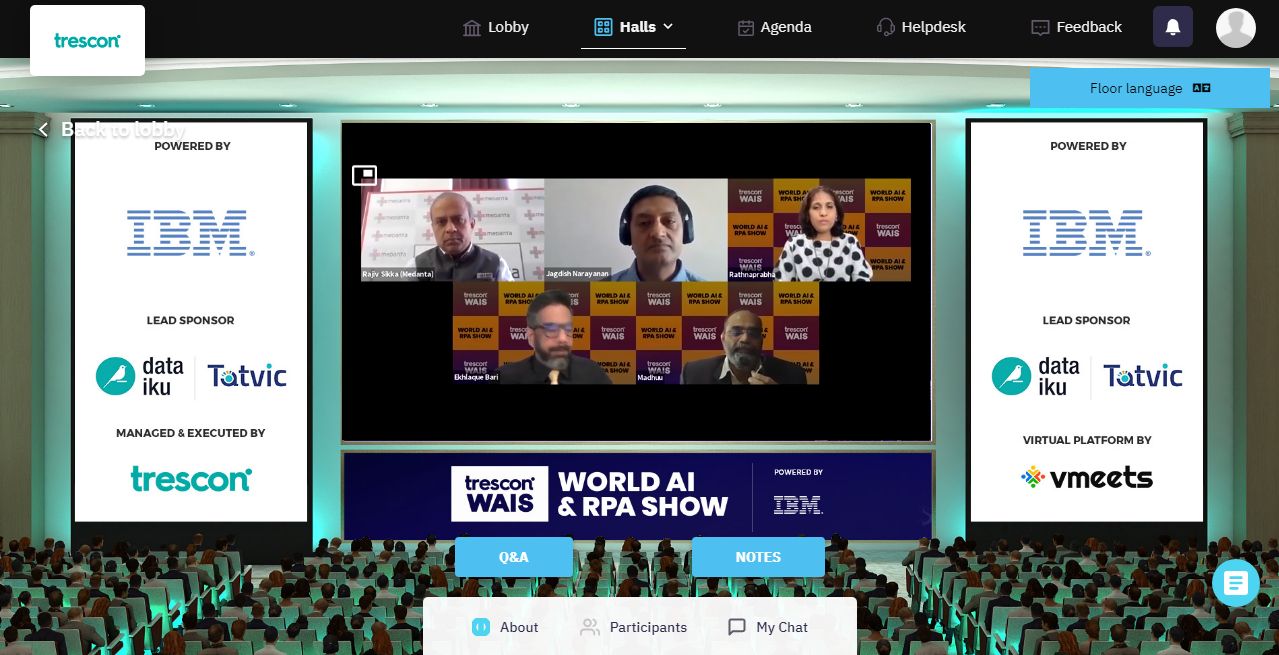
The 32nd Edition of World AI Show highlighted the importance of driving AI and RPA deployment in India
The Indian edition of World AI & RPA Show, officially supported by MeitY convened over 350+ attendees that included stakeholders of India’s AI ecosystem including government authorities, top-notch AI & RPA experts and solution providers.
On Tuesday, November 16th, 2021, India hosted the most comprehensive virtual conference on AI and associated future technologies. Hosted by Trescon, World AI & RPA show connected dots in AI research and real-world applications. With the recent AI boom, there is a greater understanding of these fields and the challenges to meet them. In this 32nd edition of the show, the theme of Artificial Intelligence and Robotic Process Automation (RPA) was highlighted in the context of current business challenges and opportunities in India. The show was Supported by MeitY; Powered by – IBM; Lead Sponsors – Dataiku and Tatvic; Bronze Sponsor – Eastvantage featured by leading AI organizations.
The main objective of the conference was to showcase the role of AI, Robotics and Digital Transformation in the industry. World AI & RPA Show India focused on supporting important government agencies and commercial businesses to provide a platform to global AI leaders, investors and innovators to get connected and exchange ideas on the current happenings and challenges in the AI sector and on current projects, with the intention to jointly progress the AI & RPA sector.
The event focused on key topics such as Applying Intelligent Automation to your IT Operations; The Trajectory to Scale Digital Transformation with AI; The Impact of AI on Cybersecurity; How Governments Can Build Trust in AI while Fighting the Pandemic; Re-Imagining CX with AI to Manage & Thrive during the Pandemic; How COVID-19 Is Transforming the Automation Landscape; Future of AI in Cyber Security amidst COVID-19 and much more. The event also showed the importance of driving AI and RPA deployment in India by showcasing the technologies being used in the market.
Some of the top speakers who attended the event that took place on 16 November 2021 included:
Dr. Rajendra Kumar, Additional Secretary, Ministry of Electronics and Information Technology (MeitY), Government of India
Dr. B K Murthy, CEO, Innovation and Technology Foundation IIT Bhilai India;
Arunima Sarkar, AI Lead, Centre for 4IR, World Economic Forum India
Rama Akkiraju, IBM Fellow, CTO - AI for IT Operations, Master Inventor, IBM Academy Member
Vishal Chahal, Director - Automation & AP Cloud Pak Lab, IBM Software Labs India South Asia
Shaun McGirr, AI Evangelist, DataIku.
Ravi Pathak, CEO & Co-Founder Tatvic Analytics India; to name a few.
Key highlights and takeaways from World AI Show include:
Dr. Rajendra Kumar, Additional Secretary, Ministry of Electronics and Information Technology (MeitY), Government of India spoke on the topic of ‘Digital Transformation with AI’ and expressed his views on how AI is going to impact our life and the governance issues in our country and the larger economic sector in the coming years. He stated that, “We can benefit from use AI technology for really understanding how our socio-economic development can boost in terms of being able to formulate more meaningful policies being able to make more meaningful and effective interventions in our development projects.”
Dr. B K Murthy, CEO, Innovation and Technology Foundation IIT Bhilai India in his Government Keynote spoke on the topic, ‘AI in FinTech - Challenges & Opportunities’. He was quoted saying, “Adoption of AI Technologies across the enterprise is no longer a choice but a strategic imperative”.
Rama Akkiraju, IBM Fellow, CTO - AI for IT Operations, Master Inventor, IBM Academy Member in her tech talk spoke on the topic, ‘Applying Intelligent Automation to your IT Operations’, where she stated that, “IT operations management is all about identifying problems early and detecting, diagnosing and resolving them quickly and more importantly preventing such things from happening”
While addressing about ‘Economies of AI’, Shaun McGirr, AI Evangelist at Dataiku stated that, “Understanding your entire business and how it functions to identify that revolutionary influence, as well as different methods of doing things would benefit a significant proportion of individuals”.
The show was hosted on the virtual events platform Vmeets which helped the participants to network and conduct business in an interactive and immersive virtual environment. Participants were also able to engage with speakers in Q&A sessions and network with solution providers in virtual exhibition booths, private consultation rooms and private networking rooms.
“India is an attractive market for AI and RPA. The country has an adequate amount of talent needed to drive AI and RPA deployment and there are some impressive examples of how AI and RPA are being deployed to solve important problems," stated Mithun Shetty, CEO, Trescon. He further added, "During these challenging times, virtual gatherings provide possibilities for the AI & RPA community to learn, connect, forecast and explore the technology and future direction of this field.”.
The show was Supported by MeitY and Powered-By – IBM; Lead Sponsors –Dataiku and Tatvic; Bronze Sponsor – Eastvantage featured by leading AI organizations.








