
Published

Zaid Arshed
CEO at Armaan Resales
Many retirees are uncertain about their pension plans and seek ways to build passive income late in life. see more
- 08:00 am

As new opportunities in the financial markets emerge on a daily basis, global online trading brand Swiss Crypto Bank has officially announced an interesting collaboration with veteran and trusted trading platform MetaTrader 4. According to Swiss Crypto Bank's spokesperson, Anthony Barone, this is the optimal solution for today's trading environment, and more importantly, for tomorrow's one as well.
"We see that thousands worldwide are already showing interest in our new products, including the MT4 offer as well as the fully managed account and the revolutionary staking options," said Barone. "This partnership we are embarking upon is part of our strategy of leaving no stone unturned to provide a fast, secure, accurate and user-friendly trading experience for the sake of our valued client. It has been our belief as a company from day one."
A much-needed change in the online trading sphere
Recent surveys show that a vast majority of online traders are currently dissatisfied with the trading conditions provided by their broker. For that reason, Swiss Crypto Bank committed thorough research of the market before developing the trading solutions offered to clients - and the feedback the brand is receiving so far, from traders and the industry alike, seems to be very positive.
"As a company with years of experience in the online trading industry, we take pride in always being one step ahead of our competitors," added Barone, "and even setting the path for them to follow. That's why we are also pioneers in offering a fully managed account, and an account with cryptocurrency staking, for traders who find it in line with their goals. We will continue to be innovative at what we do, for the sake of our customers."
- 04:00 am

Broker Insights – the high-growth company whose digital platform is transforming the commercial insurance market – has raised more than £6m in a Series A funding round led by Mercia Asset Management. Chroma Ventures, which first backed Broker Insights with seed funding in 2018, made a follow-on investment in this round, alongside a group of private UK and US investors.
The funding will enable further development on Broker Insights’ platform and accelerate its UK growth and launch in the US, in line with its plans to become a global leader in its field. The company, which currently employs 35 staff at its headquarters in Dundee, expects to double its headcount in 2022, with the majority of new jobs in Scotland.
Brokers Insights’ platform – the first of its type for the commercial insurance market – enables insurers to distribute their products more efficiently to regional brokers through automation and collaboration tools. It also provides real-time data to give them greater insight into companies’ insurance requirements.

(L-R) Chris van der Kuyl and Fraser Edmond outside Broker Insights’ base, Water’s Edge Dundee.
Broker Insights was founded in 2018 by former Aviva senior executives Fraser Edmond and Iain Crole. Its award-winning platform now connects leading insurers such as AXA, RSA, Zurich, QBE, Travelers, Markel, and Hiscox with over 160 brokers. In the past year the platform has doubled its gross written premiums (GWP), the insurance industry yardstick, to more than £1 billion. Last month, the company was named ‘Technology Partner of the Year – Commercial’ at the Insurance Times Tech and Innovation Awards.
Fraser Edmond, chief executive of Broker Insights, said: “This investment is an endorsement of our success in building our platform, technology and team. Launched three years ago, we are now serving 12 per cent of the UK commercial insurance market; we have established that our platform delivers results for our customers and is attracting significant and growing demand from brokers and insurers alike.
“We have the opportunity to become a mainstream digital marketplace for insurers and brokers. We are removing significant friction and cost in connecting brokers and insurers, and the potential market for this is here in the UK and next in the US. We have traction, proven demand, and this funding allows us to accelerate our growth.”
Mercia has invested from its Northern Venture Capital Trust funds (VCTs).
Hugo Lough of Mercia said: “The commercial insurance market has continued to operate in a very traditional way, with client-facing teams travelling around the UK to build relationships with brokers. By bringing them together online to do business, Broker Insights offers the opportunity to remove friction and cost, and improve the experience for all concerned.
“The business has grown impressively since launch and we are delighted to be backing Fraser, Iain and the wider team for the next stage of growth. The business has massive potential and we’re excited to work with them to seize the opportunity domestically and abroad.”
Chroma Ventures is the investment arm of 4J Studios entrepreneurs Chris van der Kuyl and Paddy Burns.
Chris van der Kuyl, principal of Chroma Ventures and chairman of Broker Insights, said: “Broker Insights has created a unique marketplace for commercial insurance, proven that it works and grown the business at pace. This Series A round positions the company for expansion and we are creating a global leader in the digital transformation of the commercial insurance market.
“The company’s performance and progress to date has been exceptional. This growth capital raise now positions them for further growth in the UK and entry into the US”.
- 09:00 am

Since we initiated in September, Bloc has exited two portfolio companies at a premium to holding value, Marmalade (a games developer, sold to LDC for a 4.8x cash return) and EVRYTHNG (an internet of things, IoT, data and real-time insights platform), acquired for an undisclosed price. Bloc has also made a new investment, Shield-IoT (large-scale IoT network security), taking its portfolio to 10 companies. Bloc has strengthened its team and governance with new hires and is actively raising a Series C funding round, as well as an early-stage investment fund (deeptech_one), for which discussions are ongoing with a potential cornerstone investor. Bloc's later-stage funding options may include an IPO in 2023.
Bloc can already point to a strong track record, with 39% growth y-o-y in NAV per share in H121, offering attractive potential returns as Bloc targets an annual return of 20%+, underpinned by strong secular and technology sector trends. Bloc offers a clear sector focus, a structured investment process and an early-stage portfolio with high growth potential, with the strong performance of UK and European private technology companies and the growing maturity of the sector, increasingly drawing in overseas capital and heightening competition for quality companies.
Click here to view the full report or here to sign up to receive research as it is published.
All reports published by Edison are available to download free of charge from its website
- 03:00 am
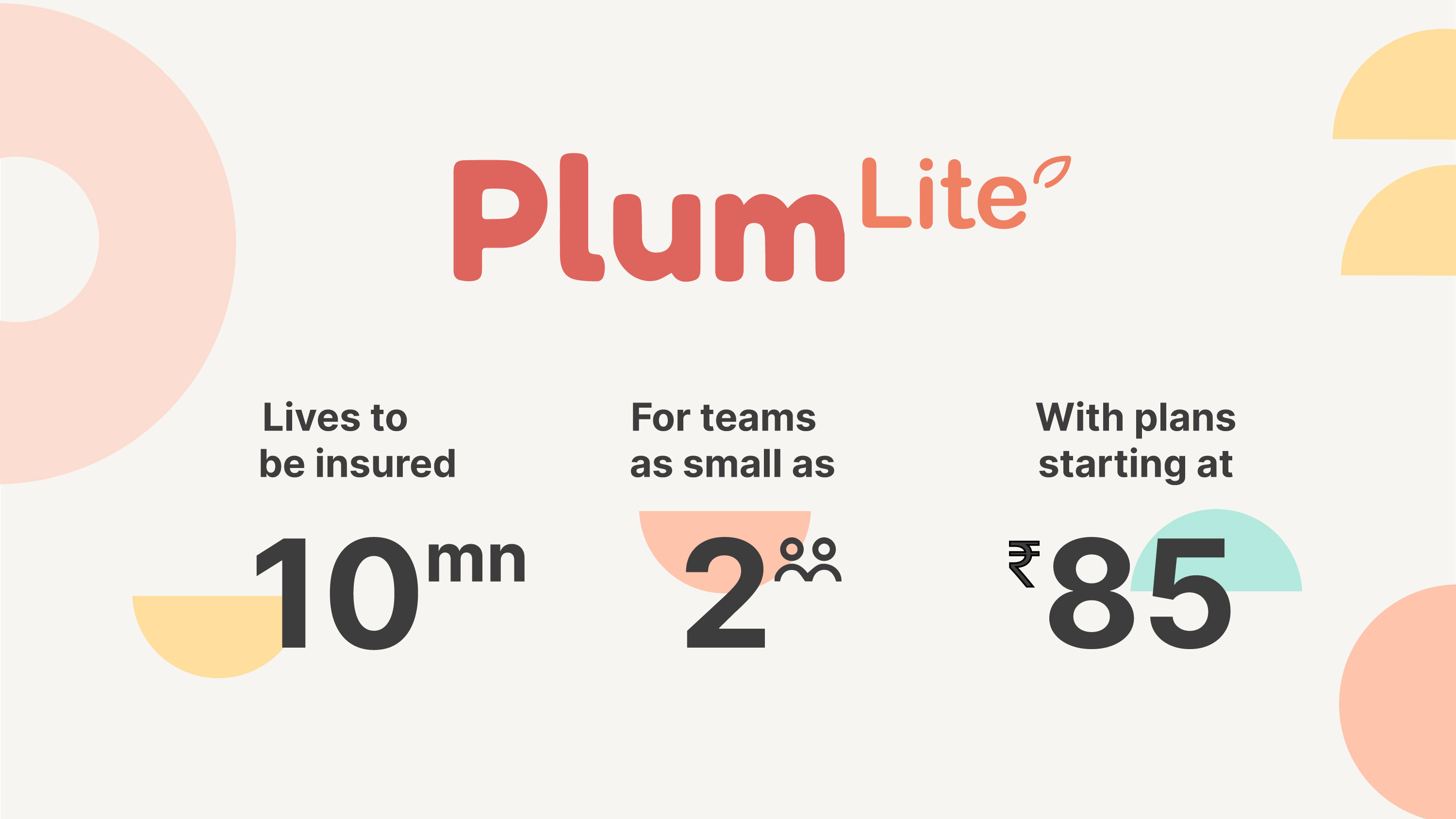
Offers instant activation for teams as small as two; for a monthly subscription as low as Rs 85/ month
Plum, an employee health insurance platform, today announced the launch of Plum-Lite - a comprehensive group health benefits membership exclusively for early stage start-ups, SMEs and gig workers/ freelance consultants. The membership will offer new-age health insurance covers, doctor consultations and Covid19 treatment covers for companies with teams as small as two members and for a premium starting as low as Rs. 85 per month.
For any early stage business, thinking of health benefits from day one is a challenge due to accessibility, affordability and usability. Current employee health plans have only been available for larger teams requiring a minimum of 10 members. Through Plum’s new Health Benefits Membership, bootstrapped teams starting with just two members can get covered. The price point starting at Rs. 85 (per member/ per month) is less than a meal or a single doctor consultation. Plum has further made it possible to avail this membership through monthly subscriptions; this ensures that bootstrapped businesses do not have to lock-in a large annual investment.
The membership covers, health insurance upto Rs 5 lakhs, unlimited doctor consultations, weekly wellness sessions, dental and vision checkups, mental wellness consultations and Covid19 treatment claims. It also covers employees, spouse and kids and has a zero human touchpoint leading to instant activation.
On the launch of Plum-Lite, Plum’s new Health Benefits Membership, Abhishek Poddar, Co-founder and CEO, Plum, said, “Plum is on a mission to make health benefits and comprehensive employer<>employee insurance available to the most underserved segments. Our first launch in this space is for early stage startups, SMEs and gig workers/ freelance consultants. We aim to create wellness-first behaviour in workplaces that care. Further, this launch also fulfils Plum’s goal of insuring 10 million lives by 2024 as it is our endeavour to ensure no one remains un/ under-insured due to unaffordability or lack of access.”
Insurance penetration amongst the 6.3 crore SMEs and 15 million gig workers in India is extremely low despite their prominent contribution towards the growth of the Indian economy. The launch of Plum-Lite reiterates Plum’s commitment on augmenting health insurance penetration among early stage startups, SMEs and gig workers/ freelance consultants.
Plum recently partnered with Razorpay Rize to offer exclusive group health benefits to early stage startup founders and aims to cover over 1 lakh new businesses and entrepreneurs. Plum has set strong roots in the fast-growing startup ecosystem in India and currently works with 1000+ startups including unicorns like Unacademy, Slice and Groww that think insurance-first. The company is backed by Tiger and Sequoia.
- 07:00 am

|
|
|
Azentio Software (“Azentio”), a Singapore-headquartered software products business owned by funds advised by Apax Partners, today announced that it has won five awards at the IBS Intelligence (IBSi) Global FinTech Innovation Awards 2021. The prestigious awards program identifies and honours technology players and banks for their excellence in driving impact through innovative financial technology implementations. IBSi is a leading global fintech research, news analysis, and advisory firm; and its FinTech Innovation Awards are a global commemoration of the best in banking and fintech with 199 participants from across 48 countries, vying for the top honours in 30 award categories this year. Robin Amlôt, Managing Editor of IBS Intelligence, said, “It gives me great pleasure to congratulate Azentio team for their exemplary performance in this 3rd edition of the IBS Intelligence Global FinTech Innovation Awards 2021. Over the years they have grown and this year they are recipients of 5 awards across categories, this is no mean feat in this highly competitive awards event”. “We are immensely proud to receive these esteemed awards. Azentio set the bar high in 2021 and was a strategic partner in many of the key implementations across marquee financial services institutions. This achievement reinforces our mission to foster continuous innovation and our commitment to deliver successful banking transformation projects for our clients”, stated Tony Kinnear, Chief Executive Officer, Azentio. The honours include:
|
- 08:00 am
Complacency widespread as 60% admit they rely on doomed third-party cookie technology that Google plans to axe in 2023, shutting off access to consumer personalisation data
50% of UK advertising companies and their clients currently have no plans to prepare for the looming ban on third-party cookies in 2023, even though it will cut off access to data that fuels personalisation and optimises interactions with consumers, according to new research by online behavioural personalisation and artificial intelligence platform Fanplayr.
Nearly two-thirds (60%) of all respondents in the study of 252 UK advertising decision-makers admit they still rely on third-party cookies for targeting of their advertising and marketing, revealing how significant the change will be. This reliance increases to 90% among companies with annual turnover between £100 million and £500 million. Yet four-in-ten (40%) of those polled admit the extinction of third-party cookies will decrease their own, or their clients’ revenues from advertising.
In addition, more than four-in-ten (45%) see the ban impairing their ability to achieve advertising personalisation. This is a trend that rises in relation to turnover. 80% of respondents working for organisations turning over more than £500 million agree the ban will have a negative effect on advertising personalisation.
“There is no room for complacency or reason for inaction among advertisers, even though Google’s third-party cookie-ban has been postponed to 2023,” said Andy McNab, VP EMEA at Fanplayr. “This is the biggest change to affect online advertising in many years and requires a major rethink by agencies and their clients.”
Among respondents who have taken steps to prepare for the ban (or whose clients have done so), the largest percentage (44%) have opted to implement a long-term solution using brands’ own “first-party” cookies to monitor and learn from the behaviour of visitors to their or clients’ websites. More than a third (36%), however, have opted for temporary first-party cookie solutions or are building their own in-house solutions to provide data on consumer web behaviour. The same percentage are looking at new approaches to SEO as the route to greater insight and impact, while 35% are increasing their initiatives in algorithm-driven contextual advertising.
Moves to ban third-party cookies follow the increase in privacy concerns following the EU’s GDPR (General Data Protection Regulation) and the CCPA (California Consumer Privacy Act) in California. Apple and Firefox have already acted, but since Google has more than 60% of the browser market, its decision is highly significant.
The decision by Google to put back implementation of its ban from next year (2022) to 2023 may explain the lack of action by some organisations. Nearly a third of all respondents (31%) said the postponement has caused them to delay implementation of alternative solutions, although the figure is higher (57%) among organisations with turnover of more than £50 million.
More than half of all respondents (54%) however, agree that the cookie ban is an opportunity to change their digital advertising strategy. Yet only 23% of advertising decision-makers regard the end of third-party cookies or the introduction of privacy regulation as the biggest challenge they currently face. Nearly three-in-ten (29%) are more concerned about increased digital competition and 23% say the biggest threat is from reduced spending.
“Advertisers must embrace innovation such as AI-driven first-party cookie technology that offers comprehensive alternatives, increasing revenues for advertising agencies by expanding the insight and value they deliver for their clients on a day-to-day basis. This level of innovation enables advertising agencies and their enterprise clients to segment consumers more effectively and profitably without infringing privacy regulation or falling foul of cookie bans” said Andy McNab, VP EMEA at Fanplayr.
- 04:00 am

Darryl Knopp, Senior Director of Global Marketing at analytics company FICO is looking ahead at how customer expectations of financial services are likely to change in 2022 and what this means for banks.
1 – Creating a Unified Experience: Mapping out the Entire Customer Journey
Looking ahead to 2022, providing a seamless customer experience is more important than ever. Banks must be able to create a consistent, integrated experience across all channels – meaning that a customer can start an application on their mobile phone, finish it on their computer, and visit a bank branch where employees have real-time data in their systems. It’s important to make sure the customer self-service and bank employee channels are connected.
2 – Investment in Infrastructure: Adopting a Robust Platform for Agility & Intelligence across the Enterprise
The banking industry has largely weathered the pandemic storm, although sluggish loan activity and low interest rates continue to curb revenue. This will soon change, however, as consumer spending increases and the market bounces back.
Banks need to invest in technology and talent to make the most of the recovering economy. It’s become crucial for companies to build an infrastructure that facilitates their digital transformation and helps them provide an exceptional customer experience. Banks need to view their enterprise as a network for digital intelligence and automated decisioning. It’s not surprising therefore that it’s predicted that a quarter of banks will increase their tech spending in 2022 by 10% or more (according to Forrester Research Inc.).
3 – Smarter, Faster Decisioning: Solutions that Satisfy (Increasingly Demanding) Customer Expectations
Challengers, upstarts, and newcomers will continue to disrupt the financial services market, which means that banks need to be quick and agile to stay ahead of the competition.
The COVID pandemic caused dramatic changes in the ways businesses could interact with consumers and accelerated the adoption of digital transformation in every industry. With rising customer expectations spurred by online retailers and FinTechs, banks need to start becoming innovators by embracing technologies that help make smarter, faster, and more profitable decisions.
Digital transformation is table stakes as the world is now “on” 24/7 and customers have more options than ever before. However, it’s not all about product and services in 2022 – it’s about the customer experience. Expectations for instant gratification and customer experience will keep increasing, as will the need for financial institutions to respond and make decisions in real-time.
4 – Embracing the Power of Data: Maximizing Data Monetization, Effectively & Responsibly
Organizations will need to have the ability to bring in data, and effectively move it and map it. To do this, banks must learn to be comfortable with employing new technology (e.g., AI-enabled solutions) that provides a holistic view of both internal and external data, along with end-to-end data integration and management tools.
In addition to streamlining business processes and reducing waste, AI solutions will also be used to help create customized digital experiences, relevant offers, and features/products that customers want.
5 – Financial Wellness & Education: Humanizing Digital Experiences & Caring About Customers
Customer-centricity has become a popular (if not over-used) branding tagline for many companies over the past few years, but what does it really mean and how is it translated into real business action? For financial institutions, being customer-centric means providing positive experiences and caring about the financial health of customers. Therefore, to be truly customer-centric, a bank’s efforts must be focused on customer experience and anchored to financial wellness outcomes for its customers.
People don’t care what you know until they know that you care. Providing the best service means caring about customers and their financial wellbeing. This approach has both social and business benefits, allowing a bank to cultivate more financially healthy customers, which in return, improves the financial health of the institution.
- 08:00 am

Written by Steph Charbonneau, Senior Director of Data Security at HelpSystems
As cyber risk intensifies around the world, regulatory authorities are looking at privacy and data protection frameworks much more seriously than they were a decade ago. In fact, since the launch of the European Union’s GDPR, this has shaped a plethora of global regulations and governing bodies who have either adopted or are considering legislation for more concrete personal data and privacy regulations. In North America alone, 33 states have introduced some sort of data privacy legislation with California, Colorado, and Virginia signing those policies into law. Globally, 76% of countries have either drafted or enacted some sort of personal data privacy protections, including China, Russia, Brazil, and Australia. Likewise, the newly drafted India Personal Data Protection (PDP) Bill includes requirements for notice and prior consent for the use of individual data, limitations on the purposes for which data can be processed by companies, and restrictions to ensure that only data necessary for providing a service to the individual in question is collected.
So, what is driving this escalating demand for enhanced privacy and data protection?
Some would say we have experienced a perfect storm. In 2020, cybercrime cost the world more than $1 trillion, a 50% increase from 2018. Today, data breaches of increasing sophistication and severity are at an all-time high. So, it comes as no surprise that consumer confidence in the promise of data security is at an all-time low and that most Americans, for example, now believe that they have lost total control of their data.
That said, managing the increasingly challenging task of maintaining data and system security in a complex, distributed environment is no easy feat – and has become even harder post pandemic. In 2021 most organizations have moved to a hybrid work environment and digital transformation programs have accelerated. In fact, in its analysis of the impact of COVID-19, consultancy McKinsey calculated that digital transformation programs accelerated by the equivalent of seven years in just a few months to meet customer demand. But this acceleration means attack vectors have grown as digital systems have multiple access points for customers, partners, and employees, resulting in an expanded attack surface.
Additionally, the volume of data has exploded and there are multiple data types, which makes it incredibly difficult for organizations to understand what data they have, how it is being used, and where it is located. Likewise, there is increasing pressure to unlock data to enable better decision-making and gain competitive advantage. Therefore, the challenge for security and privacy professionals is how to exploit data in a safe way and protect it while enabling the business.
Earlier this month, the instant messaging service WhatsApp was fined €225m by the Irish Data Protection Commission. This is the result of an investigation which started in 2018 and concluded that WhatsApp was not being transparent enough around its privacy policies and how it would process customer data. This is the second largest GDPR fine to date and clearly illustrates the risk of poor data handling. Moreover, according to GDPR Enforcement Tracker, 55% of GDPR fines are down to the poor processing of personal data and 40% of fines are around the lawfulness of processing and whether the company has the right legal basis to use the data, as well as the right controls in place to ensure usage is aligned with the purposes defined. Therefore, fines are not just around data breaches, but organizations are also fined if they have insufficient governance around their data assets.
Furthermore, there is growing emphasis around employee and workplace privacy. If an organization consumes personal information, it must clearly identify the systems where this data is stored and how it is controlled. However, employee data typically lives in unstructured files - in emails, chats and often in places that are not on a priority list for control and protection. High Street retailer H&M was recently fined because it wasn’t appropriately discovering and protecting employee data, but instead it was leaving conversations in chats and sharing sensitive data. The regulator fined the retailer because there was a disproportionate amount of data living in systems without enough control and which the company had not prioritized as needing protection.
As a result of all this heightened publicity, people are becoming much more aware of their rights as a consumer, and this means data security is having an impact on purchasing decisions. It’s also influencing the way in which organization prioritize budgets. According to a recent Now Tech Forrester report[i], budgets for privacy management software in particular are growing. On top of this, investments aimed at improving privacy and data protection practices are coming from a variety of departments, not just IT security, as employees, customers, and partners become more aware of expectations and the need to better safeguard data – whether that be personal or corporate.
Organizations can use privacy management software to ease the task of achieving compliance with privacy regulatory requirements. Additionally, it enables organizations to leverage personal and sensitive data more ethically and efficiently, while safeguarding employees’ and customers’ trust. The Forrester Analytics Business Technographics® Security Survey, 2020 asked global security decision-makers what tools they had purchased to comply with data protection regulations like GDPR: 49% said privacy management software; 44% said data management platforms; 38% use data discovery and classification tools; and 37% use other controls.
The Forrester Now Tech Privacy Management Report explains why organizations invest in privacy management software not just from a compliance perspective but also to ensure data ethics and employee and customer trust. It includes a list of over 30 relevant privacy management software vendors which was compiled based on market presence and functionality, including HelpSystems’ Data Classification in the mid-sized category. Additionally, the report provides advice around selecting the right technology to support privacy and data protection programs, and what organizations should consider, such as business needs and goals, the complexity of the organization’s data, the environment and technology infrastructure both now and in the future, and any form of measurement criteria surrounding how data is used, stored, governed, and disposed of.
Here at HelpSystems we believe data classification is the foundation of a robust data privacy strategy. By implementing a data classification solution, policies can be customized to the organization’s exact business requirements, meaning data is identified, classified, governed, controlled, and protected at all times. Our solution provides reliable data identification and classification enabling employees to work safely and with confidence. Our solutions can be customized to suit your compliance requirements and, as well as being easy to use, they can be adapted as your needs evolve.
As consumer demand for better data privacy continues to escalate, supported by a global regulatory drive, it is essential that businesses invest intelligently in the technology solutions and privacy management programs that will allow them to achieve compliance and maintain customer trust, without compromising performance.
- 09:00 am

Leading global AI-powered credit decision platform provider, Scienaptic AI announced today that Ascendus has chosen its AI-based underwriting platform to augment its lending process and make advanced loan decisions for small and medium sized businesses.
Ascendus is a New York-based online business lender that offers a range of financial products to small and medium sized businesses. In the three decades of its founding, Ascendus has lent over $255 million to more than 25,300 small businesses nationwide. The organization’s mission is to provide access to credit to the underserved sections of society across race, gender, ethnicity and financial status. The deployment of Scienaptic’s AI-powered loan decisioning platform will further its reach into small business lending, allowing even more entrepreneurs to have access to financial services they need to support their businesses.
“Our company’s first loan was $500 to an immigrant mother, who had lost her job and wanted to start her Mexican food cart for her former co-workers. One cart became two and two carts became a restaurant,” said Paul Quintero, CEO at Ascendus. “Scienaptic's AI-powered credit decisioning platform will empower us to say “yes” to many more borrowers like her who have potential to be great entrepreneurs but just need that initial financial support. We will be able to automate our loan decisioning and make advanced loan decisions much faster.”
“Our partnership with Ascendus will further our mission to empower lenders to make AI-powered advanced loan decisioning and offer better access to credit to entrepreneurs. The beauty of our platform is that we are empowering both lenders and borrowers, who will create jobs and fulfill their American dreams along with the dreams of many others,” said Pankaj Jain, President of Scienaptic. “Our platform will not only broaden Ascendus’s client base but also enhance their customer experience.”








