
Published
- 09:00 am

Worldline, the European leader in the payments and transactional services industry and #4 player worldwide, and Spreedly, the provider of the leading Payment Orchestration platform, announced today that Worldline has joined the Spreedly Payment Service Provider Program.
Spreedly’s Partnership Program was created to further support a vision for a diversified and inclusive payments ecosystem — one offering connectivity and flexibility for all players, including payment service providers globally. Through Spreedly’s unique position as the leading payments orchestration layer — and building on its over 120+ available integrations — this program helps drive faster customer acquisition, stronger revenue growth for its participants, and increased value to merchants, platforms, and other shared customers.
The Partnership Program includes a strategic level of relationship, the Preferred Partner tier. Spreedly and Preferred Partners like Worldline engage closely to build better, more holistic payments solutions. By partnering with Spreedly, PSPs further extend their global reach and accelerate the onboarding of new merchants and platforms — cutting the time to transaction from weeks to days.
“Our partner program supports our strategy of building an inclusive payments ecosystem where all participants are welcome,” said Rohan Bairat, Senior Vice President of Sales with Spreedly. “This partnership provides fast-growing businesses -merchants, platforms, and marketplaces -streamlined access to Worldline’s powerful payment processing solutions through Spreedly’s Payments Orchestration platform.”
“The partnership between Worldline and Spreedly provides enterprise businesses with unrivalled access to key global ecommerce growth corridors for payments acceptance. Worldline’s position in the payments value chain ensures optimization of payments in both traditional and emerging markets, allowing merchants to increase success rates and fuel revenue growth.” said Nathan Salisbury, Head of Indirect Sales with Worldline.
More information about the Partner Program is available at https://www.spreedly.com/psp-partnership-program.
- 09:00 am

ARIE Finance (licenced as ARIE Capital Payment Solutions, and part of the ARIE Capital Group) is pleased to announce that it has been granted authorisation to operate as a Small Payment Institution by the Financial Conduct Authority in the UK. ARIE Finance is the world’s first digital financial services platform designed exclusively for complex mid-market corporates.
The UK authorisation is a major regulatory milestone for the ARIE Capital Group, after having successfully received an Investment Banking licence in Mauritius in 2017, and a Private Fund Management Licence in China in 2021. Further licences and authorisations will be pursued throughout 2022 as ARIE Finance continues its growth and expansion.
Commenting on the FCA approval, Simon Tobelem, ARIE Finance CEO, said:
“We are delighted to have reached this very significant milestone, following a comprehensive approval process. Regulatory scrutiny of new market entrants has understandably increased substantially in recent times, so to be granted this licence demonstrates that ARIE Finance’s regulatory and operational infrastructure, as well as our value proposition, has complied with the highest standards demanded by the FCA.”
ARIE made a number of key strategic hires in 2021 as it grew its corporate clientele, strengthened its channel partners network and continued to build the partner ecosystems on ARIE’s digital finance marketplace. David Grunwald, formerly of Farfetch and Google Ventures, joined to oversee strategic direction for ARIE’s next-generation business banking proposition, while Douglas Krikler, formerly of Investec, joined as Business Development Director to oversee global growth across the group.
- 07:00 am

The one-click, passwordless mobile identity solutions provider IPification has just deployed its phone verification solution within U-Pay, the leading mobile payments services provider in Cambodia. U-Pay is the first e-Wallet company to implement bank-grade secure IPification solutions in the country.
Licensed by the National Bank of Cambodia to become the local payment service institution in December 2020, U-Pay aims to provide convenient mobile payment services. Users can transact anytime, anywhere, and in any way, including mobile top-up, bill payment, and transferring money.
IPification provides a variety of one-click, passwordless mobile identity solutions that include possession verification and fraud prevention. It is currently the only globally available mobile IP address-based authentication solution, using authentication via IM providers WhatsApp, Viber and Telegram as an alternative option.
U-Pay users will now be able to verify their identity with only one click - a streamlined onboarding experience aiming to cut the sign-up drop off rate and significantly improve app security and user experience.
“At U-Pay, we are committed to providing an easier, modern payment system to enable our users to keep up with the rapid mobile-first development in Cambodia,” Koh Hao Jie, U-Pay CEO. “IPification is completely revolutionizing and challenging the mobile authentication landscape by removing any trade-offs from the equation, making them the perfect partner for U Pay.”
“It feels great to onboard yet another service provider in Cambodia, after partnering with the major mobile network operators in the country. You could say that Cambodia is our home away from home, and we’re very excited to keep expanding our services within the country,” added Stefan Kostic, IPification CEO.
- 03:00 am

Broadridge Financial Solutions, Inc. today announced the live availability of a new Spanish issuer “golden copy” event notification and vote execution service for the Spanish market. The service, delivered in collaboration with Santander Investment S.A., the leader in Shareholder General Meeting services in Spain, provides a fully automated solution with market-wide coverage.
The launch of the service in Spain is the latest market-ready extension to Broadridge’s fast-growing Direct Market Solutions (DMS) product suite, which focuses on streamlining traditional voting processes by directly connecting investors and issuers. The service is set to improve market error rates, expand voting windows and facilitate vote confirmations. It will enable custody banks, brokers and wealth managers operating in Spain to enhance their service offering to their underlying clients while reducing their operating costs. The collaboration will also allow all Spanish financial intermediaries to obtain a one-stop-shop SRD II compliance solution without the need for major integration or change of operating models.
“Our collaboration with Broadridge will transform the voting process for the Spanish market through a more direct end-to-end chain of communications between issuers and investors,” said Luis Antonio Pérez, Executive Director of Corporate Trust Services, Santander Investment. “By removing avoidable steps from the overall lifecycle, the proxy process will become more efficient and less prone to the risks associated with multiple break points.
“We are delighted to be partnering with Santander in this innovative market solution designed to improve efficiency and deliver the highest standards of corporate governance in Spain,” said Demi Derem, GM, International Investor Communication Solutions at Broadridge. “This is the latest in our ongoing series of local market innovations that focus on industry leading partnerships aimed at improving the overall voting ecosystem.
Broadridge recently announced its expanded coverage for proxy processing and extended voting windows for 20 sub-custody markets in 2021, with more markets to follow in 2022 and 2023. This complements Broadridge’s existing leading global voting solutions that already provide 100% coverage across 100+ markets.
- 02:00 am
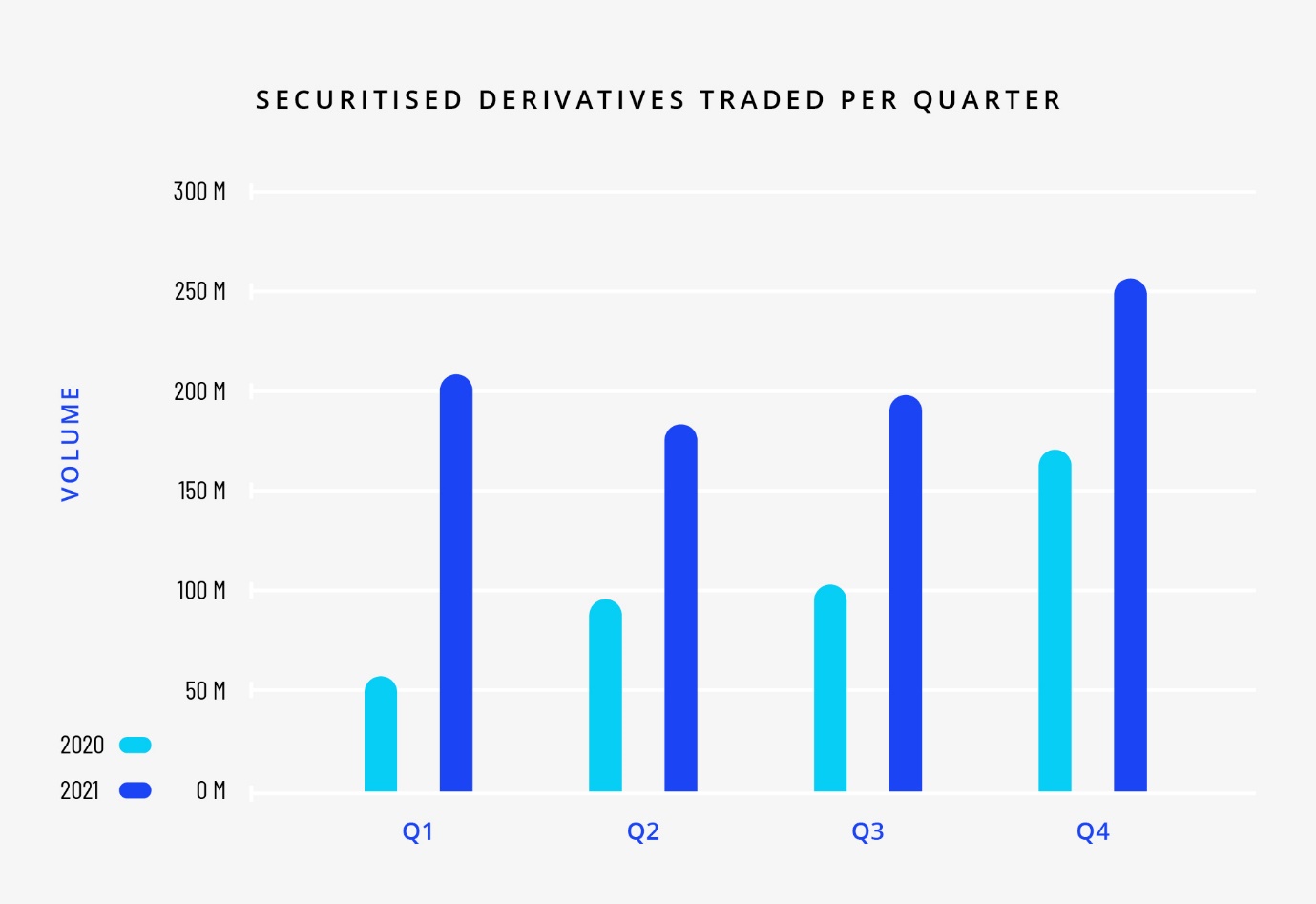
- 259 million securitised derivatives traded in Q4 2021 compared to 171 million in Q4 2020
- Most traded underlyings were DAX 40, NASDAQ 100 and OMX 30
- Q4 2021 was Spectrum’s highest ever in terms of trading volume
Spectrum Markets, the pan-European trading venue for securitized derivatives, has released its latest Quarterly Business Update, revealing continued positive momentum as its business matures.
Fourth-quarter trading volume grew by 52% year-on-year. 259 million securitised derivatives were traded on the exchange from October to December, compared to 171 million during the same period the previous year, underlining the firm’s continued strong growth.
During the quarter Spectrum also hit the milestone of trading more than 100 million securitised derivatives in a single month, with volumes passing 106 million in November and activity associated with the single-equity turbo warrants launched in September continues to grow.
“Notching up another record quarter has been a really great way to end the year, and underlines the strength of our growth ambitions in 2022 and beyond,” explains Nicky Maan, Spectrum Markets CEO. “I’m particularly pleased that we’re still seeing a lot more active retail traders, but also that the size and frequency of trades with us is increasing, as current market dynamics continue to create interesting investment opportunities.”
“We have some big announcements coming up this year, so we are really looking forward to building on what we have achieved so far and taking Spectrum Markets forwards into the next phase of its evolution.”
During Q4 2021, 35.8% of individual trades took place outside of traditional hours (i.e. between 17:30 and 9:00 CET). 83.8% of this activity was on indices, 8.8% on currency pairs, 5.9% on commodities, and 1.5% on equities, with the most traded underlyings being DAX 40 (21.7%), NASDAQ 100 (21.4%) and OMX 30 (14.7%).
- 09:00 am

The research by Robocash Group reveals that improvements in the employment rate and the final household consumption volume of the Filipino population will positively affect alternative lending in 2022.
The portfolio quality of alternative lenders has considerably decreased due to the Covid pandemic. While before, the rate of the late repayments (i.e. non-performing loans NPL) used to comprise 4-5%, and this number has been at 10-10.5% since Q3 2020. The worsening of the portfolio quality signifies the borrowers’ inability to repay loans.
The population employment rate is one of the indicators of a borrower’s creditworthiness. The wage may grow and diminish, yet it still exists and covers one’s needs. Employment or lack thereof, on the other hand, affects one’s well being in a more significant fashion.
In 2020, the employment rate suffered a sharp decrease, while the NPL share grew, i.e. the portfolio quality worsened. Thus, with a decrease in employment rate comes a rise in non-performing loans, and vice-a-versa.
According to the analysis of Robocash Group, in 2022 in the Philippines, with an increase in employment by at least 1%, the share of non-performing loans will decrease by 0.33%. It’s also noted that the increase in the volume of final consumption of households has a strong positive impact on the portfolio volumes of non-banking organisations.
The Philippines economy is on its way to recovery. According to the quarterly survey of consumer expectations by The Central Bank of the Philippines, Filipinos expect the employment rate to grow. The population’s wellbeing and the general state of economy in the country are expected to improve.
Analysts at Robocash Group comment:
“In 2022, Philippine alternative lending will experience growth both in quality of the portfolio and in size. This assessment can be made based on the existing positive effect the employment rate growth has had on the portfolio quality, as well as a positive impact on the market volume due to the increase in consumption volume. The same notion is echoed in third-party forecasts.”
- 05:00 am

- The value of payments made contactlessly increased 40.2 per cent compared to 2020
- The contactless limit increase to £100 in October 2021 increased the average number of transactions by 27.5 per cent year-on-year
- Thursday 23 December was the busiest day for contactless payments with the value of eligible transactions 121.4 per cent higher than the daily average in 2021
- Data compiled from billions of customer card transactions made in 2021
New data from Barclaycard, which sees nearly half of the nation’s credit and debit card transactions, reveals that 91.1 per cent of all eligible card transactions in 2021 were made contactlessly, with the total value of contactless payments made increasing by 40.2 per cent, year-on-year*.
The data also shows that shoppers increasingly opted for ‘touch and go’ at the check-out following the limit increase from £45 to £100 in October 2021, which resulted in the average number of transactions made contactlessly in the UK each day growing by 27.5 per cent**.
Growth across all sectors
All sectors have benefited from the contactless limit increase, with the payment method saving an average of seven seconds per transaction compared to Chip & PIN and 15 seconds compared to cash.
Analysis across sectors shows that the value of contactless transactions made in the entertainment sector, which includes cinemas, theatres, bowling alleys, arcades grew by 105.8 per cent, while bars, pubs and clubs drove an 83.4 percent increase year-on-year.
Other significant increases in the value of payments made include at sports and outdoor retailers (up 64.7 per cent), clothing stores (up 64.6 per cent) and takeaway and fast food outlets (up 39.2 per cent).
How consumers used contactless in 2021
Individually, the average contactless user made 180 contactless payments in 2021, worth a total of £2,293, an increase from 2020 where users made on average 141 payments worth £1,640.
As UK consumers finalised their festive purchases, Thursday 23 December 2021 was the busiest day for contactless transactions, where the value of eligible sales grew by 121.4 per cent, compared to the daily average of 2021.
Jose Carvalho, Head of Consumer Products at Barclaycard said:
“Our data shows that many shoppers have welcomed the £100 increase to the contactless limit and are now choosing to pay this way for goods and services in store. Unsurprisingly, many consumers are also increasingly reluctant to touch cash or PIN pads when they go to shops which is why innovations that enable a ‘low-touch’ experience, such as contactless payments have really grown in popularity.”
Rob Cameron, CEO of Barclaycard Payments, said:
“The increase to the £100 payment limit has been a great opportunity to take friction out of the purchase experience. This is especially the case in busy stores where queues can quickly build up; the faster that line moves through, the more likely shoppers are to have a good experience and want to come back. Speed at the checkout will often avoid shoppers going elsewhere, which is why the limit increase is a win-win for cardholders and merchants.”
- 01:00 am

In 2021, the Biden administration focused on securing traditional infrastructures, such as rail, water, energy, and others, with an emphasis on cybersecurity development and education. National state attacks are not the only problem. Random non-targeted attacks can have significant consequences, such as if a town’s water or waste supply is tampered with, potentially poisoning thousands of people. New solutions that can map the perimeter, find weak points, and evaluate the impact of each vulnerability that can be exploited by an attacker or criminal organization.
Radiflow is already working in North America with municipalities and utility companies to meet today’s cyber demands. “Legacy systems, are added to OT networks in a complicated multi-layered mesh,” said Ilan Barda, CEO of Radiflow, an OT cybersecurity company that is the first to offer multi-facility OT protection via their CIARA platform. “OT facilities and supply chains are continuously in motion. Proper OT security measures need to recognize this fluid motion and support it, not hinder it.”
A shift in strategic needs for organizations has put OT cybersecurity projects before compliance needs. To meet this growing shift, Radiflow brought on James Cabe as their Principal Consulting Engineer. “Securing facilities and supply chains help companies avoid unnecessary downtime and unforeseen bottlenecks at all stages, from production to consumer delivery,” said Cabe. “CIARA works with municipalities, power stations, renewable energy sites, and others to maximize the cybersecurity team’s resources by assessing what the financial and operational impact would be for each piece of equipment.”
James’ experience with companies such as CyberX, which was purchased by Microsoft in 2019, private vCISO consulting, and other development work to mitigate security issues in critical infrastructure convinced him to implement Radiflow’s CIARA across industries. This is changing the way facilities mitigate and react to increasingly sophisticated attacks.
OT presents a unique attack surface with sometimes immediate physical impact. While recent years have shown us the willingness of hackers to attack critical infrastructure operations, Radiflow is enabling companies to mitigate and address attacks directly without interrupting the quality of their operations.The US government has taken an active approach towards OT cybersecurity. “America’s OT facilities and supply chains are continuously in motion. Proper OT security measures need to recognize this fluid motion and support it,” said Ilan Barda, CEO of Radiflow.
In 2021, the Biden administration focused on securing traditional infrastructures, such as rail, water, energy, and others, with an emphasis on cybersecurity development and education. National state attacks are not the only problem. Random non-targeted attacks can have significant consequences, such as if a town’s water or waste supply is tampered with, potentially poisoning thousands of people. New solutions that can map the perimeter, find weak points, and evaluate the impact of each vulnerability that can be exploited by an attacker or criminal organization.
Radiflow is already working in North America with municipalities and utility companies to meet today’s cyber demands. “Legacy systems, are added to OT networks in a complicated multi-layered mesh,” said Ilan Barda, CEO of Radiflow, an OT cybersecurity company that is the first to offer multi-facility OT protection via their CIARA platform. “OT facilities and supply chains are continuously in motion. Proper OT security measures need to recognize this fluid motion and support it, not hinder it.”
A shift in strategic needs for organizations has put OT cybersecurity projects before compliance needs. To meet this growing shift, Radiflow brought on James Cabe as their Principal Consulting Engineer. “Securing facilities and supply chains help companies avoid unnecessary downtime and unforeseen bottlenecks at all stages, from production to consumer delivery,” said Cabe. “CIARA works with municipalities, power stations, renewable energy sites, and others to maximize the cybersecurity team’s resources by assessing what the financial and operational impact would be for each piece of equipment.”
James’ experience with companies such as CyberX, which was purchased by Microsoft in 2019, private vCISO consulting, and other development work to mitigate security issues in critical infrastructure convinced him to implement Radiflow’s CIARA across industries. This is changing the way facilities mitigate and react to increasingly sophisticated attacks.
- 01:00 am

Softline (LSE: SFTL), the global IT and digital transformation provider, in line with its three-dimensional growth strategy, today announces the signing of an agreement to become the majority shareholder in SoftClub (SCGroup Investments Limited), a specialist in the rapidly-growing industry of financial technology, and the largest developer of integrated solutions for banks, e-commerce, and stock exchanges in Central and Eastern Europe.
The company – considered by industry experts to be amongst the top-100 software firms in the world – has one of the most qualified software engineering teams in Eastern Europe with over 20 years of industry experience and with more than 950 staff, a tenured management team and deep knowledge of the sector.
SoftClub’s suite of products cover 85% of the modern bank application landscape and can support the most innovative bank operations. The company developed more than 50 of its own software products and over 15 products for core-banking systems: 62 million accounts are processed today through SoftClub’s products. More than 50,000 bank employees in 21 countries work on SoftClub’s software. SoftClub Retail, one of the company’s products, was included in Gartner Peer Insights.
Additionally, SoftClub has extremely strong expertise, supported by around 190 engineers, in Creatio, the low-code platform for process management and CRM. Creatio is one of the market leading products in sales automation, according to Gartner third year in a row.
With annual growth of almost 10%, the fintech industry is set to reach almost $200 bn in 2023[1], helped in no small part by the fact that many financial institutions are still faced with the task of overhauling legacy architectures. As such, financial services sector is tipped to remain one of the largest consumers of information technology in the coming years. The clear potential for growth in this dynamically changing sector was the key driver behind Softline’s investment in SoftClub.
Softline’s comprehensive portfolio, which covers the entirety of any modern enterprise’s IT needs, is now poised to deliver additional value to customers in the financial sector around the world. SoftClub’s team of more than 950 employees, including the management team and the company’s founder, will form the basis for a centre of excellence for fintech and CRM within Softline, and will be working on complex, large-scale transformations in the banking sector which utilise the latest IT solutions in the ever-changing world of financial services.
SoftClub delivered nearly US$11 million adjusted EBITDA in twelve months ending June 30, 2021.
Igor Borovikov, the Founder and Chairman of Softline Group explained, “Our M&A strategy is aimed at supporting our three-dimensional growth strategy: growing our geographical presence, our solutions and services portfolio and strengthening our sales channel. This deal strengthens our services capability by adding more than 950 excellent engineers to our existing force of more than 1,000 software specialists. And we benefit from the on-going consolidation of the industry by acquiring majority stake in SoftClub at the effective EBITDA multiple around our target.
This transaction is part of our journey to grow the share of services in our turnover, to have more than 5,000 software engineers at Softline available to our customers, and to receive more than half of our Gross Profit from services.”
Sergey Chernovolenko, CEO of Softline Group commented, “Our growth strategy is focused on anticipating the changing needs of our customers during digital transformation and adapting our portfolio to stay ahead of the rapidly changing environment. The financial sector around the world continues to be one of the most vibrant and demanding of all sectors, and the world-class team from SoftClub puts us in an excellent position to serve the global fintech market.
Softline’s customers around the world can rest assured that we rapidly bring these capabilities to them so that they can reduce their time-to-value. Our drive to understand our customers’ needs, combined with the specialisation required to meet those needs, is what sets us apart from our peers.”
Vladimir Sirotko, co-founder and CEO of SoftClub said, “Established in 1993, SoftClub ranks among the leaders in the region for software development, system integration and consulting in both the financial and public sector. We’re looking forward to working together with Softline in its mission to enrich its portfolio of fintech services and solutions and in providing to our clients an access to Softline Group products and experience.”
According to industry-authority Software Magazine, SoftClub currently ranks as one of the top-100 software companies in the world[2].
- 08:00 am

AutoRek, a leading software provider to global financial services firms, is pleased to welcome Flock on board as a new client.
Flock was founded on the conviction that traditional insurance business models are no longer fit for purpose in our fast-moving, hyper-connected world. They set out to change this by building a global, fully digital insurance company for connected commercial vehicles. An insurance company that proactively mitigates risk, rather than just paying claims.
In 2016, Flock emerged from academia as research into real-time risk analysis for connected and autonomous vehicles. The company now insures tens of thousands of commercial vehicles for leading fleets including Jaguar, Land Rover’s The Out and Virtuo. Driven by a mission to make the world a smarter, safer place, Flock believes the insurer of the future won’t just pay claims but will actively help its customers improve safety. AutoRek’s solution was chosen by Flock due its flexibility. As the company continues to grow at pace, it was crucial that it found a tech partner that could support its ambitious growth.
AutoRek are delighted to partner with Flock as another delegated authority insurance intermediary client, who will be using AutoRek to:
- Automate bordereau, bank and payment reconciliation requirements
- Calculate broker payments to generate statements to brokers and paid bordereau
- Take various external data sources from other insurance organisations, as well as from the general ledger
- Underpin Flock’s Insurance Broker Accounting (IBA) operations
Gordon McHarg, CEO at AutoRek, added, “It is excellent to have Flock come on board as a new client. We are delighted to be seen as a flexible and adaptable tool to help fast-growing companies like Flock scale their business. We look forward to continuing this partnership over the coming years.”
Piers Williams, Insurance Lead at AutoRek, added, “We are excited to work with Flock, they are disrupting the insurance industry with innovative new products. Behind their exciting business is a foundation of leading software solutions that are enabling the business to achieve its objectives. Flock will be deploying AutoRek’s bordereau reconciliation and financial control solution to deliver end-to-end automation.”








