
Published
- 04:00 am

Bigger investments in digital commerce lead to new financing opportunities and more buying power for small and mid-sized business
Behalf, Inc., a provider of In-Purchase Financing solutions for B2B sellers and buyers, expects big advancements in the digitization of B2B finance in 2022 as business merchants continue to invest to improve the customer experience and streamline their business operations.
“Prior to the pandemic, a surprisingly large percentage of B2B commerce still took place via traditional channels such as in-person sales, assisted selling, distributors, and phone,” commented Rob Rosenblatt, CEO of Behalf. “When everything shifted to online purchasing, a lot of B2B sellers were really unprepared. But, since then, we’ve seen a lot of progress.”
Rosenblatt expects that progress to continue on several fronts in 2022.
1. B2B Gets Real About Digital Commerce
Innovation in B2B payments has lagged B2C for many years. The fundamental changes in buyer/seller interaction models caused by the pandemic have forced the B2B merchant community to take a fresh look at how payments and financing enhance – or detract from – the overall customer experience.
In 2022, B2B merchants will continue to fortify the e-commerce experience with the goal of making the end-to-end buying process as frictionless and differentiating as possible. This will go beyond the shopping experience. Building on the momentum for Buy Now Pay Later (BNPL)* in consumer retail, B2B merchants will invest in capabilities that enable them to automate the offering of financing solutions at the point-of-sale. These capabilities will provide their customers with greater buying power (raising the average ticket) and enhance cash flow through better matching of cash inflows and outflows. They will also build customer loyalty and create important operational efficiencies.
2. B2B Buyers and Suppliers Flex on Payment Details
In B2B commerce, “payment terms” are an important aspect of any business relationship. These financing details have typically been negotiated up front — before the vagaries of specific transactions can really be considered.
As SMBs take more considered approaches to how they pay for goods to optimize capital allocation, manage cash flow, and match inventory to revenue flow, B2B merchants will respond with more flexible financing choices tailored to different types of transactions. We will move towards a “slider function” built within financing programs that facilitate alignment on financing details, discounts and payment summaries between buyers and sellers at the individual transaction level. Longer-term, we will see the evolution of category and merchandise-specific automation of financing options with the assistance of AI- and analytics-based platforms.
3. New Financing Options for Small Business
Small businesses desperately need more flexible financing alternatives to traditional business credit cards and loans. Fintech will be the solution to that problem in 2022 with the emergence of alternative lending solutions specifically for small businesses. These will come in different forms — from alternative financing solutions purpose-built for B2B, to all-in-one small business and spend management credit cards, to neobanks and defi solutions. SMBs have some access to products like these today, but 2022 will be the year in which we see a laser focus on products that specifically address the needs for expanded working capital solutions for small businesses.
4. Banks Dive Deeper into BNPL
Some traditional banks view alternative financing solutions like Buy Now, Pay Later (BNPL) as a threat – to their credit card, credit line and installment loan businesses. JP Morgan Chase, in particular, has been outspoken about this threat and vowed to defend against it. Others such as Barclays and SoFi recognize the promise of BNPL and have partnered with MasterCard to offer BNPL-type services.
In 2022, expect to see more banks incorporate alternative financing and BNPL solutions into their offerings for consumers and businesses. Some will offer solutions via acquisitions of fintech startups while others will look to partner with fintechs or build these capabilities from within. As more banks embrace alternative financing, they will in fact contribute to the proverbial “rising tide that lifts all boats.” Beside their role as a trusted source of financial advice, banks have the ability to capitalize on vast reservoirs of spend and payment history to improve access to flexible financing alternatives for both consumers and businesses.
“The web is tailor-made for B2B commerce — always on, 24/7 availability, self-service, nearly unlimited choice,” added Rosenblatt. “It creates a wealth of new opportunities for businesses to improve the way they engage and serve their customers, while also dramatically streamlining their business operations. I think we’ll see B2B start to really close the innovation gap with B2C in the next 12-24 months.”
- 05:00 am

GreenBox POS today announces its placement in an editorial published by NetworkNewsWire, one of 50+ trusted brands within the InvestorBrandNetwork (“IBN”), a multifaceted financial news and publishing company for private and public entities.
To view the full publication, “The Payment Revolution: Blockchain Changing the Game,” please visit: https://nnw.fm/QjUEA
Blockchain technology is disrupting an endless number of industries, but none more than the world of finance, a moribund market that for decades seemed mostly unmovable as big banks were in complete control. Then along came the decentralized ledger of blockchain, which leveled the playing field and tore down the barriers insulating the oligopoly by offering the potential to transform all types of financial transactions from remittances to capital formation.
For the first time ever, blockchain technology makes it possible for global financial systems to be interconnected, secure, and accessible, as well as fast, cost effective and efficient. This has opened new market opportunities being exploited by customized blockchain payment solutions provider GreenBox POS.
- 05:00 am

Montreal-based automation start-up has raised over CAD$55M in total funding after closing its Series A
New direct investment from OMERS Ventures and White Star Capital—combined with debt financing from Silicon Valley Bank (SVB) and previously raised seed funding from Desjardins Capital and Real Ventures—will see Wrk expand its team and accelerate the development of its platform
Wrk’s Hybrid Automation platform allows businesses to create end-to-end automated workflows without any technical expertise
Company adds four senior executives to its team as part of growth push, including a former Amazon CTO
Wrk Technologies Inc. (Wrk), a Montreal-based automation start-up dedicated to transforming and scaling the delivery of work, has secured CAD$55M (USD$43M) in cumulative seed, Series A, and debt financing after completing its Series A led by White Star Capital and OMERS Ventures. The total financing announcement includes CAD$12.5M (USD $9.6M) in previously raised seed financing from original seed investors Real Ventures and Desjardins Capital. In addition, several prominent angels including Sharon Rowlands (CEO Web.com), Cherif Habib (CEO Dialogue Health), Mark MacLeod (former CFO Shopify), Charlie Songhurst (former head of strategy Microsoft), and Michael Litt (CEO Vidyard) have invested over the course of the fundraising.
Founded by CEO Mohannad-El Barachi and COO David Li in 2019, Wrk is currently serving a diverse roster of clients in North America and Europe, including communications and PR giant Cision, media conglomerate Gannett, Silicon Valley Bank (SVB), and international non-profit Penny Appeal. Wrk’s Hybrid Automation platform is the first process automation solution to combine workplace automation with a skilled human workforce. By enabling organizations to automate routine tasks and freeing employees to dedicate more time for critical growth tasks, Wrk is helping organizations dramatically scale the delivery of their work without sacrificing quality or foregoing the value of human input.
To achieve this goal the company has created a unique ‘building block’ structure that makes it easy for anyone (even those without IT experience) to build workflows that can leverage the very best of bots, API integrations, Robotic Process Automation (RPA), and a vast array of human skills, without any heavy technical lifting. This easy-to-use structure and unprecedented mix of pre-configured technology with human ingenuity mean Wrk can handle almost any repetitive task, regardless of its complexity.
The trend for automation adoption has been amplified significantly by the unprecedented challenges brought on by COVID-19. A 2021 survey from McKinsey found that 83 percent of executives reported faster automation adoption rates in 2021 compared with before the pandemic.
However, while the demand for more traditional Business Process Automation (BPA) has increased steadily over the last decade, many first-generation automation solutions have struggled to ensure quick and easy adoption due to lengthy onboarding requirements, technical incompatibilities, and high up-front customization and implementation costs. By contrast, Wrk’s simplified approach to automation means that customers can focus more on defining desired outputs than devoting time to understanding the complexities of technical integrations.
“The scale of the investment we’ve received at this early stage from highly respected investors is a tremendous validation of the level of ambition and size of the opportunity we’re going after,” said CEO Mohannad El-Barachi. “For far too long, businesses have struggled with adopting automation because of the high costs of entry, rigid implementation processes, and overly complex language. This investment is the first step in bringing to market an automation solution that breaks these barriers and delivers on its mission of making automation insanely simple.”
The innovative nature of Wrk’s Hybrid Automation platform has certainly garnered a lot of investor interest in recent months, culminating in this round of funding. It is perhaps the accessibility of the end-to-end solutions provided, however, that has been most appealing to experts in the tech space.
“Unlike a lot of automation solutions, Wrk isn’t trying to replace human ingenuity—instead, it is leveraging a skilled team to tailor automated solutions for each customer, so businesses can scale when and where they need to, without the barriers that exist today. We hear from companies every day who are struggling to bridge the gap between the potential of autonomous workflows and the time and cost to implement them. We see enormous potential in backing a company that can do just that.” said Laura Lenz, Partner at OMERS Ventures.
“We were immediately excited about Wrk's product positioning in the workflow automation space,” added Christophe Bourque, General Partner at White Star Capital. “The increased adoption of automation tools by businesses, allied with the team’s unique approach combining human cognition with cutting-edge automation, has positioned the company for explosive growth. We look forward to working with the company as they continue to democratize access to business process automation solutions to companies big and small across the world."
Wrk adds senior hires
In support of this next growth phase, Wrk has added four key senior hires to the team of more than 50 full-time employees. Mathieu Rebeiro joins as Vice-President of Automation Solutions. Mathieu has led automation at some of the largest financial institutions in the world including most recently Royal Bank of Canada, TD Bank and Sun Life Financial.
Michael Thompson is joining Wrk as SVP of Customer Operations. Michael is a seasoned executive with over 20 years of experience leading large operational organizations, most recently at Gannett, bringing startups to IPO through the implementation of people, process, and technology enhancements.
In Sales, Maria Meadows joins as SVP, with almost 20 years of experience leading and building top-performing sales teams from Fortune 500 companies to tech startups across multiple industries, including most recently at USA Today and ModelB.
Finally, Jacques Bouchard will bring over two decades of expertise to the role of Chief Technology Officer (CTO). Prior to joining Wrk, Jacques spent over a decade as CTO at Amazon’s Global Security Operations division where he was responsible for leading security technology efforts.
To learn more about Wrk, visit www.wrk.com today.
- 04:00 am

Nuvei Corporation, the global payment technology partner of thriving brands, announces today that it has gone live as a payment provider with THG plc, the global technology platform company specialising in taking brands direct to consumers.
The addition of Nuvei to help power payments covers all of THG’s leading brands including Cult Beauty, Lookfantastic, Myprotein, Glossybox, Coggles and AllSole.
THG is utilizing Nuvei’s recurring billing service that allows secure, automated re-purchasing via tokenization.
“We’re delighted to partner with THG,” said Philip Fayer, Chair and CEO of Nuvei. “With a shared ethos of exceptional experience, innovation and service, we’re empowering online brands to operate in more countries and accept more forms of regionally familiar and preferred digital payment methods to drive conversion.”
Nuvei’s advanced payment platform offers online payments in more than 200 markets and over 500 alternative payment methods through one integration.
“Nuvei’s platform will further enhance the experience we create for our customers by expanding the range of payment options available to them at checkout,” said John Gallemore, CEO of THG Ingenuity, the proprietary, end-to-end technology and operating platform that powers all THG brands. “It represents another step in our ongoing journey to deliver exceptional online retail experiences for shoppers all over the world.”
Partnering with THG will further position Nuvei as the payments partner of choice for online retail.
- 05:00 am

The collaboration between Bipsync and Canoe streamlines and automates the investment document collection and categorization processes for clients and delivers superior content management for investors to make more informed investment decisions.
The best-of-breed RMS provider, Bipsync, partners with Canoe Intelligence ("Canoe"), a financial technology company redefining data management processes for alternative investors and allocators, to bring unrivaled efficiency to investment document management. The collaboration between Bipsync and Canoe streamlines and automates the investment document collection and categorization processes for mutual clients and delivers superior content management for investors to make more informed investment decisions.
Through this partnership, mutual clients can leverage Canoe to automatically retrieve investment documents from multiple sources and store those documents securely within Bipsync for future use. This new functionality is especially relevant for institutions with research management, process management, and advanced compliance and data integration needs. Mutual clients can also access Canoe's extraction technology to automate and scale their alternatives data management workflows.
Automated document retrieval is available through Canoe Connect, a first-of-its-kind technology for collecting, categorizing, tagging, and renaming documents from multiple sources such as general partners and administrator portals and email.
Documents are systematically transferred from Canoe to Bipsync via a technical API integration for utmost efficiency, security, and automation. Documents are then stored in Bipsync RMS, an integrated research environment that delivers consumer-like user experience and agility, with enterprise security and compliance. Bipsync integrates a centralized research database, intuitive note-taking, organization tools, workflow pipelines, and automation tools for research that is always available whenever and wherever investors need it.
"The mission of Bipsync is to unify and streamline investment and research processes and provide our clients with the best SaaS solution to drive pertinent growth decision-making. At our core, we empower the proprietary investment strategies of financial institutions. This will now be more apparent to our institutional investors, capital allocators, and wealth managers, thanks to our partnership with Canoe," reflects Ken Read, Chief Revenue Officer at Bipsync.
Bipsync's comprehensive API creates endless possibilities for integration, and its open-source infrastructure allows seamless integration for necessary partners such as Canoe.
Since its commercial launch in 2018, Canoe has enabled more than 150 alternative investors and allocators to scale their businesses and has become the industry-standard approach for automating alternatives documents and data management. Through its latest offering, Canoe Connect, Canoe leverages API and RPA integrations with general partners to retrieve essential documents for clients and eliminate common operational challenges such as managing hundreds or thousands of portals, changing passwords and multi-factor authentication, and inconsistent document delivery, format, and frequency. Moreover, its shared intelligence from its growing fund master database of over 14,000 funds across numerous asset classes enables Canoe to ingest high volumes of complex documents and create instantaneous access to actionable data.
"We're thrilled to partner with Bipsync to streamline the time-consuming and highly-manual document collection and categorization process for mutual clients," said Mike Muniz, Partner and Chief Revenue Officer at Canoe Intelligence. "This collaboration transforms how allocators interact with their documents and data, significantly shortening the time spent on document aggregation and management. At our core, we're enabling clients to refocus their time on the most impactful activities - data analysis, investment decision-making, and client-service."
The future of research management is ever-changing, and investors desire technology that evolves with them. The combination of Canoe and Bipsync provides mutual clients with the flexibility to integrate with other document, data, and platform partners as their organizational needs continue to shift.
- 05:00 am

AI-powered risk decisioning provider realizes a 190+ percent increase in new customers and a 55 percent SaaS revenue increase, amid continued global expansion
Provenir, a global leader in AI-powered risk decisioning software, today announced record growth in 2021, achieving a 194 percent increase in new customers and a 55 percent increase in Software-as-a-Service revenue year over year.
Provenir also continued its global expansion in response to increased demand for its products and services. In 2021, the company moved into new markets, including Germany, Austria, Switzerland (DACH), Turkey, the Middle East, the Balkans, and Africa, and expanded its presence in Latin America and Asia, bringing the total number of countries served to nearly 50.
As a result of this growth, the company increased its global workforce by 49 percent last year.
This growth sets the stage for Provenir to gain additional traction in key global regions and in the growing Buy Now Pay Later (BNPL) and challenger bank sectors, which need technology that provides access to alternative data for smarter decisioning and faster client onboarding.
“We are extremely proud of our record-breaking performance in 2021, and we see no signs of this momentum slowing down in 2022,” said Larry Smith, Founder and CEO of Provenir. “We are witnessing significant expansion in the types of businesses seeking our real-time decisioning solution across all geographies. Our unified solution brings together the three essential components of risk decisioning – data, AI and decisioning – into one single decisioning platform to help organizations provide the real-time decisioning customers demand today.”
Additional key company milestones achieved in 2021 include:
- Introduced product innovations such as Cloud 2.0 and Provenir AI, which continue to simplify data access, make AI accessible and automate decisioning.
- Invested 25 percent of revenue in research and development to continue developing industry-defining solutions, including extending AI capabilities.
- Welcomed more than 60 new partners to the Provenir Marketplace, a comprehensive fintech data and intelligence ecosystem providing access to more than 530 country/data/partner combinations through a single Application Programming Interface (API).
- Experienced a 50 percent increase in transactions, processing more than 3 billion transactions over 11 data centers.
- Expanded the use of Provenir for financial inclusion with customers in all regions.
- Among other accolades received, Provenir was recognized as the “Best Credit Risk Solution” in the Credit & Collections Technology Awards, qualified as a finalist in Credit Strategy’s Credit Awards in the “Best Technology Provider” category and was named to the Inc. 5000 Fastest Growing Private Companies in America.
Provenir customers include leaders and challengers in the fintech and financial service sectors such as Zilch, AskIf, Kueski, Koko, Reliant Funding and Rent-A-Center that are gaining a decisive advantage with risk management data and decisioning on-demand via Provenir’s AI-powered risk decisioning software.
- 01:00 am

Financial Risk Solutions (FRS), provider of investment administration software to asset owners and life and pensions companies worldwide, today announced Generation Life, an Australian leader in tax-effective investment solutions, has gone live with Invest|ProTM after selecting the software in May 2021 for its investment bond business and future product development.
FRS’ professional services team was able to implement Invest|ProTM following the technology firm’s four pillar Implementation process.
The Invest|ProTM software provides automated reconciliations, unit pricing, cash allocation and rebalancing, tax accruals, investment accounting and reporting for Generation Life. The solution includes advanced reporting and analytics, audit trails for all activity, email alerts and dashboard monitoring, giving Generation Life’s management team complete oversight of the investment administration process.
Lisa Bates, Head of Fund Operations at Generation Life, said;
“This was an important technology upgrade for Generation Life, providing a scalable and reliable platform to support our long-term growth ambitions across multiple products. We were impressed with the commitment of the FRS team to get us live with InvestPro. From designing a light-touch operating model, through to implementation and launch, the FRS team guided us every step of the way. Their extensive industry experience really sets them apart.”
Frank Carr, CMO at FRS, commented;
“This project with Generation Life is another example of how FRS delivers our award-winning software using continuous delivery capabilities to reduce risk and ensure clients are up and running and benefiting from our software quickly. We wish Generation Life every success and look forward to continuing to work with them in the future.”
- 01:00 am

Today, new data released by Yapily — the leading open banking infrastructure provider — reveals that UK banks have continued to invest in open banking technology as user adoption grows.
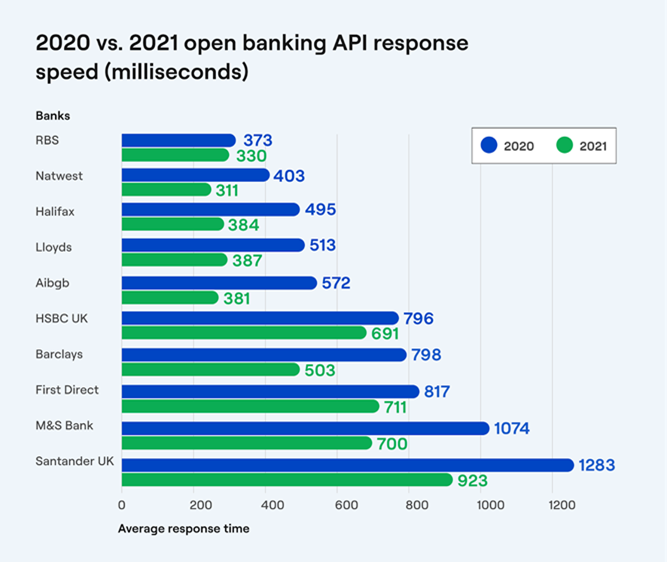
The data, which analyses the average open banking API response times across 10 of the UK’s top traditional banks, reveals that 100% have improved their response speed between 2020 and 2021, in some cases by up to 37%.
At the end of 2021, cumulatively over 26.6 million open banking payments had been made in the UK, an increase of more than 500% in 12 months. Where higher volumes would typically result in higher latency, faster response times across the board indicate that banks have invested heavily in open banking’s underlying infrastructure during this time.
Yapily’s figures also reveal that last year, the average API response time across UK banks was 511 milliseconds, an improvement of 28% from 2020, with the OBIE recording a 60% increase in user adoption over the same period from 2.8 million to 4.5 million.
Roland Selmer, Chief Product Officer at Yapily comments:
“For the customer, faster response times will create a slicker and more convenient user experience. For businesses, benefits include faster access to financial data, reduced abandonment rates, and increased levels of customer trust.
“However, it’s important to remember that response speed is just one aspect of improving the UK’s open banking ecosystem. Over the next 12 months, banks, fintechs, and Technical Service Providers (TSPs) alike will need to continue to invest in open banking architecture. In order to increase adoption, improving API reliability, uptime and user journeys will be key as this will ultimately have the biggest impact on improving conversion rates,” he adds.
NatWest, RBS and AIB had the fastest API connectivity in 2021, with an average speed of 340 milliseconds. The most improved banks in the last 12 months include Barclays, who saw a 37% reduction in average response time; M&S, who achieved 35%; and AIB, who saw 33%.
Stefano Vaccino, CEO and Founder at Yapily comments:
“To measure the success of open banking, we need to look at both user adoption and the quality of the infrastructure underpinning the wider ecosystem. The implementation of open banking in the UK has always been reliant on the readiness of the CMA9; with strong improvements in year-on-year API response times, this evidence is a positive indicator for the direction of travel and maturity of open banking in the UK.
“In 2022, I expect to see continued improvement across the UK banks as they develop and launch new APIs and functionalities, enabling more innovative use cases. In the wider ecosystem, we will see account-to-account payments compete even more closely with existing payment methods like credit and debit cards. And at some point in the near future, we will have seen a major platform integrate open banking into their payment workflow, giving rise to an inflection point in consumer adoption.”
Yapily’s API insights exclude UK challenger banks due to the volume of data transferred when compared with a traditional bank. The data was compiled and monitored throughout 2020 and 2021 by Yapily’s API platform. The company’s infrastructure is used by some of the world’s leading companies such as American Express, IBM, Intuit Quickbooks, IRIS Software Group, and more.
- 04:00 am

Having numerous technology systems scattered across the business is the biggest obstacle to financial institutions achieving strong market and trade surveillance this year, according to new research from VoxSmart.
A poll of just under 80 market participants (79), including investment banks, brokers, and investment managers, found that 69% of firms believe having siloed surveillance systems increases the risk of market abuse being carried out. Just 18% of firms said replacing legacy systems was a barrier, while a mere 13% claimed tracking trader chat through multiple channels, such as WhatsApp and Telegram, would prove to be barriers to stronger surveillance.
The findings come as the potential for market abuse continues to accelerate globally as financial institutions continue to adjust to the new hybrid working world. Figures from Refinitiv show that just under 6% of suspicious transactions set off alerts among investors last year.
Commenting on the findings, Oliver Blower, CEO of VoxSmart, said: “For years, financial institutions have been reliant on multiple disparate vendor solutions to detect any potential cases of market abuse. The trouble is that This has not been effective and the risk of risk of sensitive or misleading information being overlooked remains extremely high.
These days, surveillance is looked at on an individual conduct risk assessment basis – which means that very few areas of the business, if any, are out of bounds. Working towards a smarter way to monitor trade, markets, and comms data on one single platform so that there is more visibility into all activity cross-firm and cross-department, has to be the way forward.”
- 07:00 am

Ecobank to use the Pavilion to grow its profile and visibility in UAE
Participation to promote investments back to Cape Verde; Ecobank (www.Ecobank.com ) to use the Pavilion to grow its profile and visibility in UAE; Ecobank’s network of 33 countries key to reaching Sub Saharan Africa, as well as 5 Representative Offices, one of which is located in Dubai, UAE.
Ecobank Cape Verde, part of the Pan-African Banking Group, Ecobank Group, is partnering with the Government of Cape Verde as the official sponsor the Cabo Verde Pavilion at the Expo 2020 Dubai. The Expo that is running for six months, ends on 31 March 2022.
With the sponsorship, Ecobank Cape Verde aims to promote investment and partnership opportunities in Cape Verde, enhance its profile and visibility within the larger United Arab Emirates and globally, and expand its support for Cape Verdean businesses. As part of the Pan African Banking group that has a strong presence in 33 African countries, Ecobank Cape Verde will use the opportunity to promote its network advantage to investors and other entities interested in doing business with Africa.
Aminata Nana Sakho, Managing Director, Ecobank Cape Verde, said: “With the African Continental Free Trade Area agreement creating a new era of opportunity and growth for Africa, we’re determined to fly the flag for Cabo Verde and maximise our country’s - and Ecobank’s - visibility at the Dubai Expo. Our presence in Dubai through our international office, our pan-African knowledge and our expertise in innovative structuring solutions, make us the ideal partner at this world-renowned event.”
Through its presence at the Expo, Ecobank Cape Verde aims to help attract foreign direct investment and investors in key sectors such as tourism, ICT, finance and infrastructure. The Expo also provides a unique platform for the bank to promote its innovative products and services, its structuring solutions, and its local and pan-African know-how to an influential global audience.
One of the key events organized by the Government of Cape Verde at the Dubai Expo is the Cabo Verde Investment Forum on 3rd and 4th February. The forum aims at mobilizing resources and finance from the private and public sectors to fund catalytic projects delivering sustainable economic growth, job creation, entrepreneurship and youth development in Cape Verde. The flagship projects of the Cabo Verde Strategic Plan for Sustainable Development will also be highlighted.
There are over 200 participants at the Dubai Expo, including nations, multilateral organizations, businesses and educational institutions. The theme of the Expo is ‘Connecting Minds and Creating the Future.’
Distributed by APO Group on behalf of Ecobank.








