
Published
- 05:00 am

Appital, the Equity Capital Marketplace, today announced Bernstein as executing broker on its new bookbuilding platform ahead of launch. Appital brings technological innovation and automation to equity capital markets and improves liquidity discovery and price formation processes of illiquid equity positions.
The Appital platform gives the buyside community greater exposure to deal flow opportunities they have not been able to access before. Buyside traders looking to execute large orders often in excess of 5 days ADV, including in highly illiquid, small and mid-cap stocks, have access to real-time visibility, full transparency and maximum control over the bookbuilding, price formation and deal distribution process.
The collaboration between Appital and Bernstein was initiated by continued demand from clients, and the integration will offer the buyside community a more efficient and transparent way to execute large in size orders with minimal market impact or risk of price erosion. Flow originated on the Appital platform can be seamlessly executed through Bernstein.
Mark Badyra, CEO Appital, commented:
“We have been working with Bernstein to develop the platform from the early development phase. Asset managers told us they would like to use Bernstein to execute this type of flow because of their independent market position and strong research focus. Our collaboration gives our shared client base the functionality to find new sources of liquidity which will be unique compared to other technologically driven platforms.”
Bernstein has a history of being at the forefront of new initiatives and a proven track record in giving institutional investors access to new order types, new venues, and now also new ways of accessing liquidity that is traditionally hard to find.
Toby Bayliss, Head of European Electronic Trading at Bernstein Autonomous LLP, added:
“Our ethos is focused on the institutional market and we aim to align with the interests of our buyside clients. Appital provides an innovative, automated and more efficient way for clients to source and access liquidity, enhancing our primary role as an execution broker.”
Over 30 asset managers, who collectively manage over 30tn USD, are preparing to join Appital at launch. When building out its platform and technology infrastructure, Appital’s asset management clients provided input into the nominated broker list to be used as execution brokers when Appital goes live. Once onboarded and integrated, the Appital platform will allow them to begin setting their preferences to proactively gain exposure to deal flow which is relevant to them, and nominate brokers for execution.
- 02:00 am

Billhop enables businesses to pay supplier invoices using existing cards, regardless of the suppliers’ payment stack – tapping into $120 trillion B2B payments market, which lacks low-friction options compared to B2C
Creates opportunities for increased capital efficiencies, creating win-wins for all buyers, sellers, and their payment providers
New funding will be used for hiring, customer acquisition, and geographical expansion
Manages the complete payment process without having to onboard the end recipient, who is paid through a bank-to-bank transfer – removing previous barriers to card acceptance in B2B payments (e.g. setting up new card acceptance infrastructure, processing fees)
Today, proprietary straight-through processing (STP) payments platform Billhop – which offers businesses process and capital efficiencies based on existing credit card infrastructure – announces it has raised €10.5 million, led by EQT Ventures with participation from Element Ventures, pending SFSA approval. The funding will be used to scale aggressively – including hiring (particularly tech and marketing roles), customer acquisition, and geographical expansion.
Credit cards allow users to benefit from the interest-free credit period until the card statement is due, while also offering a swift and seamless user experience. This has led to cards becoming the preferred method of payment for consumers globally, with B2C card acceptance reaching 99% in some markets. On the B2B side, however, card acceptance is fractional worldwide – suppliers neither want to set up the card acceptance infrastructure required, nor do they want to pay the processing fees associated with accepting commercial card payments. As such, the most common B2B payment method is bank-to-bank transfers in some markets, cheques, or wire transfers.
Today Billhop manages the complete payment process for its business customers without having to onboard the company’s vendors. Vendors don’t need to change anything in their existing accounts receivables process; they simply get paid directly into their usual bank account through a bank-to-bank transfer. Companies take advantage of simplified processes and potential opportunities to optimise working capital.
The B2B payment market is worth $120 trillion, but is largely untapped by credit cards due to the low card acceptance within B2B. Billhop has seen rapid growth by creating wins for the card industry, including card schemes, acquirers, and commercial issuers – providing access to the B2B vertical, without cannibalising other products and without any implementation or investment required.
Co-founded by Sebastian Andreescu (CEO), Erik Malm (CTO) and Ingemar Sjögren (CFO) in Stockholm, Sweden, Billhop serves over 20 markets, catering to Fortune 500 enterprise customers across Europe; and sole traders and SMEs in the UK, Sweden, Netherlands, Italy, Ireland and Finland. Operating with a lean team of 19 people, 65,000 customers have been successfully onboarded and Billhop boasts strong industry relationships, working closely with all major card payment networks and a handful global commercial issuers. Currently, Billhop processes €250 million in transaction volumes annually. Last year, Billhop doubled its team, including key hires from Stockholm’s rich pool of talent in fintech and payments.
Commenting on this news, Sebastian Andreescu, CEO & co-founder of Billhop, said:
“We have seen a very strong product market fit in the last 12 months and the investment from EQT Ventures further accelerates our plan of becoming the preferred payments partner for businesses of all sizes across Europe. We are also particularly happy about having Ashley join our board of directors, as her proven track record and expertise will be of great value for us as we now enter into an ambitious scale-up phase.”
Ashley Lundström, Partner at EQT Ventures, added:
“At EQT Ventures we are keen to back founders tackling large markets seeing large changes, particularly when there are win-wins. The payment industry globally has seen a proliferation of choice in B2C payments, and we are excited to back Billhop as they bring long awaited innovations to B2B payments.”
- 06:00 am

Leading pan-African fintech enablement partner, Ukheshe Technologies, has significantly improved its Broad-Based Black Economic Empowerment (B-BBEE) performance, becoming one of the only South African fintech enablers to achieve a Level One B-BBEE Contributor certification.
As one of the first fintechs to attain a Level One score, Ukheshe joins a select handful of companies in the financial services sector to achieve South Africa’s highest transformation rating.
This, coupled with Ukheshe’s remarkable growth – having concluded over 60 enterprise partnership deals in 2021 – has prompted additional investment into the company as it continues to deliver its ecosystem of solutions in key African locations and other emerging markets.
Ukheshe’s solid growth and B-BBEE score improvement demonstrates notable success in accomplishing significant transformation at ownership level and unlocking opportunities for black South Africans in its employment, supply chain and contribution to the community. The accomplishment also underscores Ukheshe’s constant drive for tangible ways to increase B-BBEE participation and empowerment in the public sector while creating a more inclusive, sustainable digital economy for everyone.
Ukheshe has also officially announced that Mahlwane Magale, the company’s Head of Financial Operations, will take up a director position on Ukheshe’s board. Since joining the company in November 2020, Magale has demonstrated steadfast commitment to Ukheshe’s values and growth. Magale is an Allan Gray Fellow, former Management Consultant and Private Equity Investment Professional and is passionate about financial services and the ways it can power financial inclusion.
Clayton Hayward, CEO of Ukheshe, comments, “Since its inception Ukheshe has proudly championed economic and social transformation and will continue to make empowerment a priority. Attaining a Level One B-BBEE score is testament to Ukheshe’s role as responsible corporate citizen committed to doing the right thing. To be one of the first fintechs to reach this significant milestone is a proud moment for the company, especially as we focus our efforts at democratising digital financial services across the African continent.”
Prins Mhlanga, CEO of Ocean on 76 Group, early investor, and shareholder in Ukheshe has confirmed an increased stake in Ukheshe Technologies following its consistent and impressive growth over the previous 12 months and its immense potential.
Says Mhlanga, “Like-minded investors have seen excellent growth within the company. Ukheshe’s efforts in entrenching itself as a leading African fintech enabler have produced significant results and both its immediate and long-term prospects are incredibly exciting. The company’s transition to Level One certification is just the latest development to showcase Ukheshe’s aptitude for supporting its customers and employees in any environment in which they operate.”
From a South African startup to pan-African fintech, Ukheshe is at the forefront of innovation within the African payments industry. It is a KPMG Tech Innovator Runner-up, Ecobank runner-up, SARB fintech winner, runner up at the Singapore Fintech festival, and cohort member of Catapult Inclusion Africa. It is a Global Mastercard Engage partner, making it part of an elite group of only 29 companies globally.
- 09:00 am

Financing accelerates the company’s expansion to modernise accounting for the private capital industry
LemonEdge, a modern, low-code accounting platform powering the private capital industry, has completed a $4 million funding round, led by Blackstone Innovation Investments with participation from existing investors, including Sidekick Partners, Lauren Iaslovits (co-founder of Investran and a pioneer of private capital market technologies) and Tikhon Bernstam (founder of Parse and Scribd). The financing increases capital raised to date to $7 million, all within the first year of launch.
LemonEdge enables Private Capital firms to automate and digitise their end-to-end complex accounting processes, many of whom rely on older systems or spreadsheets. In a first for the industry, LemonEdge combines a modern, purpose-built financial engine alongside a customisable low-code platform with a suite of advanced reporting and scenario tools. The company’s cloud-native technology has been designed to support the unique and varied requirements of the private capital industry at scale and across asset classes.
Compared to traditional services, the powerful low-code platform is 20x faster to implement and run. The financial engine is created from the ground up to better understand partnership accounting and allocations. The platform provides firms with increased flexibility, real-time investor reporting, and greater operational efficiencies in a complex environment.
Jamie Nascimento, Co-Founder and Chief Commercial Officer at LemonEdge, comments:
“The growing requirement by Private Capital firms to have the highest efficiencies, while dealing with complexity in an agile manner is becoming more of a prerequisite for staying ahead in the market. Firms are looking for ways to deliver efficient, accurate content to clients with the goal to ultimately provide the highest level of client service in a timely manner. There is no longer the leeway to process calculations outside of systems, manually post multiple transactions, or run separate solutions for the end-to-end accounting and middle office.”
John Stecher, Chief Technology Officer at Blackstone, commented:
“We recognise LemonEdge was born out of scale and complexity, and we are excited for what their next- generation technology can bring to the Private Capital industry. We look forward to partnering with their team to continue to expand their platform.”
Gareth Hewitt, Co-Founder and Chief Executive Officer at LemonEdge, commented:
“We’re delighted to bring Blackstone into our round and have the support of such prestigious investors who similarly recognise the need for such a generational shift. Blackstone has unique insight into a diverse range of asset classes and understands the technology problems in the industry today. They’re a natural fit to have on board and as a strategic partner, will help us solve the market challenges currently restricting Private Capital firms from reaching their full potential.”
Earlier this month, LemonEdge was appointed by Kensington Capital Partners as their front-to- back office accounting solution. LemonEdge will be powering the firm’s Private Equity, Venture Capital, and Fund of Fund structures alongside an Investor Portal.
- 06:00 am

TrueLayer, Europe’s leading open banking platform, today announces its expansion into Sweden with the appointment of former Adyen executive Karl Hagner as its Country Manager. A highly experienced commercial manager, with a focus on payments in ecommerce, Stockholm-based Karl will define and manage commercial strategy in the country, alongside TrueLayer’s Chief Revenue Officer Max Emilson.
TrueLayer’s expansion to Sweden comes as demand for the firm’s open banking platform, comprising payments, payouts and access to financial data, continues to grow. Karl will lead the company’s expansion in Sweden, with a focus on scaling commercial operations and supporting existing TrueLayer clients to expand into the country.
“Working in the payments industry, I’m fascinated by emerging trends and solutions that merchants will require to deliver the best possible experiences to meet consumers’ changing expectations. It is clear that open banking is delivering that, with its ability to solve payments pain points in ecommerce, B2B, wealth and fintech,” Hagner commented. “It’s also an exciting time to join TrueLayer as it expands, cementing its position as the open banking leader across Europe. With a strong customer base and proven open banking expertise we can support innovative services that will benefit Swedish consumers and businesses.”
Karl brings a wealth of experience in payments having spent almost four years in senior roles at Payment Services Provider (PSP) Adyen, initially in Stockholm, and later on, as its account management lead in Toronto. The launch of Swedish operations follows TrueLayer’s recent European expansion, adding connectivity to hundreds of banks in Austria, Belgium, Denmark, Finland and Portugal through PSD2-compliant APIs.
Max Emilson, Chief Revenue Officer at TrueLayer, commented: “We are bringing together experts to supercharge our European growth, adding experienced leaders in France, Germany and now Sweden. Karl’s payments and ecommerce knowledge, coupled with his experience of scaling teams in Sweden and Canada will be invaluable to us as we grow in the country.”

Terry Kuester
VP of the FSI Consulting and Banking Industry at NTT DATA Services
In 2020, customers began relying on digital-first experiences to make remote banking fast, secure, and painless. see more
- 04:00 am

How do you invest one hundred thousand US dollars?
Many possibilities are available if you're trying to invest $100,000, but some are clearly superior to others. Depositing the money in a crypto business account may be the best option if you're willing to wait. You might also invest part of the money in real estate or a diversified stock portfolio. No matter what you do, you should always exercise caution and weigh your alternatives carefully. Of course, hiring a financial expert to help you invest your $100,000 might make things a little simpler (and to manage the money as it grows.)
1. Before You Invest $100,000
Paying off debt and putting money aside for an unexpected need should always come first when making financial decisions.
2. Pay down your (high-interest) debt.
It's advisable to pay off any high-interest debt before investing any of your money in the market. The debt owed on credit cards and other loans, including such payday loans, is included in this. When it comes to yearly interest rates, the average credit card interest rate stands at a whopping 16 percent. In other words, even in a bull market, paying off high-interest debt is indeed a better use of your money than investing. Consider a credit card balance transfer if you owe money on a number of different cards. Using this method, you'll be able to handle all of your debt at once. You may even be able to put interest on hold while you pay it off with an initial 0% APR.
3. What to Know Before Investing in Cryptocurrency
Buying bitcoin is fraught with peril. Compared to more stable assets like equities, the value of crypto currencies, especially the most well-established ones, fluctuates dramatically. Regulatory changes might potentially have an impact on Cryptocurrency pricing in the future, with the risk that crypto currencies become illegal and, as a result, worthless. Despite the risks, many investors are still interested in investing in crypto. Prior to making a purchase of any Cryptocurrency, you should do extensive research. Consider transaction costs when making crypto purchases, since they may vary greatly across currencies.
It's also vital to keep an eye out for new developments in the bitcoin field that might affect your Cryptocurrency investments. Investors in Cryptocurrency need to understand the tax repercussions of utilizing crypto, particularly whether they buy anything or sell their crypto assets. Because crypto currencies are a high-risk investment, you should never put more money into them than you can afford to lose.
4. Determining What Kind of Investor You Are before Investing
Be sure to complete the following before investing any of your hard-earned cash: Give yourself a few moments to reflect about the kind of investor you are. This also influences the sorts of investments you make and the businesses or services you utilize. As a do-it-yourself investor, you're more interested in doing your own due diligence, setting up your own asset allocation, and making your own trades. A brokerage account that gives you access to a wide range of financial goods is probably the best option for you.
It's possible to utilize a robo-advisor if you've never invested before or if you don't want to deal with the details of finding assets. For those who want a predetermined investment strategy built and managed for them, this is the option for you. Robotic financial advisers often cost less than traditional financial advisors and cover the essentials of investment. Consider engaging with a (human) financial counselor if you want more in-depth financial advice. A financial adviser can assist you in developing a complete financial strategy and in overseeing your investment portfolio. In terms of cost, this choice is more costly than robo-advisors, but it also gives the most individualized assistance. If you're unsure whether or if you need a financial counselor, check out this guide.
Your risk tolerance is the last piece of the jigsaw when it comes to investing. More of your portfolio will be allocated to stocks if you have a high risk tolerance (stocks). Investing in smaller firms may pique your interest because of the larger potential for profit as well as the bigger potential for loss. You may use surveys to determine your risk tolerance from a robo-advisor or a financial adviser. An asset allocation calculator may be used to determine your level of comfort with risk so that you can make financial decisions that are in line with it.
5. Best Investments for Your $100,000
Whatever your financial goals may be, the most important issue is: What assets should you really buy? For your convenience, we've compiled a list of four common choices.
6. Index Funds, Mutual Funds and ETFs
When it comes to making money, there are several alternatives. A diversified investment portfolio may be built using mutual funds and exchange-traded funds (ETFs). If you think of mutual funds as investing baskets, you'll get the idea. Any mix of stocks and bonds might be used. A manager of a mutual fund makes investment decisions on behalf of the fund. People who wish to invest in mutual funds but lack the time or expertise to thoroughly examine each company may find this an ideal middle ground. Just do some research on a mutual fund and/or the business that manages it, instead? After then, you pass over control of the fund's investment choices to it. One of the major drawbacks of investing in mutual funds is the potential for hefty management fees, particularly with actively managed funds.
There are many similarities between ETFs and mutual funds, yet they trade like stocks. They have cheaper fees than mutual funds, although this isn't always the case. Only particular kinds of businesses (such as huge firms) or certain areas of the economy (such as technology or healthcare) may be invested in, although bonds and real estate are also viable alternatives. An idea-based ETF is also available, such as one that supports green energy.
Index funds are a popular choice in the world of mutual funds and exchange-traded funds (ETFs). Index funds try to mimic the performance of a single market index rather than employing a management who makes stock selections and trades. An index fund, for example, may follow the S&P 500 index (the 500 largest publicly traded American companies). As a consequence, investing in a broad variety of firms is simple (and frequently inexpensive). This shields you from the effects of economic downturns in certain firms or industries. Index funds have a better track record of long-term growth than actively managed funds because of this.
- 05:00 am

The partnership will enable FINCI to provide quicker and more cost-effective pay-outs to key markets in Europe and APAC
Today, fintech company FINCI announced a partnership with global payments and cards issuance leader Nium, that will leverage Nium’s competitive FX rates and extensive pay-out network in strategic markets across the APAC and EMEA regions. The collaboration will enable real-time payments to new markets and improve services to existing regions for FINCI’s individual and business customers.
“Empowering young businesses with global reach and helping them build their footprint internationally is our main goal at Nium. Addressing and overcoming the constraints of local payments infrastructures is a real need for companies, such as FINCI. This partnership will give FINCI customers access to more markets, allowing them to make payments in real-time at competitive FX rates, with no hidden fees or additional transactional costs,” says Frederick Crosby, Chief Revenue Officer at Nium.
FINCI has a unique vision for how to bring a range of useful services and technologies together into one environment to better the financial lives of its customers. Through partnerships with companies like Nium, FINCI hopes to expand services to Asia, Africa and Latin America. The company’s aim is to help businesses in industries like shipping, IT, aircraft management, logistics, trading and construction to achieve a faster, cheaper and more efficient payments ecosystem.
“Our partnership with Nium is all about making it easier for FINCI customers to move money around the world,” said Mihails Kuznecovs, Chief Executive Officer at FINCI. “Whether that’s simply an individual sending money to family overseas; or, a business that needs to make or receive payments in local currencies – quickly, easily and cost-effectively, Nium provides us with advanced technology, global reach and frictionless service. That’s good news for our business and even better news for our customers.”
- 08:00 am

Back in 2017, we started tinkering with cryptocurrency. We set up accounts on several exchanges and began using a bunch of wallets. While exchanges and wallets have made it reasonably easy to buy, hold, and transact with crypto securely, it was difficult to understand what our portfolios looked like, and nearly impossible to comply with tax rules. We attempted to use spreadsheets and tried all the software out there; but to our frustration, they were cryptic, took hours to set up & maintain, or simply didn’t work at all. We thought to ourselves, “this is digitally-native money — there’s gotta be a better way.”
We set out to build CoinTracker with the mission of increasing the world’s financial freedom and prosperity. Diving into the cryptocurrency space made it clear to us that CoinTracker needs to be seamless, accurate, and provide year-round value. We focused on enabling users to connect their crypto exchanges and wallets and then built software to do the heavy lifting and handle the complexity for users. We wanted CoinTracker to just work. Magically.
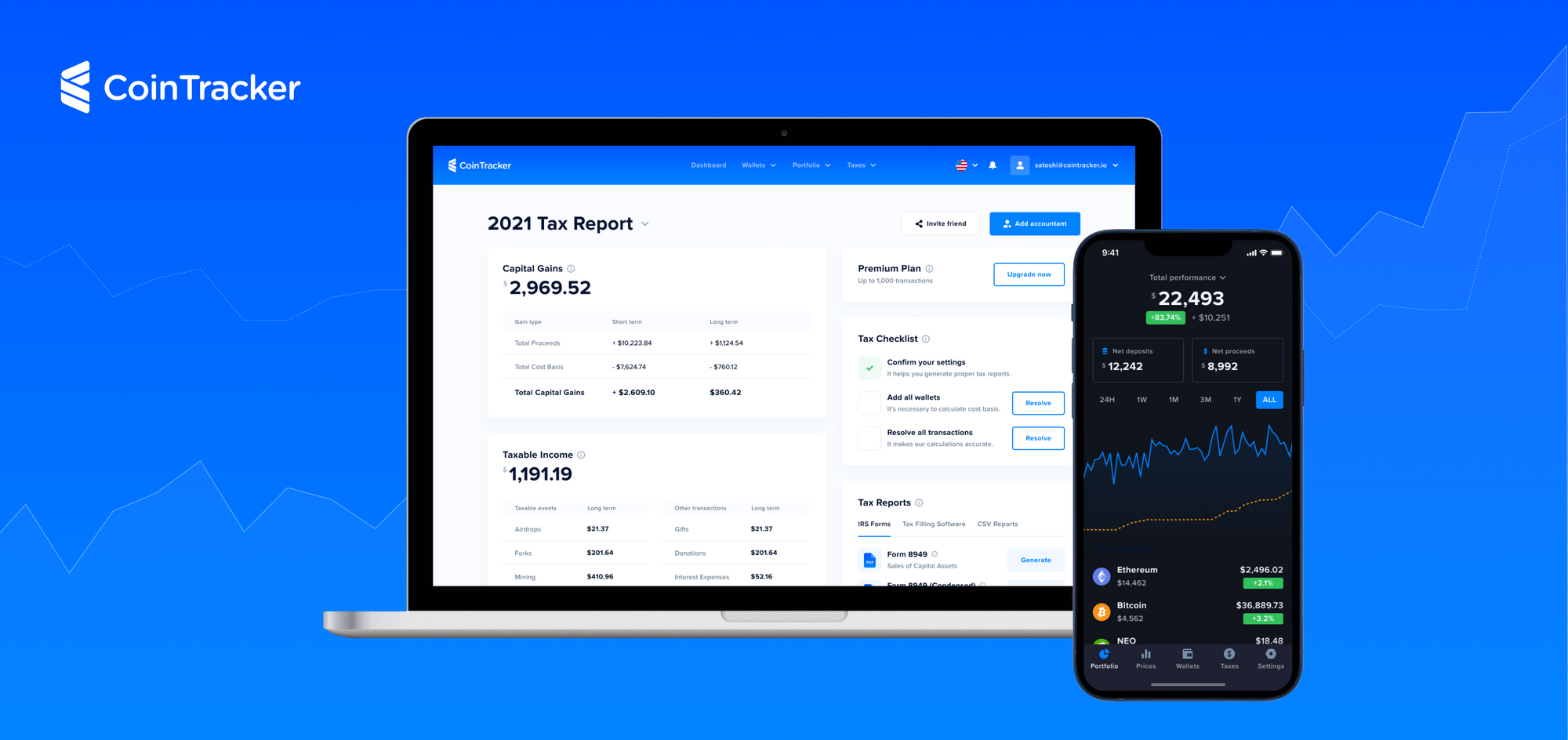
Today, over 3% of the entire global cryptocurrency market is tracked on CoinTracker: we synchronize over $50B in crypto assets on a daily basis. Users have a unified view of their portfolio as they transact with crypto, and importantly accurate and optimized taxes.
The crypto space has grown tremendously over the past few years. There are now over 200M crypto users globally. We are seeing a Cambrian explosion of innovation happening, and consumers and businesses are transacting with crypto across a range of exchanges and wallets. Crypto is used widely and deeply for use cases spanning store of value, payments, DeFi, NFTs, DAOs, and web3 more broadly. And we’re still early.
This level of adoption has led to more confusion and difficulty in tracking crypto assets and complying with tax rules. With the passing of the Infrastructure Bill in the US, there is now increased urgency in enabling the industry to become tax compliant. To ensure continued adoption of crypto it’s imperative to enable every user to comply with taxes.
Our vision is to build that platform that ‘just works’ and enables users to freely use every part of crypto without the burden of manually tracking their assets and complying with taxes. We believe this is critical for the successful adoption of crypto and is core to our mission.
To help realize this vision, we are excited to share that we have raised $100M in Series A funding from a world-class group of partners. Accel, General Catalyst, Initialized Capital, 776 Ventures, and Y Combinator bring a wealth of experience helping build the most iconic tech companies in history. Strategic investments from Coinbase Ventures, Kraken Ventures, and Intuit Ventures are a recognition of our shared mission to help ensure every crypto user can have access to seamless tax compliance and portfolio tracking. Amazing individuals and angel investors including Garry Tan, Alexis Ohanian, Claire Hughes Johnson, Gokul Rajaram, Jeremy Liew, and Alex Bouaziz are all partnering with us. Thank you to an incredible group of partners for supporting CoinTracker on this journey.
Finally, a huge thank you to our incredible team who has worked diligently and passionately to bring CoinTracker alive. You are the backbone of this company.

If you are excited about building foundational cryptocurrency products, we would love for you to consider joining us on the adventure of a lifetime.
- 01:00 am

● Sonovate marks record funding month in December, capping a record-breaking year
● 30,000 people in over 40 countries now paid by businesses receiving Sonovate’s finance and technology services
● Growth attributed to faster adoption by recruitment, labour marketplaces, and consultancy customers
● The pandemic and evolving expectations of work are creating irreversible change in the work preferences and choices of people around the world, prompting businesses to rethink how they recruit, retain and remunerate their workers
Fast-growing enterprise adoption of business finance technology has helped Sonovate to report record funding volume in December 2021, capping an overall record-breaking year for the UK lender.
Sonovate, a fintech lender that provides finance and technology services to businesses that engage contractors and freelancers, funded £90 million to both existing and new customers in December 2021. This contributed to an all-time record quarter for the company, with £240 million in funding deployed. This took Sonovate’s total funding for 2021 to £700m, a 58% increase on 2020’s total funding of £444m.
The volume of funding provided to enterprise* customers over the course of 2021 increased by 144% year-on-year. Enterprise customers now receive approximately one third of Sonovate’s total lending volume. This significant increase in volume provided to enterprise level organisations demonstrates the significant shift in larger companies’ preferences towards contract and freelance labour during the pandemic, and indicates the huge potential market Sonovate stands to serve in the years ahead.
Richard Prime, co-founder & co-CEO of Sonovate, commented:
“The future of work is fast becoming the present-day reality of work. Increasingly we’re seeing large-scale companies adapt how they staff their teams, appreciating the benefits to both businesses and individuals of contract-based and freelance working. The frictionless provision of on-demand funding alleviates an enormous pain point that faces these larger businesses as they adapt to new working practices.”
To date, more than 30,000 freelancers, contractors and gig workers in more than 40 countries have received payments from over 3,000 businesses supported by Sonovate.
Sonovate’s record performance in December was driven in large part by the expanding adoption of its business finance and technology services by consultancies, recruitment agencies and labour marketplaces throughout the world. Over the course of 2021, 20% of all funding was supplied to new customers acquired during the year – more than double the annual volume supplied to new customers in any other year since Sonovate began in 2014. In the last quarter of 2021 alone, Sonovate onboarded 45 new customers.
In September 2021, Sonovate surpassed £2 billion of funding since inception. The second billion pounds of this total was funded four times faster than the time it took Sonovate to fund its first £1 billion. Sonovate envisages continued strong growth in the coming years and expects north of 1.25 billion of total funding in 2022 .








