
Published
- 08:00 am
EquiLend, the global financial technology, data and analytics company for the securities lending, collateral and swaps industries, has launched an environmental, social and governance (ESG) data analysis and validation service for securities finance market participants.
The service enables firms to submit ESG-related data to EquiLend’s specialist data analytics team, who will then perform an independent analysis and validation. The service comes in response to a clear industry need for higher-quality ESG evaluation options, particularly in securities finance. The service builds on EquiLend’s bespoke reporting offering whereby clients partner with EquiLend’s award-winning Data & Analytics division to develop customized performance analytics to best fit their program.
A Risk Management Association (RMA) survey of institutional investors found that nearly two-thirds of respondents either applied ESG principles to their securities lending programs or had plans to do so. But only 20% of respondents reported “regular” interaction between those who manage securities lending and those who manage ESG issues at their firms. The survey findings reveal the need for securities finance to evolve in order to adhere to ESG principles long term.
Brian Lamb, CEO of EquiLend, says: “Responsible investing is here to stay. Institutional investors increasingly expect companies in their portfolios to be good corporate citizens and employ robust corporate governance practices. As ESG factors are more widely assessed by the investment community, participants in the securities finance market must ensure they are utilizing accurate and appropriate ESG data. Our new ESG service will help support the market in achieving their ESG goals.”
Nancy Allen, Head of Data & Analytics at EquiLend, says: “Our new ESG Data Analysis and Validation service addresses a critical need in the market for independent analysis of ESG market intelligence with an emphasis on the unique requirements of the securities finance community.”
- 08:00 am
2021 was a transformative year for Ekata, capped by joining the Mastercard family to accelerate our shared goal of building trust in the digital economy. As consumers moved more of their lives online, online businesses grew to serve them. Over the course of the year, Ekata solutions protected billions of digital interactions from fraud and enabled better, faster and more trustworthy onboarding and transaction experiences for consumers and merchants.
“By any measure, this was an incredible year for us as a business and as a team,” said Rob Eleveld, Ekata’s CEO. “We had the right mix of product, people and strategy to anticipate and navigate the tectonic changes taking place in the global economy. And now, as a part of Mastercard, we have the partnerships and scale to help more businesses know their customers, and, in turn, enable more people to safely interact online.”
Entering the second year of the global pandemic, consumers continued to transform the way they shop, bank and work, pushing many day-to-day transactions online and rapidly expanding the digital economy. While the availability of vaccines allowed in-person interactions to rebound somewhat in the US, Mastercard found that roughly 20% of the peak in the shift to ecommerce has stuck permanently for the retail sector. According to Mastercard SpendingPulse™, which measures overall retail sales across all payment types including cash and check, US ecommerce sales increased 9.4% year-over year in November 2021.
The rapid adoption of online commerce also offered new opportunities and new incentives to fraudsters. For businesses, this only increased the challenge of providing frictionless experiences for consumers while minimizing fraud. As the digital economy continued to grow at a rapid pace in 2021, accurate and seamless digital identity verification became even more critical to businesses.
As a result, we saw unprecedented query volume around the world. Here are a few highlights:
- Powered by machine learning and an unparalleled data set, Ekata protected close to 2.5 billion digital interactions globally against fraudulent activities in 2021.
- Query volume grew 258% in APAC, in part driven by new partnerships, and 35% in LATAM in 2021 over the previous year as reflected in the volume of API calls to the Ekata Identity Engine.
- New partnerships helped drive a 48% increase in partner-related queries from 2020 to 2021.
- Query volume among banking and lending (+55%) and ecommerce (+26%) customers was up significantly.
- In 2021, Ekata also saw great gains in the financial service sector being driven by new partnerships with Equifax and Feedzai.
The introduction of new products and improvements to existing solutions also helped Ekata meet emerging market needs:
- New fraud detection model releases helped customers even better identify genuine versus risky interactions, with a 10% increase in product efficacy across the globe.
- We introduced a new Merchant Onboarding solution to help payment service providers (PSPs) and B2B lenders better onboard the growing number of micro-merchants, sole proprietors, and independent contractors across the globe.
We are grateful to our customers, partners, and employees for their continued commitment to building trust in the digital economy. As we enter 2022, we’re thrilled to accelerate our mission together with Mastercard.
- 01:00 am

Tata Consultancy Services Expands Its Suite of Sustainability Solutions on Microsoft’s Azure IoT Platform to Enable Businesses to Reduce Carbon Footprint and Achieve Sustainability Benchmarks
Tata Consultancy Services now offers its suite of sustainability solutions consisting of TCS Clever Energy™, Intelligent Power Plant (IP2™) and TCS Envirozone™ on Microsoft’s Azure IoT platform to help organisations gain insights into energy usage and reduce waste and emissions to accelerate towards their net-zero goals. The award-winning TCS Clever Energy platform leverages IoT, AI, machine learning and cloud to help organisations understand intricate energy performance factors, enabling them to become more sustainable and empowering leaders to make informed decisions without compromising business needs.
The Clever Energy platform helps reduce energy and utilities consumption and decrease carbon emissions while saving energy costs in commercial and office buildings, retail stores, warehouses, and factories. Developed on Microsoft Azure IoT PaaS services, TCS Clever Energy addresses key functions like heating and cooling, process energy optimisation, demand response, intelligent tariff management, emission management and sustainability compliances with integration to sensors, meters, and assets across the organisation.
TCS Clever Energy is helping a leading North American pharmacy retailer to reduce emissions by 26% across thousands of its stores. At a Middle East-based retailer, TCS Clever Energy is at work across 1,300 stores, driving their CO2 reduction by 25,000 tons. This solution is the foundation on which many TCS customers are driving sustainability goals, scaling quickly to multiple assets and buildings utilising the Azure Cloud platform services. The other two sustainability solutions available on Azure are TCS IP2 and TCS Envirozone. IP2 combines AI, IoT, and digital twin technologies to support critical power plants to enhance reliability, cut emissions and reduce operating costs by 2-3%.
TCS Envirozone tracks SDG activities helping organisations adopt carbon-neutral strategies by mitigating risks around supplier-sourcing, operations, and upstream sustainability for a sustainable supply chain. The suite of sustainability offerings is underpinned by TCS’ extensive sustainability-aligned data offering suite including Dataom™ for Sustainability, Daezmo™ sustainability analytics, and the TCS ESG integration solution.
“Our sustainability solutions harness the power of IoT, data and analytics to enable companies to achieve their sustainability goals and lead with purpose—without making significant new capital investments,” said Regu Ayyaswamy, Global Head, IoT and Digital Engineering, TCS. “We are pleased to offer these solutions on Microsoft Azure, to further help our customers with actionable insights on energy demand and consumption, carbon emissions, and asset energy performance.”
“TCS’ extensive portfolio of sustainability solutions, built with Microsoft technology, provides a comprehensive approach for businesses to embrace sustainability and deliver on their commitments. Through digital twins, predictive models, and other innovative IoT deployments, we’re helping organizations record, report, and reduce their end-to-end environmental footprint," said Lakecia Gunter, Vice President and General Manager, IoT Global Channel Sales, Microsoft.
TCS’ Microsoft Business Unit works with customers worldwide to accelerate their multi-horizon cloud transformation journeys. TCS has completed over 1,000 successful Azure engagements for more than 225 global customers. TCS recently won the 2021 Microsoft Partner of the Year Award for Azure Intelligent Cloud in France, the Dynamics 365 Field Service in the U.S. Additionally, it is a designated Microsoft Azure Expert Managed Service Partner, recognising TCS’ expertise in delivering the highest quality of service on Azure. Its over 50,000 professionals deliver industry-focused solutions—all powered by the Microsoft Cloud.
To learn more about the TCS Microsoft Business Unit, visit tcs.com/microsoft-business-unit.
- 07:00 am
BVNK Clients Can Securely Deploy Crypto for Yield on Open Terms without Leaving Custody, by integrating ClearLoop, Copper’s Unique Instant Settlement Trading Network
From today, BVNK, the digital asset-powered banking platform for global businesses, will offer its clients the ability to allocate cryptocurrencies to earn yield, benefiting from the underlying technology of ClearLoop, Copper’s unique instant settlement trading network.
Businesses worldwide are facing growing demand from customers, prospects and partners to incorporate digital assets into their treasury functions. With traditional finance providers unable to accommodate these requests, BVNK launched in October 2021 to address this gap in the banking market. Through the BVNK banking platform, BVNK clients can bridge between fiat currencies and digital assets to manage payments, yield, trading and custody.
With deposits starting at a minimum of US$50,000, BVNK’s flagship Yield service enables businesses to generate returns that typically range between 4% and 8% APY in USD Coin (USDC) and Tether (USDT). BVNK Yield is delivered via the largest and best-positioned institutional lending desks in the industry and entails no direct exposure to the volatility of cryptocurrency markets.
Integrating Copper’s ClearLoop technology into BVNK Yield means that BVNK clients can deploy digital assets to lending counterparties to earn returns without them ever leaving the protection of Copper’s custody. This not only diminishes counterparty and settlement risk but also allows for instant completion of transactions and access to funds.
Jesse Hemson-Struthers, BVNK’s CEO, said:
“We launched BVNK to address a gap in the market and deliver digital-asset powered banking services to businesses. Thanks to Copper, BVNK can deliver something new and unique - secure access to institutional crypto lending for businesses to earn yield without digital assets ever leaving secure custody.”
Alex Ryvkin, Chief Product Officer, Copper, said:
“We’re delighted that BVNK has chosen the speed and security of our ClearLoop technology to launch this new product. We look forward to future collaboration as they grow.”
Copper’s custody services are audited and certified annually to the ISO 27001 international security standard. To give client’s further assurance, Copper has a Crime insurance policy that is brokered by Aon and supported by a panel of S&P A+ rated insurers in the Lloyd’s of London insurance market. Copper is focused on delivering maximum security without compromising on control.
- 07:00 am

New paper advocates for closer public-private collaboration to advance exploration of a digital currency in the UK, before a real-world pilot of ‘digital pound’ (dSterling)
New paper advocates for closer public-private collaboration to advance exploration of a digital currency in the UK, before a real-world pilot of ‘digital pound’ (dSterling)
Project New Era, a ground-breaking initiative in the UK led by The Payments Association (formerly The Emerging Payments Association (EPA)), paywith.glass and other private industry stakeholders, supported by Boston Consulting Group (BCG) as its consulting partner, today announces the publication of the Green Paper report ‘A New Era for Money’. The paper advocates for a first of its kind collaboration between central banks, regulators, commercial banks and other financial institutions (FIs) towards the exploration of a retail Central Bank Digital Currency (CBDC) in the UK. The Green Paper will be followed by real-world pilots to address open design questions and mitigate risks. The pilots will generate working data and feedback that central banks and policymakers can use to inform open design questions and enable relevant authorities to make policy decisions.
CBDCs have emerged in recent years in response to the decline in cash payments, the search for payment efficiencies and the emergence of private digital currencies, such as cryptocurrencies and stablecoins. Most central banks are currently researching CBDCs with The Bahamas, Cambodia and Nigeria already launching full implementations. China is expanding its pilot of a ‘Digital Yuan’ to tens of millions of users and India has recently announced a Digital Rupee, expected by 2023.
The primary benefits of CBDCs include near-instant settlement, the potential for reduced transaction costs, enhanced security and programmable payments - a new breed of automated payment. Secondary benefits like financial inclusion vary in materiality by country; while monetary policy implementation and countering the threat of stablecoins with a CBDC are yet to be established. The report suggests there is potential for a CBDC to power an alternative, regulated digital currency ecosystem that could otherwise be filled by privately issued alternatives such as stablecoins.
“Much has been written about the challenges posed by a retail CBDC, including the macroeconomic risks like bank disintermediation and the role of commercial banks and other FIs in the new ecosystem,” comments Kunal Jhanji, Managing Director and Partner at BCG. “These challenges require the public and private sectors to come together and create an inclusive framework for new infrastructure, legislation and policy that resolves open questions and responsibly unlocks the transformative benefits of digital money for the UK.”
Other important considerations from the research, include:
- Cryptocurrency and stablecoin exchange volume growth have both been >1000% across 2020-21, further indicating the potential for CBDCs .
- Central bank CBDC research and broader topic interest is intensifying in response: ~90 central banks analysed are publicly exploring aCBDC, with a focus on retail applications and three full launches.
- ~70% of these central banks remain in a research phase, with limited public-private initiatives and experimentation.
- Central banks can bring the industry together with an inclusive roadmap for public-private collaboration to address open questions, risks and intended roles left to commercial banks and other financial institutions.
To facilitate this, Project New Era aims to form a private consortium in the UK, (‘Digital FMI Consortium’), with central banks, regulators, and government kept informed of progress. The consortium will issue dSterling, a digital settlement asset similar to a CBDC, to drive the pilot. The pilot will focus on core design issues, including the role of commercial bank liability in a CBDC environment, withdrawal limits and other measures as mitigations to deposit disintermediation and other risks identified.
The focus of the Consortium will be to undertake a set of pilots to enable real-world testing of the initial use cases identified – including:
- Retail payments: Delivering benefits of faster payment settlement and potential to reduce transaction costs for merchants. Programmability enabling innovative use cases like conditional payments, and near-instant pay-per-use micropayments.
- Cross-border transactions: Enabling near-instant settlement, reduced transaction costs, and enhanced payment traceability compared with existing solutions. Exploring interoperability requirements in order to future-proof the digital financial market infrastructure (Digital FMI)
- Tokenisation-as-a-Service: Providing infrastructure for future use cases that enables private organisations on the Digital FMI to tokenise and transact assets for use in closed ecosystems with customers or suppliers. The assets can be financial, utility-based, or physical.
- Servicing Payment Institutions (PIs) and Electronic Money Issuers (EMIs): Enabling PIs and EMIs to use the dSterling as a secure, liquid asset with regulatory acceptance for safeguarding. The asset also enables access to an alternative payment rail, given challenges in the industry around non-bank access to banking.
Speaking on the launch of the Green Paper, Tony Craddock, Director General of The Payments Association, says:
“The widespread adoption of CBDCs could be as important to the 21st century as the end of the gold standard was to the 20th. Because of the UK’s long-standing position at the forefront of global financial services we have an opportunity to take a leading role in the next generation of financial services. Our next step will be to build a larger stakeholder network from the public and private sector that will be key in building the pilot project.”
Paul Sisnett, Chief Executive Officer at paywith.glass, adds:
“Implementing an entirely new form of digital money is a significant undertaking. It is therefore vital that government bodies, policymakers, the private sector and ultimately the consumers who will be using the currency, have high quality data on which to base their decisions. Through unprecedented collaboration with the most innovative financial services organisations, this is the only initiative of its kind that will generate those data points.”
The Green Paper is available for download here: https://thepaymentsassociation.org/consultations/a-new-era-for-money/?utm_source=Media&utm_medium=Press+release&utm_campaign=Green+Paper+launch
To register for The Payments Association’s Insights webinar on 17th February, please visit: https://epa.glueup.com/event/47791/register/
For more information, visit: https://thepaymentsassociation.org/
- 09:00 am

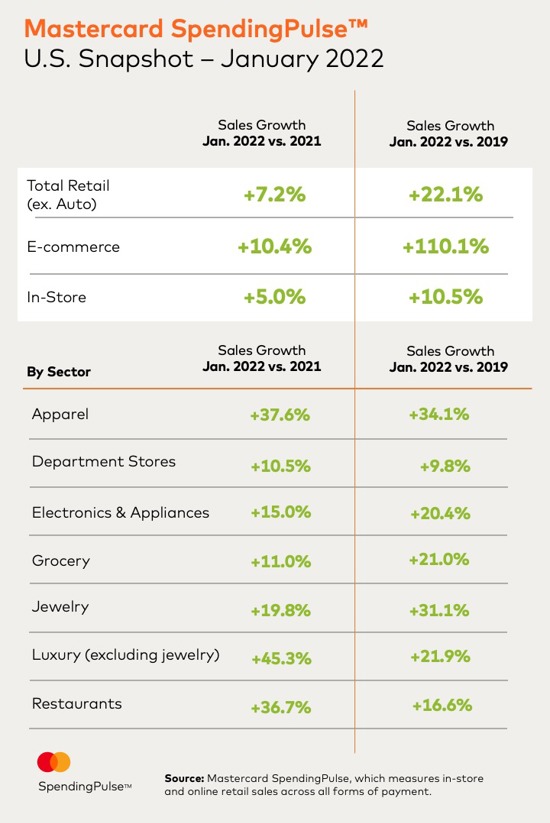
2022 kicked off with gains across nearly all retail sectors, according to Mastercard SpendingPulseTM, which measures in-store and online retail sales across all forms of payment. This January, U.S. retail sales excluding auto increased 7.2% year-over-year (YOY), with online sales growing 10.4% compared to January 2021. Despite the shadow of Omicron and elevated inflation, consumer spending was buoyed by pent-up savings, wage growth and the continued re-opening of the “experience economy.” Beneficiaries included Department Stores, Apparel and Luxury, which all saw double-digit growth.
Key retail trends were a continuation from the strong holiday season, including:
- The shift back to services: The pandemic arrested a decades-long trend of more spending on services vs goods. Since the middle of last year, this tide has begun to shift back to services – or experiences – as consumers resume in-person activities. According to Mastercard SpendingPulse, Restaurant sales grew 36.7% YOY and 16.6% compared to pre-pandemic levels.
- Digital demand: E-commerce sales growth shows no signs of stopping, with double-digit increases in January even compared to the strong base in 2021. Compared to pre-pandemic levels, e-commerce sales were up 110.1%, underscoring the sustained and significant nature of the shift to digital.
- New year, new looks: Apparel sales were up 37.6% in January YOY, the strongest growth rate for January in SpendingPulse history. The Apparel sector has experienced positive growth for 11 consecutive months as consumers refresh wardrobes and dress to impress for gatherings and events taking place in 2022. Department Stores have similarly gained from resurgent spending, with January sales up 10.5% YOY and 9.8% vs. pre-pandemic levels.
- Luxe for loved ones: Luxury (+45.3% YOY) and Jewelry (+19.8% YOY) sales continued to outperform in January ahead of Valentine’s Day.
“Coming on the heels of the holidays, January typically marks a month of returns and exchanges. However, the strong growth across sectors reflects the optimism and eagerness for the year ahead,” said Steve Sadove, senior advisor for Mastercard and former CEO and Chairman of Saks Incorporated. “With nearly all sectors up, we see consumers returning to their shopping habits with a continued emphasis on digital.”
- 04:00 am
The ‘OSR: Home Cyber Plus’ policy includes an emergency cyber response helpline for UK households and a 12-month subscription to Avast Premium Security for up to 10 devices
Avast, a global leader in digital security and privacy, and Optimum Speciality Risks (OSR), a leading cyber insurance provider, have launched a brand new multi-generational cyber safety policy to protect UK households from cybercrime. The service, OSR: Home Cyber Plus, provides protection for digital and physical assets, data loss, breaches of privacy, identity theft and wellbeing for victims of online harm and malicious content. The policy includes a 12-month subscription to Avast Premium Security for up to 10 devices, and an emergency response helpline to contact dedicated cyber security experts if a security issue occurs.
According to Action Fraud’s 2020/2021 report, over 31,000 cybercrime cases were submitted with reported losses reaching almost £10m, a 78% increase year on year. Throughout 2021, Avast Threat Labs team recorded spikes in ransomware, information stealers and tech support scams, and expects cybercriminals to make advancements in 2022 to ensure the effectiveness of their attacks against businesses and consumers.
“When people are affected by cybercrime it can be a traumatic and frightening time, however most people would not know who to call for help if an incident happens,” said Sean Yeo, Managing Director at OSR. “With cybersecurity incidents unfortunately increasing all the time, it was important for us as a cyber insurance specialist to offer a service that provides customers with access to an emergency cyber response team to assist in crisis situations. Combined with a leading insurance package and comprehensive security and privacy protection from Avast, this will give peace of mind to all generations and will help them to feel confident and in control online.”
The OSR: Home Cyber Plus policy includes the following cover as standard:
● Avast Premium Security: antivirus and advanced online security for up to 10 devices, providing protection from device vulnerabilities, ransomware, fake websites, phishing scams, web spies and more
● Digital Asset Protection: cover for digital data restoration, digital device replacement, loss of access to digital accounts and online extortion
● Digital Theft Protection: cover for digital deception loss, such as instances of fraud, digital theft, such as the transfer of funds following unauthorised access to a bank account, and identity recovery
● Digital Wellbeing: cover for reputational harm and emotional distress caused by malicious communications, and the removal of malicious content published online or on social media platforms
“Our goal is to build technologies and offer services that help people to get the most out of the digital world,” said Patrick McKay, Partner, Avast. “Avast exists to protect people’s digital freedom, a value also shared by OSR, which along with a deep understanding of the customer were significant contributors in the creation of the Home Cyber Plus policy. We believe it’ll help multi-generations families and households in the UK feel safer, freer and more secure online.”
The OSR: Home Cyber Plus policy is currently available in the UK through OSR partner insurance brokers, with two levels of cover offered to potential policyholders. For further details on how to obtain a quote, please get in contact at homesupport@optimumsr.co.uk.
- 01:00 am

Appointment highlights company’s expanding global footprint
Provenir, a global leader in AI-powered risk decisioning software, today announced Lewis Horder has been appointed Sales Executive to serve the growing number of organizations seeking AI-powered risk decisioning solutions. Lewis will oversee sales operations, business development and go-to-market strategies for Benelux.
Horder brings more than 15 years’ experience in financial services. Prior to joining Provenir, Horder served as a Sales Director for EMEA at FIS. He also held various sales management roles at WorldPay UK, developing marketing strategies and identifying and building technology partnerships to reach new customers.
“Lewis has a deep understanding of the financial services market in Benelux and strong relationships having served as a trusted advisor to many organizations,” said Frode Berg, Provenir’s Managing Director of EMEA. “Similar to other areas in the region, the need to improve the customer experience is driving innovative fintechs and banks in Benelux to seek out real-time decisioning solutions. Lewis will lead our efforts to address the growing demand for Provenir’s AI-Powered Risk Decisioning Platform.”
Provenir’s AI-powered risk decisioning software is the industry’s first, true risk-decisioning ecosystem for fintechs and financial services providers. It brings together a global data marketplace, powerful AI, and world-class decisioning into one single platform so organizations can provide the real-time decisioning today’s consumers’ demand.

Lohrasp Seify
Head of Data at Reach
Data in its many forms, schemas and sources is getting more complex to grapple with, and volumes are skyrocketing as more touchpoints come online. see more
- 04:00 am

Refinitiv AI Alerts powered by ModuleQ, an artificial intelligence-driven personalized assistant, is designed to provide breaking news and actionable insights to investment bankers and analysts, asset and wealth managers, financial advisors, and the broader financial services community.
Refinitiv, an LSEG business, today announced the launch of Refinitiv AI Alerts, a market-data powered intelligent assistant available in Microsoft Teams.
Refinitiv AI Alerts seeks to provide personalized, timely and actionable market insights for financial professionals, in collaboration with ModuleQ, a leader in human-centered artificial intelligence. User-specific content suggestions and alerts are driven by ModuleQ’s proprietary algorithms and Refinitiv’s Intelligent Tagging service, and are linked back to Refinitiv Eikon and Workspace for deeper analysis and action.
Refinitiv AI Alerts represents the latest solution to be launched as part of Refinitiv's collaboration with Microsoft, announced in 2020 for financial services.
Andrea Remyn Stone, Group Head, Data & Analytics, LSEG, said:
“Microsoft Teams has become an indispensable platform for professionals across financial services, with institutions accelerating their adoption, and increasingly integrating critical data and tools into the platform to simplify the workflow and user experience. Refinitiv AI Alerts brings critical content and insights to Refinitiv’s customer base within this platform, with the goal of allowing users to discover and act on timely information across Teams, Refinitiv solutions and Microsoft 365 seamlessly.”
Bill Borden, Corporate VP of Worldwide Financial Services at Microsoft, said:
“As Microsoft Teams becomes increasingly important as a platform for financial services, we welcome partner solutions such as Refinitiv AI Alerts which combine the best of market-leading data, AI, and workflow to provide our mutual customers with even more value from our relationships. We look forward to continuing to build on our partnership with Refinitiv to bring additional value-added solutions to the industry.”
David Brunner, CEO of ModuleQ, said:
“Since the start of the COVID-19 pandemic, two key trends have accelerated in the financial services industry – more data available than ever before for decision makers, and an explosion in digital collaboration tools. While these solutions were intended to increase productivity and communication, they have, in reality, heightened the digital noise that busy client-facing financial services professionals filter through and, in many cases, adversely impacted their ability to spend quality time building relationships. According to a report by McKinsey, employees spend 9.3 hours a week on average searching for information. Refinitiv AI Alerts sifts through the multiple information sources these professionals need, and brings them just the key actionable intelligence they need, at the time they need it, within the digital collaboration tools they are using. Users spend less time searching and more time using the information to inform their decisions and relationships.”
Refinitiv AI Alerts requests user permission to automatically learn the user’s individual priorities from their Microsoft 365 interactions, keeps that information private for the user, and recommends suggested content based on upcoming meetings and frequent email conversations. The AI also learns quickly which information the professional finds useful, allowing it to become even more accurate and relevant. For research analysts and bankers, wealth managers, enterprise sales professionals and other financial services users, this solution may provide a competitive edge in their research and customer interactions, in a seamless and simple way. Human-centered AI, and a deployment strategy within a firm’s own environment, helps to ensure a heightened level of privacy and security protection.
Find out more about Refinitiv AI Alerts.








