Published
- 02:00 am
Latest release features tiered storage, advanced streaming capabilities and expanded SQL support for enterprises to build real-time applications
Hazelcast Inc. is raising the bar for creating real-time advantages with the latest release of its run anywhere, real-time data platform. The Hazelcast Platform enables enterprises to build business applications that take automated, immediate action on data, without the wait times associated with database writes and human intervention. The new release boosts the analytical capabilities of a real-time system by enabling greater situational context to event and streaming data as it is created, yielding more meaningful insights. The new release also adds extended query capabilities and higher availability via less maintenance downtime.
Announced in the summer of 2021, the Hazelcast Platform acts as a single data layer and access point for applications to call upon and execute transactional, analytical and operational workloads. With the integration of the real-time stream processing capabilities, the Hazelcast real-time data platform is the only data platform that can begin processing the data while enriching it with the context of stored data before it is written. Processing and enriching data in motion saves application developers valuable time that can translate to new revenue streams or reduced risk exposure.
Greater Insights on Real-Time Data
Combining streaming with an in-memory data store allows enterprises to enrich streaming data as it arrives with historical context from the data store. The addition of tiered storage to the Hazelcast Platform eliminates the complexity of adding more third-party databases to IT infrastructures by automatically managing the balance between the tiers of fast data and large-scale data. Tiered storage also allows customers to easily enrich real-time data with larger sets of historical reference data stored on disk/SSDs to create the required context. The result is that enterprises can now realize even deeper insights or actions as the larger dataset improves the overall contextual quality of the real-time analysis.
“When Hazelcast announced its platform last year, the ability to merge real-time data with historical context opened new possibilities to deliver the right offer or insights to the end-user at the right time,” said Manish Devgan, chief product officer at Hazelcast. “By being able to work with datasets at scale within the same data platform, businesses can now enable even better outcomes in a much shorter window of time-to-market.”
Simplifying Advanced Analytics
Hazelcast SQL support was introduced in 2020 and its expansion to streaming provides business analysts, data engineers and data scientists a familiar language to create data pipelines for building real-time applications. The latest release includes streaming aggregation over fixed and hopping windows, additional SQL expressions, improved JOIN support and improved performance. Complementing support for ANSI SQL, Hazelcast added SQL support for JSON so that enterprises can store and query this popular data format for adding real-time processing capabilities to critical functions.
Hazelcast is a member of the Streaming SQL Expert Group within the International Committee for Information Technology Standards (INCITS) to help steer the standardization and innovation on streaming SQL.
The Real-Time Economy
Hazelcast designed its real-time data platform with the goal of eliminating waiting in today’s digital world. Thanks to the significant architectural changes inspired by the current wave of digital transformation, including advances in cloud computing and AI/ML, many leading enterprises are on the cusp of offering products and services that deliver on the promise of the real-time economy.
To truly enable the real-time economy, one where actions are instantaneously taken and insights are immediately actionable, enterprises must move beyond batch processing and into a state of continuous processing of data as it’s originated. To keep pace with this new state of operations, enterprises require a real-time data platform that incorporates streaming and in-memory latencies, to operate anywhere and pull data from any source, including databases, data lakes and data warehouses.
Availability
Hazelcast Platform 5.1 is generally available today via Hazelcast Cloud or as software to be deployed on-premises or within customers’ Amazon Web Services (AWS), Microsoft Azure or Google Cloud Platform (GCP) cloud environments. The tiered storage feature is currently in beta and will be generally available for production use in an upcoming version of the Hazelcast Platform.
For more information on the Hazelcast Platform, please visit: https://hazelcast.com/products/hazelcast-platform/
Industry Voices
“As a leading bank in the Nordics we work hard to offer the best to our customers. The Hazelcast Platform gives our customers an augmented user experience when processing their financial transactions, like payments and transfers. Adding real-time capabilities to our infrastructure means that we can always offer services to our customers whenever they want them and be able to anticipate their needs.”
- A European Bank
“For several years, Sorint.lab and Hazelcast have helped our joint customers leverage the benefits of in-memory data and in-memory computing to drive increased value for their businesses. As companies seek to take the next step in building and deploying real-time applications, the Hazelcast Platform is the only solution that can easily combine the ability to process and enrich real-time streams with the historical context, speed and low latency of an in-memory data store. Sorint looks forward to working with our combined customer base and helping them achieve the shortest time-to-value with the Hazelcast Platform.”
- Luca Pedrazzini, CEO for Sorint.lab S.p.A.
“The distributed edge is an emerging area that needs solutions to reduce latency and improve the processing of data at the edge of the network. The Hazelcast Platform lets developers create a data grid that combines in-memory computing and real-time stream processing to support ultra-fast applications in a distributed fashion.”
- Mary Jander, Senior Analyst at Futuriom

Michael Moran
Senior Currency Strategist at ACY
DXY Climbs; Oil Prices Surge; Stocks, Bond Yields and Risk Appetite Slump see more
- 03:00 am

Survey explores consumer attitudes towards financial advice, reveals generational trends
intelliflo, the leading cloud-based technology platform for financial advisors, today shared results from its recent survey conducted online by The Harris Poll. More than 2,000 U.S. adults were surveyed around their attitudes and behaviors related to financial advice.
Key findings from the survey include:
- 71% of Gen Z (ages 18-25) and 72% of Millennials (ages 26-41) strongly or somewhat agree that there are financial topics they want advice on but aren’t sure how to get it.
- Only about 1 in 3 Americans (32%) turn to registered financial advisors for financial advice, while more than half (52%) turn to family and more than 2 in 5 (41%) turn to digital sources.
- 44% of Gen Z, 49% of Millennials and 47% of Gen Xers (ages 42-57) turn to digital sources for financial advice, including social media platforms (like Instagram or TikTok – 15%), blogs/vlogs (7%), podcasts (10%), and other online sources (27%).
- The top barrier preventing Americans from seeking financial advice from a registered financial advisor when they want/need it is the belief that they don’t think they have enough money to hire one (35%).
- Roughly two thirds of Americans (68%) say a personalized financial plan based on their goals would be an extremely or very important factor if they were considering a financial advisor.
“As evidenced by our recent survey, there is a significant need and desire for financial advice across the board, but many simply don’t know how to access it,” said Jennifer Valdez, president of Americas, intelliflo. “Technology can play a critical role in helping financial advisors to efficiently serve these consumers. This need for more modern, digital software is why intelliflo was formed one year ago, with the mission of widening access to financial advice.”
On March 1, 2021, intelliflo combined five leading software businesses under one brand to offer its customers around the world a broader range of end-to-end solutions that span the financial advisory lifecycle. The platform’s scalable, API-driven architecture drives new levels of flexibility, efficiency, and personalization within financial advice, including financial planning, practice management, digital account opening, reporting, indexing, trading and rebalancing portfolios. intelliflo supports over 30,000 financial advisors worldwide across 2,500 companies, representing more than three million end-investors and over $1 trillion in assets serviced.
Valdez continued, “We introduced intelliflo to give advisors the robust software and digital tools they need to efficiently serve investors and provide the communication, collaboration and self-service tools modern consumers expect. intelliflo remains committed to enabling advisors to more effectively support investors across all demographics and sophistication levels, ultimately improving their financial health.”
- 02:00 am

The Utah Jazz and CoinZoom, a U.S. based cryptocurrency exchange and leading fintech company, today announced a partnership naming CoinZoom as the Official Cryptocurrency platform and NFT Marketplace for the Utah Jazz. With CoinZoom as the exclusive provider, the Jazz will list all its NFTs on the CoinZoom NFT marketplace.
The Utah Jazz and CoinZoom partnership will enable Jazz fans to scan a QR code at their Vivint Arena seats and get the latest Jazz NFT drops with their CoinZoom app. Jazz fans will be able to purchase the latest Jazz NFTs with a myriad of payment options, including credit cards, wires, ACH, direct deposits, and more than 40 other cryptocurrencies. No need for an external wallet and no “gas” fees applied to make a purchase. Every seat in the arena will have a QR code later this season for easy access to Jazz NFTs, the CoinZoom app, and many other innovative features.
The CoinZoom NFT Marketplace provides a safe, secure venue for fans to purchase Jazz NFTs and a free wallet to store them. Fans can bid, buy, and check out easily. No knowledge of crypto or crypto holdings is required.
In addition to being the exclusive NFT Marketplace and Cryptocurrency platform, CoinZoom will also receive prominent signage in the arena, featured in the Jazz app, social media, merchandise, trivia contests, crypto giveaways, and radio spots.
“The partnership with CoinZoom gives us the ideal platform to expand our NFT offerings and connect with a larger community of Jazz enthusiasts in a new way,” said Jim Olson, Utah Jazz president. “Through technology, we can bring more innovative and creative experiences to our fan base in a fun environment. With CoinZoom, we will be excited to deliver our next phase of NFT collectibles to the public later this season.”
“We’re thrilled to partner with the Jazz to bring the complete NFT and crypto experience to their fanbase,” said CoinZoom CEO, Todd Crosland. “The franchise’s innovative spirit aligns well with our goal of furthering the adoption and ease of use of crypto. We believe that NFTs will play a major role in growing and engaging the Jazz global fan base, and the CoinZoom NFT Platform will provide a one-of-a kind buying experience as well as a safe and secure place for the Jazz international fan base to access exclusive collectables from the franchise. We think the fans are really going to enjoy the user-friendly experience we’ve created in partnership with the Jazz.”
Last September, the Jazz launched a groundbreaking JAZZXR program that combined the franchise’s first-ever digitally designed NFTs with access to a unique live experience with Jazz owner Ryan Smith in a virtual locker room. This was the first drop in a series of NFT collectibles from the Jazz, who are among a select group of NBA teams to mint and release their own NFTs. A microsite for JAZZXR has been created at https://nba.com/jazz/nft.
- 02:00 am
- Informa’s 2022 FinovateEurope Conference returns to the InterContinental O2 Hotel in London on March 22-23, 2022, for its first in-person, on-site event in two years. More than 1,000 senior attendees will learn from 70+ insightful keynote speakers, experience live product demos of innovative fintech solutions, and receive expert advice from key influencers. FinovateEurope is also providing virtual access to as much of the conference as possible for those joining online from anywhere in the world.
FinovateEurope’s digital kick-off to the main conference is March 15, 2022, with Master Keynote Speaker Zennon Kapron, founder and director of Kapronasia, discussing “The Trends and Opportunities Shaping Fintech in Asia,” followed by a fireside chat, digital demos and a power panel of speakers debating “The Future of Fintech – Top Trends for 2022 & Beyond.”
A week later, on March 22-23, FinovateEurope’s main conference begins with sessions devoted to fintech trends in 2022, transformations expected in the financial services sector, and ideas on how to accelerate innovation and unlock business value. Other topics include “How to use data analytics and AI to create human-centric financial products,” “How Covid has transformed global e-commerce and omnichannel payment,” “Decentralized finance, crypto assets, central bank digital currencies, non-fungible tokens” and “How smart players are harnessing AI to solve real pain points for their customers and their business.”
FinovateEurope continues to be best-in-class for networking, connecting and collaboration; whether it’s at this year’s in-person conference or via Finovate’s unique, interactive digital platform. Connect directly to innovators behind some of the most exciting tech in finance at FinovateEurope. To register, stay up to date on the expanding speaker list and acquire additional information, visit https://www.nnw.fm/FinovateEurope2022.
- 06:00 am

Cyber is one of the top risks facing the financial services industry, but organisations are still working out the best way to quantify it, according to a report by ORX, the world’s largest association of operational risk professionals.
30 major global banks and insurers took part in the latest ORX Cyber study: ‘Cyber risk management: The journey to cyber risk quantification’, which provides insights into current practice, challenges and the future direction of cyber risk quantification.
The research was carried out as part of the ORX Cyber service and is based on data collected from a survey of ORX member firms and subsequent discussion groups.
The top three challenges to risk quantification highlighted by respondents were:
1) Data issues
Traditional data-driven models often require specific data sets that are challenging to obtain or may not even exist. This can result in a more subjective approach based on subject matter expert input.
2) Scarcity of skills
67% of firms are relying on on-the-job training, with the support of external online training courses. Additional technical skills that could be gained externally are often too scarce and/or expensive. 13% of participant firms have no specific training at all in place.
Of the 83% of organisations that have made a notable investment in cyber risk quantification, there is a clear consensus (67%) that the most significant benefits are realised when investment is made in specialised skills or in upskilling existing staff members.
3) High cost/cost inefficiency
Enhancing quantification approaches and outcomes requires investment in skills, data and tools. This in turn requires buy-in and support from senior management. Amidst a lack of consenus on best practice and questions over whether traditional risk quantification techniques are adequate, a lack of commitment to investment can be a real barrier to effective cyber risk quantification.
The approaches taken by organisations to cyber risk quantification are driven by their objectives, that are influenced by these challenges, 17% of firms do not have true risk quantification in place, focusing rather on more qualitative approaches to assist with risk management.
A further 37% typically use the same approach for modelling cyber risk as the one that is used for other operational risks within their organisation, typically with a focus on capital requirement calculations.
Only just over a quarter (27%) of firms use factor/exposure-based models (for example the FAIR/FAIR-CAM framework, or the XOI approach). These models focus on underlying objective risk drivers in preference to historic or subjective data sets. These are considered not only more readily available but also more reliable.
Despite there currently being no one best way to approach cyber risk quantification, there is widespread acknowledgement of its crucial role in understanding cyber risk exposure to support many strategic and operational objectives across organisations.
Steve Bishop, director of research & Information at ORX and co-author of the report said: “Cyber quantification is a real challenge. Risk experts are struggling to gain sufficient investment to develop their methods, particularly given the lack of industry consensus on best practice and a shortage of data and skills.
“We know that cyber continues to be a significant risk. Whilst it is clear there is no “one size fits all” solution, industry peers are keen to work together through ORX Cyber to develop their practice, including the use of internal and external data.”
The report recommends 10 ways to enhance cyber risk quantification in your organisation.
· Clearly state your objectives before you start
· Know what resources you have available to you and their skill sets
· Be realistic regarding your available input data and know your data sources
· Know what value tools and technology can add and use them
· Leverage knowledge or tools that are already available in your organisation
· Structure your teams to ensure collaboration and that the right people are assigned to the right roles
· Invest in skills through upskilling and hiring
· Know how your stakeholders define success and value to ensure investment can be secured
· Think to the future; know your long-term objectives, ensure your approach is scalable and stay up to date with industry trends
· Ensure you select an approach that is both
- Product Reviews
- 02.03.2022 06:54 am
- IXOPAY - Scale Your Payments Globally
Payments orchestration platforms (POPs), or payments orchestration level (POL), are innovational digital payment tools, which simplify the integration processes between a company’s website and payment service providers (PSPs). In other words, payments orchestration platforms allow one website to connect multiple payment processors at the same time, thus leading to increased geographical coverage and better customer experience.
As a payment orchestration layer acts as a core of a payment system, we are going to analyze the working process of payment orchestration platforms using IXOPAY as an example. We will have a closer look at features of this Platform-as-a-Service (PaaS), the architecture of the system, and how payment orchestration platforms can benefit e-commerce.
What is payment orchestration exactly?
A payment orchestration platform is a software level that combines and manages several payment processors and multiple service providers, thus automating the whole online payment process. The automation includes payment authorization, transaction routing, and settlements. By consolidating payment service providers and payment methods, such as Visa, PayPal, Mastercard, and American Express, the payment orchestration platform helps e-commerce merchants with avoiding numerous accounts.
As a result, there is a fully integrated website, convenient to use, which lets businesses manage all PSPs within a single web page. Moreover, thanks to payment orchestration platforms, executives deal with a fewer amount of third-party service providers, and the amount of failed transactions significantly fall.
The working process of payments orchestration
As payment orchestration chooses the best route to complete the payment processes for you, the system avoids potential failures and reduces the number of false online payment failure messages. According to the data provided by Finance Magnets, online merchants lose 62% of customers due to failed transactions. By adopting payments orchestration platforms, e-commerce businesses will consequently increase their sales and, of course, customer satisfaction levels across the globe.
Although some POPs may cover different payment adapters, e-commerce plugins, and risk management adapters, there is a similar payment pattern. Let's see how payments orchestration works:
- On your checkout page, the consumer begins the payment and selects a payment method from your list.
- Data from the cardholder goes to the payment gateway.
- In addition, the payment gateway provides the payment data to the acquiring bank and processor.
- The purchasing and issuing banks then interact to approve the payment.
- The acquirer then sends the authorized or denied payment notification to the payment gateway, and eventually to the merchant. To reduce misleading payment failure alerts, payments orchestration automatically routes transactions to another payment processor.
- The payment will be authorized if the other payment processor works.
In addition to payments, the payments orchestration platform supports payment settlements, billing, and payment reporting.
IXOPAY as a payments orchestration platform
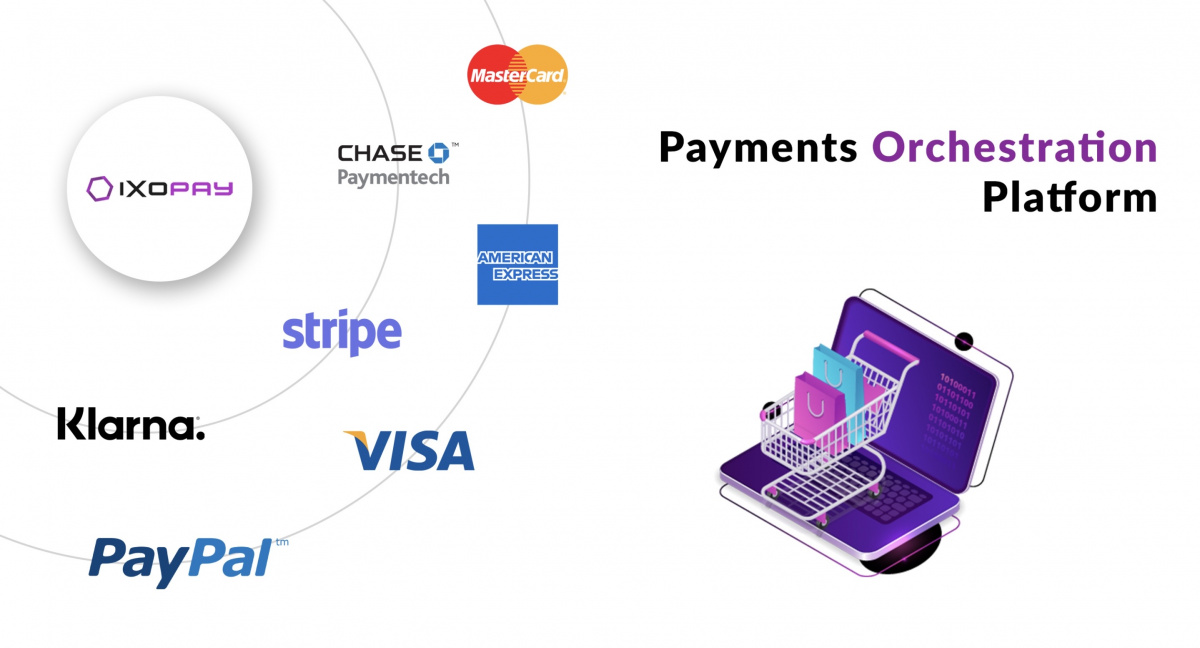
Transactions can now be handled by many payment service providers. After receiving credentials from a service provider, firms can quickly configure the adapter's technical settings and start using it without any more development work. This allows them to swiftly add new service providers to process transactions, extending multi-acquirer and multi-processor approaches and tapping into new markets.
The payment adapters do more than just handle credit card and bank transfers. Many of the IXOPAY’s adapters provide payouts and other alternative payment options, which are important in many locations. Moreover, it allows increasing conversions without raising technical or organizational efforts by incorporating local payment alternatives.
5 reasons why you should have payments orchestration
- Apart from facilitating integration, payment orchestration platforms adapt to client payment preferences.
- POPs make e-commerce businesses grow faster by providing access to a wide range of payment providers.
- As the number of authorized payments rises, e-commerce businesses won’t lose sales due to payment technology issues.
- As the company expands, payment orchestration becomes the most cost-effective alternative.
- As managing PCI compliance and other regulations is mandatory for PSPs, payments orchestration provides payment security and compliance.
Start using payments orchestration
Now that you're aware of the benefits of connecting with a payments orchestration platform, it's time to optimize your store's performance. Utilizing a platform, like IXOPAY, is an excellent place to begin. You may define payment processing rules to avoid missed purchases and to enable the acceptance of additional payment methods.
Additionally, in the event of a technical failure, you can automatically route transactions to the provider with the highest performance. This will result in fewer disruptions to the payment flow and a smooth payment experience for your consumers.
Other Product Reviews
- 04:00 am

The digitisation of finance departments is accelerating across Europe, new research finds. For the majority of companies (38%), the most important functions within their finance department are now digitised. In the past 12 months, the main focus was on financial accounting, budget creation and management, and the creation of financial plans. Yet despite the progress made, there is still a long way to go until finance teams achieve full digitisation.
These findings were released from the latest market research by Rydoo, a leading international SaaS software solution for managing business travel and expense reports. The survey explores the current status of digitisation amongst European finance departments, based on responses from 403 finance executives in December 2021, with at least 1,000 employees in the UK, France, Germany, Austria and Switzerland.
The UK is leading the way with digitisation, with 38% of executives in the region stating that their finance departments are already fully digitised. In France, just 8% have achieved full digitisation but were most likely (41%), alongside Germany (39%) and Austria (38%), to have digitised all major functions. In Switzerland, the highest proportion (42%) of executives were still operating with a mix of online and offline processes.
Today, correct and timely invoicing is now the highest priority (32%) for the finance departments surveyed across all countries. In second place is the need for all data to be accurate and connected (30%). While digitalisation can assist in meeting these objectives, making complete digital transformation a reality is being hampered by some key challenges.
First, the time-consuming transition to new solutions (37%) and second, IT security concerns (30%). While Germany, Austria and France perceive the former as the biggest challenge, the UK is primarily concerned about IT security. Executives in Switzerland, meanwhile, lack the necessary budget. In addition, less than one third (29%) of executives surveyed said their digital finance tools worked together seamlessly.
Across Europe, the need for faster reimbursement (33%) and a desire to embrace new technology across the business (32%) were the highest drivers of expense management systems (EMS) adoption amongst finance departments. However, the pace of digitising specific areas of the finance function varied between countries. For example, the UK and Austria were the two most likely markets to say that everyone kept paper receipts and filled in a paper report form. In total, just 6% of those surveyed are using a completely digital automated expense management process.
That said, those already using digital systems for their expenses are seeing vast efficiency gains, with half (50%) saving 5-10 hours of work time per week and 24% saving more than 10 hours. Despite these potential time savings, the majority of companies still rely on paper (40%) for their expense management.
“Our latest research shows the significant strides made amongst European finance teams to digitise key functions of their departments and achieve greater accuracy and efficiency. However, it is clear that more has to be done in order to maximise the full benefits of digitisation for both employees and the business. When looking at specific areas such as expense management, the valuable time saved by automating repetitive, low-touch tasks are a great case for increased adoption. If businesses can overcome the challenges facing them today and build digital ecosystems in which tools work seamlessly together, professionals can look forward to a more productive and paperless future,” commented Sébastien Marchon, CEO at Rydoo.
- 04:00 am

Platform deployment aims to significantly improve ‘look-to-book’ and automated decisions
Leading global AI-powered credit decision platform provider, Scienaptic AI announced today that NuMark Credit Union has chosen its AI-based underwriting platform to provide enhanced and faster credit decisions to its members.
NuMark Credit Union has a long history of treating its members like family, and they diligently follow their philosophy of “people helping people.” The credit union believes in enriching the financial lives of its members. NuMark Credit Union serves more than 50,000 members from nine branches. By using Scienaptic’s AI-powered loan decisioning platform, the credit union looks to enhance its member experience with faster lending decisions to help members finance their dreams and do more with their money.
“At NuMark CU, we have multi-generational clients and members who have had accounts with us for more than three decades, and this trust is our biggest asset,” said Steve Clark, Chief Lending Officer of NuMark Credit Union. “With Scienaptic’s AI-powered credit underwriting platform, we will be able to better serve members who we consider to be an extension of our family. The AI platform will enable us to maintain a deep commitment to member relationships while improving member financial lives through smarter, more personalized credit decisions.”
“We are incredibly delighted to announce that we will be partnering with NuMark Credit Union. Our AI-powered credit underwriting platform will help unlock millions of dreams through better access to credit,” said Pankaj Jain, President of Scienaptic. “NuMark will be able to make personalized credit decisions for its members, approving more loans while minimizing risk.”
- 07:00 am

CI Global Asset Management (“CI GAM”) releases two thematic ETFs tracking Solactive’s innovation indices, expanding its engagement with the German index provider. The ETFs, which are linked to the Solactive Global Genomics Immunology and Medical Revolution CAD Hedged Index NTR and the Solactive Digital Security CAD Hedged Index NTR, allow investors to have access to high-demand industries especially as the COVID-19 pandemic struck in 2019.
Biotechnology and Genomics Immunology: CI Bio-Revolution ETF
The Coronavirus has catalyzed the development of new drugs and vaccines.1 Research predicts the global mRNA vaccines and therapeutics market to grow at a compound annual growth rate (CAGR) of around 13% during 2021-2026.2 Designed for investors who pursue to gain exposure to this industry, CI Bio-Revolution ETF (CDNA) seeks to track the performance of the Solactive Global Genomics Immunology and Medical Revolution CAD Hedged Index NTR, which serves as a representation of companies that have business operations in the global biotechnology and genomics industry.
Digital Security: CI Digital Security ETF
The same pandemic led most organizations to accelerate their adoption of digitalization and shift their workforce to work from home.3 Digital security has gained prominence and grown in demand in the corporate environment. Aiming to capture the value of the growth of the digital security industry, CI Digital Security ETF (CBUG) seeks to replicate the Solactive Digital Security CAD Hedged Index NTR by providing targeted exposure
to companies that have business operations in the global digital security industry, such as digital security technologies, digital security management, digital security software and digital security platforms.
ARTIS® Classification System
The selection of the companies that constitute both indices uses ARTIS®, Solactive’s proprietary natural language processing algorithm. The system screens publicly available information such as financial news, business profiles and company publication. Using keywords, it identifies companies that have or are expected to have significant exposure to the provision of products and/or services related to the theme of the index.
"The pandemic has put global medical sectors in the limelight, and many pharmaceutical evolutions originated in the last two years, with genomics technology and personalized medicine being part of a much broader and auspicious trend. At the same time, we have seen a major switch in the workspace, which have become in great part virtual, fostering digitalization with a need for digital security. With the launch of these two ETFs, CI Global Asset Management shows their foresight of the modern trends. We share this view and we are very glad to be chosen by them to provide investors with the opportunity of capturing value from innovation”, commented Timo Pfeiffer, Chief Markets Officer at Solactive.
“CI GAM is pleased to partner with Solactive to offer these ETFs, which allow investors to focus on the exceptional growth potential of two dynamic, innovative sectors of the global economy”, said Roy Ratnavel, Executive Vice-President and Head of Distribution. “With CI Bio-Revolution ETF and CI Digital Security ETF, CI GAM continues to build on our extensive lineup of thematic ETFs and expand the investment choices available to Canadian investors.”