
Published
- 09:00 am
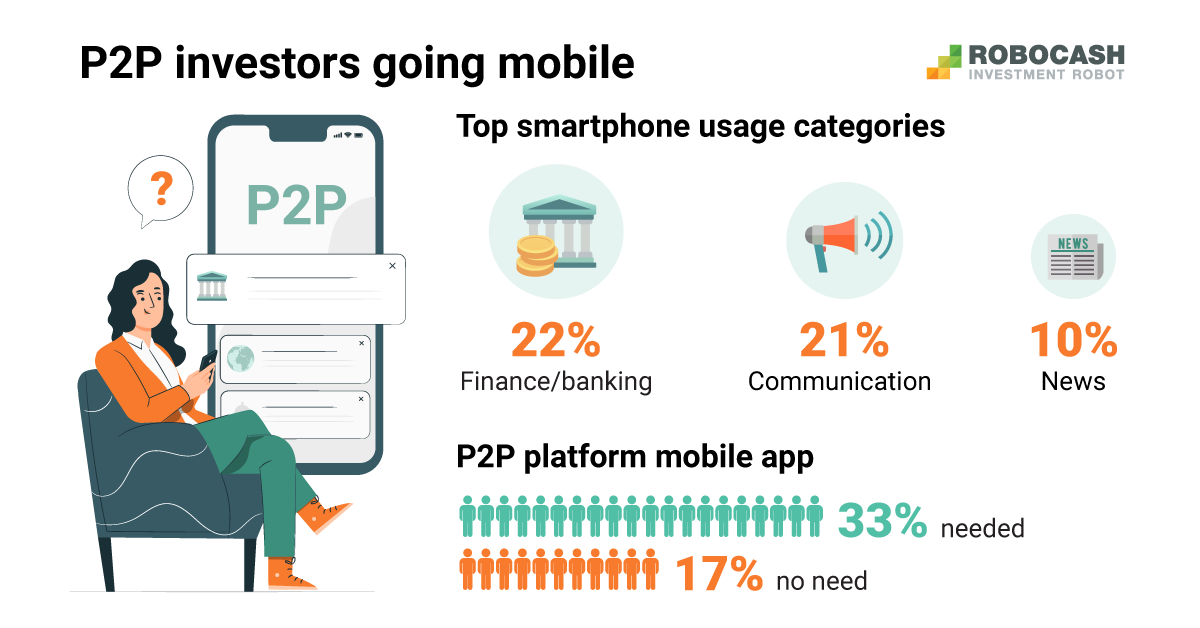
One in seven P2P investors use their smartphones primarily as financial instruments. At the same time, computers are preferable for investors when working with P2P sites. These are the results of the latest survey conducted by the investment platform Robocash.
Almost 30% of P2P investors have a mobile experience in one way or another connected with financial and investment activity. In addition to direct tracking of funds (13,1%), another 9% spend the most time on banking and 7% on business.
When choosing a gadget, respondents favor its practicality, namely, a capacious battery (21%), operating system and interface (18%). Categories such as brand are far behind (3%).
Although investors prefer to track their financial flows through a smartphone, computers turned out to be more convenient for them when working with P2P sites (58%). In addition to mobile apps and stationary programs, websites also became the main tools for working with investments. In total, more than a quarter of respondents make a key bet on them.
80% of respondents agreed that, to some extent, P2P sites need their own mobile applications. The growing importance of smartphones is indirectly confirmed by the analysis of thematic queries in Google. The share of “P2P investment” and “peer to peer lending” requests from mobile devices has been increasing steadily since February 2021. “This result can be assessed as a gradual shift of investors to mobile technologies. But a fundamental change in consumer preferences will take some time, especially given the mature age of most respondents.” - Robocash analysts comment on statistics.

Alexi Karalis
Chief Technology Officer at Iliad Solutions
Financial institutions are adopting Open Banking and its capabilities at pace, but what will the future hold as wider financial services providers adopt similar technol see more
- 05:00 am

LPA, the capital market technology and advisory firm, today announced the hire of Paolo de Vito as the new Head of Business Development, Italy.
In his role, Paolo will lead the opening of the Italian branch of LPA and be responsible for the business development, strategy, and growth of LPA’s activity in the region. Paolo will be based in Italy and will work to help LPA’s clients to transform and digitise their activity, maximising productivity and ensure regulatory compliance.
Paolo has over 25 years of international experience in the marketing and sales of services and technologies in financial services and investment management. Paolo joins LPA from global fund data provider FE fundinfo, where he was the Head of Business Development in Italy and responsible for business development for the entire product range in Italy and Ticino. He has also held roles at international information and technology providers such as Dow Jones, Bloomberg, and FIDA.
Peter Schurau, CEO of LPA, commented: “LPA has been driving the digitalization of the capital market business for over 20 years, and it’s important that we begin to build our presence in Italy. Paolo’s vast expertise and knowledge of the Italian financial services market will tremendously help to unlock our potential in the region and deliver LPA’s technology and advisory solutions to our clients across the country.”
Commenting on his appointment, Paolo de Vito said: “I am very excited to be heading LPA’s opening of an Italian branch and increasing its presence in the Italian market. LPA is a rapidly growing provider with an expertise in unlocking potential in the financial services industry, and it’s my ambition to bring this expertise to an Italian client base. I look forward to growing a strong team in Italy and providing LPA’s sound financial market knowledge and powerful technology to the Italian market.”
- 04:00 am

Chargebacks911’s dispute and chargeback prevention services to combat fraud on all fronts using Microsoft Dynamics 365 Fraud Protection core protection capabilities
Chargebacks911, a post-transaction fraud platform, is working with Microsoft to launch a new fraud protection solution for financial institutions that identifies and combats fraud with the use of integrated data and adaptive artificial intelligence (AI) technology.
By combining Chargebacks911’s dispute and chargeback technology with Microsoft Dynamics 365 Fraud Protection, financial institutions get a complete package covering both pre-authorization and post-transaction friendly fraud protection. The solution suite is also available to be white-labelled, providing banks the opportunity to drive added value and loyalty with their customers.
Financial institutions now have the benefit of accessing Chargebacks911’s friendly fraud analytics in tandem with Microsoft’s adaptive artificial intelligence technology, which learns fraud patterns and helps merchants to optimize fraud controls, dramatically reducing loss in post transaction fraud. With this integrated solution, clients will be provided with a combined data feed allowing better decisioning, creating fewer false-positives and higher transaction acceptance rates. The platform also features plug and play connections, significantly reducing the requirement of valuable IT Resources.
The core strengths of the Dynamics 365 and Chargebacks911 fraud detection platform include:
- Protects revenues by improving the acceptance rate of omni-channel transactions
- Safeguards user accounts from abuse and fraud by combating fake account creation and account takeover
- Identifies anomalies and potential fraud returns and discounts arising from omnichannel purchases
- Provides rich data insights and feedback
- Accessible ML and AI enabled tools to help detect and resolve friendly fraud behavior
- Increased automation with end-to-end accountability
In its last Chargeback Field Report, Chargebacks911 emphasized how businesses across many sectors have dealt with an uptick in fraudulent chargeback claims over the last couple of years, and how they can best protect themselves with dedicated solutions that can cut costs and safeguard revenues.
Monica Eaton-Cardone, COO and Co-Founder of Chargebacks911, explains: “Over the last two years, we have seen an increased reliance on digital channels for everyday living. As with any unprecedented change in market conditions, cybercriminals have rushed to take advantage of anxious consumers and unprepared merchants. Dozens of online scams and fraud methods have developed over the last 12 months and are causing additional confusion and losses for both businesses and consumers alike.”
Donald Kossmann, Distinguished Engineer & General Manager, Fraud Protection – Microsoft, says: “These tools decrease fraud and abuse, reduce operational expenses, and increase acceptance rates. Together, Chargebacks911 and Microsoft are closing the loop and providing a one-stop, seamless solution for fraud protection, disputes, and chargebacks processing. Over are the days where merchants and banks need to worry about integrating these systems themselves and wondering about the gaps in their armor.”
Microsoft Dynamics 365 Fraud Protection Solution is a suite of capabilities that protect against fraud by providing insights about the risk of fraud for customer-facing interactions.
To learn more about Chargebacks911, visit: https://chargebacks911.com/
- 05:00 am

Investment was led by Octopus Ventures and supported by early-backers Maven Capital Partners, bringing Delio’s total equity funding to $15.5m
Delio’s white-label technology helps financial institutions like Barclays and UBS to share and manage private markets investment opportunities through a series of digital hubs
The funding will help to engineer the building blocks of a digital private markets infrastructure from which firms can collaborate and share deals with each other
Delio has raised a further $8.3m to enable financial institutions of all sizes to create greater investor access to alternative assets such as private equity, private debt, and real estate.
The fintech, which digitises the private markets strategies of leading banks, wealth managers and other financial firms, received the backing from Octopus Ventures, one of Europe’s most active venture capital investors. Additional investment from early-backers Maven Capital Partners brings the total equity funding raised by Delio to $15.5m.
Private markets have become increasingly attractive to both institutional and individual investors. In the past decade, the market size for private equity alone has tripled to US$6tn1.The pandemic accelerated this demand further, as investors turned to alternative assets for their resilience, longer-term returns, and diversity of opportunities.
Financial institutions have typically struggled to offer illiquid investment opportunities in a scalable way despite increasing investor interest. With this demand now reaching a tipping point, they are faced with the strategic decision of adapting and digitising or risk losing clients in an increasingly competitive market. This dilemma will only intensify as recent legislative changes across the US2 and Europe have expanded the pool of investors that can access certain alternative assets, such as private equity3.
Delio’s technology has played a central role in helping companies transform how they offer unlisted investment opportunities to their clients. Digitising the private investment cycle from start to finish enables financial institutions to offer a more intuitive investment experience, enhance their operational efficiency, and gather invaluable user insights. The data-driven platforms also aim to strengthen client-advisor relationships and create more robust governance frameworks around the investment process.
Headquartered in the UK with teams operating globally, Delio powers the private markets platforms of more than 90 financial institutions worldwide, including the likes of Barclays, UBS and Sumitomo Mitsui Trust Bank.
The $8.3m investment will further enhance Delio’s international operations and lay the foundations of its non-conflicted private markets infrastructure. This digital network will connect capital raisers, financial institutions and investors on a global scale and share investment opportunities on an institution-to-institution basis.
Gareth Lewis, Chief Executive and Co-Founder of Delio said: “With investor demand at an all-time high, there is a lot of noise around how institutions overcome the traditional barriers to private markets. We’ve taken a different approach, creating white-labelled technology that acts as the digital building blocks on which firms can scale their propositions. The growth funding from Octopus Ventures validates this approach and strengthens our plan of stimulating greater connectivity between financial institutions, capital raisers and investors.”
Edward Keelan, Investment Principal, Octopus Ventures said: “Financial institutions involved in private markets face complex challenges around deal distribution, regulatory governance and overall client experience when recommending private investments to clients. Delio's market leading private company technology solution is already serving some of the world's largest global wealth managers, private and investment banks, with this funding round allowing Delio to continue to enhance its suite of private market infrastructure solutions, as well as scaling into new geographies. Furthermore, there is strong alignment between Delio and Octopus in making private company investing more available for all investors and we look forward to supporting the team on this journey”.
- 09:00 am

|

- 06:00 am

Unlocking Japanese acceptance landscape to boost preference for card payments at large scale is part of Worldline’s global growth strategy
Worldline, a global leader in payments services announced its business expansion to Japan, offering credit card payment processing for merchants nationwide. An economically mature, very secure market with conservative consumer habits, Japan offers a huge growth potential for card payments.
The Worldline proposition for the Japanese market is based on a strong partnership with Vesca, a leading local provider of payment solutions and network service provider (NSP). Worldline will provide transaction processing, leveraging the footprint, scale and technology of its global payment processing facilities, while Vesca is the technical enabler that acts as the acceptance layer in the country. Through this set-up, starting to accept credit cards will no longer be cumbersome for merchants, and they can do so at competitive costs.
Roger Niederer, Chief Market Officer Merchant Services at Worldline, said: “Strong local relationships paired with latest payment technology at scale is the approach we are taking to address new markets. Japan is one of the most promising economies for card payments, and we are glad to be transforming the market though our unique set-up with Vesca. Their deep understanding of both the Japanese merchants and international payments is an asset in our partnership".
The basic offering at launch in early 2022, consisting of credit card acquiring and POS card acceptance and processing, will be enlarged with e-commerce in the months to come. Merchants will benefit from Worldline’s offering by having a single point of contact for all their payment needs including fast onboarding.
Makoto Yoshida, Chief Executive Officer at Vesca, said: “This partnership will bring end-to-end advanced payment services and solutions for Japanese merchants as well as in-depth market expertise. Furthermore, we plan to create unique segment-specific features by collaborating with our extended ecosystem of clients and partners.”
Japan has a great potential for cashless payments, which is also endorsed by the government. Plans are to double the current rate of 35% of transactions being card-based by 2025. Next to consumer behaviour, a key barrier for the adoption of cashless payments at merchants are the lengthy onboarding processes (up to 6 weeks) and the cost for payment acceptance.
- 07:00 am

TrueLayer’s platform offers a higher-converting, lower-fraud payment approach when compared to card and bank transfer.
TrueLayer, Europe’s leading open banking platform, and ETX Capital today announce the award-winning broker has implemented its payments platform to deliver instant deposits and withdrawals for customers.
ETX Capital is an FCA-regulated broker providing institutional, high net worth and retail customers with multi-asset and multi-market derivative dealing capability through CFDs. Using TrueLayer’s payments platform, ETX Capital customers can seamlessly verify bank account information using biometric methods, and connect to the trading app for instant and secure funding using Payments Initiation in just a few seconds.
This improved process means traders can now fund their account with confidence and make timely investment decisions by getting their money to market more efficiently. TrueLayer’s platform is white labelled using the ETX Capital brand and the customer’s chosen bank, rather than a third party brand, which helps to increase trust and confidence as the trading platform owns the end-to-end payment process within its app.
TrueLayer is also delivering a more efficient withdrawal process for ETX Capital customers. While cards and bank transfers can leave investors waiting, taking anywhere from a few days to a few hours, TrueLayer provides instant withdrawals, direct to the customer’s bank account.
Research by YouGov and TrueLayer has shown that payments heavily influence investor satisfaction. Almost two thirds (64%) of current and prospective investors are more likely to trust a provider that offers instant payments. While almost half of current investors (46%) said they were likely to switch providers if that service also offered instant withdrawals.
“Open banking provides vast opportunities for us to continue to develop exceptional client experiences at ETX, we are excited to be working with TrueLayer to provide clients with instant access to their money and the financial markets by offering instant payments into and out of their trading accounts,” commented Kayleigh Lewis, Chief Operating Officer at ETX Capital. “The payments space is continually evolving and we want to offer the most progressive and secure technology to enhance our user experience. Clients are at the centre of everything we do at ETX and we will continue to work with partners like TrueLayer to revolutionise the products and services we offer.
Nick Tucker, Head of Financial Services at TrueLayer, added: “With open banking, payments now present an opportunity for firms to differentiate and drive customer loyalty. Providers that don’t offer instant deposits and withdrawals are missing out on an opportunity to develop a deeper and more positive relationship with their customers. It’s exciting to see progressive firms such as ETX Capital embracing open banking and, with TrueLayer, deliver a more compelling customer experience.”
- 01:00 am

Visa and Mastercard blocked multiple Russian financial institutions (FIs) from their networks to comply with government sanctions imposed after Russia invaded Ukraine, per Reuters. Both payment networks also said they are prepared to comply with any future sanctions.
Neither network disclosed which FIs had been cut off, but a source told Reuters they include entities listed by the US as “Specially Designated Nationals.”
- The US, the UK, the EU, and Canada removed major Russian banks from the Society for Worldwide Interbank Financial Telecommunication (Swift) on Saturday. Swift’s global messaging system facilitates payments for more than 11,000 financial institutions in over 200 countries and territories. Getting cut out of the Swift network could limit export payments for Russia and complicates matters for Russian entities doing business in Western markets.
- The National Bank of Ukraine (NBU) called on Visa and Mastercard to stop servicing their payment cards issued by Russian banks after the Central Bank of Russia (CBR) said cards issued by six Russian banks would “work throughout Russia without restrictions” despite sanctions, per NFCW.
- And remittance providers Wise and Remitly suspended their money transfer services in Russia on Monday to comply with sanctions, per Reuters. Wise also waived fees on over £500,000 (around $555,000) transfers to Ukraine intending to help residents receive emergency support.
Why this matters: These sanctions will likely have ripple effects not only on the Russian payments ecosystem, but also on the global payments market.
- Russian consumers may rely more heavily on cash or other digital payment methods, like cryptocurrencies or Mir, the card-based payment provider supported by the Kremlin in response to US sanctions from annexing Crimea. Consumers in Russia have flocked to banks and ATMs to withdraw foreign currency as the Russian ruble tumbles, per Insider.
- Zooming out, Visa and Mastercard respectively have 58% and 41% market share of Europe’s global network cards industry, per The Nilson Report. Cutting off Russia may therefore crimp some of the payment networks’ volume in the region.
Related content: For more information on the financial implications of US sanctions on Russia, check out our banking analysts’ take.

- 01:00 am

Shakepay, a leading Canadian bitcoin technology company enabling customers to easily buy and earn bitcoin through financial applications, today announces the availability of its Shakepay Visa* Prepaid Card to the public after a successful invite-only launch to its devoted community of Shakers in December 2021.
Shakepay Cardholders will earn up to 2% in bitcoin cashback on their first $5,000 spent, settled directly to the bitcoin balance of their Shakepay account. Cardholders will then earn 1% bitcoin cashback on every purchase beyond their first $5,000.
“After a tremendous year for Bitcoin and Shakepay, we’re excited to make the Shakepay Card more widely available,” said Jean Amiouny, Co-founder and CEO of Shakepay. “The exclusive invite-only launch to our community was a huge success, and we couldn’t be more excited to open access to the general public. We know our customers value bitcoin rewards, and we’re looking forward to offering Shakers more ways to earn bitcoin.”
During the 2021 holiday period, Shakepay ran several special promotions as part of its invite-only launch. Every Shakepay Cardholder has the chance to be “#shakepaid.” Each time a customer uses their Shakepay Card, there’s a chance to have the purchase entirely reimbursed by Shakepay in bitcoin. The promo was launched unannounced to the delight of customers who continue to share their surprise on Twitter with #shakepaid. In addition, Shakepay pledged to donate $0.10 to the Children’s Aid Foundation of Canada for every Shakepay Card transaction, up to $100,000.
“We think Bitcoin is a force for good in the world and we are doing our part to bring about the change”, explained Amiouny. “Overall, the Card was well received by the community and the launch led to over 70,000 card signups.”








