
Published
- 07:00 am
· Clear majority (62%) of 18-34 year olds want more information about their carbon footprint, and over half (53%) expect their financial services provider to do more to help them reduce it
· One in four (23%) 18-34s already track their environmental impact through an app and nearly half (43%) would switch to a new financial provider who allowed them to see the environmental impact of their purchases
· Younger generations of customers now looking to financial providers to reward them for becoming greener
New research from Europe’s leading open banking platform, Tink, finds that younger generations expect strong environmental credentials from their financial services providers, with many willing to switch providers to seek out greener options.
According to the survey of 2,000 UK consumers, younger customers are significantly more likely than their older counterparts to seek out financial services that help them measure and manage their environmental impact. Almost two-thirds (62%) of 18-34 year olds want more information about their carbon footprint so they can reduce their impact on the planet — compared to a national average of 48%.
Younger cohorts of customers also want incentives to do the right thing for the planet — with 56% of 18-34 year olds looking to be rewarded by their financial provider for lowering their carbon footprint.
Providers lacking a strong sustainability offering risk alienating customers
Financial services providers without sustainability offerings run the risk of losing business, by failing to meet the expectations of a new generation of climate-conscious consumers. In fact, nearly half (43%) of 18-34 year olds would switch to a provider that allows them to see the environmental impact of purchases on their bank account.
Furthermore, 42% of 18-34 year olds say they wouldn’t use a financial provider that they didn’t regard as environmentally conscious — with 40% saying they only invest their money into companies or funds considered sustainable — twice the national average of 21%. While more than half (55%) of 18-34s say they wouldn’t use a financial services provider that held assets or investments in companies which are majorly contributing to climate change.
However, for providers on the front foot when it comes to sustainability, there is a potential upside for profits as well as for the planet. Over half (51%) of 18-34 year olds surveyed say they would encourage friends or family to use a provider they regarded as environmentally conscious.
The opportunity for sustainable innovation
Tink’s findings demonstrate that there is clear appetite amongst younger generations for open banking powered tools that allow them to measure and minimise their environmental impact.
One in four (23%) 18-34 year old respondents say they already track their environmental impact through a service or app — compared to a national average of just one in ten (10%). A further 58% of 18-34 year olds would like to have the opportunity to take advantage of this type of service. While 47% would also like to be able to measure the environmental and social impact of their investments.
Appetite for information
When it comes to tracking the impact of their purchases, younger generations are as interested in measuring the footprint of their digital subscriptions as they are the everyday goods and services they consume.
In order of priority, 18-34 years olds are curious to understand how the following spending contributes to their carbon footprint:
- Consumption of digital subscription services e.g. Netflix, Gusto, and digital newspapers
- Consumption of essential items e.g. food and toiletries
- Consumption of utilities e.g. water, electricity, gas
- Usage of transportation and travel services e.g. taxis, buses and aeroplanes
- Consumption of non-essential luxury items e.g. jewellery and designer clothing
This represents a clear opportunity to pioneer innovative services related to sustainability, to appeal to a growing segment of customers, who expect their financial services provider to give them the ability and the incentives to become greener.
Tasha Chouhan, UK & IE Banking Lead at Tink, commented: “As the climate crisis worsens, our latest research makes it clear that consumer expectations for financial institutions are rising. Banks that fail to give full, transparent visibility over environmental impact and carbon footprint may be at risk of alienating a key segment of consumer — in particular, those within the 18-34 age bracket.”
“Open banking has a vital role to play in helping financial institutions build a strong sustainability offering for customers. For example, by aggregating, categorising and analysing transactions with open banking, customer data can be linked to carbon footprint analysis and consumers can know the environmental impact of their spending.
“It’s encouraging to see younger generations of customers embracing open banking powered services that give them greater control over their finances and their environmental footprint. By partnering with fintechs to experiment with open banking powered use cases, financial institutions will be better placed to attract and retain this emerging new wave of green consumers.”
Supporting information
Tink’s open banking platform powers a range of products and services that enable financial services providers to build tools that measure and manage carbon footprint.
This includes a strategic partnership with sustainability fintech Cogo to provide UK banking customers with personalised carbon footprint tracking services — now available to more than eight million NatWest customers.
For more information, please visit https://tink.com/press/tink-partnership-cogo-natwest/

Rita Liu
Chief Executive Officer at Mode
"As just the fourth firm to be approved in the regime, we welcome new regulation as it encourages prosperity in the UK’s burgeoning crypto sector. see more
- 04:00 am

Attacks on various crypto projects and ecosystems brought millions of dollars to hackers and scammers.
According to the recent findings by the Atlas VPN team, blockchain hackers stole $682 million in 72 hack events throughout Q1 2022. In addition, hacks on Solana and Binance Smart Chain ecosystems attributed to more than half of the losses during this quarter.
The Solana ecosystem suffered 4 hack events and lost $397 million in 2022 Q1. Wormhole, a communication bridge between Solana and other DeFi networks, experienced the most significant hack of the quarter and lost about $334 million.
Cybercriminals hacked projects in the Binance Smart Chain ecosystem 12 times, accumulating $99 million in losses.
Other types of hacks on blockchain caused $52 million in losses throughout 9 events. IRA Financial Trust, which provides self-directed retirement accounts, lost $36 million to a crypto hack.
NFTs were the top target among cybercriminals with 20 hacks and nearly $49 million in losses. Many scammers are launching NFT projects, which turn out to be rug pull scams.
Exchanges were hacked out of $42 million in just 3 events. At the same time, the Ethereum ecosystem lost nearly $25 million to attackers in 16 hack events throughout Q1 2022.
Cybersecurity writer at Atlas VPN Vilius Kardelis shares his thoughts on blockchain-related hacks:
“Blockchain project security should be one of the primary concerns for a person looking to invest in cryptocurrency. Most blockchain-related hack events happen because cybercriminals exploit flaws in the project code. A successful hack could cause significant losses to the creators and investors of the crypto platform.”
Blockchain hacks reach an all-time high
The growing market of cryptocurrencies entices not only legit people interested in the technology but also cybercriminals who want to exploit it.
Cryptocurrency projects experienced only 5 blockchain-related hack events in Q1 2018. Next year, in the first quarter of 2019, hacks increased by 1140% to 62. While in Q1 2020, hacks decreased to 13, in Q1 2021, blockchain-related breaches and scams jumped up by 154% to 33.
Blockchain-related hack events have reached an all-time high of 72 in Q1 2022. It represents a 118% increase in hacks compared to the first quarter of 2021.
To read the full article, head over to:
https://atlasvpn.com/blog/blockchain-hackers-stole-nearly-700-million-in-q1-2022

- 03:00 am

Major strategic move sees Klarna target financial services businesses with dedicated business unit
Klarna’s Financial Technology Platform now connects to over 15,000 banks across Europe and the US, making it one of the most comprehensive bank aggregators in the world.
Klarna, the leading global retail bank, payments, and shopping service that helps consumers save time and money, be informed and in control, today launched ‘Klarna Kosma’, a sub-brand and business unit to harness the rapid growth of its world-leading Open Banking platform.
By providing simple access to more banks than any other Open Banking provider, Kosma rapidly reduces the time for new fintech services to reach global scale and provides the essential building blocks for innovation in financial services. Kosma provides financial institutions, fintechs and merchants with the essential connectivity to build the next generation of fintech apps and services by providing simple and secure access to 15,000 banks in 24 countries around the world through a single API. The new business unit will harness the massive growth Klarna has seen in this area, having more than doubled the number of connected banks in the past year. Today, Kosma processes close to a billion information requests to bank accounts each year.
“With Kosma we are opening up the power of our proprietary Open Banking platform and technology to banks, merchants and fintechs who share our dream of a world where consumers own their data and banks compete for customers by delivering value, not by locking in data,” says Yaron Shaer, CTO, Klarna.
The platform is already being used to power a broad range of business and consumer focussed innovations. FINOM, for example, is an Amsterdam-based start-up which offers financial management, business banking, and billing services to SMEs and freelancers in France, Germany and Italy. They integrated with Klarna to create a new generation of digital invoices, which include a ‘Pay Now’ button which allows the payment directly from the invoice., helping their small and micro-business clients to collect their money much faster, improving cash flow. Konstantin Stiskin, supervisory board member and co-founder at FINOM says: “Over 5000 business clients of FINOM are already using Klarna solutions to improve their lives. Professionals and SMEs are the backbone of the European economy, but they are largely underserved when it comes to banking and financial services. At FINOM we work everyday to address this issue, providing European entrepreneurs the best tools to make their work and life easier.”
ZealiD provides a digital identity and signature service which allows consumers to register and sign-in online, and sign contracts seamlessly and securely. The service uses Klarna’s Open Banking platform to identify and validate the consumer’s identity in a simple and innovative way, from ZealiD’s user-friendly app, replacing the outdated requirement to provide a bank statement as proof of address. Philip Hallenborg, Founder and CEO at ZealiD, says, “Thanks to Klarna, ZealiD could implement the solution quickly, connecting to hundreds of banks across all EU member states.”
Klarna first entered the Open Banking space when it acquired SOFORT, a leading direct bank-to-bank payment service in Germany, in 2014. Since then Klarna has developed the service, expanding it into 24 markets, and begun to use Open Banking to power additional in-house services. Klarna now uses Open Banking to power Account Insight Services (AIS) which provide spending insights to millions of shoppers directly in the Klarna shopping app, and to provide additional, real-time data to make even more responsible lending decisions for Klarna payment methods.
“Over the past year, the demand for Open Banking services from financial institutions and fintech start-ups, has reached a tipping point,” says Wilko Klaassen, VP, Klarna Kosma, “which is why we have built a dedicated business unit which brings together engineering, product management, sales and marketing all together in the same team to focus on this $15bn, fast-growing market.”
- 08:00 am

DataBP, the data licensing and commercial management platform, today announced that MarketAxess, the operator of a leading electronic trading platform for fixed-income securities, and the provider of market data and post-trade services for the global fixed-income markets, is leveraging DataBP’s services to support and automate data licensing and post-sales processes.
As data consumption methods in financial services have rapidly evolved, the opportunity to provide a broader range of services to customers, and manage an increasingly diverse community of data subscribers and redistributors, requires an increasingly sophisticated level of scale and automation.
DataBP’s data licensing platform, which has been adopted by the majority of tier 1 securities exchanges and a growing number of index providers and data vendors, simplifies and automates the manual business processes supporting ongoing administrative workflows.
MarketAxess is leveraging DataBP’s powerful pricing engine and seamless integration with Salesforce to better meet the business intelligence needs of its institutional fixed income trading clients, while at the same time increasing efficiency and reducing risk.
Ryan Gwin, Head of Data Sales, MarketAxess, added: “DataBP’s platform provides MarketAxess the opportunity to optimize the customer experience as we develop our data services business and offer new products. Having the tools to automate market data sales administration means that we can focus on the higher value activities involved with servicing clients and developing cutting edge products."
Mark Schaedel, CEO of DataBP, commented: “We are thrilled to partner with MarketAxess who, in many ways, are doing to credit markets what we are doing in the market data space – introducing innovation and technology to support a necessary transition from analog to digital. As credit markets become more automated and data-driven, streamlining the workflows supporting the provision and licensing of data are a critical enabler for innovation. DataBP is focused completely on enabling providers of data to rapidly introduce new products, onboard customers and manage data licensing and subscription relations at scale.”

Rowan Brewer
CEO at Paymentology
Traditional banks as we know them are at a crossroads. One that will determine their role for the next several years and decades. see more
- 08:00 am
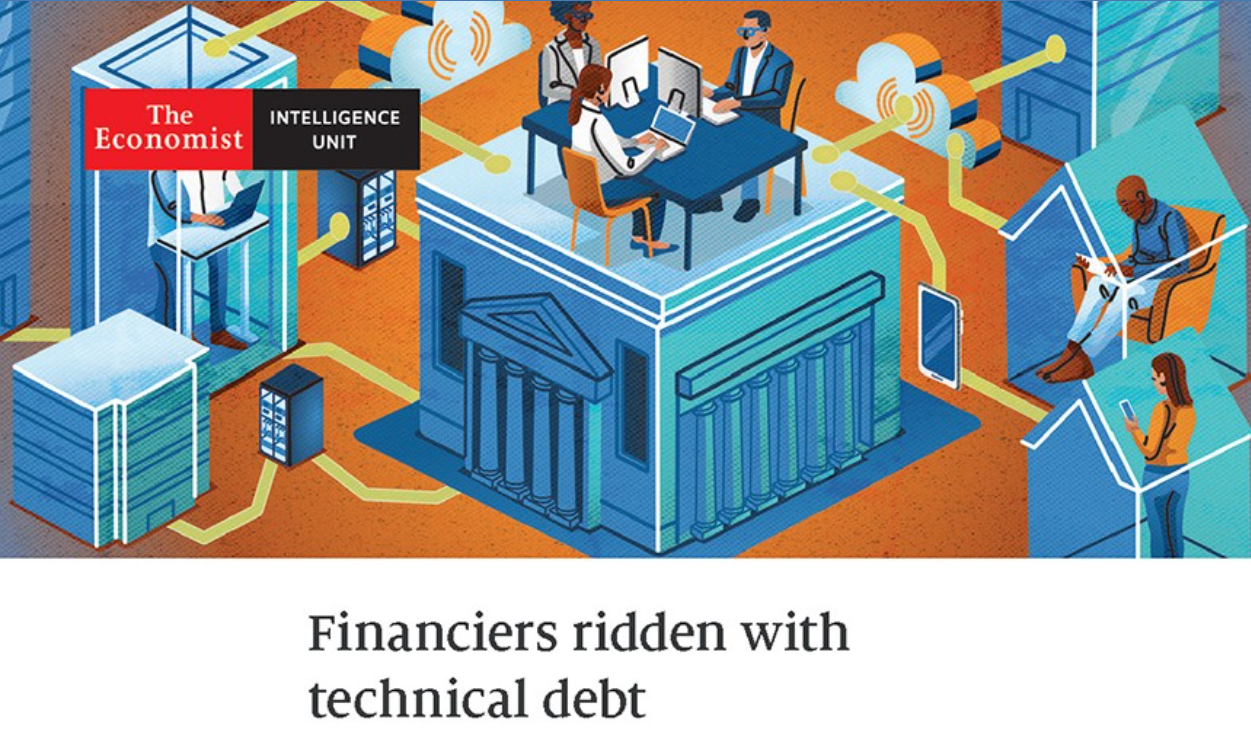
Appian today reveals that global leaders in financial services and insurance (FSI) believe that legacy IT infrastructure and applications are holding back their business transformation aspirations and automation objectives. These are the findings of a new report, "Financiers ridden with technical debt," from The Economist Intelligence Unit (The EIU), supported by Appian. The report’s findings are rooted in a survey conducted by The EIU of more than 1,000 IT decision-makers (ITDMs) and senior business executives at financial services, banking, and insurance corporations around the globe.
The need for business agility, spurred by recent global events, is causing FSI organisations to reimagine how they do business as they work at an accelerated pace to adapt to change. Notably, close to three-quarters (71%) of ITDMs in FSI organisations report that the growth of technology project requests exceeds IT budget growth, which is higher than the global average of 64%. Other key findings include:
• 87% of respondents say their organisation has encountered operational difficulties in addressing the challenges posed by the pandemic.
• 81% of FSI leaders say their organisation needs to improve its IT infrastructure and applications to better adapt to external change.
• 44% of ITDMs believe inadequate collaboration between the IT function and business units is a chief barrier to digitisation, compared to 27% of business decision-makers.
According to survey findings, automation is viewed as being one of the most important technologies over the next 12 months by 31% of global financial services executives. The report highlights that more than a third (34%) of ITDMs believe that the reduction or elimination of legacy IT would most help their organisation achieve its automation objectives. However, only 17% of financial services business decision-makers believe that overcoming legacy IT would be a key factor in helping their firms to embrace automation.
Aegon, one of the world's leading providers of life insurance, pensions and asset management, has been able to accelerate their delivery of IT applications by embracing digital automation and innovation.
“Automation initiatives are not easy and, with lots of teams launching projects in different groups, we risk making the same mistakes repeatedly. Building a central automation advisory group allowed our project teams to be independent and agile, but also benefit from experience and hard-won expertise,” said Boris Buis, Intelligent Automation and BPM Lead at Aegon.
In 2018, Aegon introduced governance, security and provisioning across the organisation within the DevOps space with 20 applications and 10 teams working with Appian. Today, Aegon’s Intelligent Automation Team has 8 total full time employees with 2 dedicated to Appian and enables more than 16 federated DevOps teams within the business to support over 50 applications.
“Financial services and insurance companies must bolster collaboration between IT teams and the business units they serve. Both groups recognise the need to collaborate more to meet their digital and automation ambitions with speed, quality, and security. Our report shows that by working together, modernising dated legacy systems, and adopting agile methodologies, organisations can overcome barriers to digitisation," said Michael Heffner, VP of Solutions and Industry Go-to-Market at Appian.
Download the full Economist Intelligence Unit report, sponsored by Appian, to read about the research and findings.
- 07:00 am
Tricount users can now reimburse expenses through a one-click bank-to-bank transfer in the app
Connection to users’ bank accounts is enabled by Aion Bank and Vodeno
Aion Bank and Vodeno are part of Mastercard’s Fintech Express programme aimed at connecting digital players and driving collaboration
Tricount, a leading pioneer in group expense management, Aion Bank, a European licensed digital bank and Vodeno, a cloud-native Banking-as-a-Service provider, have partnered to launch Tricount’s new service, which allows its users to reimburse expenses in its app through a one-click bank transfer. The three companies were introduced through Mastercard’s Fintech Express programme, which gives start-ups and emerging brands support and assistance for every stage of their growth and transformation, from market entry to global expansion. Through the programme, fintechs are able to leverage Aion Bank’s ECB licence, compliance and regulatory expertise and Vodeno’s VODENO Cloud Platform (VCP), one of the most comprehensive banking platforms, operating entirely in the cloud.
Tricount allows its users to split bills quickly and easily, categorise expenses by type and settle outstanding balances via integrated payment methods. The free-to-use app revolutionised expense management when it launched in 2010 and has grown to become popular with young people who ‘make a tricount’ whenever they need to split bills. Tricount currently serves more than 5.2 million registered users. The new in-app payment functionality removes the final layer of friction in the expense management process and makes calculating and splitting bills quick and simple. Tricount users can now send money in the app directly from their bank account, anytime and fully remotely without the need to share IBANs.
Tricount’s new feature is powered by Aion Bank and Vodeno, who offer white-label embedded finance solutions to financial and non-financial businesses. Aion Bank and Vodeno will link the Tricount app to users’ bank accounts and initiate payments. Tricount users who want to make direct bank transfer payments in the app will now be able to do this in one seamless experience. Mastercard Open Banking technology serves as the backbone that allows Tricount users with a Belgian bank account to send and receive funds.*
Guillebert de Dorlodot, who co-founded Tricount with Jonathan Fallon said: “We launched Tricount to make sharing of bills between friends and family easier. For the last 10 years, we have observed triple digit annual growth. Repayments with direct bank transfers was a long awaited feature for our Belgian users, and we believe this is one of the first PSD2 integrations that truly makes sense for consumers.”
Kim Van Esbroeck, Country Manager of Aion Bank Belgium added: “Together with Vodeno and, in partnership with Mastercard, we offer innovative, embedded banking services to both regulated and non-regulated entities. Tricount is a good example of our ability to offer payments-as-a-service and innovate this space. Our entire spectrum of products include: deposits, investments and lending together with cards, payments and KYC through our open APIs that can easily connect with any fintech’s frontend.”
Henri Dewaerheijd, Country Manager, Mastercard BeLux said: “We are pleased that our fintech partners Aion Bank, Vodeno and Tricount have chosen the Mastercard Open Banking Connect network to enable safe and easy transfer of funds between users. The application of (PSD2) Payment Initiation as a service is a first for Mastercard in Belgium. We are looking forward to seeing this technology scale in fintechs or merchant apps.”
- 05:00 am

Accelerated Payments today announced it has been ranked fifth on Business Money’s Receivables 2021 Intermediary Index, an industry review of the UK invoice finance sector. The review sees experienced commercial finance brokers reporting on how invoice financiers around the country respond to, and manage client needs, the appraisal process, and the ongoing relationship.
With the simultaneous challenges of Brexit and the pandemic, 87 per cent of small business owners in the UK reported losing money over the last two years. However, last year, the UK invoice finance sector played a crucial role in helping businesses to recover. In the first half of 2021, the number of new businesses in the UK rose by 14 per cent, which is significantly higher than the global average of six per cent.
Furthermore, previous research by Independent Growth Finance has shown that 27 per cent of businesses (with a turnover of between £1M and £500M) use invoice financing and the impartial monitoring performed by Business Money and others, fosters ongoing trust and professionalism throughout the sector.
“This is a prestigious recognition and a tremendous achievement for the company,” said Ian Duffy, CEO, Accelerated Payments. “Making it to the fifth position in the index is a testimony to the critical support we deliver. With our help, companies have managed to grow and scale despite unprecedented challenges such as COVID-19 - and we want to continue to do more good work and reach more customers that are in need of services. This ranking, therefore, is not only important from a peer review perspective, but also critical in offering us greater visibility in the market. It will help us to raise greater awareness about invoice financing and how it can help more businesses manage their cash-flow challenges.”
Founded in 2017, Accelerated Payments has become one of Europe’s fastest-growing FinTechs and a leader in the alternative finance sector. The company solves the problem of cash flow for businesses through a flexible and innovative individual invoice financing service.
Companies decide which invoices to fund by using a simple, client portal that allows businesses to upload and select invoices for funding. Once approved, payment is advanced usually within 24 hours.
During the past year, a few trends have also emerged, including an increase in exports to countries outside of the EU post-Brexit and longer payment terms. Accelerated Payments has stepped up to provide support during this critical time, as the company has experience with SMEs trading internationally - and is a key strength that sets it apart from other fintech providers.
Accelerated Payments works on a global basis with offices in the UK, North America, and Europe, and has the expertise and network to fund exporters that invoice worldwide.
Business Money, launched in 1993, is an industry journal in commercial finance and banking. It is available in print and digitally in the UK and digitally in 90 nations that look to the UK as a world leader in product innovation and software support.
- 03:00 am

Tech-focused investment bank ICON Corporate Finance has acted as adviser to Relative Insight, the rapidly growing AI based text analytics software platform, on a Scaleup funding round from YFM Equity Partners, through the British Smaller Companies VCTs, which has been raised to accelerate product development and drive US expansion.
As the volume of text data - surveys, reviews, social, customer experience (CX) and voice of the customer (VoC) - rapidly increases, crucial insights can be harvested by decision makers if analysed quickly and easily.
Relative Insight’s AI based text data analytics platform delivers high-value insights for digital marketing, consumer analytics and customer experience by using pioneering analytic techniques to identify the critical nuances in consumer language and changes over time, across different demographics and geographies, to explain market trends, customer service issues, product opinions and marketing campaign effectiveness.
With offices in London, New York and Lancaster, Relative Insight has a growing international client list including leading global companies such as Sky, Nespresso, Starbucks, General Mills, MetLife, and Sony. This investment from YFM will enable Relative Insight to further grow its customer base as well as continuing to develop the platform to provide greater customer insights and data integrations for its clients.
Commenting on the deal, Eddie Harding, Partner at ICON said: “We’re delighted to have advised Ben and the team on this transaction and were not surprised by the strong level of interest we received from investors. Relative Insight’s highly innovative AI-based software generates significant value for its clients, and the company is now at a very exciting stage in its growth plan. YFM’s funding will help Relative Insight to scale up its operations considerably, particularly in the US where there is significant market potential.”
Ben Hookway, CEO of Relative Insight commented: “With an ever-increasing amount of data available to businesses, many are struggling to make sense of this valuable information. This can prove vital in understanding what is causing business outcomes, and what can be done to change them. Our platform is able to rapidly analyse millions of words and compare them across a range of variables to highlight the critical differences in consumer language, helping to explain market trends, customer behaviour and provide actionable insight including making communication more effective with target audiences.
“Having seen rapid growth over the last four years, the business is now embarking on the next stage of its journey as we expand in the US. We believe that YFM is the ideal partner to support us. As well as having an established track record scaling SaaS businesses, they have a real understanding of our market and are a great fit culturally - we like the team and are confident they will add real value.”
YFM has a growing national portfolio of software and tech businesses, including data transformation software company Matillion and innovation intelligence provider Vypr.
Dan Freed, Partner at YFM, added: “Data and text analytics is a rapidly expanding market and one with huge potential given the ever-increasing demand for improved business intelligence, and customer insights. The Relative Insight platform is a compelling proposition helping companies to understand why things happen. The heritage of the business resonates with us, and we believe it is a best-in-class platform led by an experienced and very impressive management team.”
Read the full story here: ICON: Tech Investment Banking | ICON advises AI Analytics innovators… (iconcorpfin.com).








