
Published
- 07:00 am

New report finds luxury shoppers are turning their backs on brands due to security issues, tedious returns processes, and slow authentication
62% of luxury brand consumers will shop elsewhere if retailers provide a poor payment experience, according to research published today by Vyne.
The specialist account-to-account payments platform today launches a report, High-value consumers’ payment preferences unpacked: The post-pandemic shift in luxury shoppers’ demands, which explores the online payments preferences and experiences of over 2,000 British consumers, following nearly a 12% rise in the purchasing of online luxury goods in 2021.
The research reveals that over 86% of respondents with a household income over £75,000 (higher income households) are open to trying out new methods of online payment, which is 25% more than those from households with a lower annual income (61%).
Frustrations with card payments, such as slow authentication checks and concerns around fraud, have left luxury retailers seeing a dramatic increase in basket abandonment. In an average week, 19% of individuals from higher-income households abandoned their basket at an e-commerce checkout.
Security is a major concern affecting luxury brand shoppers and 74% of respondents from higher income households stated that they would use an option which enables them to authenticate themselves using their banking app, rather than using traditional card payments, if this was available to them.
Karl MacGregor, CEO and Co-founder of Vyne, says: “There is a clear appetite for the purchasing of high-value goods, as the luxury retail sector saw a total revenue of £12.16bn in 2021. The challenge is that high-value consumers expect seamless experiences and the current payment options being provided by most luxury brands do not live up to these expectations. Our research demonstrates that high-value shoppers will not tolerate outdated payment solutions. If luxury retailers want to build a loyal customer base and reduce checkout abandonment, it is imperative that they implement solutions fit for the modern consumer.”
The report also uncovered that the return of purchases has been a major pain point for online shoppers, with 31% of all respondents stating that the refund process is tedious and frustrating. 76% of respondents in higher income households (over £75,000pa) claimed they would be more likely to shop with a luxury brand if they offered instant refunds and, if available, almost 4 in 5 (78%) would use a payment method that enabled instant refunds over their traditional payment method.
Luke Flomo, Chief Revenue Officer at Vyne, adds: “Payment methods that were not designed for the digital world negatively affect consumer sentiment and drive away potential customers. Open Banking offers a more modern, transparent and seamless approach that benefits both buyers and sellers in a transaction. Indeed, consumers are crying out for the benefits it offers - from stronger security to better user experience.”
- 03:00 am

SmartSearch, the UK’s leading anti-money laundering solution, is warning of the dangers of Non-Fungible Tokens (NFTs) being used to get around sanctions.
“When new technology is launched, fraudsters and money launderers are never far behind.,” cautioned Martin Cheek, managing director at SmartSearch.
“Those looking to avoid sanctions may look to purchase NFTs to hide their money in unregulated assets.
“Therefore it is crucial that everyone involved in the process of purchasing NFTs is vigilant to the dangers they pose. Finding the source of funds will be critical and enhanced due diligence undertaken whenever a client is looking to buy an NFT.
“Shell corporations may be used to disguise who is actually attempting to launder money so identifying the ultimate beneficial owner is crucial.”
NFTs are unique digital tokens that represent ownership of items ranging from art to property. The NFT market generated $1.5bn in trading in the first three months of 2021 and grew 2,627% over the previous quarter, according to a February study by the US Treasury Department.
Because UK money-laundering regulations do not include NFTs, concerns have been raised that they could be exploited as yet another way to launder money anonymously and untraceably. These fears were underlined by the recent seizure by HMRC of three NFTs as part of a probe into a suspected VAT fraud involving 250 alleged fake companies.
As a relatively new phenomenon, regulations are still catching up with NFTs. In general, if a business provides the services of exchange or custody of crypto, it will be subject to the Money Laundering Regulations (MLRs). These businesses must be registered with the Financial Conduct Authority (FCA), perform Know Your Customer (KYC) checks on customers and monitor their transactions, along with other AML requirements.
“That’s why it is important businesses are conducting the required due diligence,” said Martin Cheek.
“Whether it’s running a quick automated background check on a new client or investing in a monitoring service, it’s imperative that businesses take an active approach to anti-money laundering and sanctions.”
He added that trade-based money laundering, which is defined by the Financial Action Task Force as “the process of disguising the proceeds of crime and moving value through the use of trade transactions in an attempt to [legitimise] their illicit origins”, is already a problem in the art world, and that NFTs could also be ripe for exploitation.
For more information about anti-money laundering solutions in the UK, please visit www.smartsearch.com
- 02:00 am

Following a hugely successful year of growth for Phoebus Software Limited (PSL), the balances of loans and savings serviced on the Phoebus servicing platform have now increased to over £80 billion.
This growth has been achieved during a significant period of investment in the strategies both for Phoebus digital and Phoebus ecosystem. PSL has made investment in its award-winning originations and migrations API which enables lenders to seamlessly on-board mortgages from any origination or servicing platforms. This means PSL clients can choose to make a true ‘best of breed’ choice for both their originations and servicing end-user experience.
Other major investments include enabling lenders to provide their borrowers with the functionality to digitally self-serve their mortgage accounts, putting them in control and helping to reduce the flow of calls and correspondence into client contact centres. In addition, a new suite of AI powered, call-centre user screens have been developed with benefits including prediction of the next likely screen to be required during a conversation. All of this, backed by working with carefully selected strategic partners to deliver value-add solutions, has assisted in significant growth.
Commenting on this milestone for the PSL business, Richard Pike, sales and marketing director says, “We continue to grow both organically and in new business wins. The Phoebus product suite is renowned both in terms of functionality and stability and this has been reflected in the demand we have seen from significant new and existing clients.
“Our investment in digital technology will ensure the Phoebus system is both state-of-the-art now and remains so in the future.”
To find out more about PSL visit: www.phoebus.co.uk
- 08:00 am
Ecommerce and custom web development company O2W Leading Software has enlisted the help of open banking expert Nordigen, to help users track their balances and transactions.
O2W is a web development company, creating powerful e-commerce products to help automate processes and create the most effective systems possible. They have a catalogue of solutions designed to enable their customers to have a stronger website and internet presence, through custom web and application development and the creation of online stores.
Their services also include ERP process management, social media management, customer and supplier management, business data and analytics tools, and an electronic invoicing system. Additionally, they provide full integration with messaging and marketing platforms such as Google Tag Manager and Google Analytics.
“Our clients are very important to us and we strive to overcome any challenge our customer is faced with. We like to know that our service is as beneficial as possible for the consumer and we want them to feel confident in our expertise and that we provide the best customer user experience. As we love automation and making our clients’ lives easier, Nordigen was the natural choice, as their open banking solution makes manual financial input a thing of the past,'' says José Sánchez, CEO of O2W.
Nordigen allows O2W’s clients to connect their bank account to the platform directly and to track all their financial data in one place.
“Improving user experience should be a consistent priority for everyone running an online business. Creating simple, efficient and automated processes is a great way to go about making customers' lives easier. Open banking has the power to bring this idea to life, by eliminating manual financial input within management software,” explains Rolands Mesters, co-founder and CEO of Nordigen.
- 09:00 am
- 68% of consumers have abandoned a financial application, up from 63% in 2020
- This highlights the “expectation paradox” where, despite improvements in the onboarding process, consumer expectations and abandonment rates are increasing
- 92% of consumers are concerned about how financial service providers use their data
Signicat, the Trusted Digital Identity™ company, today revealed new research that shows 68% of consumers in Europe have abandoned financial applications in the past year. The results are the worst for financial service providers since the Battle to Onboard report debuted in 2016, which has seen the abandonment rate steadily increase over the last five years.
The fifth edition of Signicat’s regular report, The Battle to Onboard: The Growing Power of Consumer Demands, is based on a survey of 7600 consumers across Europe including Belgium, Denmark, Finland, France, Germany, Lithuania, the Netherlands, Norway, Poland, Spain, Sweden, the UK, Estonia and Ukraine. Consumers were asked to report their experiences and expectations of financial services onboarding in the last year.
Financial service providers must comply with Know Your Customer (KYC) and Anti Money Laundering (AML) rules which requires them to gain access to and check a consumer’s personal information. Unfortunately, all too often identity checking processes are not designed for digital, do not consider local market nuances and create a poor user experience for the consumer.
Key findings include:
- Ease of application: Nearly a third (30%) of respondents said that they found the application process “complicated”.
- Speed of abandonment: The average time that a consumer would typically abandon an online application for a financial product was 18 minutes and 53 seconds. This is seven minutes quicker than the 26 minutes on average it took for a consumer to abandon in 2020.
- Reasons to abandon: The time to apply (21%), the amount of personal information required (21%) and changing their mind (21%) are the main reasons applications are abandoned.
- Importance of onboarding methods: 38% of respondents report abandoning an application for a financial product because they did not have the right identity credentials, such as a passport or digital identity.
Interestingly, the research found an “expectation paradox” when comparing markets. Those countries with an easier and faster onboarding experience—thanks to digital identity schemes like BankID —did not necessarily have happier consumers that are less likely to abandon an application. In fact, consumers in “more mature” digital identity markets were more demanding, less likely to tolerate a bad experience and in some cases more likely to abandon an application than in “less mature” markets.
The report also found that:
- 92% of consumers are concerned about how financial service providers are using and taking care of their data, thanks in part to a lack of understanding of why this data is needed.
- Assumptions about different countries are dangerous—new identity technologies are not universally popular in every country, though digital identity schemes are the closest to this ideal.
- COVID is still affecting access to services. 42% of respondents found they were unable to access essential financial services as they were either inaccessible or unavailable digitally—up very slightly from 2020.
“A record number of consumers have abandoned financial service applications in the last year which is a wake-up call to the industry. The solution however isn’t simple. While digital identity makes onboarding quicker, this better experience makes for higher expectations from consumers—and increased abandonment if these are not met,” said Asger Hattel, CEO, Signicat. “The key to creating a better onboarding experience is an in-depth knowledge of the market, an understanding of consumer behaviour and the ability to offer multiple onboarding methods.”
The report is available at Battle to Onboard 2022: The Growing Power of Consumer Demands.
- 02:00 am

In recent years, the emerging investment industry - cryptocurrencies such as Bitcoin, Ethereum, Dogecoin, etc., have become a new trend in the market. Entering 2022, Bitcoin has fallen rapidly within 10 days, with a single-day drop of 5%, which has caused many investors to worry. Although the investment risk of cryptocurrency is high, stable coins are one that can play a risk-averse role for investors. In 2022, CYOTC has launched their store in Yuen Long, with free consultation seminars to help investors solve problems and assess risks.
CYOTC provides exchange services for USD Tether and Hong Kong dollar and holds regular talks for beginners to gain knowledge of cryptocurrency investment. According to CoinGecko's data, as of March 8, the circulation of stablecoins on the entire network has exceeded $187.2 billion, of which USDT ranks first with $80.2 billion, and USDC ranks second with $52.6 billion. The increase of stablecoins has accelerated significantly and entered a typical period of rapid expansion. CYOTC's stablecoins transactions are suitable for transactions ranging from small to millions of dollars. In addition, they offer complimentary one-on-one tutoring to help customers better understand their own investment products.
CYOTC's Background
The initial tie that Chan formed with Bitcoin was through her client. Since then, Chan has started to grow her knowledge of cryptocurrency. After gaining a complete understating of cryptocurrency's huge market potential, Chan has been committed to promoting cryptocurrency to Hong Kong people.
Chan has been positive about Bitcoin's and Ether's development since 2020 when the market value of Bitcoin and Ether were around 9,000 US dollars and 200 US dollars respectively. While the market value of Bitcoin was only about 400 US dollars in 2014. The upside potential of Bitcoin is huge and the growth of its market value could be said to outperform many investment products. Many people made their first pot of gold as they followed Chan's advice on cryptocurrency investment.
Being able to help other people has further reinforced Chan's confidence in cryptocurrency. Moreover, she received many requests for assistance due to fraud in cryptocurrency transactions. This has planted the seeds in Chan's mind to open CYOTC as she believed that cryptocurrency is a good investment product and should not be used as a cheat on people.
- 08:00 am

The concept for Yonder was born of CEO Tim Chong’s frustration with the struggle of accessing a quality credit provider as an Australian in London - despite a successful career and excellent credit score back home. While credit cards hold the key to building a credit score, securing purchase protection, managing cash flow, and numerous membership perks, Chong found countless customers were underwhelmed by the options available. The market size for 'credit invisible' customers who are underserved by current credit providers stands at 5 million people across the UK. Yonder’s mission is to restore consumers’ confidence in credit, eliminating stress and complexity from the customer experience.
“For too long, credit cards have taken advantage of consumers. Hidden fees, discriminatory credit scoring, and rewards that belong in the 1990s, all in the interest of bank's quarterly earnings,” said Yonder’s CEO and co-founder, Tim Chong. “We’re challenging the status quo with a beautiful card that helps our members to discover the best of their city, and a promise to put the customer first.”
Yonder offers a rewards programme designed around real people’s lifestyles, inspired by hundreds of user research sessions with Londoners from around the globe to learn how they really spend their time and money. Yonder’s credit card will provide members with access to exclusive drinking, dining and leisure experiences with partners including The Gladwin Brothers and Kricket restaurants, plus the ability to spend abroad with zero FX fees.
Yonder takes a novel approach to evaluating credit suitability which is based on transaction data, using open banking to build a more nuanced, personalised picture of its customers’ spending habits than relying on traditional credit checks alone. Yonder secured FCA authorisation in just nine months.
Joining Chong on his mission to transform customers’ relationship with credit are co-founders Theso Jivajirajah and Harry Jell, also of ClearScore, alongside senior talent from Monzo and Wise. Following a pre-seed round of £850k in February 2021 led by Seedcamp and LocalGlobe, Yonder’s total funding to date stands at £20.85M.
“The new funds will enable us to grow our team and build an incredible selection of rewards and features. We’re thrilled to have the backing of investors with such a strong track record in propelling consumer fintechs to success,” said Chong. “Our members are adventurous spirits who want to unlock the best of their cities, and we’re partnering with some of the coolest experience providers in London to make sure their Yonder membership will deliver bang for their buck. We can’t wait for people to experience credit the way it should be.”
Jeppe Zink, General Partner at Northzone said: "We have seen the rise of a $300bn+ fintech industry, predominantly driven by customers demanding better seamless financial services, and yet a key service has not changed for decades: credit cards. Yonder is creating a modern, digital credit card experience for young professionals that replaces outdated loyalty programmes with a highly curated experience-based membership service. There is an urgent need to redesign the payments industry with the customer at the heart – and Yonder is doing exactly that.”
Remus Brett, General Partner at LocalGlobe added: “Credit has earned a bad rap, with companies benefiting from a huge profit pool while sidelining their customers’ best interests. We’ve been actively looking to invest in credit challengers, and Yonder has all the qualities we look for at LocalGlobe. The team has deep industry expertise, a magnetic consumer brand and a slick product. Above all, Yonder is a truly mission-driven business - and today, that’s a crucial factor in fintechs' success.”
Carlos Espinal, Managing Partner at Seedcamp said: “Credit and credit products do much more than simply allow people to buy things, increasingly, they can be the conduit to showcase what you want to support, and how you want to live your life. We backed the team at Yonder because they have a vision for how credit products need to evolve from where they are today, catering to the few and well established, rather than enabling a new generation of customer to live life and experience the best of what their local community has to offer.”
- 07:00 am
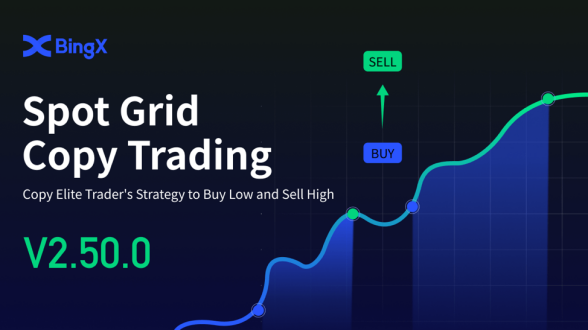
BingX, the leading crypto social trading platform, has introduced a new Spot Grid Copy Trading feature, offering unprecedented flexibility to users.
As the name suggests, the system combines the benefits of Grid trading with that of Copy trading, using strategies from professional traders to earn money from crypto asset volatility. Grid trading is similar to providing liquidity on AMM DEXs, as it sets up gradual buy and sell orders in a defined range of prices. As long as the price oscillates within the band, users can make reliable profit from these fluctuations.
The strategies are created by professional traders going through strict screening by BingX. Up to 8% of the followers' profits will be given to the creator of the strategy, incentivizing them to be as efficient and effective as possible. Users are presented with a choice of multiple strategies, which can be evaluated by investment amounts, past returns, projected annualized returns and many more.
For new crypto users, the Spot Grid Copy Trading is particularly valuable as it's fire and forget and easy to set up. The consistent income can be incredibly valuable, especially in a flat ranging market like that of early 2022.
"We are very excited to launch our Spot Grid Copy Trading Feature. We've promised to give our users new cutting-edge features throughout 2022 and we are doing just that. In an industry where innovation is at its peak, it is crucial for BingX to remain competitive by way of innovation. Both our product and marketing teams have been working tirelessly behind this scene to add more value for traders with the spot trading arena being the epicenter. We also understand that being a first mover in the industry comes with several advantages which we hope to capitalize on. Users can look out for more spot trading pairs being listed as well as other new innovative tools from BingX." - Public Relations & Communications Director at BingX, Elvisco Carrington
Over 300 spot cryptocurrencies such as Ape Coin, Chainlink, Shakita, STAKE, CVX and IDEX have already been listed on BingX with plans in motion to further optimize the spot investment experience for users.
- 01:00 am
nCino, Inc., a pioneer in cloud banking and digital transformation solutions for the global financial services industry, and Natixis Corporate & Investment Banking (Natixis CIB) announce their partnership to streamline and automate several of Natixis CIB’s processes.
Natixis CIB, part of Groupe BPCE, the second-largest banking group in France through the Banque Populaire and Caisse d’Epargne retail networks, is using nCino to speed up its credit journeys, improve efficiency, and deliver intelligence into the financial analysis process by adopting Automated Spreading, which is powered by nCino’s artificial intelligence (AI) application suite, nCino IQ (nIQ®), as part of the cloud-based nCino Bank Operating System®. Natixis CIB will also use nCino’s Corporate Banking Solution to eliminate manual processes and automate repeatable tasks for seamless collaboration across deal teams and faster credit decisioning to deliver an enhanced client experience with embedded regulatory compliance and procedures.
Anne-Christine Champion, co-Head of Natixis CIB said: “Under our 2024 strategic plan we are investing significantly in technology to strengthen our competitiveness and attractiveness. Our decision to implement nCino’s solutions as part of the digital transformation of our financing activities reflects our commitment to make our processes faster and more robust, and ultimately to enhance the service we provide to our clients.”
“We are extremely proud to be working with Natixis CIB,” said Pierre Naudé, Chief Executive Officer at nCino. “The nCino platform is well positioned to support financial institutions in France and globally, and we are very excited to provide Natixis CIB with an agile single platform that enables the bank to have more automated, digital processes, allowing front office and risk teams to focus on analysis, credit decisions, and providing greater value to their clients.”
- 05:00 am
Worldline, a global leader in payment services, has extended Scan & Go to nine Carrefour Proximité stores in March 2022.
The past two years have seen a ramp-up in the pace of developments in which Worldline was already actively involved, leading to more digital payments and the growth of e-commerce. In France, the use of mobile payments has doubled over the last two years and half of French people intend to use their smartphones to pay for items in stores[1]. Furthermore, 76% of consumers would choose not to buy an item if they had to wait too long at checkout[2].
An innovative and safe experience for retailers
The collaboration between Worldline and Carrefour’s convenience store network responds to the new challenges within the customer experience, with consumers’ increased expectations of their in-store experience and the payment sector itself subject to constant change.
The solution developed by Worldline offers retailers complete peace of mind when making sales, while also responding to new market expectations and reducing consumer frustration.
A straightforward solution for an improved consumer buying experience
Scan&Go, which uses the WL Scan & Pay solution, is an in-store self-scanning app. For the first time, Carrefour Proximité customers can do their shopping completely autonomously at a number of the chain’s stores using a web app that opens in just a few seconds in any mobile web browser without the need for downloads. The app works in off-line mode for the duration of the customer’s shopping. An internet connection is not needed until the point of payment. The customer’s smartphone experience consists of four stages:
- Scan a QR code on entering the store to access the web app
- Scan the items chosen
- Pay using their smartphone
- Show their receipt upon leaving the store
The app is intuitive, easy to use and practical, meaning shoppers do not have to go through checkout, and delivers an innovative solution that meets consumers’ expectations.
Eric Thomas, Project manager—IT coordination at Carrefour Proximité, comments: “The way in which we shop and pay for goods and services has changed dramatically. The health crisis has only increased the pace of change that was already happening, and contactless payment or payment by mobile phone have become essential services for customers of these stores.”
“Worldline is pleased and proud to be working with Carrefour Proximité on implementing digital tools able to respond to its customers’ expectations and ensure secure payments,” stresses Ariane Pottlitzer, Head of Digital Services & Products at Worldline.








