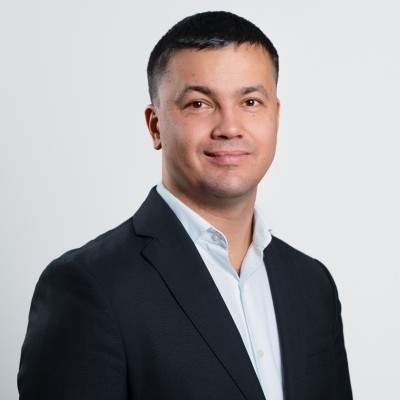

Form3: How Cloud, Agentic AI and Stablecoins Are Redefining Payments
- 01.07.2026 -- 09:36 am
- Mike Walters, CEO & Co-founder , Form3
Interview with Mike Walters, CEO & Co-founder of Form3 At Money20/20 Europe 2026, Financial IT caught up with Mike Walters, CEO and Co-founder of Form3, to discuss the forces reshaping payment infrastructure — from cloud-native architecture and instant payments to agentic AI and the rise of stablecoins. Financial IT: What's the biggest shift...

Jon Cosson Sees AI as a Cyber Security Protector and Threat
- 21.05.2026 -- 01:02 pm
- Mark Chillingworth, Editor & Founder, Horizon Digital Leadership Network
Artificial intelligence will keep wealth and investment management services firm JM Finn secure, and with careful consideration of the business requirements, deliver business process improvements. Jon Cosson, Head of IT and CISO for JM Finn, was at the recent Nutanix .Next conference in Chicago, USA, and answered our questions on how he is balancing...

Making AI Part of Everyday Work
- 20.04.2026 -- 08:21 am
- Niv Liran, Chief Product and Technology Officer, Unzer
AI is quickly becoming part of everyday work. But while many organizations focus on deploying tools, the bigger challenge often lies elsewhere: helping people understand how to use them confidently. For Niv, Chief Product and Technology Officer at Unzer, AI transformation is less about technology and more about AI fluency across the organization. In...

The End of Payment Fragmentation? PayDo’s Vision for a Unified Financial Ecosystem
- 13.04.2026 -- 03:17 pm
- Serhii Zakharov, CEO and Founder, PayDo
How PayDo is eliminating complexity in global payments through a unified infrastructure approach As global commerce becomes increasingly digital and borderless, the complexity of payments infrastructure continues to grow. Merchants today are expected to navigate a fragmented ecosystem of banks, payment service, providers, payment schemes and...

Global Settlement Has an Incentives Problem
- 01.04.2026 -- 09:14 am
- George Davis, Founder and CEO, Lorum
The standard explanation for friction in global payments is that the infrastructure is old. George Davis, Founder and CEO of Lorum, disagrees. In this Q&A, he argues that the real issue is structural: clearing and settlement still operate inside institutions whose economics are shaped by lending, not by the movement of funds. The industry...

The Human Layer of AI in Compliance
- 27.01.2026 -- 10:12 am
- Shani Golov, VP of Sales, ThetaRay
Interview by Tawney Kruger, Editor, Financial IT Artificial intelligence in financial crime compliance is evolving rapidly. Yet, as the technology matures, so do the questions surrounding trust, explainability, and the future role of human analysts. I sat down with Shani Golov, VP of Sales at ThetaRay, to explore how AI is reshaping transaction...

Fintech’s Resurgence: A Conversation with Markus Fehn
- 05.11.2025 -- 06:08 am
- Markus Fehn,, Head of Strategy and Innovation, Chartered Investment
By Financial IT Magazine As fintech enters a new phase of maturity, the lines between traditional finance and digital innovation are blurring fast. Markus Fehn, Head of Strategy and Innovation at Chartered Investment, shares how the company is bridging that divide — from early blockchain experiments to BaFin-regulated tokenization — and why the...

Scaling FP&A With AI, Customer Obsession, And Global Ambition
- 02.10.2025 -- 03:14 pm
- Jorge Lluch , COO, Abacum
Financial IT’s Tawney Kruger sat down with Abacum COO Jorge Lluch to discuss the company’s recent $60 million Series B raise, its journey from inception to today, and the evolving role of financial planning in the age of AI. Tawney Kruger (Financial IT): Jorge, welcome. It’s great to finally have you with us. Congratulations on...