
Published

Vince Graziani
CEO at IDEX Biometrics
Mastercard’s recently launched see more
- 06:00 am
International multi-asset trading platform Vantage (or "Vantage Markets") is announcing the launch of Vantage Connect, a liquidity solution for institutions and corporates in the UK.
To be officially announced at Finance Magnates London Summit 2022, the news comes as part of a wider strategic push by Vantage to expand the institutional side of their business in response to growing demand among hedge funds, family offices, banks, brokers, money managers and asset managers for bespoke trading solutions.
Widespread volatility has led to a 17.2% year-on-year increase in trading volumes globally this September. This presents both risks and opportunities for institutions, who must navigate rapidly changing market conditions, such as the LSE widened the spread limit on UK gilts, as well as bigger spreads, such as on the CFD and derivatives contracts that are commonly used in hedging strategies.
Vantage Connect allows these institutional clients to manage volatility effectively and make the most of market opportunities by leveraging Vantage's deep liquidity pool to buy and sell complex assets quickly.
The offering is customised depending on what the clients' needs are across the full range of Vantage's services, including in-house built risk management and their unique PAMM (percentage allocation management module). It is quick and secure, as clients can easily plug into the service via an API, ensuring speed to market, and are protected under Vantage's FCA license.
Vantage Connect will be exhibiting at this year's FMLS and will be joined by the McLaren Extreme E team, who will be featuring their new vehicle.
David Shayer, UK CEO at Vantage, commented: "Market volatility often brings opportunities for those who know where to look, and we've seen the increasing volumes over the last few months. We've built up a strong retail solution, and now is the right time to expand to institutional investors. We have a strong team in the UK, all of whom are excited to launch the new service, which ensures that Vantage can be a trusted partner and a one-stop shop for the institutional trading community, and gives them the springboard to make the most of the market opportunities."
- 02:00 am

Global financial technology company SumUp has today unveiled a new suite of POS solutions - with the launch of POS Lite in the UK, Ireland, France, Germany and Spain, alongside the new and improved Point of Sale system POS Pro. With POS Lite the company is creating an entry-level Point of Sale product that will serve the smallest businesses. With the improved POS Pro, SumUp is expanding the product suite for businesses of all sizes, whatever their needs, building on the success of the POS solution. By merchant count, SumUp is already on course to become the leading POS solution in Europe by the end of the year, and these new products will accelerate that pace.
SumUp co-founder Marc-Alexander Christ comments: “SumUp has consistently delivered cutting-edge technology, which supports and serves the global small and nano business community. By expanding our Point of Sale solutions, SumUp continues to provide merchants with the tools they need to make a success of their business. Innovation is at our core, and SumUp is very proud to support over 4 million merchants around the world.”
POS Lite is an out-of-the-box Point of Sale solution that will empower nano to small merchants to perform smooth over-the-counter sales with a key set of features: from registering card and cash payments to organising the merchant’s item catalogue, tracking earnings, and much more. Unlike what the market offers today, it's ready to use straight away, comes with free pre-installed SumUp Point of Sale software, and no subscription charges. It is built entirely in-house by SumUp, based on merchant feedback: merchants with a growing business are looking for easy tools to run their business but don’t need a full-fledged Point of Sale solution just yet.
The latest offering combines proprietary hardware (a 13” splashproof touchscreen, die-cast aluminium stand, card reader) with SumUp’s user-friendly software, accessible and easy-to-use interface and compatibility with multiple printers and cash-drawers. Merchants will pay a one-time price of £199 (at launch - which covers the hardware) and it requires no monthly subscription. No longer will merchants have to make multiple purchase decisions and wonder about compatibility to have a POS solution (iPad plus card reader plus software subscription plus any additional tech), and gone are the days of poorly designed systems.
The dedicated POS Lite hardware is built to keep up with everything that is happening on the counter of a small business and offers merchants access to the entire SumUp ecosystem with a myriad of products - from invoicing to an online store and business account.
SumUp has also unveiled new features to its POS Pro product that will be available in the UK and Ireland, France, Spain and Germany. SumUp POS Pro enables merchants to process multiple orders concurrently. Merchants from a range of sectors are capitalising on POS Pro’s capacity to efficiently handle several transactions at once and a prime example is restaurants being able to route different orders, e.g. sending multiple table order tickets to the kitchen or bar all at once.
The technology can be used by merchants of any size, ranging from small segments all the way up to large restaurants, coffee shops, and at major stadiums. With SumUp POS Pro, merchants can access meaningful analytics, stock management, and reporting capabilities that allow them to make smarter business decisions and further their growth. Solutions can be adapted to a merchants’ needs as a company grows and evolves - what was suitable last year might be too small now, and SumUp can seamlessly update the available technology, and integrate it into a businesses’ workflow. POS products can be integrated with third-party software extensions such as delivery systems, click and collect, reservations and loyalty programmes, and more.
The POS product launch and updates quickly follow the launch of SumUp Magic Pay in the summer. Now, at the end of a meal, everyone at the table can receive a copy of the bill, by scanning a QR code on the table. From there, a bill can be split, a tip added, and payment conducted (Apple or Google Pay both an option). Receipts can be sent via email as well. No app, account or any admin - just scan, split, pay. Another way that SumUp is giving merchants of all sizes the best possible tools to do their job and get paid.
- 03:00 am
Securrency, a leading developer of institutional-grade, blockchain-based financial and regulatory technology, today announced that it has received a United States patent for its Compliance Aware Token® Framework (CATF). This framework is a critical step in Securrency’s four-phase vision that includes:
• Tokenizing financial assets at scale
• Interconnecting global marketplaces on a universal transaction and compliance rails
• Accelerating decentralized finance by combining powerful smart contracts with automated business logic
• Enabling a global, liquid digital assets marketplace available to all
In landmark pilot projects with global regulatory agencies and in commercial deployments with world-class financial institutions, Securrency has demonstrated how CATF can solve some of the most pressing issues for digital assets by allowing issuers, their agents, and intermediaries to:
- Easily build rule sets into a token for: identity authentication and authorization, securities regulations, and transaction and liquidity requirements
- Automate multi-jurisdictional compliance and risk-management functions, such as preventing fraud, enforcing holding periods, and applying trading volume and collateralization rules
- Repeat and reuse rule sets to streamline compliant digital asset creation and issuance
- Audit rule sets to facilitate reporting on tokenized securities offerings
- Empower authorized individuals or entities to freeze or claw-back tokens from a user wallet in, for example, a tax, bankruptcy, or criminal proceeding
Dan Doney, CEO of Securrency, said: “A massive wave of regulated asset tokenization is fast approaching. Basic tokenization without sophisticated, automated compliance isn’t going to cut it when it comes to equities, public funds, fixed-income products, and fiat currencies. Financial service providers will need to implement tokenization solutions that encompass identity, security, risk, transaction, and liquidity rules to succeed in a digital assets market that is expected to reach over $16 trillion by 2030. This requires new ways to scale compliance, and our patented Compliance Aware Token Framework will be the foundation for achieving this critical industry milestone.”
Jonathan Steinberg, CEO, WisdomTree, said: “We expect all financial assets to eventually move onto blockchain infrastructure. As first-movers, WisdomTree and Securrency are focused on leading the way with a sophisticated, compliance-centred approach to blockchain-enabled financial products and services as we create the digital marketplaces of the future.”
Nadine Chakar, EVP, State Street said: “Compliance is fundamental to the evolution of digital assets as it will expand global access to capital and investments, help with institutional adoption, and allow for
appropriate regulations. As an early investor in Securrency, we saw the potential of the company’s compliance technology as a key element in State Street’s digital asset strategy.”
Securrency’s Compliance Aware Token® Framework simplifies critical functions like custody, transfer agency, and regulatory compliance and is enabled by four key components of Securrency’s Capital Markets Platform:
- Identity Services support fast onboarding and authenticate investors based on flexible third-party credentialing systems such as Anti-Money Laundering (AML), Know-Your-Customer (KYC), and Know-Your- Business (KYB), using an open identity-proofing approach
- Attestation Registry provides real-time, risk-based authorization for market participants to engage in transactions for which they are properly credentialed based on factors such as their location and regulatory requirements
- Policy Rules Engine provides a real-time representation of cross-jurisdictional, asset-specific, and dynamically configurable policies through an intuitive, user-friendly interface so compliance can be embedded in every transaction through smart contracts
- Compliance Oracle enables tokens to reference encoded rules and regulations, ensuring that a tokenized or digital asset may only be transacted in accordance with specified policies
- 06:00 am
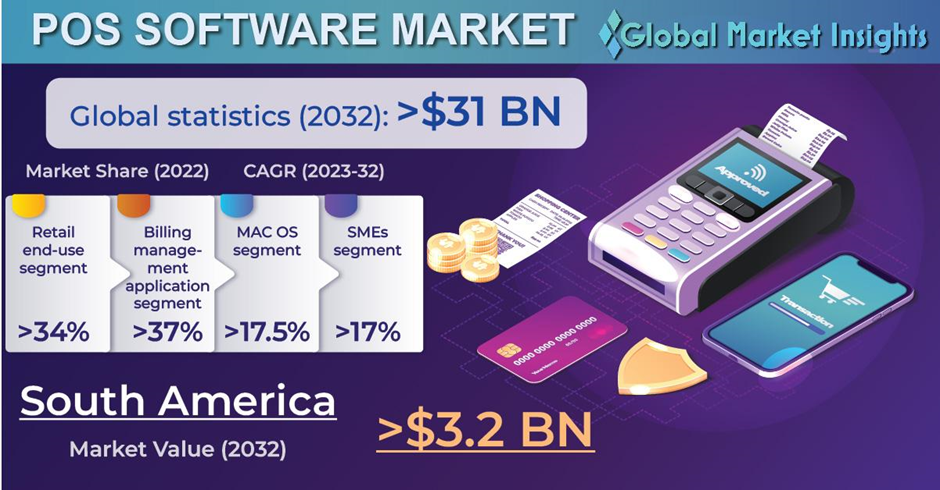
As per the report by Global Market Insights, Inc. “Worldwide POS Software Market was valued USD 7 billion in 2022 and will surpass a revenue collection of USD 31 billion by 2032 with an annual growth rate of 15% between 2023 to 2032.”
The significant strides in the retail industry along with the increasing consumer spending capabilities have largely contributed to the higher volume of transactions and payments. Consequently, there is a stronger need for streamlining the retail operations as well as automating the transaction process whilst tracking important sales data. To that end, the POS software market is expected to witness massive momentum in the near future.
In addition to processing customer transactions as well as accepting payments, point-of-sales (POS) software assists in updating inventory levels for retail establishments. In fact, it also comprises helpful tools, such as inventory management, sales reporting, and integrated loyalty programs. In light of their various benefits, leading technological entities are engaging in numerous inorganic strategic ventures for increased global penetration. Stating an example, in August 2022, Toshiba Tec opened a U.S. hub in Texas, Dallas for developing and marketing the point-of-sale software for retailers.
Mentioned below are some prominent end-user industries that will infuse a positive scenario for the growth of this industry space
Restaurants
POS software is calling for significant deployment in restaurants for limiting manual labour and simplifying operations whilst processing transactions. Using a single point of sale system, hotel owners and managers are now able to easily manage all the restaurant operations associated with orders, bookings, inventory, and cash flow. To illustrate, Digirestro is an increasingly adopted digital restaurant POS system enabling hotels, restaurants, and cafe managers to smoothen their workflows and operations.
The advent of cloud technology is also supporting the demand for humble POS systems for complete restaurant management. The increasing integration of the software with various third-party applications, including online ordering, E-wallets, table reservations, and loyalty programs is also adding to the industry development.
Healthcare
The POS software market will witness significant expansion from the healthcare sector, given its increasing adoption for managing bills, invoicing, accounting, order taking, and delivery, among other applications. Equipped with a high-class touchscreen display, the POS systems offer the best touch response as well as good screen resolution for ensuring smooth readability. In recent years, mobile point of sale (MPOS) technology has grown extensively favoured as it offers faster inventory count and asset tracking in stores, supports checking-in registration counters, and provides inpatient care within hospital wards for medical supervision.
Retail
Of late, the demand for retail POS software is picking up a significant pace as it enables the retail staff to deliver higher service levels as well as build customer loyalty in omnichannel scenarios. Using this technology, retail businesses are now able to find information about products, accept payments, and create sales orders, whilst expeditiously delivering receipts. The software also provides information to the customers on product availability and pricing. There has also been a considerable influx of various advanced POS solutions for delivering functionality to manage inventory and customer profiles.
The advent of various new technologies is expected to make way for innovative POS terminals in a host of industries for minimizing human error when it comes to pricing adjustments. Increasing strides in POS innovation for providing hoteliers with compiling guest profiles and the benefits of payment option flexibility are other trends driving the growth of the POS software market.
- 02:00 am
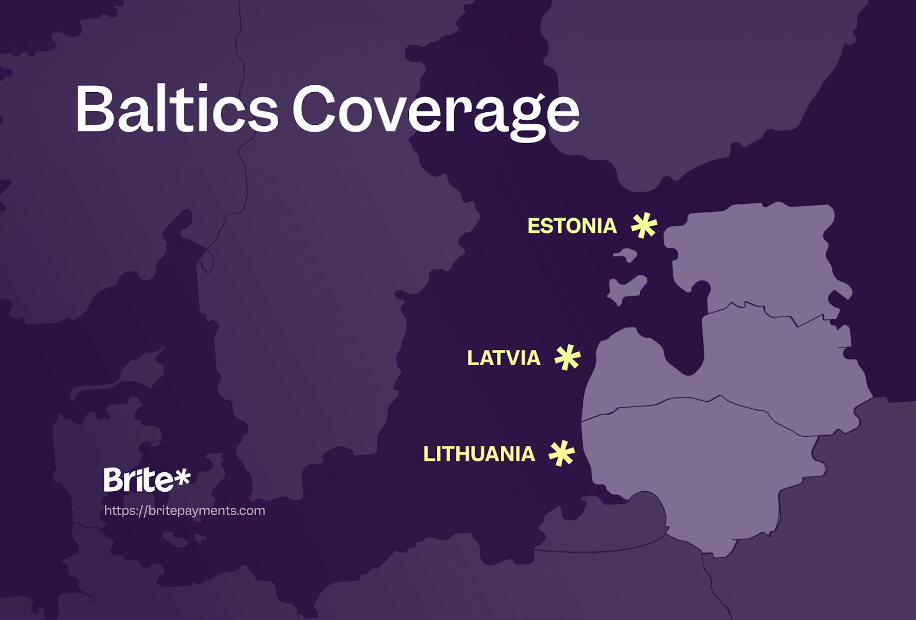
Brite Payments today announced further expansion to offer full product coverage across the Baltic region, following the successful launch of its instant pay-ins solution in Estonia earlier this year.
Utilising the Open Banking framework, Brite Payments facilitates account-to-account (A2A) payments without the need for customers to input cumbersome card and personal data. The Stockholm-based instant payments specialist now offers its innovative instant pay-ins and pay-outs products in Estonia, Latvia, and Lithuania.
The quick, simple and secure pay-ins solution enables customers to pay straight from their bank account with a single authentication step (except for cases with applicable regulation). Additionally, the convenient pay-outs solution facilitates the rapid receipt of funds from merchants to consumers in fields such as insurance, financial investment, and gig economy wages.
The Baltic region, with a population of more than six million, has become a fintech hotspot and is at the forefront of digitalisation and developing technical infrastructure. Brite’s expansion presents an opportunity for the company to offer A2A payment products with which consumers are already familiar and ready to adopt.
Brite’s announcement follows a period of strong demand for its innovative solutions with several milestones achieved in 2022, including the launch of its convenience-driven Single Sign product and a much-celebrated partnership with European’s payments giant, SOFORT. The business is on a growth trajectory with several recent strategic hires to support its ambitious upcoming market expansion plans.
With local operations already established in the Baltics and existing customers trading within the region, Brite is primed for further growth and is excited to offer its solutions to local customers.
“We are really proud to announce that we now offer full coverage across the Baltic region, and are able to impactfully serve both local and Nordic merchants. This move represents another big stride forward in our mission to bring quick, easy and secure instant payments to customers and merchants across Europe,” said Lena Hackelöer, CEO & Founder, Brite Payments. “The Baltics have been on our radar since our inception in 2019 and we have been really pleased to see the population’s adoption of digital payments.”
In addition to this regional expansion, Brite Payments is continuing to expand its product portfolio, with upcoming developments built on PSD2 APIs. Brite has more than doubled transaction volumes processed over the past year, with the full launch across the Baltic region expected to drive further user growth.
“Customer convenience is at the forefront of what we have created at Brite, and now with full product coverage in the Baltics, we will allow users to authenticate and pay instantly, as efficiently as possible,” she continued.
- 09:00 am

Markor Technology has partnered with Sumsub to provide enhanced verification and fraud protection while ensuring full compliance.
Sumsub is a global tech company with five international offices in London, Berlin, Cyprus, Tel Aviv and Miami. It offers businesses an all-in-one verification platform that secures the whole user lifecycle with customizable KYC, KYB, KYT, and AML solutions. Sumsub helps 2,000+ clients across the fintech, crypto, shared mobility, trading and gaming industries expand to new markets while staying fully compliant with shifting regulations.
Markor Technology has rapidly started to establish itself as a globally-recognised provider of B2B and B2C technology solutions to the iGaming industry, supplying multi-product and multi-licensed PAM (Player Account Management) and aggregation platforms and a comprehensive line-up of products and services.
“Markor Technology aims to offer world-class gaming services and the best customer experience through cutting-edge technologies. By partnering with Sumsub, we stick to our high standards by providing fast and flexible onboarding, compliance and antifraud solutions to our clients in the iGaming industry,” says Melissa Summerfield, CEO of Markor Technology.
“Finding a trustful iGaming partner like Markor Technology is an honour for us because we share the same goal of creating a responsible iGaming environment, enabling players to enjoy online gaming and gambling services freely and safely. We’re making this a reality by offering end-to-end KYC, KYT, and AML solutions to effectively onboard honest users and keep fraudsters out,” adds Andrew Sever, Co-founder and CEO of Sumsub.
- 08:00 am

Banked Ltd (“Banked”), the London-based fintech company building a next-gen global payment network, today announced that it has raised over $15 million in a Series A extension round, led by global software investor Insight Partners. The investment round was supported by Citi and National Australia Bank Ventures, recognizing Banked’s traction and distinct approach to building a Pay by Bank global network. Newly announced commercial partner and global payments firm Rapyd also participated in the round.
The extension came as a result of an oversubscribed Series A earlier this year that was led by Bank of America. This latest infusion of capital brings Banked’s total investment raised to date to over $50 million and includes the participation of new global investors supporting the company’s expansion into new geographies with a focus on the U.S.
Insight Partners is an experienced investor in the open banking space, having previously invested in Tink AB which was acquired by VISA last year. The growth and expansion adds to the major partnership Banked announced earlier in the year with Bank of America. In a demonstration of Banked’s commitment to the US and as a signal for how important the country will be to its future strategy, Banked opened an office in Palo Alto, California and CEO Brad Goodall has relocated from London to lead this expansion.
Banked now has close to 100 staff and is growing at a time when many fintech rivals and the industry at large have been put under huge pressure to consolidate. This is due to increasing merchant demand and accelerated interest by banks to play a role in the expansion and commercialisation of real-time payment rails globally.
“Pay by Bank is taking off globally. Leading banks recognise the significant opportunity it presents to improve the end-customer experience and merchant value proposition. This is supported by increasing merchant demand driving use cases for Pay by Bank in the enterprise B2B and B2C space. There is a queue forming to be part of the new payment network and to help shape its future with a seat at the table. Banked has a unique partnership model which relies on global go-to-market partners in the shape of banks, PSPs and technology platforms. This means we have had to build real depth and capability in areas such as risk and compliance, security, consumer protection, platform scalability and most importantly feature-rich user experiences for our partners and their clients and customers. Banked has been heads down building products and partnerships for four years and it is exciting to be launching markets globally at pace now.” - Brad Goodall, Banked : CEO
Of the new investors, Goodall says, “Insight Partners is an amazing global firm with such strength in the payments and fintech space. To increase our share price in this current market with overwhelming demand from investors, I couldn’t be happier to have Insight onboard to build what is a multibillion-dollar opportunity. I am also excited that Citi, NAB and Rapyd are joining as it shows that Banked has real strength in working with the biggest and best banks and payment firms in the world.”
“Banked has a huge ambition and we believe they have built the team and product to tackle such an exciting opportunity in payments. There are many ways to approach the problem, and Banked's unique strategy in partnering with commercial banks and payment service providers, as well as their product capabilities, stood out to us.” - Byron Lichtenstein, Insight Partners
- 02:00 am
Payments 20 (P20), the leading voice of the global payments industry, has published a new report calling for collaborative action within the industry to improve the efficiency and accessibility of cross-border payments.
The value of cross-border payments is estimated to increase from $150 trillion in 2017 to $250 trillion by 2027. The World Bank monitors the global average cost of sending a $200 international payment which in June 2022 stood at 6.01% with the target of halving this figure to 3% by 2030.
The advocacy group, alongside leading organisations including AfricaNenda, the Bank of England, Bank of America, EY, FIS, Hogan Lovells, J.P. Morgan, Mastercard, NatWest, New York State Department of Financial Services, UK Payment Systems Regulator and The Clearing House, has created a new report entitled “Toward Borderless Payments”. The report outlines several best practices calling for collaboration between public and private sectors in delivering real improvements to the cost, speed, transparency and accessibility of cross-border payments.
The primary objective of P20’s new report is to harmonise cross-border rules and regulations on interoperability, efficiency and cost while ensuring that there is a continuing decrease in fraud and money laundering.
The report provides some recommendations to help the industry move towards borderless payments:
· Improving regulation and standards – Adopt ISO 20022 as the global messaging standard and improve collaboration between legislators and regulators. Develop common sharing standards for both data sharing and digital currencies that ensure robust regulatory compliance, alongside a standardized approach to KYC, AML and CFT sanctions.
· Combating Financial Crime – Educate consumers on the culture of ‘Stop, Challenge and Protect’ method of combatting online fraud. Deliver and reinforce several key messages relating to online safety while accelerating the use of AI in monitoring and identifying suspicious activity.
- Improving efficiency – Implement best regional practices with the aim of linking standards globally. Create payment system operation hours with a 2–3-hour window of worldwide access, enabling real-time access and immediate confirmation without facilitating financial crime. Reduce friction by examining screening frequency, value thresholds, intermediary dependency, interlinking payment systems and reciprocal liquidity arrangements.
Duncan Sandys, Chief Executive Officer at P20, comments: “The inefficiency of cross-border payments is well known and lags behind the improvements seen in domestic payments. This stifles global trade and particularly hurts SMEs who are the engine room of economic growth. Harmonizing cross-border rules and regulations on interoperability, efficiency and cost while ensuring that there is a continuing decrease in fraud and money laundering would be transformational for the payments industry and global economy. However, this can only be achieved through collaboration between governments, regulators and industry. This report is designed to add to conversations already taking place among these organisations and help fuel the drive towards borderless payments.”
Mark Monaco, Head of Enterprise Payments at Bank of America, commented: “Harmonization of technology standards is achievable. The more substantive challenge is aligning or harmonizing schemes from rules and regulatory perspective. The key items to focus on are AML and CFT rules, ensuring that those are applied consistently and comprehensively and sharing KYC and identity information.”
Victoria Cleland, Executive Director for Payments Bank of England, commented: “In a world of increasing global trade, cross-border payments are becoming far more important. Increased efficiency of cross-border payments is vital but difficult to achieve – the frictions in cross-border payments are many and deep. This is why the G20 published in 2020 a roadmap to enhance the whole cross-border payment ecosystem. It doesn't just look at the core payment systems, or regulatory issues or data issues, but is instead holistic, with a focus on both improving the existing system and more forward-looking initiatives.”
Sara Castelhano, Managing Director & Head of EMEA Payments & Commerce Solutions Product at J.P. Morgan commented:“In my view, I don't believe a single global payments area is achievable. But I do believe that, as a global payments industry, we can come together and agree on foundational information transfer between institutions and countries, such as using ISO 20022 and better interoperable standards across countries. That will ensure that transferring information becomes better, enriched and more secure.”
Simon Eacott, Head of Payments at NatWest, commented: “In time, all payments, domestic and cross border, will be instant or in near real-time. But already a great deal of progress has been made, the days when a cross-border payment could take days to arrive and required multiple banks with opaque fees are long gone. Today, most cross-border payments arrive in less than 30 minutes, and the enhancements we have seen to country corridors and domestic infrastructures continue to improve transparency and speed.”
Elena Whisler, Senior Vice President, Sales & Relationship Management at The Clearing House, commented: “ISO 20022 may not be a silver bullet for payments specifically or for others but, if utilized correctly, it does create an opportunity for more robust payment messages across different jurisdictions and even domestically will enable more information to be carried. So even though different systems may use ISO 20022 in slightly different ways and accommodating for local differences, a common standard allows for easier access and interoperability as the global environment becomes more concentrated and consolidated.”
- 03:00 am
The Global Legal Entity Identifier Foundation (GLEIF) today announces that it has expanded the scope of its collaboration with Swift by providing certification for the mapping of the Market Identifier Code (MIC) to the Legal Entity Identifier (LEI). The resulting launch of a new open-source file mapping the MIC to the LEI will further enable market participants that use GLEIF and/or Swift data, such as financial institutions and public authorities involved in risk analysis and market monitoring, to link and cross-reference key entity identifiers, free of charge. This will ease the process of gathering, aggregating and reconciling counterparty information based on interoperability across parallel identity platforms.
This collaboration between GLEIF and Swift, the world’s leading provider of secure financial messaging services, builds on cooperation established in 2018 to link the Business Identifier Code (BIC) to the LEI. The MIC is an International Organization for Standardization (ISO) code used to process and clear trades and is gaining traction as the securities industries move toward straight-through-processing.
"This expanded collaboration with Swift continues to enhance transparency and provide identity management efficiencies across global markets," comments Stephan Wolf, CEO at GLEIF. "The mapping of open LEI data to the MIC enables market participants to efficiently and accurately gather and cross-check counterparty information, decreasing the cost and potential for manual error. The LEI is a critical data connector globally and GLEIF’s continued pursuit of enhanced interoperability between the LEI and other identifier systems worldwide helps ensure that the highest quality entity identification reference data is obtainable to all. This makes it easier to conduct compliance, KYC, regulatory reporting, and due diligence."
Anne Suprenant, Head of Standards Registration Authority at Swift, said: "Collaborating with GLEIF on the certification of mapping the MIC with the LEI, is a significant milestone. Following the success of the BIC-mapping exercise, we have now extended the benefits of cross-identifier mapping to a broader audience. We now offer entity identification efficiencies that support greater trust and transparency for global market participants."
Following the successful certification process, GLEIF will publish open-source relationship files monthly, in a CSV format, which will map the MIC to the LEI. Currently, more than two million LEIs have been issued to legal entities globally. Of the approximately 2,600 MICs assigned to date, currently approximately 50% of them pertain to organizations that are legal entities or foreign branches and therefore, qualify for the mapping against LEIs. In the first published file, there are about 600 mapping pairs. This is an important foundation on which to grow this industry resource.
Swift is a global member-owned cooperative committed to providing actionable global ID and reference data services and products, like the MIC, to global market participants, including regulators and the financial services industry. These enable the unique identification, classification and description of exchanges, trading platforms, regulated or non-regulated markets and trading reporting facilities.
GLEIF encourages engagement with the GLEIF Certification of LEI Mapping service, which is available to interested data vendors and other organizations free of charge. GLEIF is already working with its Vendor Relationship Stakeholder Group to advance its mapping certification objectives.
In addition to providing MIC-LEI and BIC-LEI mapping certification, GLEIF has also certified a mapping relationship between International Securities Identification Numbers (ISIN) and the LEI in the past, working in collaboration with Association of National Numbering Agencies (ANNA).








