
Published
- 03:00 am
FOMO Pay, the Singapore-headquartered major payment institution, announces that it has become an official SWIFT member and obtained its own Business Identifier Code (BIC), also known as SWIFT Code: FOMPSGSG.
This is a meaningful achievement for FOMO Pay in its pursuit to provide more efficient, secure, and reliable payment services. FOMO Pay will utilize the SWIFT Code to eliminate manual errors, reduce transfer fees and times, and streamline business transaction processes, thus enhancing its clients' global collection and payout experiences.
SWIFT is the world's leading financial messaging service provider, connecting more than 11,000 banks and financial institutions in over 200 countries. SWIFT Code is used to identify financial institutions and allow them to communicate with one another for seamless fund transfers.

Nayan Ramani
Product Manager at Google
The world of fintech is constantly and rapidly evolving. see more
- 06:00 am
As the year winds down, reflecting on fintech news' highs and lows is appropriate.
2022 began well. Mega funding rounds continued and venture funding was plentiful. However, the second quarter changed things. Alongside with other crises, FTX collapsed has left a visible footprint on crypto market. But first, let’s have a look at positive stories – best partnerships, job moves, M&A deals, large funding rounds of unique startups that are transforming the whole fintech market in a number of different industries, including paytech and rapidly developing web3.
Here are top 10 stories that influenced whole fintech market in 2022.
Brex Reaches $12.3B Valuation and Hires Former Meta Executive as Head of Product. Brex raised $300 million in a Series D-2 round in the latest fintech megaround, raising its valuation to $12.3 billion. Moreover, Brex hired Meta (formerly Facebook) executive Karandeep Anand alongside the funding announcement. After leading Meta's business products group, which served over 200 million organisations, Anand was named chief product officer. Anand oversaw the Azure cloud and developer platform product management strategy for 15 years at Microsoft.
SoFi Technologies acquired Technisys for $1.1B. This all-stock purchase represented 10% of SoFi's market capitalization in February. SoFi now owns Technisys' main banking platform, which powers mobile banking apps, opens accounts, and tracks consumer deposits. SoFi is offering offer personalised financial services to its banking customers using Technisys. It will also allow other banks and FinTech companies to use the Latin American bank-dominated platform.
Global Payments acquired fellow paytech EVO Payments for $4B in August. Global Payments pays $34 for each EVO share, a 24% and 40% premium on its closing price and 60-day average price, respectively, in the $4bn purchase. By purchasing EVO Payments, Global Payments wanted to extend its targeted markets, leadership, presence in new and existing geographies, and B2B software and payment solutions with accounts receivable software with broad third-party acceptance with the acquisition.
UBS' $1.4bn all-cash acquisition of automated wealth management business Wealthfront was a notable acquisition this year. This acquisition helped UBS grow in the US, access rich investors, and increase distribution. Wealthfront provides financial advice, banking, and investment management to millennial and Gen Z clients. It manages $27bn for 470,000 US clients. Wealthfront, along with remote human guidance, will form UBS's digital solution for affluent investors.
Ramp raised $759M in funding and reached $8.1B valuation. Given that Ramp only became a unicorn a year ago with a $115 million round, the impending decacorn valuation is fascinating. It raised $300 million at $3.9 billion last August. Ramp's finance automation tool saves thousands of organisations 3.3% and closes books 86% faster. Ramp, founded in 2019, powers the fastest-growing corporate card in America and facilitates billions of dollars of sales annually.
Other megarounds of this year include Acorns, Toss, Novicap, Stax, MFS Africa, Interswitch, Covalto, FinAccel, Lendbuzz, Nelo, Mineplex, TripActions, Step, Pie Insurance, Power, Liberis, AtoB, Neon, Capital on Tap, Cross River, ClearBank, Clara, Checkout.com, SpotOn, DailyPay, Flutterwave, GoCardless, Xendit, PayFit, Deserve, Capchase and many more.
Looking back at the negative events of the year, we can assume that most of them were caused by the global recession, which will be still active in the year 2023. But fintech is not the only sphere that suffered – all industries should be able to adapt.
Klarna’s valuation fell from $46B to $6.5B. In July, Swedish buy now, pay later behemoth Klarna was allegedly close to signing a new funding round that will lower its worth to $6.5 billion, about 1/7 of its June 2021 estimate. Klarna, competing with publicly traded Affirm, is expanding into the US. Klarna reported in early June that its “U.S. customer base has increased by over 65%, reaching over 25 million consumers” in the past year. Klarna's big valuation decline lends new meaning to "down round." The entire BNPL (buy now, pay later) industry has been battered recently.
Stripe’s valuation fell by 28% in July. Stripe is the latest high-profile fintech startup to see its valuation drop as the market downturn hits the sector hard. The payments processor's share value has fallen 28% from $95 billion. Over the past months, fintech businesses, which were an exception to the previous market collapse due to their robust 2021 fundraising activities, have seen their fortunes reverse. Consumer-facing fintechs like Stripe may suffer from rising interest rates and concerns about consumer discretionary spending in a recession.
FTX collapse made large tokens sink at an unprecedented rate. FTX’s troubles have had a profound effect on the U.S. crypto market. Bitcoin's price dropped below $16,000 twice in November due to FTX's issues. On Nov. 9, Ethereum fell below $1,100. On Nov. 9, CoinDesk reported that Alameda held a lot of Solana, sending it below $13. On Nov. 13, Solana fell below $13, losing approximately $700 million in assets. On Nov. 10, Tether devalued by 3%. Thus, investing in cryptocurrency became dangerous. Diversifying your cryptocurrency holdings reduces risk.
Morgan Stanley, Goldman Sachs and 14 other largest financial institutions were charged $1.1B to US regulators. In September, the Securities and Exchange Commission (SEC) fined 16 of Wall Street's major financial organisations $1.1 billion for failing to supervise employee correspondence. Barclays Capital, Citigroup, Morgan Stanley, Goldman Sachs, and Bank of America will pay SEC recordkeeping law penalties. These companies' investment banking executives, equity, and debt traders have violated the Securities Exchange Act of 1934 by using unmonitored personal devices to discuss business.
Fintech spere faced with a row of layoffs. To be precise, Chime fired 12% of employees (160 individuals), Opendoor let go 18% of the staff (500 employees), Chargebee laid off 10%, Stripe fired 14%, Pleo let go 15%. Additionally, Credit Karma and Notarize fired some of its staff, too. Most of the CEOs of the abovementioned companies complained about an ‘uncertain environment’ within the global economic arena, which was definitely caused by the COVID-19 crisis and war.
It was more than the aforementioned. Like other sectors, fintech venture dollars stagnated. In 2021 and 2022, meaningful companies with clear visions and goals survived. Fintech innovation, particularly for inclusion and access, is crucial. Many startups perform great things, and we can't allow the bad apples to ruin them. There is still a long way ahead, so we are excited for 2023 to come and bring better opportunities for young fintechs.
Happy New Year!
- 05:00 am

Despite the market downturn, Indian fintech Money View announced on Monday that it has received $75 million in a fresh investment round, its second this year, as it seeks to scale its core credit business and develop additional products for the South Asian market.
Money View raised $900 million in a Series E investment round led by Apis Partners, increasing its valuation from $615 million in a Series D funding round in March to $900 million. The business stated in a statement that it still plans to acquire additional funds and that the round hasn’t concluded.
In October, TechCrunch reported that Money View was talking to investors about raising up to $150 million at a $1 billion valuation. The startup said today that it received money from previous backers Tiger Global, Winter Capital, and Evolence as well.
Customers who would normally lack a credit score and be unable to obtain credit from banks and other financial institutions can now take use of the eight-year-old startup’s customised credit products and financial management services. Due to India’s small credit bureau data book, the majority of people in the South Asian market are credit-ineligible. Fintechs operate through a maze of regulatory arbitrage that is increasingly getting closed and contemporary underwriting technologies to lend to customers.
According to the company, Money View is now handling over $800 million and disbursing loans totalling roughly $1.2 billion on an annual basis. The firm reported $30.6 million in revenue and $2.14 million in profit for the fiscal year that ended in March, claiming that it had been profitable for the previous two years.
“Our performance and growth over the past two years has allowed us to drive our mission of true financial inclusion in India with great success,” said Puneet Agarwal, founder and chief executive of Money View, in a statement. “We are thrilled to have Apis Partners join us in our journey and with their support, we look forward to becoming India’s leading online credit platform with innovative and holistic financial solutions.”
Money View stated that it intends to use the additional capital to expand its credit company, increase its product offering to include services like digital bank accounts, insurance, and wealth management, as well as hire more people.
Its fresh investment comes at a time when deal flow activity in the South Asian market has drastically decreased as investors become warier in writing new checks and assessing their underwriting models after the valuations of publicly listed companies fall sharply.
“Money View has achieved great success already, with their credit products democratising the access for millions of customers in India, and we are truly excited to partner with the company at this stage of its journey,” said Matteo Stefanel, Co-founder and Managing Partner at Apis Partners, in a statement.
- 06:00 am
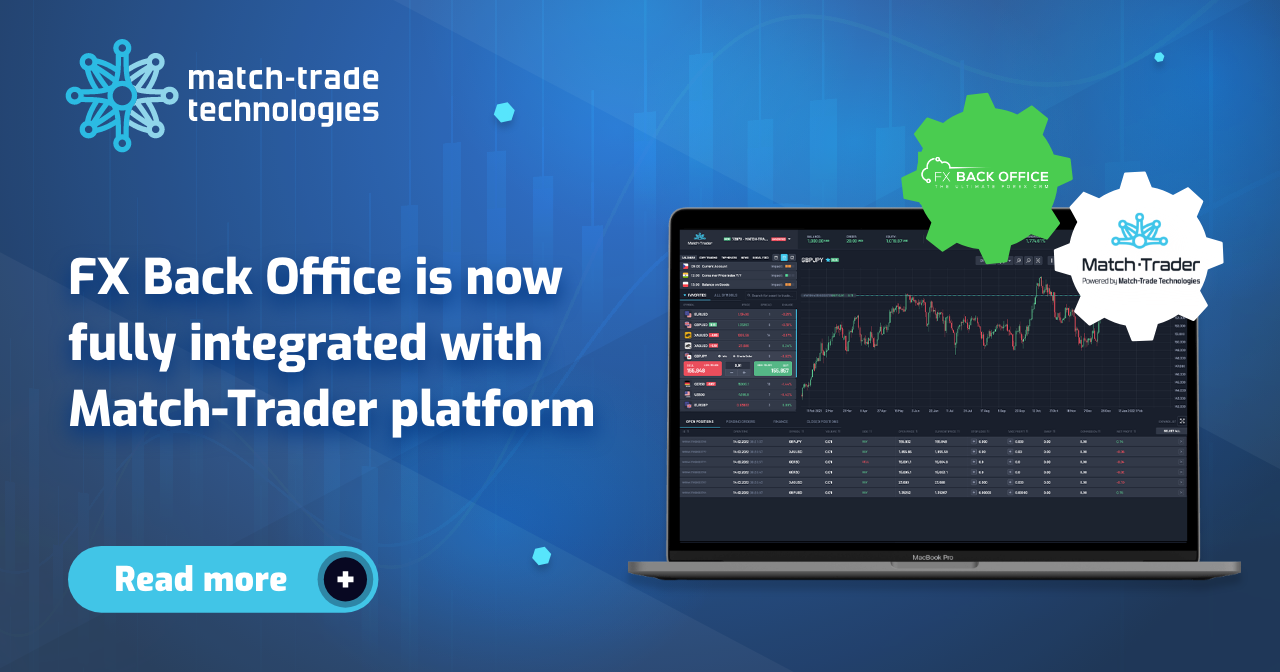
FX Back Office, a renowned CRM software for forex brokers, is now fully integrated with Match-Trader, the award-winning platform created by Match-Trade Technologies.
FX Back Office’s state-of-the-art technology and forex industry expertise make the company a leading all-in-one solution for forex brokers seeking to manage their customer relationships. To ensure that it provides clients with a complete technological ecosystem, FX Back Office is constantly improving its systems and expanding its list of integrated trading platforms, payment service providers, and more.
The integration was aimed at providing Brokers using FX Back Office the ability to offer their clients the Match-Trader platform. This year, Match-Trade Technologies introduced the Match-Trader full server solution offer. Now, Brokers can easily integrate it into their current setup to create a complete trading ecosystem. Providing traders with multiplatform support will allow them to gain more flexibility in their offerings.
Jacek Czarniawski, Head of Product Development at Match-Trade Technologies, commented on the integration, “Our collaboration with FX Back Office Tech goes back to 2021 when they integrated our processing technology, Match2Pay, into their CRM. Now they have also decided to offer their clients the Match-Trader trading platform. As Match-Trader is an open ecosystem, the integration process was very straightforward and took only a week and a half. We are happy that such an established forex provider trusts our technology. This integration is a significant step towards the expansion of our platform.”
Vasily Sokolov, Chief Technology Officer at FX Back Office Tech, added: “ We’re delighted to be working with Match-Trade Technologies. Match-Trader is one of the most powerful platforms in the trading business, and we’re happy to be able to offer it to every brokerage using our CRM and back-office tools. Ever since we’ve worked with Jacek and his team, we’ve been planning to integrate Match-Trader with our system. We’re sure that our clients and their traders will benefit from this award-winning platform.”
- 02:00 am
Nova banka a.d. Banja Luka has partnered with UnionPay to roll out UnionPay’s virtual card solution in Bosnia and Herzegovina via TIZI wallet, a universal e-wallet that will make mobile contactless payment available on its Android app through host card emulation (HCE).
Nova banka customers can use their UnionPay virtual cards located within the TIZI wallet app at Nova banka terminals and over five million merchant terminals that accept NFC contactless services in Bosnia, region and around Europe. Local residents can use UnionPay virtual cards to complete all daily transactions, such as groceries, gasoline, dining out and others.
Wang Han, Deputy Head of UnionPay International Europe said: "The partnership marks a new development in UnionPay’s card-issuing business in Bosnia and Herzegovina. TIZI wallet users can use the mobile app to make payment overseas at more than 13 million UnionPay mobile contactless merchants in 95 countries and regions outside mainland China. By using TIZI Transakcije and TAS Eastern Europe’s solutions and professional services we are delighted to be expanding our network with Nova banka to deliver a wider range of mobile payment solutions to local consumers in this region”.
Vladimir Bjelić, Head of Department for Development and Technology from Nova banka said:“As the rate of digitalization continues to accelerate, we believe that it is crucial for us to continue providing innovative payment solutions that are easily accessible by consumers, to encourage more people to go cashless. TIZI wallet offers consumers an all-in-one mobile payment solution that is contactless and secure. HCE is automatically enabled for Nova banka customers who are using Android smartphones, with UnionPay virtual card available on the TIZI wallet, where users can top up their mobile balance, shop for groceries, make travel bookings, and make payments and transfers.”
In partnership with more than 2,500 institutions worldwide, UnionPay International (UPI) has enabled card acceptance in 181 countries and regions with issuance in more than 77 countries and regions. UPI provides cross-border payment services to one of the world's largest cardholder base and ensures local services to cardholders and merchants.
- 06:00 am

2022 was a year of unprecedented changes and struggles in the financial markets. For the international broker OctaFX, it was a year full of hard work that helped achieve several significant milestones and make investing more accessible for many people around the world. Here's what 2022 was all about for the broker.
Crypto trading seven days a week
Early in the year, OctaFX made cryptocurrency trading available on the weekends. While most banks and platforms work only from Monday to Friday, non-stop trading was welcomed by traders who sought to open orders on Saturday and Sunday or could not trade during weekdays.
25 new crypto instruments
OctaFX added 25 new cryptocurrency instruments to provide its clients with more opportunities to diversify their portfolios and profit from the highly volatile nature of the crypto market.
Best Mobile Trading Platform award
One of the major awards this year, the Best Mobile Trading Platform from the international Forex news portal fxdailyinfo.com deserved a special place in OctaFX's trophy case. The winners in 27 nominations of the Forex Brokers Award 2022 were determined by public voting that reflected the views of the global trading community.
Swaps removed
Swaps (fees traders pay for leaving their orders overnight) are charged every day and tend to accumulate, making trading less profitable. OctaFX lifted this financial burden off of its clients by optimising its work processes.
Rebranding and 11th anniversary
Eleven years of providing brokerage services marked an important milestone for OctaFX. For the first time in its history, the broker decided to hold a visual rebranding, adopting a fresh new look with elegant colours, space-inspired elements, and a new logo.
Best Global Broker Asia 2022
Another essential accolade of 2022 was the title of Best Global Broker Asia from International Business Magazine, a Dubai-based financial publication. The editorial decided to honour OctaFX with the award for 'delivering the top of the line services to investing clients and partners, the most promising investment products, and its impressive figures of 12 million trading accounts throughout 150 countries—all of which are a testament to its reliability.'
150 stocks added
In November 2022, to its existing 80 CFD instruments OctaFX added 150 stocks listed on 16 exchanges. The list of stocks included some of the most notable names, such as Airbus, Amazon, Apple, BMW, and Tesla, as well as other major companies from Australia, Europe, Japan, Singapore, the U.K., and the U.S.
OctaTrader released
Towards the end of the year, OctaFX its own trading platform—OctaTrader. The platform aims to provide OctaFX's clients with a clearer view of the market, help them decrease possible risks, and streamline decision-making. Apart from that, OctaTrader is seamlessly integrated with the broker's other apps and web services.
Commitment to education
Throughout 2022, OctaFX's financial experts held over 700 webinars and workshops in 6 languages, while the broker's YouTube channel grew to more than 980,000 subscribers. For OctaFX, commitment to education means a commitment to its clients' goals, which is essential to building long-term, robust relationships with them.
Helping local communities overcome global challenges
Corporate social responsibility always remains among the broker's most cherished values. In 2022, the company's seventeen charitable initiatives included emergency response projects that helped almost 2,000 people overcome the devastating effects of the flood in Pakistan and the earthquake in Indonesia. Other projects were mostly centred around education, aiding 50 schools and organisations and more than 4,000 students of all ages in India, Indonesia, Malaysia, Mexico, Nigeria, and Pakistan.
OctaFX 2023 outlook
2022 was a year full of efficient work and impressive achievements. Some of its brightest developments are set to continue in the upcoming year. OctaFX will resume work on OctaTrader, launch in several new regions, and help more people achieve their investment goals.
- 03:00 am

Mercurity Fintech Holding Inc. (the “Company,” “we,” “us,” “our company,” or “MFH”), a digital fintech group powered by blockchain technology, today announced that on December 23, 2022, in connection with its private investment in public equity financing (the “PIPE”), it entered into a Securities Purchase Agreement (the “SPA”) with an accredited non-U.S. investor to offer and sell the Company’s units, each consisting of one ordinary share and three Warrants (each, a “Warrant” and collectively, the “Warrants”) for total gross proceeds of $5 million (the “Proceeds”). The closing of this third PIPE financing together with the consummation of the first and second PIPE financing would yield total gross proceeds of $13.15 million invested in the Company’s shares and warrants by third parties in the second half of 2022. The Company expects to use the net proceeds from the three rounds of PIPE financing to develop its Web3 and blockchain infrastructure, expand its consultation services, and pursue the licensure for a cryptocurrency (“BitLicense”) from New York State Department of Financial Services although the Company cannot provide any assurance on actually obtaining the “BitLicense” in the near future or at all.
Pursuant to the SPA, the Company shall issue an aggregate of 4,545,454,546 units at a purchase price of $0.00110 per unit for total gross proceeds of approximately $5,000,000. Each unit shall consist of one ordinary share and three Warrants, with each Warrant entitling the investor to purchase one ordinary share at the exercise price of $1/360th per ordinary share subject to certain adjustments and conditions set forth therein. The warrants shall have a term of three years from the issuance date.
The securities described above were sold in a private placement and have not been registered under the Securities Act of 1933, as amended, and may not be offered or sold in the United States absent registration with the Securities and Exchange Commission (the “SEC”) or an applicable exemption from such registration requirements.
“It took hundreds of years to build Wall Street, but with crypto, everything is accelerated. Despite the fluctuation of capital markets, we plan to dedicate three years in building the Web3 and blockchain infrastructure, and we believe that we will prosper from our business model and steadfast devotion to this exciting and ever-expanding space,” said Shi Qiu, the Company’s Chief Executive Officer. “We are proud to announce this most recent PIPE financing together with the consummation of the first two rounds of PIPE financing totalling $13.15 million in the second half of 2022. We would like to thank our investors for sharing our vision of the future and supporting our company by giving us the responsibility of building it. In early 2023, the Company plans to release a detailed growth strategy to the public to outline the Company’s strategic vision for the next three years.”
This press release shall not constitute an offer to sell or the solicitation of an offer to buy any of the securities described herein, nor shall there be any sale of these securities in any state or jurisdiction in which such offer, solicitation or sale would be unlawful prior to registration or qualification under the securities laws of any such state or jurisdiction.
- 08:00 am

Digital Asset Research (DAR), an industry-leader in cryptocurrency exchange vetting, today announced five best practice areas that institutions should consider when conducting diligence on crypto exchange platforms. Since 2017, DAR has completed quarterly reviews of 450+ crypto exchanges to identify venues that meet institutional standards, with the latest evaluation qualifying 19 Vetted Exchanges and 9 Watchlist Exchanges.
The five best practice areas that should be evaluated when performing crypto exchange diligence include strategic assessments related to the categories of: Regulatory, Governance, Institutional & Financial, Technical, and Data Science.
“In the wake of FTX, we believe the industry needs transparency and diligence to make digital assets a better place by sharing exchange vetting insights we have gathered over the years,“ said Doug Schwenk, DAR’s CEO. “It’s our goal to help more institutions make informed decisions on which exchanges are safe and appropriate to rely on for quality of pricing or other use cases.”
DAR never added FTX to its list of Vetted Exchanges list due to weak controls, including KYC and AML policies, unwillingness to respond to standard confirmatory diligence questions, and an opaque relationship to Alameda, among other factors.
Within these five best practice areas for exchange diligence, some factors DAR recommends evaluating are detailed below.
1. Regulatory Assessment – a review of the regulatory landscape where the exchange is domiciled and operates, including existing regulatory frameworks, licensing or registration requirements based on user locations, and the exchange’s efforts to comply.
2. Governance Assessment – an evaluation of the exchange’s policies across key areas such as KYC/AML, trade surveillance, listing requirements, insider access to information, handling of customer funds, personal trading, and others.
3. Institutional & Financial Assessment – a look at whether the exchange has financial strength through reserves, balance sheet, and insurance, and effectively implements the policies and governance it claims.
4. Technical Assessment – a review of data availability, downtime history, security practices or deficiencies, cold storage custody, and business continuity plans.
5. Data Science Assessment – an in-depth analysis of exchange data to see if there is any evidence in the reported trade and order book data that volume is not actual economic activity between real buyers and sellers, including looking for evidence of wash trading or other non-economic activity.
DAR’s Exchange Vetting Methodology is designed to provide market participants with a transparent view of the objective process followed to evaluate the largest digital asset exchanges by reported volume. This process aims to identify better exchange platforms and encourage best practices, promote transparency, and address concerns of participants entering the space.
The Exchange Vetting methodology is continually reviewed to ensure it meets the needs of the maturing market. DAR regularly engages with global regulators and market participants to discuss the behaviours an exchange must adopt to meet institutional requirements and investor needs.
- 09:00 am

Zurich, 26 January 2022 – Today, UBS and Wealthfront, an industry-leading, automated wealth management provider serving the next generation of investors, signed an agreement whereby UBS would acquire Wealthfront in an all-cash transaction valued at $1.4 billion. Through this acquisition, UBS will accelerate its growth ambitions in the US, broaden the firm’s reach among affluent investors and expand its distribution and capabilities.
With over $27 billion in assets under management and more than 470,000 clients in the US, Wealthfront’s award-winning, state-of-the-art platform helps clients easily manage their wealth by providing access to financial planning capabilities, banking services and investment management solutions. Following the transaction, Wealthfront and its clients will benefit from access to UBS’s leading wealth management capabilities, including the UBS Chief Investment Office’s best-in-class thought leadership, an unrivaled global footprint, and deep products and services shelf.
“Adding Wealthfront’s capabilities and client base to our global investment ecosystem will significantly boost our ability to grow our business in the US,” said Ralph Hamers, Group Chief Executive Officer of UBS. “Wealthfront complements our core business in the US providing wealth management to high net worth and ultra high net worth investors through trusted relationships with financial advisors, and will enhance our long-term ambition to deliver a scalable, digital-led wealth management solution to affluent investors.”
Wealthfront’s primary focus is on millennial and Gen Z investors, a client segment with significant domestic growth potential. With more than 130 million investors in the US alone, millennials and the Gen Z population together comprise a high growth segment that will own an increasing share of the world’s wealth. As UBS looks to establish and grow relationships with additional affluent clients, Wealthfront’s capabilities will become the foundation of its new digital offering which will also include access to remote human advice. In addition, Wealthfront will expand UBS’s existing offering through the firm’s Wealth Advice Center, which focuses on serving core affluent clients, and its Workplace Wealth Solutions business, which works with employees of corporate clients on equity plan participation, financial education and retirement programs.
“Partnering with UBS will allow Wealthfront to offer our clients additional value-added services and best in class research that will help accelerate our vision to make growing wealth delightfully easy,” said David Fortunato, Chief Executive Officer of Wealthfront. “We couldn’t be more excited to have found a strategic partner who has the same view on the power of technology as we do. We look forward to providing our service to even more millennial and Gen Z investors.”
Wealthfront’s existing clients will see no immediate change to their experience and can look forward to benefiting from UBS’s breadth of products, services, and intellectual capital. Clients will continue to have access to automated investing and personalized financial planning, which provides the ability to link and view outside accounts to better tailor services to each individual client. In addition to investing services, clients will also continue to have access to Wealthfront’s banking services, including securities backed loans, instant transfers to investment accounts, direct deposit, bill pay, and transfer services.
Wealthfront will become a wholly owned subsidiary of UBS and will operate as a business within UBS Global Wealth Management Americas. The transaction is currently expected to close in the second half of 2022, subject to closing conditions including regulatory approvals.
UBS Investment Bank is serving as financial advisor to UBS and Sullivan & Cromwell is acting as legal counsel. Qatalyst Partners is serving as Wealthfront’s exclusive financial advisor and Fenwick & West is acting as legal counsel.








