
Published

Lissele Pratt
Co-Founder at Capitalixe
The UK government's recent announcement of plans to launch a public consultation on a nation see more
- 04:00 am

UK banks have been criticised for failing to tackle issues with their risk management systems, despite regular messaging.
The Prudential Regulation Authority (PRA), the regulatory arm of the Bank of England responsible for prudential regulation and supervision of banks, set out its priorities for 2023 in a letter to chief executives of institutions.
The top priority set out by regulators was to improve risk management and governance frameworks to build financial resilience, addressing the blind spots exposed by the energy crisis and other major economic events which have impacted financial markets over the past few years.
Dr Henry Balani, Global Head of Industry & Regulatory Affairs at Encompass Corporation, said: “In uncertain economic times, it’s more important than ever that regulators work closely with banks and financial services organisations to improve risk management. All too often, manual systems remain in place for managing complex and time-consuming tasks related to anti-money laundering, risk and compliance. This approach is no longer fit for purpose.
"It’s time to wake up to the crucial role that innovative technology, and particularly automation, can play in improving and modernising risk management, and enabling banks to be ensured of effective and efficient compliance. Doing so will not only save time and money but will also help protect banks and their customers in increasingly challenging times.”
The PRA stated that these issues have continued, despite regular messaging around addressing the risks that arose following the collapse of a major hedge fund in 2021.
- 06:00 am

Bybit, the world’s third most visited crypto exchange, has announced a partnership with Copper.co, a leading provider of institutional digital asset custody and trading solutions, to offer custodial and settlement services for Bybit’s institutional clients via Copper’s market-leading ClearLoop service. Subject to contract, Bybit expects to integrate into the ClearLoop service in Q1 2023.
The collaboration allows Bybit's institutional clients to deploy capital and trade immediately on Bybit, while maintaining their assets off-exchange in independent custody using Copper’s pioneering ClearLoop technology. It also enables Bybit clients to increase allocations, mitigate counterparty risk, and optimize capital efficiency.
Bybit’s move anticipates rising demand for a variety of asset custody and custodial service options to satisfy an increasingly demanding clientele, and signals a renewed focus on higher net-worth individuals and institutional clients.
“Our aim is to ensure maximum trust and flexibility for our clients, and provide the reassurance institutions and sophisticated investors demand and expect,” said Ben Zhou, co-founder and CEO at Bybit. “This partnership with Copper, is a perfect example of how we continue to listen to our customers, care about their concerns, improve our services and partnerships to provide even higher levels of excellence and commitment.”
Dmitry Tokarev, CEO at Copper, commented: “Recent events demonstrate that crypto market structure needs to evolve to mirror traditional finance and a key element of this is off-exchange settlement. We’re excited to join forces with Bybit, who share our commitment to asset security, user experience and to setting higher standards for the crypto industry to reach its full growth potential.”
The partnership with Copper is the latest in a series of strengthened compliance, security and custodial enhancements and support from Bybit: it recently announced a $100m support fund for institutional investors, launched its own proprietary Web3 wallet, and enhanced its compliance and AML infrastructure.
- 01:00 am
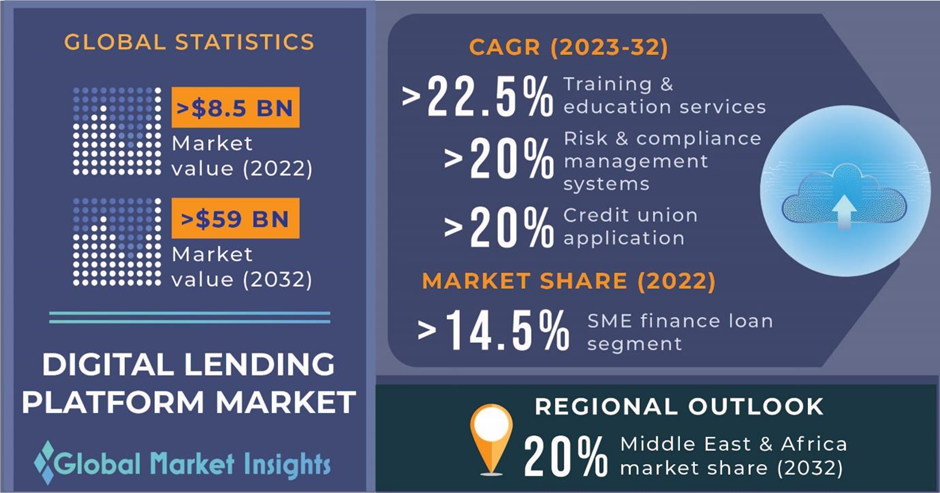
As per a recent industry report put forward by Global Market Insights, Inc. Digital Lending Platform Market is forecast to register its name in the billion-dollar fraternity down the line of seven years, by exceeding a revenue of USD 59 billion by 2032 with a projected CAGR of 20.5% over 2023-2032.
Digital lending and digital mortgage have emerged as prominent concepts in the field of online banking. Over the past few years, the financial sector has undergone rapid digitization with the emergence of novel banking needs.
Digital mortgage is rapidly replacing traditional loan processing systems as it provides a holistic experience to lenders as well as borrowers. Lenders are increasingly implementing modern digital mortgage strategies across targeted marketing, auditing, loan closing, and lead generation activities. Owing to the ease and level of sophistication, a combination of hyper-automated tools, big data analytics, and real-time digital mortgage applications are gaining demand among businesses.
In November 2022, Navi Technologies, an Indian financial service provider, unveiled its cloud-based real-time co-lending platform, called Navi Lending Cloud (NLC). The platform aims to support direct assignment collaboration and digital management co-lending with banks and NBFCs.
The digital lending platform market is classified into component, solutions, service, deployment, business model, product, application, and region.
Based on solution, Point of Sale (POS) systems held more than a 10% share of the digital lending platform industry in 2022. POS systems enable lenders to source and validate documents and e-signatures of credit customers and facilitate conditional decisions instantly. Advancements in mortgage POS systems allow lenders to process loans more efficiently and manage large volumes of data regarding lending rates, borrower behavior, and risks.
In terms of service, the digital lending platform market share from design & implementation is anticipated to record over 21.5% CAGR from 2023-2032. Design and implementation service providers are expected to address the growing need for robust and validated digital asset management processes. Technological advancements and rapid integration of artificial intelligence (AI) will enable the automation of services pertaining to the design & implementation of digital lending platforms.
By deployment, the market landscape is fragmented into cloud and on-premise deployment. The cloud segment is projected to exhibit over 20% CAGR through 2032. Due to low maintenance features and cost-effectiveness, cloud-based digital lending is picking up pace. Increasing demand for fast processing, documentation storage, and reduced cost and time consumption associated with loan processing will proliferate cloud-based digital lending platforms.
With regards to the business model, the industry is segregated into staff-driven, and customer driven. The staff-driven segment is expected to witness promising growth between 2023-2032. Digital lending platforms cater to staff needs including loan disbursement, customer acquisition, and repayment. Growing end-user requirements to reduce the risk of fraud and improve loan processing efficiencies will accelerate the segment growth.
Based on product, mortgage loan accounted for more than 15% share of the digital lending platform in 2022. Large mortgage banks are increasingly implementing digital strategies and technologies to boost the traction of credit seekers for mortgage loan. Digital mortgage solutions reduce costs per loan, allowing considerable savings. The influx of smart technologies will advance the capabilities of mortgage lifecycles on digital lending platforms.
From a regional perspective, North America digital lending platform market share was more than 38% in 2022. Rapid digitization of banking services in the region has resulted in the acquisition of open-banking platforms. A large number of fintech giants in the U.S. and Canada are ramping up efforts to digitize lending processes and safeguard financial services. For instance, in September 2022, J.P. Morgan announced plans to acquire Renovite Technologies, Inc., a cloud-native payments technology firm to modernize payment infrastructure.
Source: https://www.gminsights.com/industry-analysis/digital-lending-platform-market
- 03:00 am

PayPoint today announces a new partnership with Funding Circle that will see the UK’s largest small business lending platform now provide funding access to PayPoint’s network of 28,000 UK retailer partners.
This follows the successful launch of a partnership between Funding Circle and Handepay, part of the PayPoint Group and leading card payments solutions provider, in October 2022. The extension of the partnership to PayPoint’s retailer partner network, which is larger than all supermarkets, bank branches and Post Offices combined, will allow retailers on its loyalty scheme to apply for a Funding Circle loan.
With applications taking no longer than 10 minutes to complete and no more than a 24-hour wait for a decision to be made, Funding Circle’s loans offer retailers access to fast and affordable finance.
Mark Latham, Banking Services Director at PayPoint said: “At PayPoint, we’re always looking at ways to support retailers to help them get the most out of their stores and this partnership with Funding Circle does exactly that.
“When businesses want to invest in adapting to market conditions, they should be able to do so swiftly and with confidence. This was the key reason for expanding PayPoint Group’s partnership with Funding Circle and I look forward to building on the opportunities we can offer small businesses across our network over the coming year.”
- 04:00 am

Open banking has been a game-changer for the financial industry since its introduction five years ago.
The concept of allowing customers to share their financial data with third-party providers opened a host of new possibilities for financial services and products. However, the industry is now moving beyond this to the next stages of development: open finance and open data.
Open finance takes the principles of open banking and expands them to include other types of financial data, such as insurance, pensions, mortgages and investments. This will allow for the creation of new products and services that were previously impossible, such as personalised financial advice based on a customer's entire financial history, not just the information held by their bank, or fuller, more accurate risk assessment and faster, fairer and more inclusive decisions.
One of the main drivers behind the shift towards open finance is the need to truly fulfil what open banking promised –frictionless free movement around the financial system. This has always been stifled slightly by the need in some cases to break out of a fully automated process and request manual information or to have a 300° view of a customer, but not 360°. Open finance will plug these gaps and allow us to provide intelligent services that save time, add value, and ultimately, provide better outcomes for both businesses offering products and, importantly, for consumers too.
This evolution does not come without its challenges. I am a huge supporter of the UK’s original approach, with a centralised authority ensuring standardisation and a unified set of technical and regulatory steps for all players in the market. As we move beyond PSD2 and regulatory compliance driving new features, we must continue to guarantee interoperability between different financial institutions and platforms. To keep competition alive in the UK, we also need to make sure it is cost-effective and not overly complex for innovative small companies to connect to the ever-growing numbers of providers and work in a standardised way with the data they receive.
Another significant challenge in the industry is who pays for this new set of ever-moving technical goalposts. With open banking, we’ve all been spoiled by the free-to-access APIs provided at vast expense by the big banks. A new model must be found that ensures uptake by the data holders, including the smaller providers, whilst also allowing the creation of services – that are often free to end users - to be built upon them. If this model cannot be found, then adoption will be low, either leading to low market coverage, or low market adoption. Both outcomes have the potential to cause confusion among consumers if their provider is not covered by an application or, if there are still gaps in a providers’ full view, frustration at slow or inaccurate decisions.
It is certainly exciting to see the industry moving in this direction and to create products that provide in-depth, real-time insights for providers. At CRIF, we will continue to work with regulators and the ecosystem closely to help overcome these challenges and reach the potential that open data promises.
- 01:00 am

Pioneering issuer processing powerhouse, Enfuce, today announces a new partnership with Orka Ventures, the Nordic-Czech fintech holding company, to launch Orka Card, a new consumer lending card and mobile app that challenges the traditional understanding of ‘Buy Now Pay Later’ (BNPL) lending.
Ondřej Šmakal, CEO of Orka Ventures, comments “At the beginning of 2022, Orka Ventures was looking for a new partner to support the development and launch of Orka Card. We chose Enfuce because of its excellent technical expertise, supportive team and great attitude to problem-solving. Enfuce is now a part of our team, and our developers consistently give us feedback about how easy it is to integrate with Enfuce’s platform. It was also important to us to choose a partner that is willing to support the expansion of Orka Card into the Nordic markets as well as to work with us in Iceland – this is not common as it’s a small country with complicated regulations.“We want Orka Ventures to grow sustainably by nurturing and further monetising the relationships we have with our existing customer base. By offering them services that are useful, and that they will probably not be offered by the legacy banks, we can grow our revenue and eventually our customer base. From a customer perspective, Orka Ventures’ aim is to bring fair, convenient and sustainable consumer lending to customers who are often excluded from lending or loan opportunities with our new, premium product.”
Denise Johansson, Co-Founder and Co-CEO of Enfuce, says: “The Enfuce mission is to remove the complexity of payments and provide flexible payment solutions that enable our customers to grow and provide an excellent customer experience to their end-customers. We’re confident that our partnership with Orka Ventures will deliver real value to consumers in the core markets of Iceland and the Nordic regions.”
Monika Liikamaa, Co-Founder and Co-CEO of Enfuce, adds: “Supporting the growth of an inspiring fintech with the kind of big ambitions Orka has, is what Enfuce is all about. Our partnership with Orka demonstrates our joint commitment to smashing down barriers and promoting financial inclusion. Using Enfuce’s cloud-native card issuing platform, with unmatched scalability and enhanced security, Orka Ventures is set to bring sustainable consumer lending to more customers across Europe.”.”
- 09:00 am

Award-winning Swiss FinTech NetGuardians, renowned for its enterprise risk platform for combatting financial fraud, has announced that Switzerland’s leading payment app TWINT has selected its software as part of an enhanced fraud prevention program.
NetGuardians software detects anomalous payments through its innovative behavioural analytics, machine learning, and artificial intelligence. The software monitors all of TWINT’s payment transactions in real-time and provides a risk score through profiling.
The software ensures accurate detection and a minimal volume of false positives, fostering customer trust whilst keeping operational costs low. Machine-learning algorithms help financial institutions to discover and stay on top of emerging threats from fraud schemes.
TWINT chose NetGuardians as a provider due to its capability to monitor, process, and store large volumes of transactions in real-time while providing the best possible protection for TWINT’s customers.
Joël Winteregg, NetGuardians Co-Founder and CEO, said: “This is more than a new contract for NetGuardians, it is the perfect example of two Swiss fintechs who both became leaders in their respective domains and are partnering to make Swiss payments faster and safer.”
- 04:00 am

Apex Group Ltd. (“Apex” or “The Group”), a global financial services provider, announces today the acquisition of Pacific Fund Systems (“PFS”), a leading global fund administration software business, from co-founders and Pollen Street Capital.
This acquisition follows Apex Group’s longstanding partnership with PFS through the use of PFS-PAXUS and will expand use of the technology platform to enhance the delivery of timely, accurate and independent portfolio accounting, fund and investor reporting.
Founded in 1999, PFS supports investment fund clients via its core PFS-PAXUS product. PFS-PAXUS is a specialist accounting and administration software that fully supports the administration of all manner of open and closed-ended traditional and alternative funds, including hedge funds and private equity investment vehicles. PFS-PAXUS is used by more than 4,000 individual users at over 100 clients managing over $1 trillion of assets under management.
PFS-PAXUS integrates all the processes that are normally performed on multiple systems, including: securities portfolio, allocation system, general ledger, fee calculation, share registry, investor communications and web portal. Benefits of this approach include increased efficiency, reduced risk of error, faster valuations, a simplified technical landscape and the ability to support complex investment structures whilst significantly reducing IT costs.
The expanded product offering will allow Apex Group to act as a single-source provider of services across the entire life cycle of client funds for both existing and acquired PFS clients.
Peter Hughes, Founder and CEO of Apex Group comments: “Through a combination of partnerships with award-winning technology providers, as well as our own market-leading platforms, we deliver high-quality solutions to asset managers globally. PFS-PAXUS is a proven global technology solution for the funds industry that enables our clients and third parties to automate all fund administration components on a single platform. Bringing PFS-PAXUS into the Group will help us to continue exceeding client expectations by delivering a single-source solution which improves administrative efficiencies, implements essential controls, and manages our clients’ operational risk.”
Paul Kneen, CEO of PFS further comments: “PFS is dedicated to providing a first-class global business solution to its clients and we are excited to be joining Apex Group which shares these core principles and objectives. My team and I are looking forward to deepening our relationship with Apex Group, an important existing client of PFS, and a supportive home as we continue to enhance and grow our market-leading offering.”
James Scott, Partner at Pollen Street Capital, adds: “Since investing in the business just over two years ago, PFS has gone from strength to strength, recording strong organic growth, recurring revenue and margins. This is a great outcome for PFS and the transaction represents the first exit in our flagship Fund IV. Pollen Street is looking forward to continuing its support of Paul and his excellent management team as well as working alongside Apex Group for the next phase of PFS’s growth.”
Terms of the transaction are undisclosed. Deutsche Bank advised Apex Group on the acquisition, and Arma Partners acted as financial advisor to PFS. Kirkland & Ellis International LLP acted as legal advisors to Apex Group and Proskauer Rose LLP acted as legal adviser to PFS.
- 07:00 am

Shieldpay, the market leader in solving complex B2B payments, has today announced the recent appointment of Isabel Pitt as Product Director. Isabel will lead the Product team under the recently appointed CTPO Andrew Hawkins and will further develop the company’s product offerings in line with its next stage of innovation and growth.
With more than 10 years of global industry experience in product leadership roles, Isabel joins Shieldpay with a deep understanding of the payments ecosystem. Most recently, Isabel held the role of Head of Core Services at Zopa Bank to lead on the bank’s product strategy for core function enablers, covering payments, customer data and consumer authentication. Prior to this, Isabel was Vice President of Product Delivery at Banked where she spearheaded the due diligence of their strategic partnership with Bank of America. And in her role at Lloyds Bank as Senior Digital Product Leader, Isabel collaborated with major industry players such as Form3, Google and Visa to pioneer Lloyds Bank’s payment journey into the cloud.
As a prominent thought-leader in the payments and cyber security space, Isabel appeared on Innovate Finance’s 2020 & 2021 Women in Fintech Powerlists and was one of Digital Women’s 50 Digital Women to Watch in 2022. Isabel’s strong drive and passion for diversity and inclusion in the fintech world, reinforced by her active participation as a mentor in the Industry Mentor of Women in Payments programme, will bolster Shieldpay’s ongoing drive for diverse talent within the company, alongside shaping key developments within the B2B payments sector.
Isabel Pitt, Product Director, Shieldpay, comments:
“I’m on a mission to disrupt and innovate the payments ecosystem, and Shieldpay is the perfect platform to deliver that change. I’m excited by the huge potential of the opportunity and I’m looking forward to solving these market challenges and seeking out the future global opportunities.
“Shieldpay is a market leader in innovation and I’m excited to be able to develop the diverse talent in the company and support our ecosystem as we start 2023.”
Andrew Hawkins, Chief Technology & Product Officer, Shieldpay, added:
“Isabel’s appointment as Product Director marks a key milestone in the growth and development of Shieldpay. With her exceptional leadership skills and track record of delivering best in class payment products, we are confident that she will be a key driving force behind our mission to deliver secure, high-value, B2B payments that people trust. We are thrilled to have her on board and can't wait to see what the future holds under her leadership.”








