
Published
- 09:00 am

TD Wealth® has tapped Salesforce Financial Services Cloud (FSC) to help advisors automate and quicken client account openings and onboarding with a unified, predictive intelligence console that provides teams with insights and recommendations, such as next best actions and life event alerts.
Why it’s important: Since its integration with Salesforce, TD Wealth® has seen an increase in productivity, helping advisors increase their sales volume by more than 18%.
What’s the impact: TD chose Salesforce because of its ability to connect disparate systems and data. Before its implementation with Salesforce, TD colleagues were using over 60 different applications and systems that were not connected, causing headaches for advisors and slowdowns for clients. With Salesforce, TD addressed key friction points for advisors across sales, onboarding, and services with automated workflows.
- With FSC, TD has eliminated the need to switch between different systems and automated many workflows to provide a more streamlined experience across lines of business. This helps to enhance worker productivity and improve the client experience.
- Now, TD Wealth Advisors can onboard clients and eliminate re-entering client information, making the client account opening process more efficient.
- Advisors have realized the benefits of leveraging integration and automation to augment their work, and as a result, TD reported an adoption rate of 75% among employees.
- TD was also able to streamline cross-selling efforts between retail banking and wealth channels by improving communication and enabling efficient, secure record-keeping of client data.
Open Image Modal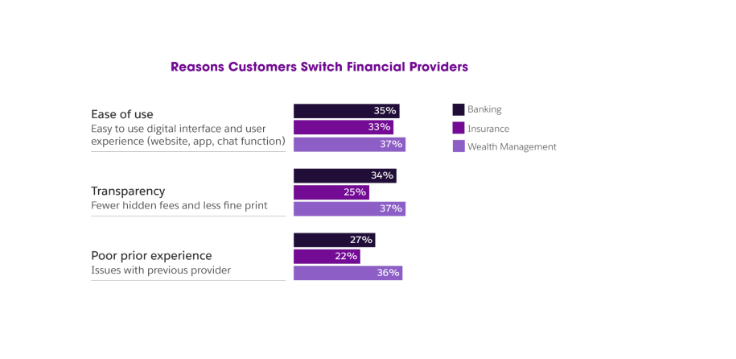 According to Salesforce’s 2022 Future of Financial Services white paper, more than a third (36%) of wealth management customers cite issues with a previous wealth management provider as a top reason for switching.
The customer perspective: “Frontline teams have gained so much time back from automation of a previously manual process. Now, instead of jumping from one system to another, our advisors and sales teams are using Salesforce Financial Services Cloud for one unified view of their clients, and are able to quickly pull insights and recommendations, servicing them quicker than ever before.” – Ken Thompson, Head of Shared Services, TD Wealth®
Now, instead of jumping from one system to another, our advisors and sales teams are using Salesforce Financial Services Cloud for one unified view of their clients, and are able to quickly pull insights and recommendations, servicing them quicker than ever before.
KEN THOMPSON, TD WEALTH
The Salesforce perspective: “Many wealth management firms struggle with disjointed legacy systems. Firms like TD are now leveraging Salesforce and Financial Services Cloud as a unified platform to accelerate advisor productivity, streamline complex business processes, and align their front, middle, and back office for a consistent user experience and set of workflows.” – Michelle Feinstein, VP and GM of Wealth & Asset Management, Salesforce
- 02:00 am

Adoption of trading in emerging markets from hedge funds, proprietary trading firms and bank trading and execution desks are set to grow significantly as firms look to diversify trading strategies, seek unique opportunities and broaden exposures, a new study has found.
The study Expanding Connectivity: Exploring the Challenges and Solution for Trading in New Markets, published today, was produced by Acuiti in association with BSO.
According to the report's findings, more than half of the surveyed firms express definite plans to venture into a new market within the next three years. Additionally, one-third of the participants are actively considering expanding into new markets.
Hedge funds and proprietary trading firms, in particular, reported looking for new markets to trade in which they can deploy their strategies and expand operations.
However, while secondary and tertiary markets have made significant advances over the past decade to improve the connectivity process for international trading firms, it is still an onerous process at many exchanges.
This is reflected in the time it takes to connect to a new market. Most survey respondents reported the timeframe for connecting to new markets once the decision has been made to connect as stretching to seven months or longer and that the timeframe for adoption was increasing.
In addition, firms reported several challenges connecting to new markets. The cost of market data was the most significant barrier to entry for firms with connectivity costs, and preferred brokers providing access also being key barriers to entry.
When it came to which regions firms were planning to trade, Asia and the Americas were the top choices selected by 76% and 67% of respondents, respectively. In Asia, Taifex, KRX and HKEx were the top markets firms were looking to start trading, while in The Americas, firms reported interest in Brazil, Mexico and Chile.
“The decades-long trend towards globalisation of trading strategies is accelerating as the infrastructure and technology of emerging market venues improve at the same time as firms look to expand their strategies beyond their traditional markets,” says Ross Lancaster, head of research at Acuiti.
“While the trading opportunities are attractive, the operational lift of connecting to these new markets can take months and, frequently, longer than a year. This is leading many firms to work with third-party providers.
“These vendors often have long-standing expertise in the markets that firms want to enter and established connectivity routes. In addition, they can significantly reduce the time to market to ensure that opportunities, once identified, can be captured.”
The report, based on a survey and a series of interviews of senior executives at 76 proprietary trading firms, hedge funds and bank execution and trading desks, also found that latency has become increasingly important for firms, even those that do not rely on speed for their strategies.
Michael Ourabah, CEO and founder at BSO, said: "The accelerating trend of globalising trading strategies is driven by the improving infrastructure and technology of emerging market venues, coinciding with firms' aspirations to expand beyond their traditional markets. Connecting to new markets involves inherent risks in terms of costs and opportunities. However, by collaborating with third-party providers, firms can mitigate these risks, reduce costs, minimise time-to-market, and leverage their expertise in the new market. With BSO, businesses no longer face the dilemma of prioritising between global reach and low latency, just as they shouldn't compromise on choosing between cutting-edge technology or exceptional service, bespoke solutions or off-the-shelf products."
Download the full report here: www.acuiti.io/expanding-connectivity/
- 05:00 am
Leading Accounts Payable (AP) automation solution provider, Yooz, today announces that it has launched its third annual investigation into the State of Automation in Finance.
More than 1,500 financial and accounting decision-makers across the UK, USA, France, Spain, South Africa, Switzerland, Belgium, UAE, and Luxembourg took part in the study, which tracks the evolving challenges facing finance teams from 2021 to date. This includes the progress of digital transformation and the evolution of hybrid working.
The award-winning cloud-based Purchase-to-Pay (P2P) automation provider conducts this annual research to gain insights into the opinions, challenges, and opportunities that Chief Financial Officers (CFOs) and finance leaders are facing. In 2023, these range from talent shortages, rising inflation, potential recessions, post-COVID recovery and future-proofing to the status of electronic invoicing, and the deployment of the latest technologies in Accounting.
Key highlight results specific to the UK from the report include:
Say goodbye to your expenses! - 43% of businesses have reduced expenses to minimise the impact of inflation and tighter monetary conditions on the business.
More money doesn’t keep the top finance talent! - Flexible working (49%) and remote working (38%) are the top two measures organisations use to retain and attract finance talent.
Work smarter, not harder! - Just under a third of Accounts Payable departments (30%) spend, on average, over 20 hours a month on invoice processing. This is the equivalent of spending almost 3 business days a month on managing invoices.
Commenting on the results, Laurent Charpentier, CEO at Yooz said, “Our annual research over the past three years continues to provide a fascinating insight into the way Finance Departments have had to constantly adapt to address the most challenging issues of a generation. Finance leaders are increasingly at the centre of any business’ resilience strategy, providing the essential expertise and confidence required to not only manage economic crises but also drive innovation and growth.”
Charpentier continues, “Automation is now viewed as a key tool for modern finance leaders to manage the diverse demands of their role. Effective automation allows teams to concentrate on added value activity and to explore new technology such as AI and data visualisation. The introduction of the latest technology will empower organisations as they take on new challenges in 2023.”
You can gain full access to Yooz’s third annual State of Automation in Finance report - ‘An investigation into how Finance leaders can become drivers for positive change during times of instability’ - by following the link.
- 09:00 am

Tools for Brokers, a leading technology provider for retail brokers and hedge funds, announced the appointment of Han Ong as the company’s new Head of the Singapore office.
Han joined TFB in October 2022 as the Sales Manager for APAC, where his primary focus was expanding the company’s network of partners and strengthening relationships with key clients in the region. In his new role, Han will be developing and executing strategies for the APAC region centered around driving business growth and strengthening relationships with key stakeholders, including local clients, authorities and regulators. Another focus for Han will be to build a high-performing team and an inclusive office culture that emphasises rewarding excellence that would support the growth across all Asian countries.
Commenting on the new role, Ong said, “I am excited about joining the new role as Head of the Singapore office. The Asian market plays a critical role for us, and we have many plans for Singapore, Thailand, China, and other APAC countries that I cannot wait to start working on. With the excellent team that we have and my diverse experience in the finance industry, I am confident together we will make a difference for our clients and partners, helping them grow faster and further globally.”
Commenting on the promotion, Albina Zhdanova, the COO at TFB, said, “Han is not only a strong professional but an empathetic leader with a vision. His work ethic and drive to improve everything around him are admirable. We are excited to have him as the Head of the Singapore office, and we’re confident he’ll help expand TFB further into the Asian market and reach new heights.”
Han started his career in the industry over 11 years ago with a focus on buy and sell operations. Over the years, he founded two companies and was instrumental in growing a brokerage from its inception to achieving a seven-figure annual revenue as the COO.
- 05:00 am

Finfra, the one-stop shop for companies launching white-labelled lending products in Indonesia, has announced it raised $1 million in funding. The funding round was a collaborative effort by DSX Ventures and Seedstars International Ventures, regional fintech experts Cento Ventures and Fintech Nation, Baltic-based startup support incubators FirstPick and BADideas Fund, and Silicon Valley-based Hustle Fund. Finfra plans to accelerate product development and grow its engineering, data, and finance teams in an effort to boost revenue and further establish itself as a market leader within the Southeast Asian embedded lending industry.
Indonesia underwent a transformative period of digitisation in the late 2010s and early 2020s, fueled by an influx of VC investment in e-commerce, logistics, and financial services. As a result, Indonesia’s internet economy has grown tenfold since 2015, reaching US$ 77 billion in annual gross merchandise value (GMV).1 This trend was accelerated by the pandemic, creating a mass influx of new digital platforms that enable Indonesian entrepreneurs to launch asset-light business models. Access to credit, however, remains low for businesses and individuals – so much so that only 3% of the population has a credit card. Offering credit and other financial services to existing customer bases can help boost user adoption, increase per-customer spend, deepen customer loyalty, and improve retention.
Finfra enables underbanked businesses and non-financial digital platforms to embed financial products and services, particularly credit lending, into their own distribution channels. Its top-to-bottom approach ensures total regulatory compliance while providing a complete loan management system, scoring, portfolio analytics, and access to debt capital. In areas where conventional banks refuse to go, Finfra provides sophisticated and business-friendly fintech solutions that drive financial inclusion. This is also essential work in light of recent initiatives by the Indonesian Financial Services Authority (OJK) to reach financial inclusion targets of 90% by 2024 (compared to 75% in 2019) and improve access to sustainable and transparent financial services.2
Markus Prommik, co-founder and CEO at Finfra, said: “As entrepreneurs ourselves, we understand how challenging it is to build, grow, and maintain a business on its own terms. Expanding to offer lending as a service is a highly attractive prospect to many companies but a huge undertaking in its own right. Rather than do it themselves, companies can use our APIs to solve the crucial unit economics of lending. There’s real demand for comprehensive credit-centric services and lending among Indonesian small businesses, particularly as it relates to providing lending as a service. We’re determined to make it not only feasible but genuinely easy for Southeast Asian companies to do so.”
Patricia Sosrodjojo, General Partner at Seedstars International Ventures, said: “The multi-billion dollar Indonesian market is actively transitioning from the lending strategies of the first phase of digital finance to a more sophisticated and complex iteration built on existing digital economy infrastructure and ecosystems. We’re excited to back Finfra’s experienced team and support their mission to advance access to finance in a scalable way. We’ve seen similar initiatives succeed in emerging markets where MSMEs face significant hurdles to accessing capital. Finfra’s approach not only aligns with national economic development goals but is well-positioned to take on the challenges of this rapidly growing market.”
Dmitry Levit, Partner at Cento Ventures: “With their experience navigating Indonesia's intricate financial services ecosystem, the Finfra team stands as seasoned industry veterans. We firmly believe that the best tools are crafted by masters of the craft and already see the company emerging as the toolmakers of choice for digital businesses that rely on credit embedding. By strengthening the foundation of the country’s digital financial infrastructure, Finfra will contribute to a stronger, healthier, and more thoughtfully inclusive financial services ecosystem in Indonesia and across Southeast Asia, benefiting businesses and consumers alike”
Reinis Simanovskis, co-founder and CTO at Finfra, emphasized that “numerous platforms fail to acknowledge the untapped demand their sellers have for capital and the inherent difficulties in building these financial products in-house. Finfra is dedicated to resolving intricate infrastructure problems to enable platforms to optimize their support for sellers.”
The team’s initial venture, Danabijak, now operates as a subsidiary of Finfra and remains profitable. Meanwhile, Finfra’s roster of live partners has tripled in the last six months alone. Kickstarted with early support from Plug & Play Indonesia, Chocolate Ventures, and other angel investors with industry expertise, Finfra’s explosive growth continues unabated.
- 09:00 am

Today Coincover, the leading digital asset protection company, announces the appointment of Vikki Sly as Chief People Officer (CPO), boosting the firm's commitment to building a healthy scaling business. With a strong background in designing and implementing successful internal cultures, Vikki will play an integral role in building a company culture that prioritises its people.
Vikki has held several senior leadership roles, including VP of People at Bitrise, where she led the company's people operations and talent acquisition efforts. Prior to that, Vikki served as the Chief People Officer at Blue Prism, where she oversaw the company's global HR strategy and was responsible for driving employee engagement and retention. She also spent several years as the Vice President of Talent Development at Qlik, as well as household names Barclaycard and Vodafone.
"We are thrilled to welcome Vikki to our team," said David Janczewski, CEO of Coincover. "Her extensive experience and passion for building and shaping people-centred cultures will be instrumental in helping us achieve our mission to make cryptocurrency accessible and secure for everyone.”
"We're seeing a lot of behaviours in the market where companies have grown aggressively and failed to address the challenge of scale as they’ve grown. They are now going through an unfortunate situation where people are being laid off," said Vikki Sly. "I am committed to building a company culture that pays attention to the current organisation and positively impacts the existing infrastructure.”
In her new role, Vikki will oversee the development of the company's internal structure, collaboration processes, and learning opportunities. She will work closely with the executive team to ensure that Coincover's employees are empowered to deliver the highest level of service to its customers.
- 04:00 am

Zimpler, a fintech company providing seamless and secure account-to-account (A2A) payment solutions, has appointed Susanne Hannestad to the Board of Directors.
Susanne Hannestad is the Founder and CEO of Fintech Mundi and part of the board in several companies within sustainable banking, digital cash and fintech. She has held several senior management positions within Nordea and also been part of the boards of Nordax Group, several subsidiaries of Mastercard and Visa and a variety of fintech, payment infrastructure and open banking companies.
Susanne Hannestad said: “I’m looking forward to the international scaling of Zimpler in Europe, Latin America and beyond. It is an exciting next phase of open banking where I see Zimpler as a frontrunner.”
Susanne is Norwegian, born 1961. She is an alumni of Oslo University, INSEAD and Northeastern University, in the latter two she has also been a lecturer. For seven years she was also a part of Norway’s national handball team.
Johan Strand, CEO at Zimpler said: “Susanne has a proven track record from scaling businesses. As Zimpler is on a journey from start-up to scale-up, these are experiences of crucial importance.”
- 01:00 am

Gold-i has integrated its Crypto Switch™ with Hidden Road, the global credit network for institutions. Hidden Road is one of the first firms across traditional and digital assets to offer prime brokerage services with real-time API functionality. By integrating Crypto Switch™ to Hidden Road’s API, Gold-i is providing fast and robust crypto liquidity aggregation and can drop copy every trade in real-time for their settlement processes.
Tom Higgins, Founder & CEO, Gold-i said, “Hidden Road is a leading provider across traditional and digital assets, and has used its expertise from the FX world to build a highly credible ecosystem in the crypto world. With functions that are segregated from custody and execution - such as prime brokerage, clearing and financing - Hidden Road helps counterparties mitigate risk. This seems to be a model which institutional investors are embracing.”
“We are delighted to have integrated our Crypto SwitchTM with Hidden Road’s API. Institutional digital asset adoption continues to grow and Hidden Road has a compelling offering, with impressive connectivity and a formidable pool of OTC Market Makers providing deep liquidity.”
Michael Higgins, Global Head of Business Development, Hidden Road (no relation to Tom Higgins) added, “Hidden Road’s focus remains to provide our clients with a robust set of tools across traditional and digital asset classes, both through our own offerings and through the use of strong partners. Gold-i's Crypto Switch™ is a great fit with our credit network and OTC prime brokerage offering, and further evidence of our partner-first philosophy.”
- 04:00 am

From today, American Express is launching a new limited-time offer for new Cardmembers signing up to the Business Platinum Card, rewarding entrepreneurs further for their everyday business spending.
Between 14 June to 18 July 2023, new Business Platinum Cardmembers that sign up and are approved can earn a £100 statement credit, on top of a Welcome Bonus of 40,000 Membership Rewards® points, when they spend £12,000 in the first three months on the Card.
Earned on every transaction, Membership Rewards allow business leaders to use their points however best suits them, whether that’s stocking up on office supplies, redeeming for business and leisure travel, or treating hardworking employees. And at a time when businesses are facing rising costs, the £100 statement credit can be used to offset expenditure.
The limited-time offer launches as new American Express data1 reveals that UK SME leaders are looking to invest in the year ahead to help drive business growth. The survey revealed that four in 10 (41%) SME owners and decision-makers are looking to ramp up their marketing activity, with a quarter (26%) targeting improved staff productivity and about one in six (16%) investing in automation through new software or technology.
Amanda Salt, Vice President, Small & Medium Enterprises, UK Card Services at American Express, said: “Small and medium businesses continue to face challenges but it’s encouraging to see a significant number targeting investment in areas that will help drive growth. Our focus is on supporting SME leaders and their businesses with the financial backing they need, along with access to valuable rewards and benefits earned from their everyday business spending.”
The ability to earn up to £100 Statement Credit and Welcome Bonus of 40,000 points comes on top of a wide range of existing benefits for Business Platinum Cardmembers, including:
· Accelerated points earn 10,000 extra Membership Rewards® points when they spend over £10,000 on their Card, every month; up to 120,000 per year
· £200 Annual Travel Credit when booking with American Express Travel Online
· Simpler supplier payments with access to the Bluechain platform that helps streamline invoice management and payments
· Cashflow Management, with up to 54 days to pay for purchases, cash can stay in your account for longer, making money management more flexible.
· AmexExpense frees up business time with a simple solution to complicated and frustrating company expenses
· Business-focused offers for example, Business Platinum Cardmembers get £150 of credit with Dell per year
Full terms and conditions apply. 18+. Subject to status. For more information visit the Business Platinum Card sign up page
- 01:00 am

TaxNodes, a crypto tax computation and expert-assisted ITR filing platform, today announced the successful completion of its seed funding round, securing $1.6 million amidst the challenging funding winter. In this round, notable veterans in the web3 and wealth tech space, including Rahul Pagidipati, CEO of ZebPay and an experienced angel investor, Nischal Shetty, CEO, Shardeum & Founder of WazirX, Ashish Singhal, Co-Founder & CEO, CoinSwitch and Ajeet Khurana, Founder of Reflexical, have invested in the company founded by Avinash Shekhar, a chartered accountant and former CEO of one of the oldest Crypto Exchanges.
The successful funding marks a significant milestone for TaxNodes and the company intends to utilize these funds to bolster its mission of simplifying tax computation, and providing end-to-end solutions for individuals navigating the complexities of crypto taxation. The company is developing an AI-assisted tax advisory model for individuals and corporates to provide control & compliance using GPT-like Large Language Model.
Since its inception, TaxNodes has witnessed a 5X month-on-month spike in its customer base. The company is poised to play a pivotal role in ensuring a safer and more compliant crypto ecosystem, facilitating smoother operations and regulatory adherence.
Additionally, TaxNodes has recently announced partnerships with crypto exchanges like ZebPay, WazirX and Giottus and is focused on helping crypto users to comply with tax laws. TaxNodes will also help Crypto exchanges to increase their internal controls and automate reconciliation & accounting.
Commenting on the development, CA. Avinash Shekhar, Founder & CEO, TaxNodes said, ”We are thrilled to have successfully completed our seed funding round and delighted to see that seasoned leaders from the crypto ecosystem are placing their trust in TaxNodes. This funding will enable us to provide a complete solution for crypto natives making it easier for them to handle their tax obligations. With our advanced tax computation engine, a team of seasoned crypto experts, and a full-stack solution, we aim to simplify the complexities of crypto taxation and filing, ensuring accuracy, compliance, and peace of mind for our users. Furthermore, this investment will propel our research and development efforts to create innovative products that cater to crypto exchanges, investors and Finance professionals, including Crypto auditors.
Crypto has witnessed significant movement towards regulations, compliance and specific taxation rules, leading to an increased need for specialized tax management tools. TaxNodes recognizes the challenges faced by crypto natives in accurately computing profits and losses, reconciling transactions across multiple centralized and decentralized platforms, and fulfilling tax obligations.
Mr. Nischal Shetty, CEO, Shardeum & Founder, WazirX, said, “I am thrilled to join hands with TaxNodes. The team at TaxNodes has an exceptional understanding of Crypto business and taxation. I believe in their vision and I am confident that TaxNodes will help in compliance and controls in the Crypto space. I look forward to supporting their growth and success as they continue to disrupt the tax landscape.”
Mr. Rahul Pagidipati, CEO, ZebPay, said, “TaxNodes has immense potential to change the way crypto taxes are computed and filed. I am thrilled to be a part of this seed funding round and support their mission to simplify the tax computing process. With their innovative platform and expert assistance, individuals and businesses can navigate the complex world of crypto taxation with ease. I have no doubt that TaxNodes will play a vital role in shaping the future of crypto taxation. I have worked with Avinash for a long time and have complete confidence in his ability to lead TaxNodes to success.”








