
Published
- 07:00 am
IBM PureFlex – is a complete, flexible cloud infrastructure system that integrates and optimizes all compute, storage and networking resources to deliver infrastructure-as-a-service (IaaS) out of the box. This innovative solution can be configured for any specific business needs and may be complemented by a package of support services.
With PureFlex Diasoft customers obtain balanced solution, complementing computing resources, data storage and network infrastructure, optimized for FLEXTERA and other solutions of the company. Moreover, IBM system ensures increased speed of Diasoft`s solutions installation, requires fewer efforts and simplifies maintenance of IT-infrastructure.
Diasoft has successfully implemented IBM PureFlex in Capital Moscow Bank. With PureFlex system Diasoft was able to prepare and implement working and testing environment for FLEXTERA solution in a record time. Moreover, the experts from Diasoft’s Competency center together with IBM’s specialists deployed an integrated hardware and software platform PureFlex in BANK just within 5 days, after which they proceeded to configuring FLEXTERA applications. As a result the whole process of FLEXTERA implementation was performed in terms, exceeding all expectations of BANK.
- 01:00 am
In the report EMEA Policy Administration Systems 2013: General Insurance ABCD Vendor View Celent looks at policy administration systems available to insurers in Europe, the Middle East and Africa. This report profiles 52 policy administration systems for EMEA personal and commercial insurance products and focuses on the property and casualty systems, non-life or general insurance systems depending on the country.
FLEXTERA Insurance is an innovative front-to-back STP solution catering for every aspect of the Insurance Business. The functional scope of FLEXTERA Insurance covers all major business needs of the companies specializing in General Insurance, Life Insurance, and Re-Insurance. FLEXTERA solutions provide Insurance companies with the most advanced mechanisms ensuring high-level customer servicing, distribution chain management, claims processing, policy and product management, billing, financial control, and business intelligence.
The solution is built on JavaEE technology in full compliance with SOA principles and was developed in tight collaboration with IBM — a globally acknowledged SOA industry leader. Due to its component-based SOA-architecture and business process-based approach to automation, the solution can be tailored to fit any individual business and technological requirements of the most dynamic Insurance companies.
FLEXTERA Insurance provides comprehensive tools for the management of the whole policy life cycle, including automated application management; underwriting; policy quoting, issuance, and endorsement; generation and management of supporting document; accounting procedures; automatic batch or manual renewal; work with prepackaged and individual policies; and management of the full history of policy versions.
“Large transformation projects are always risky and difficult with examples of the effects of poor execution available across EMEA,” says Craig Beattie, Senior Analyst with Celent’s Insurance Group and author of the report. “The evaluation in this report represents Celent opinion mixed with our feedback from the insurer community as well as our involvement in selection and implementation projects. There is never a single best answer for all insurers but we believe the data held herein provides the most detailed view of the vendors in this market and will aid any selection project or IT strategy review. ”
In comparison to most insurance solutions FLEXTERA Insurance enables real time integration with the company General Ledger for the immediate update of the company financial data.
FLEXTERA solutions are built on the principles of separated operational product accounting and regulatory financial accounting. The back office systems which are responsible for product management operate with internal product accounting data and do not record transactions into financial accounting systems. A special tool — FLEXTERA Accounting Engine — converts operational product accounting data into financial accounting forms in accordance with national and international accounting rules and standards. Such independence enables the use of various accounting methodologies and adjustment to the local regulatory peculiarities without the need to change the business logic of a financial institution and allows the Insurer to generate sophisticated management reports for multi-sided analysis of products, branches and staff performance.
“Our FLEXTERA solution has achieved a strong baseline of good functionality and incorporates modern technologies that allowed it to be named among the top market players by Celent”, said Alexander Budnik, VP, Head of Insurance Business, Diasoft. “We are proud of this achievement and plan to continue the development of our product offering to ensure the business agility and technological flexibility to our customers in order to deliver the best insurance services”.

- White Papers
- 20.03.2014 07:00 pm
The responsibilities of the treasurer are expanding and commodity management is increasingly moving from procurement to treasury. In this paper, Reval demonstrates how technology can help treasurers better understand commodity exposures and more effectively implement hedging programs.
Treasury is in different stages of transformation around the world, and what is included in treasury’s remit is different too. There is a notable increase amongst multinational corporates for treasury to manage commodity risk. We have seen this at Reval, and a recent gtnews risk survey indicates that 44% of treasurers are already responsible for commodity risk management.
This is the case for a few reasons:
- Greater need for global visibility of all financial risks
- Understanding the correlations amongst different asset classes
- Optimizing hedging strategies for significant cost savings
- Growing volatility of commodity prices around the world
Previously, many companies – commodity consumers – were reluctant to hedge commodity price risk as they believed their shareholders expected them to be fluctuating according to the market prices. However, the volatility and subsequent impact on the bottom line is no longer sustainable, and hence needs to be actively managed and hedged. Similarly, the banks that are financing those companies are not in favour of this volatility and are looking for more secure profit margins.
This is relevant not only for consumers and producers of commodities, but also for many organisations that have some exposures to non-financial items. For example, airlines are exposed to jet fuel and diesel, but also to emissions as they look to reduce their carbon foot print. Retailers are exposed to fuel costs for deliveries as well as many soft exposures – wheat in the cereal, in the biscuits, and in the beer they sell, for example. Beverage companies not only are exposed to the ingredients to make the beverage, but also the paper, aluminium and plastic costs.
Commodity exposure management is a complex area, but getting on top of commodity risks can have a significant financial impact. The following guide helps treasurers better understand what they need to determine the Return on Investment of commodity risk management:
- Making exposures across the company visible
- Monitoring and assessing risk correlations
- Considering the impact of IFRS 9, IFRS 13, EMIR and Dodd Frank
- Leveraging SaaS technology
Please fill up these fields in order to read the publication.
Other White Papers
- Reports
- 16.03.2014 07:00 pm
Please fill up these fields in order to read the publication.
Other Reports
- Reports
- 04.03.2014 07:00 pm
We can truly say that, for European projects, the year 2014 started with a bang, obviously under the pressure of the electoral calendar.
As expected, the Trilogue came to an agreement on the Directive on Criminal Sanctions for Market Abuse (CSMAD), put to the vote at the plenary meeting of 4 February. However, the most striking development has been the Trilogue's agreement in principle on the text of the new Markets in Financial Instruments Directive known as MiFID II.
This agreement had been eagerly awaited especially following the long and turbulent discussions surrounding the MiFID revision since the launch of the Commission's consultation in 2010. Sensitive issues like the regulation of high-frequency trading and dark pools, the defining of OTFs (Organised Trading Facilities) and the extension of the scope of the Directive on commodities, greatly disrupted the initial calendar.
Please fill up these fields in order to read the publication.
Other Reports
- Case Studies
- 03.03.2014 07:00 pm
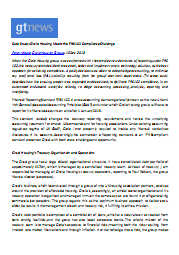
When the Circle Housing group was confronted with the complex new demands of reporting under FRS 102, the treasury team decided to research, select and implement a new technology solution, as the best approach for achieving compliance. A policy decision was taken to adopt hedge accounting, to minimise any profit and loss (P&L) volatility resulting from the group’s derivative operations. This case study describes how the ensuing project was organised and executed, to facilitate FRS 102 compliance, in an automated end-to-end workflow relating to hedge accounting processing, analysis, reporting and interfacing. Financial Reporting Standard (FRS) 102 is a new accounting standard generally known as the new UK and Irish Generally Accepted Accounting Principles (GAAP) and under which Circle Housing group will have to report for its financial accounts on and after 1 January 2015. This standard radically changes the statutory reporting requirements and hence the underlying accounting treatment for smaller UK companies and for housing associations. Under existing accounting regulatory regime of UK GAAP, Circle is not presently required to include any financial derivatives disclosures in its accounts. Accordingly the conversion of reporting standards to an IFRS compliant standard presented Circle with both a new challenge and opportunity.
Please fill up these fields in order to read the publication.
Other Case Studies
- 03:00 am

ElectraCard Services (ECS), provider of software and processing solutions for electronic payment systems, today announced that Nepal Electronic Payment Systems (NEPS) has selected ECS’s electra iTx platform to setup a shared switch infrastructure to enable electronic payment transactions. NEPS is a company that is promoted by a group of seven Nepali Banks with the mandate to setup a shared e-payments switch and card infrastructure.
NEPS has undertaken the shared switch initiative with the aim of achieving robustness, security and cost effectiveness in electronic retail payment systems. The shared switch is a milestone in the Nepal banking industry which was in the making for the last few years and now, a reality under the direction and leadership of NEPS. Currently this is a joint consortium between seven banks in Nepal with more banks expected to join.
With the NEPS shared infrastructure solution, the banks will be able to meet the growing regulatory requirements as well as provide their customers with secure transactions. Banks can offer customers additional products and services and meet all PCI-DSS and EMV compliance requirements.
“We are very excited to partner with NEPS and be a part of this revolutionary project in Nepal. With the large growth in banking needs and the need for stronger security, it is essential for banks to move to a newer platform and offer new services faster,” said Mr. Ramesh Mengawade, CEO, ElectraCard Services.
Mr. Anish Tamrakar, CEO, NEPS, said, “There is an imminent need for the banks to upgrade their platforms to meet regulatory requirements as well as ensure safety of their customers, hence the banks of Nepal have come together to set up a common platform to address the needs in a cost effective manner. ElectraCard Services brings with them the guarantee of over 200 successful implementations globally and expertise in Nepalese electronic payments.”
After a careful process of selection and evaluation of various global players, ECS was selected because of its products’ modern architecture and excellent references from its existing customers. The electra iTx suite with its proven scalability and support for 24x7 multi-channel payments will provide the bank with a unified customer view and seamless integration across channels. ECS has a strong partner in Imark Pvt. Ltd., which is one of the largest IT systems integrator in Nepal.
- White Papers
- 22.02.2014 07:00 pm
Please fill up these fields in order to read the publication.
Other White Papers
- White Papers
- 20.02.2014 07:00 pm
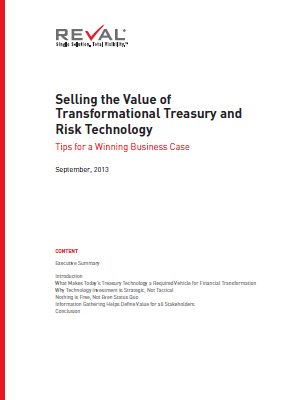
The responsibilities of the treasurer have expanded over the last few years as the disconnect between what a treasurer needs to support his or her broad remit and what the Chief Financial Officer is willing to fund continues to run deep. In this paper, Reval demonstrates how treasurers can frame the business case for transformative technology and sell the value of a strategic investment in next generation treasury technology. Challenges that treasurers face today are different than they were five years ago. And treasurers know that five years from now there will be new, more complex challenges they will be facing. As stewards of their company’s financial nerve center, treasurers are living with the reality that new responsibilities and financial risks are lurking around every corner. In fact, while 86% of those surveyed in 2013 by the Association of Financial Professionals say that risk assessment is very important, 53% say they have greater difficulty today anticipating risks to their companies’ earnings than they did before the global financial crisis. In fact, the visibility of these risks – regulatory and market risks among the most pressing and unpredictable – has reached the boardroom level at 80% of companies Deloitte surveyed in the second quarter of 2013. With risk concerns at this level, the treasurer is increasingly relied upon as a strategic business partner in delivering on corporate performance. Consequently the responsibilities of the treasurer have expanded over the last few years as well. Still, the disconnect between what a treasurer needs to support his or her broad remit and what the Chief Financial Officer is willing to fund continues to run deep.
Please fill up these fields in order to read the publication.
Other White Papers
- 05:00 am
Diasoft, a global provider of cutting-edge software solutions for financial institutions, is shortlisted in “Cloud Computing Innovation of the Year” category of FSTech Awards 2014 jointly with BFA Bank.
Now into its 14th year, the FStech Awards recognizes excellence and innovation in the field of information technology within the UK and EMEA financial services sector. Diasoft and BFA Bank fended off competition from numerous of entries to be shortlisted in “Cloud Computing Innovation of the Year” category. The shortlisted companies of this nomination demonstrate excellence in the area of cloud computing for 2012/13, including new strategies, evidence of success by utilizing the cloud, and how the cloud computing innovation has brought customers cost and efficiency benefits.
Diasoft and BFA Bank are recognized by FStech Awards for the complex automation of retail business of the bank through implementation of innovative FLEXTERA solution.
In order to deliver the system in the shortest timeframes Diasoft offered to BFA Bank a radically different approach to building a banking environment – implementation of its cutting-edge FLEXTERA based on innovative cloud infrastructure.
Cloud deployment of FLEXTERA allowed the bank to acquire numerous benefits, including flexibility and scalability to meet the growing business demands, reduction of IT costs and resource sharing among a large number of users.
“Recognition from one of the leading IT associations on their best-of lists is a one more proof point that the financial institutions around the globe are benefiting from Diasoft`s cutting edge solutions available for cloud implementation”, said Dmitry Zubarev, CEO, Diasoft. “Today all of the FLEXTERA Products are available for Cloud Deployment — an alternative to the on-site implementation of an application. Cloud technology allows small and mid-size financial institutions to easily get access to the infrastructure, platform and software, and ensures considerable time and budget savings already at the implementation stage”.
This year Diasoft launched a private cloud service, allowing for customers screening against Public Officials (PO) and Politically Exposed Persons (PEPs) lists. New cloud service from Diasoft - “Screen your customer!” - is used for the automation of business processes of financial institutions in accord to the requirements of the Law "On Anti-Money Laundering and Combating Terrorism Financing".
FSTech honor reflects Diasoft`s consistent record of delivering the solutions that financial market needs to simplify operations, minimize costs and gain secure IT infrastructures. Recognition from FSTech come on the heels of numerous other accolades for Diasoft – the company is positioned as a leader in Gartner Magic Quadrant for International Retail Core Banking, included into the FinTech 100 ranking of the Global Technology Providers of the Financial Services Industry, awarded with the “Best IT-solution” accolade by Retail Finance Awards 2013, named to Software Magazine’s 31st Annual Software 500 ranking among other recognitions.








