
Published
- 05:00 am

As the UN’s E-Commerce Week Geneva and the Commonwealth Heads of Government Meeting 2018 commence, the International Chamber of Commerce (ICC) United Kingdom calls for a cohesive voice from across the developed and emerging markets.
To make progress on digital trade over the next two weeks, governments from both developed and emerging markets should work together on digital trade and development priorities.
The barriers to digital trade are well known; mis-aligned national regulations, poor infrastructure, low use of electronic payments, undeveloped legal systems, low purchasing power, lack of enforcement capability and low levels of digital skills. Many of these issues can be solved by better aligning development assistance with digital trade priorities. The policies, frameworks and resources exist to address all of these issues if governments can work together to mobilise them. This would be a pragmatic solution to the issues that have stalled progress for the last 20 years.
The prize for doing so is enormous:
Intra-African trade is one of the lowest of any region at 10%, yet by 2030 Africa will have 1 billion people under 25 years old.
It’s estimated that digital trade could add $1 trillion to collective Commonwealth GDP, lifting millions of out poverty across 53 countries.
4 of 5 digital businesses are run by women – digital trade fosters gender equality in trade; we need to accelerate take-up.
At a fraction of its global potential, an additional 47% of the global population –currently not online - could have access to global markets via the internet – further expanding digital trade worth $25 trillion.
Digital trade increases financial inclusion, tackles gender inequality and enables SMEs to access global markets and export opportunities. These are all national trade and development priorities and UN Sustainable Development Goals. As discussions on digital platforms take place at the UN this week, governments that have blocked progress on digital trade in the past will be tested.
Chris Southworth, ICC United Kingdom states: “Businesses want platforms where they can buy and sell without limitation. Government action is critical to removing impediments to electronic commerce. The ICC United Kingdom advocates updated frameworks for cross-border consumer protection, data privacy, and cyber security, as well as measures for ensuring cross-border data flows such as those proposed at the WTO last December.”
Emmanuel Doni-Kwame, Secretary General, ICC Ghana states: “Regional integration is a fundamental pillar for Africa to realize her development aspirations as articulated in the SDGs and the African Union Agenda 2063.
ICC Ghana commends the African Union on its drive for a Continental Free Trade Area (CFTA), free movement, and single air transport market.
Digital trade can also be a tool for boosting intra-regional trade, as demonstrated by MercadoLibre – the largest online marketplace in Latin America –, which helps foster intra- regional trade by connecting buyers and sellers in this region, and providing online payment services for the regional businesses that do not have bank accounts.”
- 06:00 am

QuantHouse, the leading independent global provider of end-to-end systematic trading solutions including innovative market data services, algo trading platform and infrastructure solutions, today announced the launch of its trade and book updates synchronisation feature in response to client requirements.
The new trade and book updates synchronisation feature is focused primarily on feeds from derivatives exchanges and is currently live for EUREX, CME and ICE feeds. It allows clients to reconcile trades and book updates when consuming data in real-time, or when working with historical data. The new feature is available on QuantFEED and ConsolidatedFEED.
QuantFEED is an ultra-low latency fully managed solution designed to capture, normalise and disseminate market data for more than 140 feeds, available via a single API. ConsolidatedFEED is QuantHouse’s cost-effective global consolidated feed designed to feed a wide range of consuming applications. This end-to-end consolidated market data feed is powered by QuantFEED technologies and QuantLINK high performance trading infrastructure.
Pierre Feligioni, Co-Founder and CEO, QuantHouse, said, “QuantHouse has always been keen to develop new features that help simplify our clients’ day-to-day operations, and this latest feature is yet another example of our commitment to meeting our clients’ needs. Reconciliation of trades and book updates has been a recurring challenge for market participants who are always looking for more accurate back-testing of trading strategies, and we are delighted to offer this new capability in response to client demand.”
Stephane Leroy, Co-Founder and Chief Revenue Officer, QuantHouse, concluded, “In today’s complex automated trading environment, sophisticated historical and real-time market data is key for staying ahead of the competition. Having a way to synchronise trades and book events empowers firms to do more advanced research and better improve the back-testing of their strategies, resulting in more informed trading decisions.”
- 06:00 am

MFS Africa, a leading Pan-African FinTech company, today announced a $4.5m Series B funding round led by LUN PartnersGroup, a China-based global investment management group. Goodwell Investments, an Amsterdam based investment firm focused on financial inclusion, fintech and inclusive growth, as well as several angel investors completed the round.
MFS Africa is the first African FinTech to receive funding from a China-based global investment management group. The investment is in-line with China’s ‘Belt and Road’ strategy, and follows wider interest from global investors in African FinTech, which took nearly a third of African VC funding in 2017.
MFS Africa operates the largest digital payments network in Africa. The company connects over 170m mobile wallets through 100+ partners, including Airtel, Ecobank, MTN, Orange and Vodafone across 55 markets. By providing a single access point for global organisations to reach and transact with millions of African consumers and businesses across networks, across borders and across currencies, MFS Africa aims to drive financial inclusion and accelerate the continent’s digital economy.
As part of the deal, MFS Africa will work with LUN Partners Group, its portfolio companies, and investor base to boost financial inclusion in countries targeted by China’s ‘Belt and Road’ initiative. The Belt and Road initiative is an ambitious economic strategy that aims to disseminate China’s services, investment, and infrastructure at a global level. LUN Partners will work with MFS Africa to help Chinese and other Asian enterprises, especially FinTech and ecommerce firms, drive financial inclusion and trade more easily in Africa by providing a single access point to scale and monetise digital services across the continent using mobile money networks.
“China is home to some of the most exciting and fastest growing technology firms in the world, and Africa is the birthplace of mobile money. At the same time, the continent remains fragmented with no single network able to serve the region. Organisations that want to transact with African consumers and businesses need to secure agreements with each and every provider, stunting competition and growth,” said Peilung Li, Founder and Chairman of LUN Partners Group. “MFS Africa has spent years connecting these mobile money services to create one Pan-African network which can substantially boost cross border trade and open up new opportunities for Chinese as well as global firms.”
By connecting African mobile wallets to each other and the formal financial economy, MFS Africa can drive financial inclusion across the region. Its digital payments hub - accessible via one API - exceeds industry standards in terms of performance and compliance, allowing mobile operators and financial institutions to deliver a range of essential and sophisticated services to underserved individuals.
"At Goodwell Investments, we’re exclusively focused on companies that can generate good financial returns and high social impact at the same time,” said Wim van der Beek, Founder and Partner of Goodwell Investments. “MFS Africa plays a key role in our investment strategy. It is uniquely placed to accelerate the speed and scale of delivering financial services to those that need them most across Africa and beyond.”
The investment will fuel the expansion of MFS Africa’s network in Africa and beyond and help unlock new capabilities including a merchant services offering. This offering will allow major retailers and internet companies to accept payments from consumers via their mobile wallets. The investment follows the appointment of industry luminaires Michael Joseph, widely credited with spearheading M-Pesa, and Reg Swart, leader at mobile money pioneer, Fundamo, to evolve and expand its capabilities.
“The pioneering funding round, and strategic nature of the investors, is a testament to MFS Africa’s performance and unique potential,” said Dare Okoudjou, Founder and CEO of MFS Africa. “By connecting mobile money users to each other, we have effectively built the biggest digital payments network in Africa and we’re now perfectly positioned to drive financial inclusion, accelerate the African digital economy, and connect millions of African consumers and businesses to the global economy.”
- 03:00 am

Smaller merchants are systematically failing to engage with PCI compliance programs, according to a new acquirer survey from Sysnet Global Solutions, a leading provider of cyber security and compliance solutions to the payments industry.
The survey revealed that all acquirers believe small merchants are not effectively engaging with PCI programs, with many identifying the challenges small merchants face, including a lack of knowledge, a lack of urgency and a lack of time to dedicate to security and compliance – a worrying trend.
As a result, the vast majority of acquirers indicated they would like their compliance rates to be higher, with most aiming for minimum 70% compliance rate, and more than 15% targeting near-perfect compliance levels of 90%+. Acquirers are split on how to achieve this. The majority of respondents (76%) favour regular communication (i.e. calls, emails), while managed security and compliance service and merchant education prove equally as effective with 72% favouring each.
“We conducted this survey to put some structure on the many conversations we have had with acquiring organisations who feel they’re fighting a losing battle when it comes to getting smaller businesses secure and compliant,” said Gabriel Moynagh, CEO at Sysnet Global Solutions. “PCI non-compliance fees seem like a good idea to prompt smaller businesses to take action, but the real problem is that they just don’t have the knowledge, time or resources to get and maintain compliance.”
In reality, over half (56%) of acquirers do not believe fees drive compliance, and agree that the industry needs to wean itself off non-compliance revenue, which is a significant contributory factor in merchant attrition.
Sysnet’s survey also revealed that 44% of respondents consider non-compliance fees to damage their brand as an acquirer, and nearly every acquirer agreed that they need to do more to provide a SME offering that helps these merchants to secure their business and raise PCI compliance rates.
Wally Mlynarski, Chief Product Officer at Elavon, commented, “It is likely that PCI compliance will continue to evolve over the next five years, and it’s important for us to continue to develop and grow our SME offering by adding new value to our payment solutions. Working with Sysnet, we are already providing our SMEs with managed PCI compliance and cyber security tools, eliminating the need for them to navigate the complexities of the PCI standards, or figure out the appropriate security tools. Equally important, we are making headway in the move away from non-compliance fees as the only means to drive compliance rates and are already seeing positive results.”
Commenting on the significant challenge that acquirers face to achieve desired SMB compliance rates, Sysnet CEO, Gabriel Moynagh, added:
“We’ve always looked for ways to improve the self-assessment process for smaller merchants, and have concluded that what those businesses really need is help. Our managed compliance and security solution, Proactive Data Security (PDS), not only helps merchants complete the compliance process, it also identifies and installs the security tools necessary to protect the business. A double-win for merchants, PDS reduces the risk of costly data breaches, while eliminating monthly non-compliance fees – and it costs the same or even less than they’re currently paying in non-compliance fees.”
- 07:00 am

The use of artificial intelligence (AI) and machine learning (ML) in financial services (FS) is on the rise, with 83% of banks having evaluated AI & ML solutions, and 67% having actively deployed them, according to a new study out today.
The research with 200 global tier one and tier two banks was conducted by capital market research firm TABB Group on behalf of augmented intelligence solutions provider Squirro, and revealed that AI is the most important ‘disrupter’ for banks today. The study – ‘Enhanced Bankers – The Impact of AI’ - also highlighted a lack of understanding around AI & ML as specifically applied to improving business processes, with 83% of respondents still unaware of how to apply the technology to solve business problems.
Using AI and machine learning to source new leads and opportunities is key to bankers, with 87% of respondents saying that it would be highly impactful if an AI engine could spot relevant events that led to engaging with a client and closing a deal. Bankers recognize that AI driven insights will have a tremendous impact when it comes to anticipate market events to stay ahead of the competition.
“The potential of augmented intelligence to support relationship managers with data driven lead sourcing and next best action recommendations is starting to gain real momentum,” said Miguel Rodriguez, VP Customer Success at Squirro. “Investment banking as an example is highly competitive and anything that provides an advantage will be seized upon, although investment banks could use AI even more effectively by deploying it to enhance specific business processes.”
84% of respondents said that a real-time 360° Client View, combining internal and external data was either important (17%) or very important (67%), to obtain insights.
“The right AI platform will manage a variety of data sources, both internal and external, be able to analyse the data and provide the relevant information in context of core banking or CRM systems” continued Miguel Rodriguez. “There is particularly great value to be gained from unstructured data, an area that traditional CRM and core banking systems have been unable to cover. Our augmented intelligence solution can bridge this gap and open up unstructured data to banks by connecting data silos. This will be a vast leap forward in terms of the insights generated.”
The research also revealed a large majority of bankers wanted AI insights delivered to them using existing methods, making AI as integrated into current workflows as possible. 100% of respondents said they would want AI-driven recommendations via email, while 83% wanted them within their CRM system. Just 17% of respondents wanted AI-driven recommendations via mobile, highlighting how much of corporate FS remains a desk-based industry.
“The report has shown that banks are increasingly receptive to using AI and machine learning in their organisation, but it also highlighted what needs to be done to ensure maximum value is gained,” concluded Miguel Rodriguez. “Insights and Recommendations need to be fully integrated with CRM and core banking systems, to deliver real value to bankers. Used in this way, it can deliver customer and market insights to source new deals, recommend the next best action and improve all manner of other business processes in banking.”
- 08:00 am

To keep pace with the spectacular growth exhibited by the fintech industry, traditional financial institutions must move away from old legacy technology systems and adopt more agile, flexible IT services. This is according to the multinational software innovator, TmaxSoft, which believes this migration is needed to respond to changing consumer habits in real time and offer more personalised customer service.
The financial services sector has seen a significant amount of innovation and disruption in the past decade. This has been driven in part by the rise of fintech companies who have put a significant amount of pressure on the industry by introducing new convenient methods of consumer banking. According to recent research by McKinsey & Co, traditional banks might lose up to 60% of retail profits to fintech startups. In addition, the study estimated that 40% of their revenue could disappear to fintech companies by 2025.
Carl Davies, CEO of TmaxSoft UK, commented: “The traditional financial services industry is now competing with new, agile fintech companies, who have incorporated flexible IT. Some within the financial industry have embraced the new digital economy, with strengthened business strategies and opportunities. While several banks have introduced services such as mobile banking apps and live customer service chat services to adapt to the changing consumer demand, many still operate with traditional legacy IT systems, which lack the right tools and applications to serve their customers with the flexibility they have come to expect from service providers. This in turn slows down the pace of innovation. Speed and responsiveness is crucial in an age where real time customer data and insights can make a major impact on a business’s bottom line.
The mainframe has been the bedrock of most financial services institutions for decades, and while these systems have served their users well during this time, many major banks are finding that they are increasingly failing to provide the functionality banks require. Not only is it becoming more difficult and more costly to maintain the mainframe as the technology ages, the pool of IT professionals with the specialist skills required is constantly diminishing. Recent technology developments have allowed fintech startups to start their journeys with a clean state which is not cluttered by old unencumbered investments in IT, which allows them to offer a much more agile, personalised and responsive customer service.
With technologies such as Big Data and artificial intelligence set to disrupt entire markets within the next few years, businesses must move away from legacy mainframes in order to take full advantage of new commercial opportunities. It is also now no longer the case that moving a mainframe to a new environment is time-consuming or risky. Businesses can re-host their mainframes in a new environment without having to alter their programmes and applications or rewriting millions of lines of code.
Carl concludes: “The growth we’re seeing in the fintech space, and the changing expectations from consumers about how they interact with the financial services industry, presents a challenge for the traditional banks, and the mainframe sits at the heart of this. Those that continue to operate on mainframes will find that they do not have the flexibility or agility to develop new applications and offer the innovative and user-friendly services that customers are becoming accustomed to receiving from fintech start-ups. If these large financial institutions are to thrive in the era of digital transformation, they must take the initiative and move to more advanced IT environments that are compatible with the new breed of digital services.”
- 01:00 am

UK scale-up Natterbox has announced today that it has secured significant Series A funding from Octopus Investments to continue its rapid growth. As the world’s first global business phone system managed entirely within Salesforce, the Natterbox platform allows companies to revolutionise interactions with customers over the phone and provide them with a much more streamlined, informed and personalised experience.
Self-funded to date by its founders, Natterbox has always heavily invested in product development and evolving its service offering. The new injection will boost marketing and sales, helping to further improve on the fantastic customer service which customers such as Groupon and Legal & General rely on. It will fuel growth within existing geographies – UK, Germany and Australia – as well as moving into new territories including North America and the Nordics.
Natterbox chose to partner with Octopus Investments based on its track record of successfully supporting high-growth technology firms and a shared commitment to a customer-first approach.
“Our goal is to help brands provide the ease, flexibility and personalisation of service over the phone that customers get when interacting online. There is a huge opportunity, that many businesses are missing out on, to take insights from phone calls and use them to better inform customer service agents and sales teams when speaking to customers,” says Neil Hammerton, CEO and co-founder of Natterbox. “We believe we are one of the most disruptive business in our sector, and our success to date shows the market need for what we deliver. We have the people, the technology and now the capital we need to accelerate our growth.”
“Natterbox is a really exciting business. It has a compelling, disruptive proposition, which is supported by a strong customer base that makes it perfectly poised for rapid growth. With its experienced management team and customer-first approach, it is a great addition to our portfolio” says Grant Paul Florence, head of Intermediate Capital at Octopus Investments. “We look forward to working with the team as it expands into new areas and builds on its success to date,” adds Ian Potter, Investment Director, who led the investment for Octopus and will join Natterbox’s Board.
As part of this Series A funding, Natterbox also chose Clydesdale Bank to re-finance and significantly extend its banking facilities with growth finance capital. “Clydesdale Bank's Growth Finance team is one of the few lenders disrupting the traditional understanding of banking relationships for Software-as-a-Service companies. The team overachieved to develop and deliver a highly competitive funding package that provides us with a stable platform from which to grow,” says Tim Ampstead, Chief Financial Officer at Natterbox.
- 06:00 am

At its FICO World 2018 conference in Miami Beach, analytics software firm FICO unveiled several solution upgrades that will help banks, lenders, fintechs and other institutions fight financial crime. These solutions bring unparalleled efficiency and machine learning capabilities to fraud, risk and compliance professionals.
More information: http://www.fico.com/enterprisefraud/
“We’re giving our customers new tools across the spectrum of our fraud and financial crime portfolio,” said TJ Horan, vice president of fraud solutions at FICO. “These releases, along with our continued leadership in machine learning R&D, keep our solutions at the cutting edge of AI-based financial crime protection. In addition, our solutions are supported by a rapidly growing team of advisors with deep industry experience. This is why financial institutions around the world overwhelmingly choose FICO.”
FICO Falcon Platform, designed to adapt fraud defenses across all channels, with each transaction, will provide third-party model support that allows users to deploy analytic models created by their own data science teams. This Falcon Platform 6.5 release also includes new executive dashboards that make it easier for fraud teams to track detection performance across a variety of financial products while monitoring evolving fraud vectors and distribution trends.
Anti-Money Laundering (AML) Advanced Analytics, designed to work with the FICO TONBELLER Siron platform, leverages supervised and unsupervised machine learning to combat money laundering. These analytic models use explainable AI techniques to efficiently detect money laundering, reduce false positives and prioritise alerts that require further investigation. The models complement rules-based AML systems to increase efficiency, improve speed of detection, and reduce operational costs associated with false positives.
FICO® Card Compromise Manager 2.0, leverages advanced analytics and data from the billions of payment cards protected by Falcon Platform customers worldwide to detect data breaches and points of card compromise. Available this summer in the cloud, Card Compromise Manager enables card issuers and processors to proactively monitor cards at risk of fraud and execute risk management strategies within the Falcon Platform to minimise fraud losses while protecting consumers from harm.
FICO® Application Fraud Manager, which helps institutions detect and prevent fraudsters from opening accounts, includes new rule simulation capabilities that allow organisations to evaluate new rules and policies against “what if?” scenarios. With this functionality, fraud managers can test new business rules to see if, working with machine learning algorithms, they can detect a greater percentage of fraudulent applications without slowing the approval process for legitimate customers, or increasing the false-positive ratio.
FICO® Identity Resolution Engine 5.0, which combines entity resolution and graph/network analytics that enable the proactive detection and investigation of organised crime, now provides continuously updated entity analytics and data visualisation tools. With these new capabilities, analysts can use real-time analytics to pinpoint organised fraud at an extremely granular level of detail.
“One of the biggest trends in the financial crime industry is the convergence of fraud and regulatory compliance operations, which includes AML and know-your-customer, or KYC, regulations,” Horan said. “FICO has more combined expertise and more powerful solutions in these two sectors than any other company. At FICO World, we also previewed the FICO Financial Crimes Studio and FICO Falcon X, a new platform that will give institutions a whole new, integrated way to manage fraud protection and financial crime compliance. We’re excited about this game-changing platform — stay tuned for more.”
FICO® World 2018 runs through April 19 in Miami Beach, Florida. More than 1,000 business leaders from 50+ countries are attending to explore new ideas, technologies and solutions in AI, advanced analytics and decision management.
- 04:00 am

The Agenda of IFINTEC Finance Technologies Conference and Exhibition (08 - 09 May 2018 - Istanbul, Turkey) is announced on the event website. With 900+ attendees, attendance from 15+ countries, 30+ speakers, 30+ speaking sessions, IFINTEC 2017 was organized very successfully. IFINTEC is a global and niche conference with its focus on Retail Banking, Digital Banking, Payment Systems, Banking Technologies, Banking IT Solutions, Finance Technologies and Banking Solutions. IFINTEC is one of the biggest events in EMEA region in its category. Sponsorship and delegate registrations are open for IFINTEC 2018 Conference.
The conference speeches will be either Turkish or English and simultaneous translation to Turkish or English will be available. Currently there are more than 20 confirmed Speakers.
Retail Banking, Digital Banking, Payment Systems, Banking Technologies, Banking IT Solutions, Finance Technologies, Banking Solutions, Core Banking, Universal Banking, Mobile Banking, Branchless Banking, Artificial Intelligence Technologies for Banking, Digital Transformation, Banking IT Infrastructure, Secure Banking, Authentication Technologies for Banking, Lending Solutions and Risk Management are core topics of the event.
For more information about IFINTEC 2018 Conference, please visit event website www.ifintec.com or contact: info@ifintec.com
- 06:00 am
3rd Global Asset Allocation Focus 2018 (hereinafter as GAAF2018) will commence on May 17th-18th in Shanghai. GAAF2018 is Organized by CDMC Finance Research Institute (hereinafter as CFRI) and CDMC Group, with the support of Beijing Wealth Management Industry Association, International Wealth Management Association, Alternative Investment Management Association, Association of Family Office in Asia and Association of Private Bankers in Greater China Region. It will gather 500+ senior executives from domestic and foreign private banking, wealth management, asset management, family office, trust, fund, insurance, law firm, service and technology providers, etc, committing to an richly informative and excellent networking platform for insiders.
Conference Framework
The conference will invite top industry experts from home and abroad to discuss core issues in the global asset management field. The conference framework is as following:
May 17th | May 18th | ||
AM(Plenary) | AM(Plenary) | ||
Opening Forum: Discuss the Future of Wealth | Independent Wealth | ||
PM:Stream1 | PM:Stream2 | PM(Feature Activity) | PM(Plenary) |
Private Banking | Investment Hotspots | C-suite Closed-door Meeting | Family Office |
Evening | |||
VIP Awards Ceremony&Dinner | |||
Partial GAAF2018 Speakers:
Leader, China Securities Investment Fund Industry Association
Bai Ruiming, Deputy Secretary-General, China Banking Association
Sheng Songcheng, Former Counselor, People's Bank of China
Zheng Yang, Director, Shanghai Financial Services Office
Hao Xiangjun, Secretary General, Shanghai Financial Industry Federation
Liu Min, General Manager of Private Banking Department, Bank of China
Wang Jing , General Manager of Private Banking Department, China Merchants Bank
Lin Manyun, General Manager of Private Banking Department, Ping An Bank
Li Zhaohui, President of Private Banking Department, China Minsheng Bank
Wang Shuidi, Deputy General Manager of Private Banking Department, Agricultural Bank of China
Nie Junfeng, General Manager of Private Banking Department, Bank of Beijing
Gao Hong, General Manager of Private Banking Department, Shanghai Pudong Development Bank
Tang Ning, Founder, CreditEase
Lin Guofeng, President, Noah Group
Ma Huihong, Discretionary Managing Director, Gopher Assets
Francois Monnet, Head of Asia Pacific Private Banking Department, Credit Suisse
Sascha Banz, Chief Investment Strategist of Greater China, Credit Suisse
Nick Mideleton, Co-Director, UBS SmartWealth
HuYifan, Chief Investment Director of Greater China and Chief Economist, China, UBS Wealth Management
Mark Mcfarland, Chief Economist, Asia, UBP
Zhu Haibin, China Chief Economist, JPMorgan Chase
Peng Wensheng, Global Chief Economist, Everbright Securities
Liao Qun , (International) Chief Economist, CITIC Bank
Qian Xuening, Deputy Director, Industrial Finance Research Base, Chinese Academy of Social Sciences
Zhang Anyuan, Chief Economist, Dongxing Securities
Sermon Swan, Head of Greater China , Bank of Singapore
Wang Xinjie, Head of Investment Strategy, Wealth Management, China, Standard Chartered Bank
Clarence Lee, Executive Director, Bank of Singapore
Wu Fan, General Manager, China, Alternative Investment Management Association
Gao Hao, Director of Global Family Business Research Center, PBC School of Finance, Tsinghua University
Hu Run, Chairman and Chief Researcher, Hurun Report
Liao Junxia, Partner of FOF, CreditEase
Li Dan, Partner, Shengshi Investment Management
Mitzi Perdue, Heir, Sheraton Hotel
Sun Jinling,President of China, the Swiss Resoler Family Office,
Guo Shengxi, Founder, Griffin Plutus Family Office
Luo Mengjun, President, Association of Family Office in Asian
Rui Meng, Professor of China Europe International Business School, Director of China-Europe Family Business Research Center
Some Speakers are confirming~
Global Asset Allocation Awards Ceremony
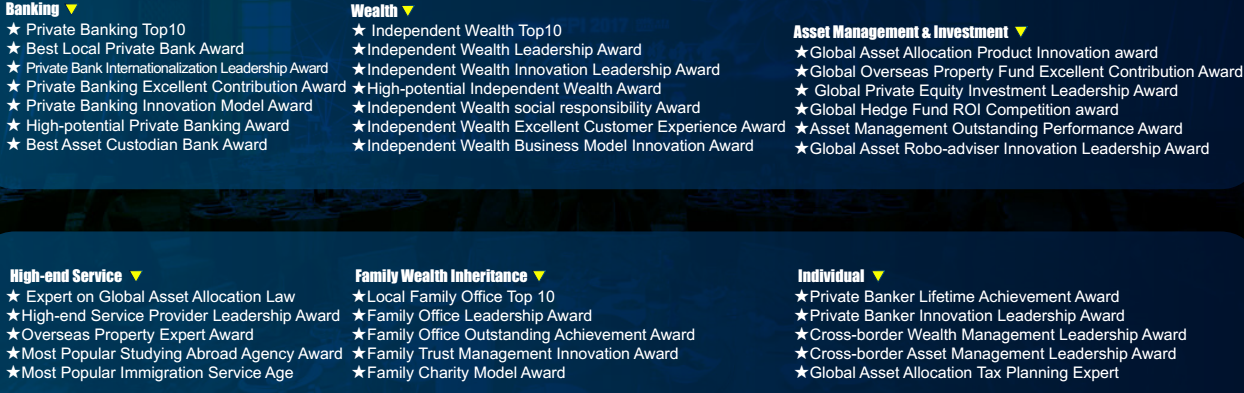
Global Asset Allocation Awards Ceremony, which honors enterprises and individuals who have made outstanding contributions to wealth management and asset management. We have set up six awards categories, including “Banking”, “Wealth”, “Asset Management and Investment”, and “High-end Service”, “Family Wealth Inheritance” and "Individual". Now the organizing committee has opened the application channel for awards. If you need to apply for a prize, you can contact the organizing committee.

Website: http://www.gaaf-annual.com
Contact Us: 173-1739-2107 (Mr. Shen)
China Decision Makers Consultancy(CDMC)Group was founded in 2004. CDMC Finance Research Institute (CFRI) is committed to the sustainable development of China and worlds' finance development through conducting research on difficulty points and hot issues. With a 8-year proven track record, CFRI is studying on payment, internet finance, fintech, customer finance, supply chain finance, block chain, situational finance, global asset allocation, non-performance asset investment, ABS, real estate finance, forex, derivatives, wealth management, asset management, etc.








