Published
- 01:00 am

ChinaPay, a Chinese financial services and payments provider, and PPRO Group, a cross-border e-payment specialist, announces today a partnership to bring over 15 European alternative payment methods (APMs) to ChinaPay’s Chinese merchants. The partnership will help to expand the merchants’ customer reach across Europe, with the possibility of adding additional APMs in the future.
There is huge potential in China for cross-border e-commerce, both into and out of the country. In fact, recent research has found that in 2018, 74 million people are already shopping cross-border from China, compared to 41 million in 2016. Not only that, but Chinese merchants’ cross-border sales from outside of China have reached 8.8 trillion RMB compared to 6.3 trillion RMB in 2016, showing an appetite for Chinese goods from international customers.
International e-commerce opportunities are currently out of reach for Chinese merchants because of the need to have a local presence in order to process local payment methods. Through this partnership and PPRO Group’s simple cross-border solution, Chinese merchants looking for international expansion outside of China will be able to leverage the revenue streams the European e-commerce market has to offer. ChinaPay will be able to provide its merchants with access to several established European payment methods, including eps, giropay, iDEAL, Qiwi and SafetyPay.
Covering the entire value chain, from acquiring through to processing, local collection and reconciliation, PPRO Group offers all acquiring services for a multitude of international APMs across more than 100 countries. Under one contract, through one single integration and one platform PPRO processes, collects, reconciles, consolidates and pays out all payments for PSPs’ and acquirers’ merchants.
An executive at ChinaPay comments: “Europe represents huge opportunity for global e-commerce and as such is an important market for Chinese merchants. We want to be able to facilitate this global trade for our customers – local payment options are integral to this which is why we are so pleased to be partnering with PPRO Group to provide a selection of popular APMs for our customers.”
ChinaPay recognises the importance for merchants to offer international payment methods to facilitate custom from outside of China. Customers will always want to use their preferred payment methods, otherwise they will simply shop elsewhere. This is an exciting partnership with ChinaPay that will help Chinese merchants in their journey to going global,” states Ronnie D’Arienzo, Chief Sales Officer, PPRO Group.
- 06:00 am

Cyber Security Base with F-Secure, a free online course series developed by the University of Helsinki and F-Secure, is now open for its third year. The course series, designed to give students the practical skills and knowledge required for a career in cyber security, exemplifies some of the unique strategies companies and educators are using to address a global cyber security talent shortage.
F-Secure’s Kristian Kristensen, who helps coordinate F-Secure’s Cyber Security Academy – a recently launched internship program designed to turn IT professionals into cyber security experts – says that the cyber security skills shortage needs solutions more than studies or research trying to show that it’s real.
“There’s no shortage of evidence showing that the cyber security talent gap is a problem for society, companies and frankly everyone, so it’s basically redundant to keep pointing that out,” said Kristensen, Director of Delivery for F-Secure’s Cyber Security Services. “What we do have is a shortage of attention being paid to solutions. So we need to change gears and start focusing more on how to solve this problem if we want security to keep up with tomorrow’s needs.”
Cyber Security Base with F-Secure – a massive open online course (MOOC) – packages the cyber security knowledge and expertise of F-Secure and the University of Helsinki’s Department of Computer Science into an accessible series of online courses. The series’ contents cover a range of topics participants need to understand in entry-level cyber security positions, as well as capture the flag-style hacking challenges and other hands-on exercises to help students apply what they learn.
The course series has attracted tens of thousands of students from around the world since it was launched in 2016, with hundreds of people completing courses and some even earning credits toward university degrees. And while the series’ primary aim is to directly prepare participants for entry-level cyber security positions, it can also be useful as a primer for additional training, or even for employed IT workers who wish to learn more about security.
There are no formal education requirements or fees to participate in the MOOC. And according to the University of Helsinki’s Department of Computer Science Post-Doctoral Researcher Samu Varjonen, this accessibility makes Cyber Security Base with F-Secure an innovative way to let potential professionals explore the field.
“Cyber security has been around for decades but there’s no single path for people interested in the subject to become true professionals,” said Varjonen. “This MOOC offers potential cyber security professionals the opportunity to learn more about the field without asking them to give up existing jobs or invest in a full degree. It’s a great way for software developers, IT admins, computer science students, and more to familiarize themselves with the work to see if it fits their strengths and professional interests.”
- 07:00 am

Duco, the global provider of enterprise data quality and reconciliation services, today announced that former HSBC and Merrill Lynch veteran Spencer Lake has joined the board of directors as a non-executive director. The company has also significantly bolstered its senior management team with the appointments of Danielle Price as Head of Finance and Operations, Peyton Kay as Vice President of Strategic Marketing, and Scott Glazer as Head of Sales, North America.
Prior to joining Duco, Lake spent 10 years at HSBC where he served as a Group General Manager, Vice Chairman of Global Banking and Markets, Co-head of Global Markets, and Global Head of Capital Financing. Previously he spent 17 years at Merrill Lynch in senior roles spanning investment banking, debt capital markets, and real estate finance. Lake is currently an advisor and board member to several technology firms challenging the status quo, including Fenergo, nCino, Nivaura, Inforalgo and Callsign.
“Duco offers a disruptive take on the data quality and reconciliation industry which is in drastic need of an overhaul,” Lake commented. “Manual processes and legacy technology still dominate this space, mainly due to a lack of data standards. Duco’s data-agnostic, augmented machine learning-enabled technology, and commitment to innovation, means the company is uniquely placed to enable financial institutions to fully digitise and automate these processes. I am delighted to be joining Duco at this exciting time, and look forward to helping the company deliver its vision.”
Christian Nentwich, CEO of Duco, said: “I am very pleased to welcome Spencer to Duco. He is a true innovator at heart. His expert industry knowledge and deep ties to the global banking industry will be great assets as we continue our hyper-growth, rapidly expanding our offering while adding new clients to our roster. I am also very happy to announce our latest round of senior management hires, who collectively bring an impressive growth track record delivering enterprise solutions to financial services firms. We are excited to benefit from Danielle, Peyton and Scott’s expertise as we embark on our next phase of growth to transform the way financial institutions collect, manage and use their data.”
- 08:00 am

Meniga, the global leader in digital banking solutions, today announced a €3 million investment from Íslandsbanki, bringing the total investment in the company from banks this year to €9.1m.
Íslandsbanki is the third bank to have invested in Meniga this year. The Icelandic bank follows Swedbank´s investment in April and the strategic partnership announced with UniCredit in June. Meniga will use the proceeds from the Íslandsbanki investment to enhance product research and development.
Meniga announced the investment at its Fin42 customer conference in Reykjavik today. The conference brings together industry leaders in banking and fintech who are discussing the future of bank-fintech collaboration to improve customer service.
Commenting on the announcement, Georg Ludviksson, CEO and co-founder of Meniga, said: “Meniga is committed to supporting banks in their digital banking journey and this investment is another exciting chapter in our long-running partnership with Íslandsbanki. The banking landscape is evolving faster than ever and is driven by new competitors, regulatory changes and rising customer expectations. Therefore, it is vital for banks and fintech companies to work even closer together to thrive in the new digital ecosystem.
Birna Einarsdóttir, CEO at Íslandsbanki: “We strive to constantly improve our customers' digital banking experience and we believe that Meniga’s industry-leading digital banking offering is a key part of this effort. By committing investment to the company we are not only deepening our relationship with the team but also investing in the future development of innovation in digital banking and personal financial management solutions.”
Íslandsbanki and Meniga have worked closely together since launching the first Personal Finance Management solution in Europe in 2009. In 2017 they partnered to deploy a Meniga’s personalised reward program which provides the banks' customers with cashback offers tailored to their individual spending profile.
- 03:00 am
Fenergo, the leading provider of Client Lifecycle Management solutions (CLM) and services for financial institutions, has announced its expansion into Private Banking and Wealth Management, with the creation of a new division lead by Steve D’Souza.
The establishment of this new Private Banking and Wealth Management division directly aligns with Fenergo’s market expansion strategy and its objective to deliver value-adding, innovative and proven CLM services to financial institutions. Steve will report directly to Fenergo’s CEO Marc Murphy and will be based in London.
“The creation of this division demonstrates our commitment to growing the business even further and extending our award-winning CLM platform to new market segments,” said Fenergo CEO, Marc Murphy. “This division will build on the successes we have already achieved in the Corporate and Institutional Banking (CIB) space and will allow us to enhance and develop our proposition to Private Banking and Wealth Management clients further.”
Commenting on his appointment, Steve D’Souza said: “Fenergo has proven its ability to bring CLM technology to the CIB sector and our goal is to extend and enhance our onboarding and unique regulatory capabilities to Private Banking and Wealth Management professionals. These firms are encountering greater competition for customers, and by using Fenergo to streamline their processes and workflows, they can reduce costs and ensure better and faster customer experiences.”
Marc Murphy added: “We will continue to invest in our core CLM platform and will now enhance its capabilities to better serve this new segment. Mirroring our recently announced activity in the asset management space our aim is to engage with market practitioners through the Fenergo Global Regulatory Forum. The forum will allow us to better understand their needs, extend our world-class services based on their preferences and drive mutually beneficial growth for all parties.”
Steve’s 35-year career encompasses roles at Unisys, Odyssey, Parity, Propero and TCA Consulting before setting up Sales Kinetics in 2008. During his time at Sales Kinetics he has worked with over 25 IT firms driving and creating revenue in the UK and Switzerland. His successes include sales into Brewin Dolphin, Quilter, Brooks Macdonald as well as the LGT Group.
- 01:00 am
Chinese households possess a huge spending capacity. From 2010 to 2017, the retail sales of consumer goods in China accumulated from 158 bn RMB (22.7 bn USD) to more than 366 bn RMB (52.7 bn USD) – revealing a Compound Annual Growth Rate of 11 percent p.a. over the last eight years. Targeted at investors who seek the ability to participate in this flourishing trend, Solactive released its new Solactive China Consumer Index (.SOLCHCN), which serves as the underlying of Deutsche Bank’s Solactive China Consumer Index Certificate (DE000DS9CHC2).
Solactive’s index intends to track the price movements of the 20 largest Chinese companies by market capitalization, which are classified in any of the three following business segments: Consumer Services, Consumer Durables, and Consumer Non-Durables. Furthermore, eligible companies have to derive more than 75 percent of their revenues from China, a factor that ensures investors obtain a direct exposure in the Chinese domestic market.
Timo Pfeiffer, Head of Research at Solactive, commented: “China’s demographics present a huge opportunity for steady, and long-term investment strategy. As more Chinese citizens raise their living standards, the purchasing power of domestic households more than doubled within the last eight years. Alongside a growing middle-class, which forms the backbone of every country's economy, China’s consumption power is expected to experience further increases.”
Mathias Schoelzel, Head of X-markets at Deutsche Bank, commented: “The Chinese consumer sector is one of the sectors with a strong growth potential. With our new index tracker, we offer the opportunity to participate in a selection of the largest Chinese companies. We regard the Solactive China Consumer Index as a great addition to our existing index universe.”
- 06:00 am

CryptoCompare, the global cryptocurrency market data provider, today published its monthly Exchange Review for October 2018, designed to offer institutional and retail investors insights into the cryptocurrency exchange industry.
The monthly review includes exchange trade data; order book and web traffic analysis; news highlights; exchange market segmentation; an overview of trans-fee mining and decentralised exchanges; information on volumes and pairs including Bitcoin to Fiat volumes; as well as exchange security and KYC requirements.
The Methodology: CryptoCompare’s Monthly Exchange Review evaluates the consistency and quality of exchange data, which is incorporated into CryptoCompare’s real-time Aggregate Index Methodology (the CCCAGG), used to calculate the best price estimation of cryptocurrency pairs traded across global exchanges. It aggregates transactional data from more than 70 exchanges using a 24-hour volume weighted average for every cryptocurrency pair. Constituent CCCAGG exchanges are reviewed and amended each month to ensure that the most representative and reliable market data is used in CCCAGG pair pricing calculations.
Key findings from the October review include:
- The top exchange by 24h spot trading volume was Binance with an average of just under 980 million USD, followed by OKEX and Bitfinex with volumes of 405 million and 368 million respectively.
- Spot volumes constituted less than three quarters of total market volumes on average (less than 7 billion USD) compared to futures volumes (3.2 billion USD). Within total spot volumes, exchanges with taker fees represent approximately 90% of the exchange spot market volumes, while transaction-fee based (TFM) and no-fee exchanges represent the remaining 10%.
- Bithumb saw a 356% spike in trading volumes from an average of 140 million USD to an average of 640 million USD after the 7th of October. This follows after the Singapore-based BK Global Consortium bought a controlling share in the exchange.
- Bitfinex saw a spike in volumes towards the 15th of October as the Bitcoin premium on Bitfinex vs Coinbase reached an all-time high of 11.28%.
- An analysis of the top 100 exchanges by 24h volumes suggests that a third of top exchanges store the vast majority of users’ funds in cold wallets (offline).
- If we look at the ratio of order book depth down to volume, we can rank exchanges by how immune to manipulation their markets might be. What we find is that, itBit, Kraken and Bitstamp have relatively more stable markets compared to exchanges such as CoinEx, ZB and Coinbene.
- CoinEx, a well-known trans-fee mining exchange, has a significantly higher trade frequency and lower trade size than other exchanges in the top 25. This may point to algorithmic trading, given its almost 176 thousand trades a day at an average trade size of 125 USD. In contrast, Bithumb and HuobiPro had an average trade size of just under 3,000 and 1,500 USD respectively and significantly lower trades per day (12–18 thousand).
- According to a web traffic analysis using Alexa data, exchanges ZB and EXX showed significantly lower daily visitors relative to other exchanges with similar volumes. Both exchanges trade volumes in excess of 150 million USD per day, but attract no more than 700 visitors per day.
Karl Turner, Head of Data Partnerships, CryptoCompare, said: “Data inconsistencies across exchanges may originate from the illiquidity of certain pairs on exchanges, manipulation, broken APIs, differences in fees across jurisdictions, hacks or shutdown of exchanges. etc. Therefore, in order to maintain consistent pricing and volume data that is representative of the market, CryptoCompare maintains a selection of CCCAGG exchanges that have met our minimum data integrity standards. The exchange review detects exchanges that diverge from patterns of the larger exchange pool.”
Charles Hayter, CEO of CryptoCompare, said: “Accurate, clean data is crucial for all retail and institutional investors looking to make digital asset investments. That’s why our data aggregation methodology and standards are rigorous, to safeguard data integrity and ensure consistency and confidence in the market.”
- 08:00 am

Industry change in the Nordics is not primarily fueled by digitally native companies that disrupt the market overnight, but by established industry players transforming their existing businesses. Disruption increasingly comes from companies that already have a strong market position, an existing customer base, a thriving partner ecosystem, and high brand awareness. These are among the key findings of the new study Towards a data-driven future, conducted by IDC on behalf of Tieto.
“Disruptive initiatives from established organizations are often less apparent. However, the impact is at least as profound as that of a digitally native start-up. It should also be noted that these initiatives may come from companies that are not head-on competitors, but niche players or only present in other countries today,” says Markus Suomi, CTO at Tieto.
IDC predicts that by 2021, more than 50% of the global economy will be digitized, and growth across all industries will be driven by digitally enhanced offerings. This means that organizations are compelled to digitalize the offerings, supply chains, and entire business models to remain competitive and relevant.
Nordic organizations lag behind their global peers in digital transformation
Led by North American companies, the share of digital transformers (29%) is significantly larger globally than in the Nordics (16%). Nordic organizations are focusing on business optimization and progressing cautiously unless a true disruptive force is present. While fast to leverage new technology, very few Nordic organizations (7%) have changed revenue models or made similar fundamental shifts in their business models.
However, transformation brings unprecedent opportunities for efficiency gains and business growth to Nordic organizations. 80% of Nordic executives believe that the most significant changes are still to come, while 85% of the executives expect to change business or operational models, meaning that most organizations are in the early stage of their digital transformation journey.
“Our previous study showed that more than seven out of ten believe their current business model will become obsolete in the next five years or earlier. This study shows that business executives across all industries in the Nordics acknowledge the changes and the impact on their business. Customer requirements and expectations have changed, and new products and services are launched by both existing and new competitors, with the potential to disrupt the market,” continues Markus Suomi, CTO at Tieto.
Nordic organizations are fast to leverage new technology to become more efficient and customer centric but are cautious about transforming their actual business models. The stronger the competition and harsher the economic conditions, the more likely companies are to transform beyond business optimization, and the organizations that see digital transformation as a threat are most likely to develop new and alternative business models.
Maturity level differs in various industries
The impact of change is apparent across all segments. There is a tendency that the change in customers’ requirements and expectations is most evident for Finnish organizations (52%), and least evident to Norwegian ones (35%).
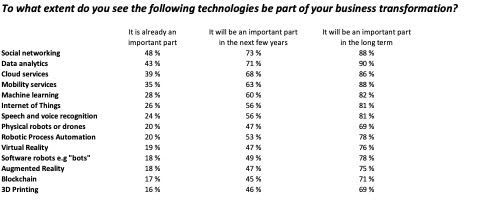
While social networking and data analytics are rated as most important technologies to fuel business transformation, machine learning (Artificial Intelligence) technology is among strategic priorities for most companies and industries. Blockchain is mainly important in selected industries such as transport and logistics and financial services as the use cases are fewer and more difficult to envision in the core business in other industries.
Sweden leads the digital transformation in the Nordics
In the transformation journey, Swedish organizations are slightly ahead of Finnish ones, which in turn are slightly ahead of their Norwegian peers. This is partly explained by the different economic development following the financial crisis as well as the differences in industry demographics.
Technology acumen is key for successful digital transformation
The importance of technology is recognized across the organization, and leaders with an IT background increasingly drive the strategic transformation. Third platform technologies and innovation accelerators are increasingly adopted, and IT organizations are reinvented.
As digital transformation has IT at the very core, technology acumen is paramount for successful transformation. IT executives are not just increasingly involved in decisions but get new roles in the corporate management – either in totally new positions or with significant change in responsibilities. Consequently, IT is increasingly taking the lead in business development as organizations adapt to the digitally transformed world.
- 06:00 am
Saxo Bank, the leading Fintech specialist focused on multi-asset trading and investment, today announces two changes to the Board of Management in order to further strengthen client focus, corporate governance and strategy execution.
- Board of Management member Søren Kyhl has been promoted to Deputy CEO while he continues in his role as COO.
- Damian Bunce has been appointed member of the Board of Management with the new title of Chief Commercial Officer.
Members of the Board of Management are appointed by the Board of Directors. The Board of Management now consists of CEO Kim Fournais, Deputy CEO and COO Søren Kyhl, CFRO Steen Blaafalk and CCO Damian Bunce.
The changes strengthen Saxo Bank’s leadership and accountability in the Board of Management in relation to clients, shareholders, Board of Directors, regulators and employees.
With Damian Bunce as a new member of the Board of Management, Saxo further increases the essential client and commercial focus. The promotion of Søren Kyhl to the newly established role as Deputy CEO adds even more firepower to Saxo’s strategy execution and provides a steadfast long-term leadership of the Bank. As Deputy CEO and COO, Søren is the natural and logical interim successor to Kim Fournais should that become necessary.
Kim Fournais comments:
“I am proud and satisfied that Søren has been appointed Deputy CEO and that Damian will join our Board of Management. The appointments reflect their excellent skills, knowledge, attitude, motivation and high importance to the Bank and our future growth journey. With these changes we ensure clarity, focus and accountability and the changes allow me to focus on constantly improving and executing the strategy for Saxo Bank while building a world-class team and organisation.
Søren is a very natural and competent Deputy CEO that I trust to run certain important strategic priorities. These changes will further strengthen and professionalise Saxo and I am proud to be leading such a unique team. I am more passionate and fired up than ever to ensure that Saxo will prevail and become the fastest growing financial institution within traders, investors and wholesale partners. This is therefore not a retirement plan for me but an upgrade of our leadership capabilities, better supporting our fiduciary duties as well as creating a natural deputy function for me and Saxo going forward.”
The Executive Team will continue to be the global executive leadership team in Saxo Bank. Besides from the Board of Management members, it consists of CIO Ashok Kalyanswamy and CHRO Stig Christensen.
- 08:00 am
The number of US pension plans with assets equal to or exceeding 95% of their liabilities on an accounting basis has risen to 37%, nearly doubling from 20% at the end of 2017, according to RiskFirst data.
Analysis by fintech company RiskFirst of the data from approximately 500 plans, with total assets exceeding $100bn, reveals that, in Q3 2018, alone there has been almost a 25% increase in plans within this funding level band – which arguably makes a buyout or significant risk-transfer deal a feasible option.This sharp increase reflects the favorable conditions in the market to de-risk.
Michael Carse, DB Pensions Product Manager,RiskFirst, says: “The 2017 plan year is the last opportunity to maximize a pension plan’s tax deduction before the lower corporate tax rate comes into force. For the majority of US corporate plans, the final deadline for plan sponsors to make contributions for the 2017 plan year was September 15th2018, and this been reflected in our Q3 2018 analysis, with a number of plans putting in sizeable contributions before the deadline, thereby improving plans’ funded positions further since June 30th.”
Accounting reforms, increased PBGC premiums, and afavorable quarter for market movements – with liability discount rates increasing slightly (resulting in liabilities decreasing), and positive asset returns – are additional factors that could have contributed.
Matthew Seymour, CEO, RiskFirst, comments: “As pension plans look to de-risk, it is all the more important that they are positioned with the right tools to manage risk effectively. By carrying out detailed analysis on both assets and liabilities and regularly and accurately monitoring their funding levels,plans can make truly informed decisions on how to optimize their strategy andharness opportunities in the market.”