
Published
- 05:00 am

Axyon AI, Italian start-up that brings deep learning to finance, today announced it has completed a Series A round of funding with UniCredit and ING Ventures, the venture capital arm of ING Bank. Individual investors also participated. The investment will be used to accelerate growth and further develop the product offering. It will also be used to support additional investment in research and development.
“We are extremely pleased to have the backing of these two leading financial institutions, each of which will bring immense value as we scale” says Daniele Grassi, CEO of Axyon. “Corporate and investment banks need to analyze large and complex sets of financial data to provide their clients with valuable advice. The data is often fragmented, and extracting value remains a painful manual process. We are excited to solve this problem through deploying our expertise in deep learning, an incredibly powerful branch of artificial intelligence (AI)”
One of Axyon’s core products is SynFinance, an AI-powered platform that identifies the investors who are most likely to participate in a syndicated loan. These insights help banks offer better advice to their clients whilst becoming more effective in the process. SynFinance is offered as a web-based application that delivers liquidity analysis and market insights directly to financial professionals.
Benoit Legrand, Chief Innovation Officer of ING and CEO of ING Ventures commented: “ING Ventures is constantly looking for fintechs that help us to deliver a differentiating experience for our clients. We invest in companies that are of strategic relevance for ING to accelerate its strategy. Axyon AI specifically is of interest because of their use cases in AI that can bring value to financial institutions, thanks to their predictive solutions. Additionally, Axyon AI has an ongoing partnership with the Wholesale Banking Advanced Analytics team and the syndicated lending team is using Axyon’s SynFinance product to enhance their activities.”
Ranieri De Marchis, co-Chief Operating Officer at UniCredit, said: “In our view, fintechs can effectively generate ideas for banks, adding to the digital transformation already under way. We are strongly committed to developing innovative services and we are now proud to be investing in and partnering with Axyon AI in order to accelerate our digital transformation and further enhance the quality of our client advisory services. This perfectly fits with our strategy of collaborating with the most promising operators in the fintech space to explore, support and develop innovative solutions that can improve the experience of our corporate customers and meet their changing needs”
Axyon recently partnered with Refinitiv (Financial & Risk business of Thomson Reuters) to power the SynFinance platform. It has also partnerships with IBM and Nvidia.
- 04:00 am

LexisNexis® Risk Solutions, the global information solutions provider, has, for the second consecutive year, retained the Best Regtech Solution in Financial Crime & Sanctions Compliance award at the Compliance Register Platinum Awards 2018.
Taking place in central London, The Compliance Register Platinum Awards is now in its 15th year. The event celebrates the achievements of individuals and organisations in the field of compliance and regulation operating within the financial services industry.
The Best Regtech Solution was secured due to the LexisNexis® Bridger Insight® XG platform. Utilised by businesses globally, Bridger Insight XG helps customers to conduct due diligence, meet regulatory obligations and combat financial crime via a single platform.
Michael Harris, Director of Financial Crime and Reputational Risk at LexisNexis® Risk Solutions, commented:
“Securing a win for Best Regtech Solution at the Compliance Register Platinum awards is a true testament to the team at LexisNexis Risk Solutions, who work hard to deliver best in class technology, data and analytics that combat the ever present threat of financial crime. It is a privilege to win this award at an event which sees the best in the industry come together to celebrate the successes of the last twelve months.
The team at LexisNexis Risk Solutions will continue to drive innovation in the fight against financial crime through 2019 and beyond, and hope to be back enjoying further wins next year.”
- 06:00 am

BT today announced the appointment of Kevin Brown as managing director of BT Security, where he will be responsible for the company’s physical and cyber security activity around the world. Kevin succeeds Mark Hughes, who is stepping down at the end of this year to take up a new position outside of BT.
BT is one of the world’s biggest providers of cyber security services, with 3,000 experts around the world protecting BT’s operations across 180 countries as well as its customers’ networks. Its global network of Security Operations Centres protects BT against 125,000 cyber-attacks every month and provides cyber security solutions and services to consumers, governments and businesses, including some of the world’s largest multinational organisations.
Kevin joined BT in 2012, following a 20-year career in law enforcement. He has specialised in security throughout his time at BT, and in previous roles has led its global investigation and intelligence teams and driven the modernisation of BT’s protection systems. In his previous role, Kevin led BT Security’s engagement with international governments, and managed its relationships with international law enforcement agencies such as Interpol and Europol.
Kevin said: “I’m thrilled to be leading BT’s security operations at a time when the need to protect households, business, governments and entire nation states from damaging cyber-attacks has never been greater.
“Our global network gives us a ringside view of the latest threats so we can anticipate and mitigate emerging attacks before they impact our business or our customers. Our expertise in securing BT’s global network is why organisations around the world trust us to protect their most critical assets. I’m really looking forward to continuing the rapid growth that BT Security has seen in recent years.”
BT’s Security business is one of the company’s fastest growing areas, driven by the industrialisation of cyber-crime and the need for organisations and individuals to take proactive measures to protect their digital assets. BT is also the UK’s biggest private cyber security employer, and plans to increase its headcount by 25 per cent over the next five years in order to develop the next generation of cyber security professionals and meets its growth ambition.
- 07:00 am

The alternative investment specialist Aquila Capital has launched a green bond with a volume of EUR 50m and a duration of five years via the Norwegian hydropower operator Småkraft AS to finance the company’s further growth. With over 100 hydropower-plants across Norway and an annual energy production of 1 TWh, Småkraft AS is already the biggest independent operator of small-scale hydropower plants in Europe. The additional financing is being secured in the wider context of the company’s goal to double annual production to 2 TWh by 2022.
The Norwegian research institute CICERO (Center for International Climate and Environmental Research, Oslo), a leading independent rating organisation for green bonds, rated the bond “Dark Green”. This top category is reserved for projects and products that contribute in a sustainable fashion to a low-emission and climate resilient future.
The senior secured green bond will yield an annual interest rate of 1.9 points above EURIBOR and is traded at the Oslo Stock Exchange. Apart from refinancing existing obligations and general corporate purposes, the capital raised by the joint lead managers ABG Sundal Collier, Nordea and SEB will be used to further expand into Norwegian hydropower, both via the acquisition of existing plants and the construction of new run-of-river plants. Specifically, it is planned to purchase four more hydropower plants and to refinance seven that are already owned.
Roman Rosslenbroich, Co-Founder and CEO of Aquila Capital, comments: “Green bonds are an attractive instrument to continue driving the European energy transition. Institutional investors increasingly insist on such sustainable financing options because they offer more transparency as to how the capital is used at an equivalent risk-return-profile compared to conventional bonds. This is why we view this development not as a short-term trend but as one of the most sensible ways to mobilise the capital required to transform European energy grids. Norway, with its mature and robust hydropower market, therefore lends itself as a natural starting point.”
- 02:00 am

A new white paper published by Greenberg Traurig, LLP reveals that asset managers are failing to optimize corporate actions decisions on a massive scale. The paper highlights the costs to beneficial owners of suboptimal decisions in corporate actions as well as the regulatory and legal risks asset managers face for systematically failing to optimize corporate actions decisions.
Greenberg Traurig analysed losses by investors, including some of the largest asset managers in a dataset comprised of all scrip dividends globally between 2011 and 2017. The paper highlights include:
- Average aggregate losses to beneficial owners from scrip dividends alone total $1.3 billion annually – and between 2011 and 2017, approximately $8.9 billion were missed. Findings also conclude that in 38% of scrip dividends, the majority of shares were elected in a suboptimal manner.
- Aggregate losses from undersubscribed rights offerings exceed $100 million per year and losses are compounding each day. There were fewer rights offerings than scrip dividends between 2011 and 2016, but the missed value was far larger - approximately $662 million out of $485 billion capital raised.
- As of the end of 2016, unfunded liabilities of private-sector defined benefit pension plans in the U.S. alone stood at $0.5 trillion. The approximately 10-basis points per year improvement that asset managers would derive from recovering missed value from scrip dividends alone, would add 1% to the return of portfolios over seven years.
Regulators are demanding increased transparency which means greater scrutiny leading to investigations and enforcement. Increased regulatory transparency also raises the prospect of lawsuits and civil liability. Significant risks exist for asset managers who ignore fiduciary obligations.
According to Robert S. Frenchman, Esq. at Greenberg Traurig, “It’s now only a matter of time before regulators commence investigations and enforcement cases and civil plaintiffs commence lawsuits against asset managers that systematically fail to maximize the value of corporate action determinations. We think the courts are especially likely to uphold fiduciary obligations, where many are knowingly failing to recover the full value of corporate action events that are the undisputed property of their investors.”
Asset managers require systems that value corporate action determinations on election date and ensure optimal election is captured for the beneficial owners. A compliant system needs to include capabilities to value each possible corporate action election as of the election date, the ability to determine whether the election made is optimal or suboptimal, and the opportunity to change the election and where the election is stock; lock-in the increased value for the client immediately at election.
According to Jonny Ruck, CEO of Scorpeo, a company specializing in capturing missed corporate actions value, “The problem the industry is facing is more daunting than many asset managers realize and the consequences of ignoring it are massive. Whether firms decide to leverage their own internal resources, or work with a corporate actions technology provider to put a system in place, asset managers need to act now. With the tools, technology and processes that exist today, there’s no reason investor beneficiaries should be incurring losses of this magnitude. As an industry, we need to systematically improve the way we optimize corporate actions – these are critical functions that can no longer be neglected.”

Jake Olcott
VP at BitSight
Following the breaking news today that Marriott’s Starwood bookings database has been comprised with half a billion people affected, it highlights the importance of organisations see more
- 04:00 am

Hartford InsurTech Hub, powered by Startupbootcamp, unveils the 2019 cohort of startups for its acceleration program. The chosen startups cover a wide range of abilities, from Property Insurance Claims to Peer-to-Peer Insurance (P2P). The selected ten companies exhibit a diverse range of technologies and insurance types.
The 10 successful teams, selected from over 230 applications, will relocate to Hartford ready for the start of the program in February, and will remain for its three-month duration. For the startups themselves, joining the program means they will receive the support, resources, and industry and investor connections they need to help grow their businesses. With support from Startupbootcamp, the teams will be provided with access to an extensive range of partners, mentors, and investors from across the accelerator’s global network.
The 10 startups who will join the second year of the Hartford InsurTech Hub acceleration program will work closely with Hartford InsurTech Hub’s insurance corporate partners: Aetna, Capgemini, Cigna, Deloitte, The Hartford, Travelers, USAA, White Mountains and CTNext are:
- Pineapple: Pineapple offers a fair, transparent, and affinity based P2P insurance and they’re coming to Hartford from South Africa.
- handdii: Coming from Australia, handdii is a digital platform that automates the property insurance claim process from FNOL through to claim finalization.
- Dream Payments: Dream Payments is a Fintech startup from Canada that powers digital and mobile payment services for business customers.
- Pitch Gauge: Pitch Gauge, from Georgia, is a roofing estimating application using mobile devices to do property inspections.
- Medyear: From New York, Medyear is a social network for healthcare collaboration. They connect consumers to over 190 health systems and 700k doctors for real-time chat, secure email, microblogging, and personal health records.
- SkyWatch: SkyWatch is a licensed insurance broker in all 50 US states offering a holistic software solution for on-demand risk-aware solutions for connected, moving platforms. They’re originally from California.
- Talem Health Analytics: Coming from Canada, Talem Health Analytics provides data driven insights on bodily injury claims cost.
- See Your Box: See Your Box provides Industrial IoT tools to digitize supply chains. SYB is a tech-service platform that collects, analyses and extracts information related to goods across all steps of the supply chain and is coming to Hartford from Switzerland.
- ClaimSpace: Coming from Australia,ClaimSpace is a platform that bridges the communication gap between customers, insurers and stakeholders during the claims process.
Sabine VanderLinden, CEO at Startupbootcamp InsurTech, expresses her excitement: “The insurance industry is continuously evolving and technology is having a huge impact. InsurTech of the past has been about enhancing retail-based offerings with improved customer engagement. InsurTech of today is focused on business model innovation and reconfiguring value chains - something which we are committed to developing in Hartford. We have built strong foundations over the last 18 months and we’re on the way to transforming the City of Hartford into the InsurTech capital of the US. There’s still much to do and I am therefore delighted to be welcoming some truly inspiring teams into the next program in Hartford to continue this transformation.”
Dawn LeBlanc, Managing Director, Hartford InsurTech Hub, adds: “The startups mentioned the most unique and valuable portion of the Selection Days experience has been the tremendous support and input from the broader community involved in InsurTech. From insurance experts, lawyers, regulators, investors, mentors, politicians and potential collaborators, each shared their insight to promote growth of their business and were able to make valuable connections.
After five months of scouting over 500 startups from 38 different countries, the announcement comes after 22 talented InsurTech startups met in Hartford this week for three intensive Selection Days. The Hartford InsurTech Hub’s corporate partners, mentors, and investors selected the 10 most relevant insurance technology startups that will enter its cohort beginning in February 2019.
As many of us are starting to unwind ready for the holiday season and the start of the new year, we at Hartford InsurTech Hub are eagerly awaiting the next phase of the program. Stay up to date with Hartford InsurTech Hub by following on TwitterLinkedInand Facebook
- 01:00 am

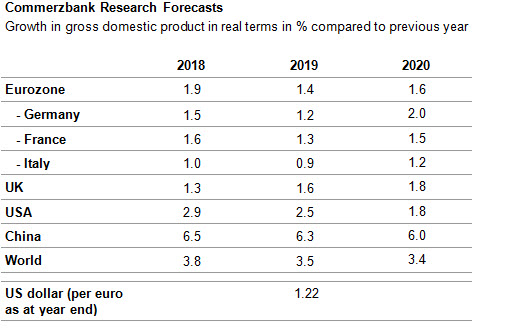
The global decline in economic indicators is not a harbinger of a dangerous economic downturn, said Commerzbank chief economist Jörg Krämer on Friday in Frankfurt. “What we see here is just a slowdown of growth,” said Krämer.
The US economy, for instance, has been boosted this year by the reduction in taxes and an increase in government expenses, which will not repeat itself next year. In addition, the US Federal Reserve's monetary policy is depressing economic growth. The Fed has already raised interest rates eight times since the end of 2015 and will – after another step in December – raise it two further times next year, according to Commerzbank analysts. The rate would then be at 3.00%. The Bank's economists expect the US growth to fall to 2.5% in 2019.
In the Eurozone, the manufacturing sector, which is dependent on foreign trade, shows signs of weakness. According to Krämer, this is primarily due to exports to China, which are seeing less growth currently. “The development of economic growth in the Eurozone predominantly depends on China,” said Krämer. He believes, however, that the Chinese government will successfully stimulate domestic demand and thereby stabilise the Chinese economy. In this case the upswing in the Eurozone should continue to grow at a rate of 1.4% in 2019, according to Commerzbank economists.
The budget crisis in Italy represents a downside risk to this forecast. However, Krämer does not believe that the conflict will escalate. “Italy will continue this dispute until the elections to the European Parliament next May,” said Krämer. “After the elections, Italy will strike more modestly and in doing so open the door to a compromise.” Brexit also continues to be a factor of uncertainty. “Unfortunately, the EU has clearly left its mark on the Brexit agreement so an approval by the British Parliament is questionable,” said Krämer.
These factors combined with core inflation not picking up will have an impact on the European Central Bank. According to Commerzbank experts, the ECB will not raise interest rates in 2019, but in March 2020 instead – without initiating a rate hike cycle. “A true turnaround of monetary policy in the Eurozone is still not in sight,” said Krämer. It is expected that the DAX will recover as soon as economic indicators pick up next spring, and after the elections to the European Parliament, when the Italian government shows it is willing to compromise (DAX year-end forecast: 12,500).
- 02:00 am

On November 29, 2018, Eric Jing, Executive Chairman and CEO of Ant Financial, was appointed to the United Nations’ newly launched Task Force on Digital Financing of the Sustainable Development Goals (SDGs). The global task force will recommend strategies for large-scale digital finance flows to SDGs.
The Task Force comprises a select group of leaders and top experts from around the world. Along with Mr. Jing, other members include government ministers, tech entrepreneurs, bank and investment CEOs, central bank governors, and civil society representatives. Together, they will work to explore deeply how digital financing can advance the SDGs of United Nations.
“I am honored to join the Task Force and contribute Alipay’s knowledge and technology in promoting inclusive financing,” said Mr. Jing. “Alipay, with support from the United Nations, has long advocated for the launch of an innovation task force for digital financing. In and beyond China, our cutting-edge digital technologies serve millions of small and micro businesses and improve the lives of hundreds of millions of ordinary people. We are committed to bringing equal opportunities to the world and I believe this resonates with the UN’s SDGs.”
António Guterres, the United Nations Secretary-General, released his Strategy for Financing the 2030 Agenda for Sustainable Development in September 2018. It highlights the need for deep changes across the business and financial sectors and in public policy to mobilize private finance at the required scale and speed. A core part of this strategy is to seize the potential for financial innovations, new technologies and digitalization to provide equitable access to finance. The Task Force was created specifically to help answer questions of how to unlock the potential of digitalization of finance and manage the risks.
This month, Mr. Jing was also appointed to the External Advisory Group on Digital Technology of the International Monetary Fund.

Dr. Thomas Di Giacomo
CTO at SUSE
While artificial intelligence is still in its relative infancy in a number of areas, the UK government has recognised the potential for this technology to boost productivity in t see more








