
Published
- 05:00 am

As executives struggle to understand their organisations’ exposure to cyber-risk, Huntsman Security has launched The Security Scorecard – the first tool of its kind to give instant visibility of an organisation’s Cyber Security Posture. The Scorecard is a standalone product that gives non IT people such as auditors, risk managers and senior executives a clear understanding of an entity’s cyber security exposure.
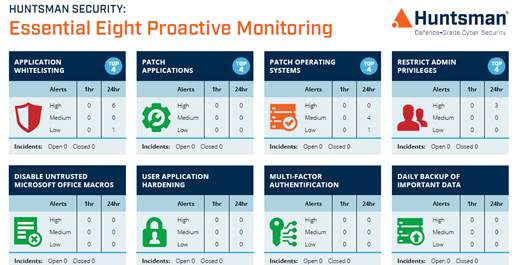
Security Scorecard Dashboard
The Scorecard technology automatically measures eight key security controls whose effectiveness determines just how secure an organisation is from a cyber-attack. Based on findings by the Australian Signals Directorate (ASD), these best practice controls can reduce the likelihood of a cyber-attack by more than 85 percent. Measuring against these, the Scorecard gives an immediate and automated understanding of risk and exposure: allowing the business to tune the effectiveness of the controls in line with its risk appetite.
“One of the biggest issues security teams face is presenting a convincing argument to the board about what measures need to be taken to reduce risk, and why,” said Jon Collins, industry analyst at Gigaom. “In this situation, the security team doesn’t want to present a list of thousands of outstanding actions, but a shortlist of the highest priorities. A simple scorecard acts as a paring knife, allowing organisations to act more quickly to reduce risk.
“Ultimately, any organisation suffering a breach wants it to be because they fell victim to a complex, never-before-seen attack; not because they failed to follow basic precautions. Huntsman’s scorecard is a great starting point for security teams and executives who want to ensure they have taken essential precautions, based on clear criteria.”
Utilising the “Essential Eight” controls, the solution consists of eight processes that, together: prevent initial attacks, and limit the extent of incidents, recover data and restore systems availability.
The processes are split into a ’Top Four’ – application whitelisting, patching applications, patching operating systems and restricting admin privileges – that are critical to achieving security: plus a further four – disabling untrusted Microsoft office macros, user application hardening, multi-factor authentication and daily backup of important data. The ‘Top Four’controls are mandatory for Australian federal government departments, and the eight controls collectively complement the best practices put in place by other Governments, such as the UK or USA.
The Security Scorecard continuously measures the performance of the controls, reporting clear metrics and red, amber, green colour-coded status that is easily understood by any audience.
Security Scorecard – Status of Controls
Armed with this information, stakeholders have an immediate overview of their exposure and security teams know whether to focus on these essential processes or examine other ways to reduce risk further.
A standalone product, the Scorecard has a small proactive footprint that sits alongside other security technologies. Security teams can continue with their primary operations without any distraction and without significant investment in new security systems. Because of this, the Scorecard is easy to implement for any organisation.
The Scorecard can be used by organisations in a supply chain to give visibility of their security posture to partners up and down the chain.
“No matter how good or detailed your criteria for effective security, if you only measure it once a year; it won’t give auditors a representative view of operations and it certainly won’t enable the proactive management of risk that security teams and executives aspire to”, said Peter Woollacott, CEO and founder of Huntsman Security.
As a Computer Aided Audit Tool (CAAT), the Scorecard comes into its own; rather than providing an expensive ‘snapshot in time’ it delivers a continuous view of cyber posture for auditors. It also serves to support security specialists in their pursuit of plugging any security gaps.
The Security Scorecard is available now: huntsmansecurity.com/products/security-scorecard/
- 05:00 am

Temenos, the banking software company, has become the first vendor to win "Best Digital Banking Solution" at the Banker Africa – North Africa Banking Awards. Previously the awards have only gone to banks, making this the first vendor-specific award.
Temenos was handedthe prestigious prize in recognition of its market-leading digital banking softwareand continued dedication to the region. This month marked a major milestone with the launch of Temenos Infinity – a breakthrough digital front office product – and Temenos T24 Transact, the next generation in core banking. Thesenew products further demonstrate a commitment to constant innovation, leveraging 25 years of functionality from 3,000 banks in more than 150 countries with the most advanced cloud-native, cloud-agnostic, API-first technology and design-led thinking.
Winners of the awards, designed to celebrate innovation and the ability to gain market share, were decided by readers of CPI Financial – mid-management to senior board level members of banks and financial institutions – who submitted votes after experts from the publication compiled a shortlist.
Temenos digital banking solutions empower banks to serve up the right customer insights at the right moment, via the right channel. The platform also drives massive efficiencies in the back-office. As an end-to-end digital platform, the technology offers front office differentiation with back office automation.
With Temenos digital banking software,banks are able to transform their customers' experience, while overcoming long-standing barriers to investment. Temenos digital banking softwareserves more than 150 financial institutions in 35 countries across Africa.
The awards highlight all aspects of successful banking – from financial inclusion to corporate social responsibility, commercial operations, along with several individual accolades.
Matthew Amlôt, Editor, Banker Africa, said: “The Banker Africa Awards program has become a valued and respected benchmark within the industry and Temenos should be proud that our readers have chosen them for this prestigious prize, which is a celebration of innovation in banking software. This demonstrates the trust and respect for Temenos from the banking and finance community across the North African region.”
Jean-Paul Mergeai, Managing Director – Middle East and Africa at Temenos, said: "I am delighted that Temenos is the first vendor to win this prestigious award. We are constantly striving to keep our market-leading digital banking software ahead of the curve and awards like this, which demonstrate that the market recognizes our efforts. Our strategy to invest 20 percent of our revenues on R&D every year is clearly paying off. This will enable us to continue providing the best technology for our clients to deliver engaging and empowering digital banking experiences to customers and staff. Solutions which, as with everything we do, are open, packaged and upgradable – ensuring our clients never fall behind."

Aaron Hughes
Managing Director at Equiniti
A wiser man than me once said that anyone attempting to make predictions will end up either wrong or lucky. see more

Frederik Mennes
Senior Manager Market & Security Strategy, Security Competence Centre at OneSpan
2018 has been a turbulent year for banks in the UK. Physical branches are closing, with online and mobile channels becoming increasingly popular. see more
- 08:00 am

New research from the Global Blockchain Business Council (GBBC), the leading association for the blockchain ecosystem, reveals that 26% of institutional investors believe major listed companies will have to start proactively reporting on their plans and ambitions around blockchain because investors will demand this. A further 38% anticipate they will start to have to do this between three and five years from now, and only 13% think companies will never have to do this.
Global Blockchain Business Council (GBBC), which is running “Blockchain Central”, the premier venue at Davos this year for all things blockchain, believes some companies will soon start to have heads of blockchain sitting on their Boards. One in twenty institutional investors (5%) anticipate this will start to happen within the next two years, and a further 26% anticipate this starting to happen between three and five years-time. A further one in five expect it to happen between five and ten years from now.
This growing level of importance that investors expect businesses to place on blockchain can in part be explained by the fact that 40% believe that blockchain could be the most transformative technology since the internet. Only one in three (34%) disagree with this view, with the remainder undecided.
Speaking at Davos, Sandra Ro, CEO of the GBBC, said: “There is little doubt about the potential impact blockchain can have on most sectors, and key areas of everyday life.
“Increasingly, the winning organisations of the future will be those that have a clear and comprehensive strategy for blockchain and those that are committed to implementing and using it to transform their organisations.
“It is perhaps not surprising that investors will soon want to know what companies are doing in this area, and that they have confidence in the executives chosen to implement the programmes.”
- 08:00 am

Baloise has chosen Tieto’s Insurance-in-a-Box solution to create an agile digital platform that will enable it to implement new services in a faster way, and realise its ambition to be one of the most innovative insurers on the Belgian market.
“Baloise Insurance has the ambition to keep pace with the latest development in the insurance market. Together with our distribution partners, the independent brokers, we want to offer tailored solutions to our customers, meeting their changing needs. Tieto’s Insurance-in-a-Box will help us to launch and test innovative services and processes, fail fast on non-successful ideas and accelerate quickly on those that work”, says Joris Smeulders, Managing Director of Baloise Insurance.
Tieto’s Insurance-in-a-Box platform is a combination of several partner solutions, with Insicon the key partner providing the core system. Leveraging the partner ecosystem, the full-stack platform brings the latest technology and distribution accelerators to the customers in a fast and agile way. The solutions are prepackaged and modular, helping Baloise speed up integration and time to market. It also allows the insurer, its brokers and channel partners to reach out to consumers with modern and relevant services.
“At Tieto, we are proud that our Insurance-in-a-Box solution has been chosen by Baloise as their agile insurance platform. This is a great example of how ecosystem partnerships can be leveraged to create real business value for our customers. This cooperation with Baloise, our first insurance customer in Belgium, also opens up new possibilities for Tieto in Europe”, says Christian Segersven, Executive Vice President, Financial Services at Tieto.
“We at Insicon are excited and proud to start the Insurance-in-a-Box [iiB] journey with Baloise. IT is a big step for us to address markets outside our Nordic home base. Together with Tieto and other iiB partners, we will be able to help Baloise achieve their targets”, says Martin Sjöberg, Managing Director of Insicon.
- 06:00 am
IBM and the Bank of the Philippine Islands signed a $260 million multi-year services agreement calling for IBM to provide IT services for agile IT and hybrid cloud, as well as development to accelerate BPI's digital transformation, IBM said Wednesday.
BPI is the third-largest bank in the Philippines in assets, with more than 9 million customers, providing services over mobile, ATMs, cash accept machines and branches, IBM Corp. (NYSE: IBM) said in a statement.
IBM and BPI designed an IT environment that supports open APIs to create application and services. BPI wants to achieve continual upgrades for bank branches with new technology, as well as additional financial services apps for customers, IBM says.
The deal continues two weeks of good news for IBM's cloud business. And IBM hasn't had a lot of good news in the last couple of years, as it struggles to transition from its legacy systems business to emerging technology including cloud, cognitive computing and analytics.
The cloud helped IBM boost revenue and beat expectations for fiscal 2018 and sent the company stock soaring following an earnings report Tuesday. IBM traded at $133.04 up 8.59% Wednesday afternoon. (See IBM Had a Very Good Day in the Cloud.)
Tuesday morning, IBM announced an eight-year deal with BNP Paribas, France's largest bank, which does business in 73 countries, to extend their cloud partnership for real-time baking, mobile services, digital transformation and improved efficiency. IBM did not disclose a price tag on that partnership. (See IBM Inks 8-Year Cloud Deal With BNP Paribas, France's Biggest Bank.
IBM and Vodafone Group plc (NYSE: VOD) inked a $550 million deal to provide cloud services to European enterprises last week. (See IBM, Vodafone Strike $550M Cloud Deal.)
Also last week, IBM Services announced a $325 million deal to move Juniper Networks Inc. (NYSE: JNPR) infrastructure to the cloud. (See IBM Inks $325M Deal to Move Juniper to Cloud.)
And Red Hat Inc. (NYSE: RHT) shareholders approved a $34 billion deal for that company to be acquired by IBM, to further IBM's multi-cloud strategy. (See Red Hat Shareholders Greenlight $34B IBM Acquisition.)
- 08:00 am

Nasdaq Inc. (Nasdaq:NDAQ) and Bolsa de Valores de Panamá (BVP) have announced that BVP has successfully gone-live with its new trading system.
The system is operating on Nasdaq matching engine technology, allowing BVP to meet their strategic growth plans and leverage the modular functionality to offer additional services to their members and clients.
“After the implementation work during 2018, we are very pleased and proud to launch our new Nasdaq matching engine trading system,” said Olga Cantillo, CEO, Bolsa de Valores de Panamá. “This important investment, crucial for our strategic plan with the aim of positioning ourselves as the regional capital market hub, confirms our commitment to the Panamanian capital market and the development of our country’s economy. This achievement has been thanks to the support of Nasdaq, the high sense of commitment and teamwork of our employees and the brokers of our stock exchange, who also supported us with their recommendations, feedback, training and time.”
“BVP has shown significant commitment in becoming a central player in positioning Panama as a major capital markets hub in Latin America,” said Carlos Patino, Head of Latin America, Market Technology, Nasdaq. “By launching their exchange on Nasdaq’s matching engine technology, they will be offering the market a world-class matching engine with capabilities to expand, grow and be a key driver of the Panamanian economy.”
Nasdaq's market technology powers more than 250 of the world's market infrastructure organizations and market participants, including broker-dealers, exchanges, clearinghouses, central securities depositories and regulators, in over 50 countries with end-to-end, mission-critical technology solutions.
- 09:00 am

Onfido’s machine learning technology powers identity verification for over 1,500 customers worldwide. With just a photo of an identity document and a smartphone camera, users can confirm their identity and gain access to a host of online services, helping businesses onboard more customers, more securely.
BitPay is the largest global crypto payments provider. It processes over $1 billion annually from merchants and B2B customers. BitPay verifies the funds and accepts the Bitcoin on behalf of the organization; businesses then receive settlement in fiat currency within one to three business days.
Partnering with BitPay helps Onfido expand into international markets where credit card payments are impractical. While over 2 billion adults worldwide are un- or underbanked, half of those own a smartphone. BitPay enables transactions from any computer or mobile device, meaning Onfido can deliver identity verification services to a large number of otherwise underserved global users.
As well as opening up access to new users, Bitcoin payments also help increase payment transparency and reduce the fraud risks associated with credit cards. Cryptocurrency provides increased transactional transparency and security as every transaction is verified, recorded and stored on the blockchain. The transaction itself contains no sensitive information, and as a push transaction, similar to taking cash out of a wallet, the user sends the exact amount of Bitcoin needed to pay the bill. This eliminates traditional credit card fraud and identity theft risks associated with credit cards. As a result, there are no chargebacks, which cost merchants almost $19 billion in 2017 alone.
In addition to Onfido being able to accept payment in bitcoin, Onfido is also the KYC provider for BitPay. For BitPay, using Onfido’s identity verification technology helps them onboard more users, more quickly. With demand for digital currencies reaching unprecedented levels, crypto payments providers are coming under increasing scrutiny. Onfido helps BitPay meet with its KYC requirements, keeping fraud off the platform without compromising BitPay’s ability to scale. Onfido is quickly becoming the go-to provider for KYC in this space, and is already used by over 30 of the world’s largest crypto exchanges and wallets.
Husayn Kassai, CEO and co-founder of Onfido, said: “At Onfido, it’s our mission to build an open world where identity is the key to access. Partnering with Bitpay was the obvious choice for both our businesses. BitPay enables us to securely service more people in a way that is cost-effective and quicker than a bank wire, while we can deliver them the most trusted identity verification service in the crypto space.”
Stephen Pair, President and CEO at BitPay, said: “We’re delighted to be working with Onfido to enable them to accept payment in Bitcoin. We selected Onfido as our internal identity verification platform as it had the most robust functionality and was easiest to use. Allowing crypto companies to pay in Bitcoin shows Onfido’s commitment to the crypto space, and we’re excited to be working together to make crypto more secure, for more people.”
- 07:00 am
Confluence, the global leader in investment data management automation for regulatory, financial and investor reporting, today announced that a more efficient and cost-effective response to CPO-PQR reporting, is now available within its Unity NXT Regulatory Reporting platform.
Form CPO-PQR requires that registered commodity pool operators file specific information about their firm and the pools that it operates with regulators on a quarterly basis. Confluence's new Form CPO-PQR solution supports reporting to both the CFTC and the NFA on a wide range of required data, including investment strategy, asset classes, risk metrics, collateral, counterparty credit exposure, and the use and levels of leverage, among many other aspects of their operations.
Unity NXT®, a flexible platform constantly under development to support client reporting requirements in an ever-evolving regulatory landscape, recently succeeded in enabling Confluence clients – including fund administrators and asset managers that service over 75% of all ’40 Act funds – to successfully meet their Form N-PORT and N-CEN reporting obligations. Form CPO-PQR is the latest form that can be filed through this technology, easing the complexity, time commitment and expense of compliance.
“In the midst of a revolution in the way data is managed in our industry, Form CPO-PQR is a requirement that many firms have continued to handle manually, despite the time and costs that entails,” said Todd Moyer, Chief Operating Officer at Confluence. “We’re excited to offer a brand-new solution that leverages the power and convenience of our Unity NXT platform to help our clients meet their reporting requirements easily and efficiently.”








