
Published
- 07:00 am

IBFD today announced a completely revised version of its Tax Research Platform that has been redesigned and enhanced to ensure a simplified international tax research experience for practitioners that is more intuitive, efficient and effective. This complete overhaul of the IBFD Platform is its largest redesign and it provides a seamless experience across mobile and desktop.
The IBFD Platform is the leading, comprehensive online solution for international tax research. It combines country tax guides in several levels of detail, news, treaties, case law, easy-to-use tools and much more in one online solution that enables tax professionals to quickly access the vital information they need wherever they focus their work.
What can clients expect?
More intuitive: The design and navigation have been significantly improved by aligning with commonly known and proven interface design standards for all types of devices.
More efficient: The new IBFD Platform is not only fast, but the detailed search filters and superior functionality empower clients to quickly access and use the relevant information they need. Easy, streamlined access to actions, personalization settings and comparison functionality helps boost productivity.
More effective: Several enhanced features, such as support for having multiple documents open at one time, enable clients to navigate more efficiently between different sets of information, wherever they go, no matter what device they are using.
“Tax practitioners must navigate through a dynamic environment which is increasingly complex and which makes finding what you need and being well informed increasingly time consuming. Whenever we ask, they indicate that they need to be able to gather relevant information quickly and be alerted to relevant developments in the most efficient way possible and at the same time not miss anything. This allows them to concentrate and spend more time on their actual work as analyst, advisor, consultant, tax manager or tax lawyer,” said Maarten Goudsmit, IBFD’s Director of Publishing. “We understand these challenges and have taken a thoughtful approach to ensure we’re delivering a solution that creates more value for our clients.”
“When we were redesigning the Tax Research Platform, the central focus was to greatly enhance the total user experience for our clients,” said Jan Maarten Slagter, CEO of IBFD. “This required a complete overhaul which would enable IBFD to develop a solution that is more accessible, more user friendly, better searchable and more workflow-oriented. The launch of the new Tax Research Platform is an important milestone for IBFD and further solidifies our position as the home of international taxation.”
The new IBFD Platform can be accessed via https://research.ibfd.org. If you are not yet an IBFD client and would like to try the new Tax Research Platform, you can request a trial by registering as a new user and clicking the trial button on the product page of your choice via the IBFD web shop.
- 09:00 am

Shield Financial Compliance (Shield FC), a cross-regulation compliance platform that provides a 360 view on electronics communications (eComms) and trades to make compliance more efficient and ROI driven, is proud to announce its strategic partnership with German market expert niiio Finance Group AG. The partnership offers customers Shield FC’s AI-powered compliance platform as a compelling addition to niiio’s partner and marketplace service portfolio.
Shield FC is a provider of cloud-based compliance-as-a-service solutions that deliver fully-integrated financial and communications data management. Eran Noam, VP Global Sales & Business Development commented, “We are delighted to partner with niiio. Germany is one of our core growth markets for the coming years, and niiio's marketplace strategy is the ideal addition to our expansion plans across the country.”
The Shield FC solution is unique in its ability to capture, archive and investigate interactions across all electronic communications (eComms) channels from a single platform. It is the ideal platform from which financial institutions can satisfy Germany’s federal financial supervisory authority – BaFin, that they comply with the regulations imposed upon them, including MiFID II, MiFIR, GDPR and Dodd FRANK.
Eran added, “The German financial market is heavily regulated, which makes it perfect to fully utilise the Shield FC cross-regulation platform’s ability to employ powerful machine learning capabilities. These drive down false positives and improve the compliance investigation process, saving resources and ensuring full peace of mind that all regulations are being met.”
Johann Horch, CEO of niiio finance group AG commented, “With its fully-integrated financial and communications data management solution, Shield FC ideally complements our ecosystem partner and marketplace service portfolio. The regulators are increasingly demanding that financial institutions and intermediaries record, secure and archive all customer interactions. Shield FC provides unrivalled expertise in achieving this goal and offering customers full assurance they are and continue to be fully compliant.”
Kris Grgurevic, Chief Growth Officer of niiio finance group AG also commented, “The symbiosis of Shield FC's compliance-as-a-service solution and our financial services marketplace is already promising a high-growth triple-win situation - for Shield FC, for us, and for our marketplace customers”.
Along with specific German market regulations, the Shield FC platform ensures Compliance Officers can effectively manage and comply with a raft of international regulations whilst providing full customer assurance that their data is being handled appropriately.
- 03:00 am

HCL Technologies (HCL), a leading global technology company, announced the opening of a new office in The Hague, expanding its presence in the Netherlands. From its new state-of-the-art office, HCL will have a core focus on offering next-generation solutions and the ability to serve major blue-chip organizations in the Netherlands and in Europe. This further strengthens its position as one of the fastest growing technology companies in the region.
“This is an incredible milestone marking HCL’s long legacy and strong relationships with customers in the Netherlands,” said Sudip Lahiri, SVP and Head of Financial Services in Europe, HCL Technologies. “We’ve had the privilege of working with some of the region’s largest blue-chip companies and we look forward to continuing to grow our customer base even further, especially with our Mode 2 & Mode 3 offerings. Our new office in The Hague places us right at the heart of the Netherlands’ business district, where we can work even more closely with our clients’ ecosystem and continue to drive our business growth.”
HCL has been supporting European businesses from its offices in the Netherlands for the last 20 years. During this time, HCL has empowered organizations to embark on their digital transformation journey, helping them to become more competitive and operationally efficient. Through design thinking, cybersecurity, cloud-native services and the ability to leverage new data and analytics capabilities, HCL helps its clients to create more agile, customer-centric approaches to service delivery.
The new office was officially opened by HCL’s SVP and head of financial services in Europe, Sudip Lahiri, during an inauguration ceremony. The ceremony was attended by leading business dignitaries, including Ms. Pauline Krikke, Mayor of The Hague, Mr. Venu Rajamony, Ambassador of India in The Netherlands, Ms. Anke Schlichting, CTO of Aegon Netherlands and Mr. Jesper Erichsen, CIO Leaseplan.
Some of HCL’s key milestones in The Netherlands include:
- The opening of HCL’s first ever office in The Hague, Netherlands in 1998 followed by two other offices in Amsterdam in 2017
- Successful strategic business transformation engagements with leading global customers across verticals in the region, including many financial services companies like Aegon and Leaseplan
- The inauguration of HCL and Aegon’s joint cXstudio in The Hague in 2015, creating a co-innovation lab for superior customer experience.
- HCL’s ‘Scale Digital Delivery Center’ in Amsterdam on digital transformation programs in scale & distributed agile delivery models.
- HCL’s Fintech Innovation lab in Amsterdam in collaboration with one of the region’s largest financial services companies
“I am proud of the business prospects, local talent pool and partnership opportunities that The Hague has to offer, providing a strong draw for multinational companies like HCL who have established their roots in the Hague for the last two decades ,” said Pauline Krikke, Mayor of The Hague. “I’m delighted that HCL, a next-gen, global technology company, has chosen our city as the base for its innovation-led projects and expanded presence in the Netherlands.”
“I am delighted that HCL is expanding its presence in the NL through an additional office in the Hague,” said Mr. Venu Rajamony, Ambassador of India in The Netherlands. “I am confident that HCL will continue to maintain its reputation of being a top class provider of services to the business community and contribute to the increased capabilities of Dutch business."
- 02:00 am

The Philippines, through the Cagayan Economic Zone Authority (CEZA), unveils a comprehensive set of new rules governing cryptocurrencies in a bid to effectively regulate and protect investors.
CEZA has approved the Digital Asset Token Offering (DATO) regulations that cover the acquisition of crypto assets, including utility and security tokens. Under the new framework, CEZA is the principal regulating authority. The Asia Blockchain and Crypto Association ("ABACA") is designated as a SRO to help implement and enforce the new rules.
"It is our goal to provide a clear set of rules and guidelines that will foster innovation yet ensure proper compliance by actors in the ecosystem. It is our hope that these set of regulatory innovations will take the digital asset sector one step closer to adoption and acceptance by institutions and the traditional financial system," said Sec. Raul Lambino, CEZA administrator and chief executive officer.
Under the rules, all DATOs must have proper offering documents with pertinent details on the issuer, project, and accompanying advice and certification of experts and DA Agents. Tokens must be listed on the licensed Offshore Virtual Currency Exchange (OVCE). Stakeholders must also have confirmed arrangements with accredited wallet providers and custodians.
The regulations cover three levels of DATO. Tier 1 involves assets and investments not exceeding $5M with payment made in digital tokens. Tier 2 covers $6M to $10M in investments, while Tier 3 covers investments exceeding $10M.
Utility tokens, also known as app coins or user tokens, give holders future access to the products or services offered by a company. Security tokens, meanwhile, are backed by real assets such as equity, shares of a limited partnership company, or commodities. These are used to pay dividends, share profits, pay interest or invest in other tokens or assets to generate profits for the token holders.
The power of the blockchain and digitization of securities and assets are seen to make a big impact on the fintech space in the long run. CEZA's new DATO rules will provide much needed change to the industry and encourage innovators to use new technologies responsibly.
"The safeguards built into CEZA's rules and system will lead to greater investor protection and transparency. The involvement of DA agents and experts bring in competent and neutral third parties into the process to help ensure issuers are truthful and accurate," Lambino explains.
Lambino said CEZA has built an ecosystem of OVCEs where tokens of issuers can be listed. CEZA and ABACA have also approved wallet providers and insured digital asset custodians to ensure proper storage and governance of investor proceeds.
ABACA, as a newly-appointed SRO, will help the government regulate cryptocurrency companies by effectively converting industry players into enforcers. The SRO is enforcing a code of conduct among the members and reports to CEZA any breach, violations, or any matters relating to OVCE rules and regulations.
CEZA has emphasized that collaboration with locator fintech firms and industry players will help the government gain insights and keep up to date with innovations on the emerging markets. The economic zone authority is using research on national and international business standards to efficiently regulate the industries and licensees under its jurisdiction.
"The SRO model allows industry players to police its own ranks, while also promoting and protecting the interests of cryptocurrency investors. The rules will remain stringent in assessing the ethics and integrity of companies eyeing to launch Digital Asset Token Offerings" says Ma. Juanita Cueto, Chairperson of ABACA.
"CEZA is moving forward with its goal to develop the economic zone as the center of fintech firms in Southeast and Northeast Asia. The economic zone authority has already approved and issued provisional principal offshore virtual currency exchange licenses to 19 companies engaged in the blockchain ecosystem industries.
- 08:00 am

HCL Technologies (HCL), a leading global technology company, announced the opening of a new office in The Hague, expanding its presence in the Netherlands. From its new state-of-the-art office, HCL will have a core focus on offering next-generation solutions and the ability to serve major blue-chip organizations in the Netherlands and in Europe. This further strengthens its position as one of the fastest growing technology companies in the region.
“This is an incredible milestone marking HCL’s long legacy and strong relationships with customers in the Netherlands,” said Sudip Lahiri, SVP and Head of Financial Services in Europe, HCL Technologies. “We’ve had the privilege of working with some of the region’s largest blue-chip companies and we look forward to continuing to grow our customer base even further, especially with our Mode 2 & Mode 3 offerings. Our new office in The Hague places us right at the heart of the Netherlands’ business district, where we can work even more closely with our clients’ ecosystem and continue to drive our business growth.”
HCL has been supporting European businesses from its offices in the Netherlands for the last 20 years. During this time, HCL has empowered organizations to embark on their digital transformation journey, helping them to become more competitive and operationally efficient. Through design thinking, cybersecurity, cloud-native services and the ability to leverage new data and analytics capabilities, HCL helps its clients to create more agile, customer-centric approaches to service delivery.
The new office was officially opened by HCL’s SVP and head of financial services in Europe, Sudip Lahiri, during an inauguration ceremony. The ceremony was attended by leading business dignitaries, including Ms. Pauline Krikke, Mayor of The Hague, Mr. Venu Rajamony, Ambassador of India in The Netherlands, Ms. Anke Schlichting, CTO of Aegon Netherlands and Mr. Jesper Erichsen, CIO Leaseplan.
Some of HCL’s key milestones in The Netherlands include:
- The opening of HCL’s first ever office in The Hague, Netherlands in 1998 followed by two other offices in Amsterdam in 2017
- Successful strategic business transformation engagements with leading global customers across verticals in the region, including many financial services companies like Aegon and Leaseplan
- The inauguration of HCL and Aegon’s joint cXstudio in The Hague in 2015, creating a co-innovation lab for superior customer experience.
- HCL’s ‘Scale Digital Delivery Center’ in Amsterdam on digital transformation programs in scale & distributed agile delivery models.
- HCL’s Fintech Innovation lab in Amsterdam in collaboration with one of the region’s largest financial services companies
“I am proud of the business prospects, local talent pool and partnership opportunities that The Hague has to offer, providing a strong draw for multinational companies like HCL who have established their roots in the Hague for the last two decades ,” said Pauline Krikke, Mayor of The Hague. “I’m delighted that HCL, a next-gen, global technology company, has chosen our city as the base for its innovation-led projects and expanded presence in the Netherlands.”
“I am delighted that HCL is expanding its presence in the NL through an additional office in the Hague,” said Mr. Venu Rajamony, Ambassador of India in The Netherlands. “I am confident that HCL will continue to maintain its reputation of being a top class provider of services to the business community and contribute to the increased capabilities of Dutch business."
- 07:00 am

EquiLend has partnered with Stonewain to offer securities finance market participants around the globe the ability to manage their book of business on a single, comprehensive and integrated platform.
The solution—offered by EquiLend and leveraging Stonewain’s Spire system—will tie in seamlessly with EquiLend’s suite of trading, post-trade and market data services, including NGT, the leading* trading platform in the securities finance industry.
The EquiLend Spire solution will allow firms to replace all or part of their legacy securities lending technology.
Clients can consolidate disparate systems by adopting the comprehensive, full-service offering covering the front, middle and back office. Or, they can choose one or more modules that complement and are interoperable with their existing technology. The platform streamlines the management of a firm’s operation with a bird’s eye view of their entire business.
The new system allows users to efficiently process inventory management, cash and non-cash collateral, trade distribution through electronic trading algos and trading desk P&Ls—all with enhanced management and client reporting.
The combined offering is a state-of-the-art platform and technology-driven hub for securities finance firms of all types, including agent lenders, prime brokers, retail brokers, beneficial owners and collateral managers.
Brian Lamb, CEO of EquiLend, says: “EquiLend’s full suite of services for securities finance market participants, now with streamlined connectivity to Stonewain’s Spire platform, offers clients an unprecedented ability to manage their entire business all in one central place. We look forward to working with Stonewain to offer clients an all-inclusive system for securities finance businesses.”
Armeet Sandhu, CEO of Stonewain Systems, says: “Stonewain is pleased to be partnering with EquiLend to offer firms in the securities finance industry a powerful new way to manage their businesses. With the seamless integration of our modular and scalable securities finance platform Spire with EquiLend’s full suite of services, users can expect nimble, responsive and client-focused joint technology perfectly aligned with the industry’s evolving needs.”
- 05:00 am

Banking customers are increasingly opening multiple accounts, particularly the younger generations, with up to a third of Millennials and Gen-Zs having opened at least two new accounts in the past 5 years. The research, commissioned by digital banking software provider CREALOGIX, found consumers are attracted by mobile features that improve convenience, functionality and control.
Gen-Zs (survey respondents aged 18-21) are particularly active in opening new accounts; 81 per cent would consider opening an additional bank account in the next three years, dropping slightly to 75 per cent of Millennials. These younger generations are driving the rapid adoption of challenger banks, with a quarter of those under 37s surveyed already using mobile-only challenger bank accounts. The research found that Monzo was the most popular with Millennials.
Mobile banking features attract new account signups
When asked what they look for when opening a new account, respondents overwhelmingly responded with feedback relating to mobile banking user experience, including convenience, functionality and easy control over their account. Under 37s are particularly inclined towards mobile banking features, with 83 per cent of Gen-Zs and 76 per cent of Millennials stating that access to certain desirable features would attract them to try out another bank. Gen-Zs will soon make up the largest demographic cohort, so user experience innovations pioneered by challenger banks are set to provide them a strong advantage in continuing to win market share unless high street banks are able to offer more feature parity.
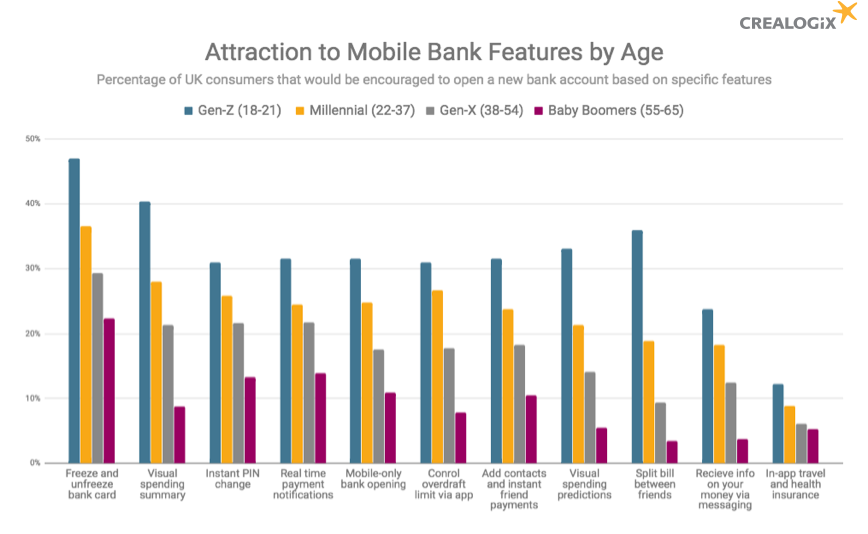
A graph showing the percentage of UK consumers that would be encouraged to open a new bank account based on specific features
Anton Zdziebczok, Head of Product Strategy at CREALOGIX UK, said: “With the recent anniversary of the Open Banking initiative, our research found that the directive has had a positive impact on overall competition in the retail banking market, and customers are increasingly trying out new bank accounts. This comes as good news for financial regulators, who have been fighting in the 10 years since the financial crisis for more consumer choice and innovation in the highly concentrated UK retail banking market.
“This increased competition encourages innovation, ultimately delivering the best experience to the consumer. However, where the agile, mobile-first banks are using technology to win new customers, the incumbent banks have been slower to adapt.”
Jo Howes, Commercial Director at CREALOGIX UK, commented: “To compete and stay relevant, every financial institution needs to increase the pace of innovation and offer differentiated mobile user experience features to satisfy digitally-demanding customers.
“For now, the challenge for established financial brands is simply how to maintain reasonable feature parity with the challengers, and time is of the essence. With every passing month, the feature and design gap between challengers and less technologically agile banks is widening. Butestablished banks have the foundations of trust and market share to keep them ahead of the game. They are more than able to bring the competitive fight back to the challengers if they succeed in using technology to place their customers at the heart of their business.”
- 01:00 am

- Over three-quarters of a million financial services professionals would turn down a role that didn’t offer flexible working
- 94% of financial services employees say it’s important for them to choose when and where they work
- Almost three fifths (59%) would turn down a job opportunity that didn’t allow flexible working
- Today, one in six (15%) employees work in businesses that don’t offer flexible working
The lack of productivity growth has been the biggest source of weakness in the UK economy in the decade since the financial crisis. According to the Bank of England, the finance sector is the biggest contributor to the country’s productivity slowdown. Since 2009, productivity has shrunk by 2.1% per year.
61% of banks reported a moderate to severe skills shortage in 2017 [1], claiming it is seriously impacting productivity, innovation and profit. With fears over Brexit hitting business productivity, almost half (49%) of financial services firms are concerned about finding the necessary talents and skills when recruiting [2]. Yet aren’t taking the steps needed to attract talent.
New research from TeleWare, a leading provider of communications technology, reveals a staggering 94% of employees in financial services find it important to be able to choose the hours they work and where from. Yet, just over a third (36%) of employees in financial services work for firms that offer flexible working for everyone. Of those firms that do allow it, more than a fifth (22%) of employees said it isn’t available to all employees – only those of a certain level of seniority.
The finance sector has been held back from adopting flexible working practices due to, in part, its strict compliance requirements. However, firms will continue to miss out on significant benefits by not allowing employees to work in their preferred style. Almost three fifths (59%) of workers would turn down a job opportunity that didn’t allow flexible working.
In addition to helping to attract new talent, almost half of employees say flexible working enables them to be more productive (48%). When considering employee wellbeing, almost three fifths (59%) of employees believe working flexibly improves their work/life balance and almost half (47%) say it makes them happier.
Steve Haworth, CEO at TeleWare, comments: “With Brexit on the horizon, and financial services in the UK set to be particularly hit, retaining and attracting key talent is a high priority. Firms must be aware that almost three fifths (59%) of financial services employees would turn down a job opportunity that didn’t allow flexible working.
As millennials become the largest generation in work, the demand for flexible working is only going to increase. For businesses, the benefits should be clear. Flexible working allows them to save money, create a more productive workforce and retain the best talent.”
- 03:00 am
Danske Bank and Nets have entered into a five-year agreement to issue and develop the Dankort card.
Danske Bank’s customers must also in future be able to pay with the Dankort card, thus using one of the most popular payment solutions in Denmark.
This is one of the main points in a new five-year agreement between Danske Bank and Nets, which stands behind the Dankort card.
“Immense changes are taking place in the payment market these years,” says Jesper Nielsen, Interim Chief Executive Officer of Danske Bank. “Mobile payments are becoming increasingly popular as are a number of other new payment solutions. Moreover, we know that the Dankort card remains one of the most widely used payment solutions in Denmark. This being the case, we are pleased that we, with the agreement, send a clear signal to our customers that they, also after 2019, will be able to use the Dankort card for payments as they do today.”
Easy, secure and inexpensive payments
The previous agreement in the area was entered into between the banks jointly and Nets, and it runs until 31 December 2019. The new agreement, however, is entered into directly between Danske Bank and Nets, and it ensures that Danske Bank’s customers can have a Dankort card also after 2019.
“It is not possible to predict what the payment market will look like over the coming years, and it is therefore also difficult to make long-term plans in the area,” adds Jesper Nielsen. “What we consider most important is that our customers are able to make easy, secure and inexpensive payments, and, with this agreement, we also assume joint responsibility for cooperating to develop the payment infrastructure in Denmark for the benefit of Danish consumers and businesses.”
“We are pleased that the largest bank in Denmark has decided to continue issuing the Dankort card as we know it today for the coming five years,” says Bo Nilsson, Group CEO of Nets. “Danske Bank’s decision is an important step towards creating a stable foundation for the Dankort card of tomorrow, so it can retain and develop its position in society as a secure, innovative and cost-effective means of payment.”
Cooperation to develop the payment infrastructure
In continuation of the agreement, Danske Bank and Nets will examine how they can develop the Danish payment infrastructure together, thereby continuing to deliver new, innovative and user-friendly payment solutions to shops and end users of payment services in Denmark.
- 03:00 am

Dinosaur Financial Group, LLC (Dinosaur), a New York-based institutional brokerage firm, today announced its partnership with tZERO Group, Inc., a global leader in blockchain innovations for the capital markets.
Dinosaur Managing Director of Equity Trading Elliot Grossman commented: “Becoming the provider of brokerage accounts for tZERO security token holders is a significant milestone for Dinosaur. Blockchain is changing how securities are traded and settled, and I am particularly proud that Dinosaur has joined with tZERO, tZERO’s broker-dealer subsidiary, PRO Securities (and the PRO ATS), PRO’s other partners and Electronic Transaction Clearing to pioneer disruptive changes for issuance, trading, and settlement in the capital markets.”
He added: “tZERO’s security token is a digital security tracked via a blockchain protocol. It’s an evolutionary change that will reduce operational risk and drastically improve the process of clearance and settlement.”
Dinosaur Founder and Chairman Glenn Grossman said: “We are very pleased to have partnered with tZERO and PRO Securities and to offer our services to accredited investors interested in trading digital securities. Dinosaur is an agile business, and our clients expect us to use leading-edge technology, so today’s announcement should be no surprise. Working with blockchain technology is a natural step for me because of my previous work pioneering electronic trading in US Treasury markets.”
tZERO CEO Saum Noursalehi noted: “We’re very excited to be joining forces with Dinosaur as the broker-dealer for our new security token platform. With Dinosaur, we have found a firm that understands our vision to bring transparency and efficiency to global markets and accelerate the adoption of security tokens.”
tZERO, a subsidiary of the digital retailer Overstock.com and a Medici Ventures portfolio company, is one of the first companies to issue security tokens. The launch of trading will be a pivotal moment for the company and its founder, Patrick Byrne, who has championed blockchain technology since he learned about it in 2014. Mr. Byrne founded tZERO soon after in 2014 with the purpose of bringing innovation and transparency to financial markets through blockchain.
Dinosaur is a New York-based brokerage firm and investment bank with extensive experience in capital markets and a global reach. The team behind Dinosaur, led by father-son pair, Glenn and Elliot Grossman, has decades of experience in electronic markets globally. Its institutional brokerage provides clients with a comprehensive investment service and is now making its services available for tZERO’s security tokens.
In 2016, tZERO’s parent, Overstock.com, was the issuer of the world's first public crypto security, and PRO Securities, the broker-dealer subsidiary of tZERO, introduced the concept of real-time trade settlement. Almost three years later, PRO Securities is now using tZERO technology, making its first steps toward a blockchain-powered market alongside its newest partner, Dinosaur. Using the tZERO technology, the digital securities trading platform is designed to enable private resale transactions to accredited investors, consistent with U.S. securities law.
Dinosaur was advised by Seward & Kissel LLP and tZERO was represented by Jones Day on this transaction.








