
Published
- 09:00 am

The internet of things explosion has proven controversial due to the insufficient security measures in many of these internet-connected devices. And a new report from cyber security provider F-Secure finds that threats and the number of attacks continue to increase, but still rely on well-known security weaknesses, such as unpatched software and weak passwords.
The report, using data collected and analyzed by F-Secure Labs, highlights that threats targeting internet-connected devices are beginning to multiply more rapidly than in the past. The number of IoT threats observed by F-Secure Labs doubled in 2018, growing from 19 to 38 in the space of a single year. But many of these threats still use predictable, known techniques to compromise devices. Threats targeting weak/default credentials, unpatched vulnerabilities, or both, made up 87% of observed threats.
F-Secure Operator Consultant Tom Gaffney says that larger device vendors are paying more attention to security than in the past, but there’s a lot of devices from many different manufacturers that don’t offer consumers much in the way of security or privacy.
“The big guys like Google and Amazon have made strides in their smart home products with the help of massive backing and ethical hackers like our own Mark Barnes, who executed the first proof of concept for a hack of an Echo in 2017,” said Gaffney. “But for years manufacturers have been releasing products without giving much thought to security, so there’s a lot of ‘smart’ devices out there vulnerable to relatively simple attacks.”
IoT threats were rarely encountered before 2014, the report explains. But that changed around the time the source code for Gafgyt – a threat that targeted a variety of IoT devices, including BusyBox devices, closed-circuit television (CCTV) devices and many digital video recorder (DVR) devices – was released.
In October 2016, Mirai, which was developed from Gafgyt’s code, became the first IoT malware to achieve global infamy when its massive botnet was used to launch one of the largest distributed denial-of-service attacks in history.
Mirai’s code has been public “for Research/IoC Development Purposes” since 2016.** Originally, it used 61 unique combinations of credentials used for infections. Within three months, that number had reached almost 500. And it’s incredibly prevalent as a malware family. Approximately 59 percent of attack traffic detected by F-Secure’s honeypot servers in 2018 targeted exposed Telnet ports, with Mirai’s attempts to spread as the main culprit behind the attacks.
According to F-Secure Labs Principal Researcher Jarno Niemela, the root cause of many of the IoTs problems starts with the manufacturers’ supply chains.
“Most device vendors license software development kits for the chipsets they use in their smart cameras, smart appliances, and other IoT devices. That’s where the vulnerabilities and other issues are coming from,” explains Niemela. “Device vendors have to start asking for more in terms of security from these suppliers, and also be prepared to issue updates and patches as they become available.”
F-Secure’s report, IoT threat landscape: same hacks, new devices, also includes:
- A quick history of IoT threats from the turn of the millennium through 2018
- An overview of the failures and potential hopes for regulation
- A look at potential privacy risks associated with IoT devices
The full report is available on F-Secure’s blog.
- 07:00 am

SAI Global, a recognized leader of integrated risk management (IRM) solutions, today announced that it has completed its acquisition of BWise® from Nasdaq, Inc. (Nasdaq: NDAQ), forming one of the world's largest risk management and ethics learning businesses.
Starting today, the combination of BWise's award-winning risk management, internal audit and regulatory compliance platform with SAI Global's industry-leading SAI360 risk and compliance solution will create the most complete integrated approach to risk management in the marketplace.
"This is a significant milestone and the next step in SAI Global's growth roadmap, expanding our global presence, bringing us closer to financial services customers and delivering world-class internal audit and regulatory compliance management software capabilities at scale," said Peter Granat, CEO of SAI Global. "We're thrilled to formally welcome the BWise team and we look forward to leveraging their capabilities and deep industry domain expertise to accelerate innovation."
With the addition of BWise, SAI Global's solutions and services are better positioned to support customers navigating today's risk landscape with an integrated approach across financial, regulatory, digital and operational risk. Organizations are now forming integrated risk management task forces convening the chief risk officer, corporate compliance officer, general counsel, head of internal audit, head of internal control, chief financial officer, chief information security officer, and data privacy officer around one table.
Here is what customers can expect as BWise integrates with the SAI360 risk platform over time:
- Starting today, BWise customers will be introduced to SAI Global's catalogue of risk and compliance solutions, including the company's ethics and compliance learning content that helps organizations develop and build a sustainable risk-aware and compliant culture.
- Customers will now have access to an expanded global network of services and support teams in more than 50 offices across 28 countries and six continents to support their risk, audit and compliance initiatives.
- Customers will see increased R&D investments in BWise's award-winning technology, which will become part of the broader SAI360 risk platform strategy.
- Following SAI Global's August 2018 acquisition of Strategic BCP, customers can incorporate software and expertise in developing business resilience programs to protect organizational brand and reputation.
On Feb. 11, SAI Global announced plans to acquire BWise, a recognized leader in internal audit, regulatory compliance management, and operational risk management software. Originally founded in the Netherlands in 1994, BWise has grown to become a leader in enterprise GRC software with capabilities in internal audit, regulatory compliance management and operational risk management. Terms of the transaction are private.
"The industry is rapidly changing and there is growing pressure for companies to rapidly adapt and respond to threats, seen and unseen," said BWise CEO Jonathan Deeks, who will report to Peter Granat under the acquisition. "We have found a great strategic fit with SAI Global and are focused on the expanded capacity for innovation and greater support for our customers that this collaboration will bring."
- 01:00 am

AJIB will now be able to enhance their customer centricity by reducing cost of fund transfers, secure their private information and promptly address their requirements. ICS BANKS Blockchain Adapter users will benefit from such a platform to overcome the challenges they currently face in the current processes in terms of security, delays, faster-automated transactions and the exclusion of third parties. ICS BANKS Blockchain Adapter is integrated with Oracle Blockchain Service, ICS BANKS Core Banking System and ICS BANKS Digital Banking platform.
- 04:00 am

Applications are now being accepted for Accenture’s (NYSE: ACN) annual FinTech Innovation Lab Asia-Pacific, a 12-week program that helps early- and growth-stage fintech companies accelerate product and business development through mentorship with executives from top financial institutions.
Fintech entrepreneurs developing cutting-edge products, services and technologies are invited to apply now until May 10 at https://www.fintechinnovationlab.com/asia-pacific/.
The sixth year of the Lab comes after global fintech investments more than doubled in 2018, to US$55.3 billion, led by a surge in funding to start-ups in mainland China, as well as by record fintech investment in Canada, Brazil, Australia, Japan, Indonesia and Malaysia, among other markets.
A recent Accenture report noted a clear shift in focus between fintechs and traditional financial services companies over the past 12 to 18 months, from competition to collaboration, which sets the stage for a positive outlook for the industry and future investments.
“There’s now widespread acceptance that the best way forward for banks and fintech startups is to collaborate where possible, creating big ecosystems that will help unlock huge value for all stakeholders, particularly consumers,” said Piyush Singh, Accenture’s financial services lead for Asia-Pacific and Africa and regional programme sponsor for the Lab. “That’s a big focus for the FinTech Innovation Lab Asia-Pacific, instigating this sense of partnership between well-established financial firms looking for the next breakthrough technology and nimble startups eager to test their solutions and push them to market.
“We’ve already seen banks, insurers and wealth managers partner with fintechs here in Asia and elsewhere around the world, but the outlook for further collaboration and the resulting value creation is what’s making investors more comfortable to spread their bets more widely, pushing broad gains around the world.”
To be eligible for the Lab, startups must have a working version of their technology/solution for financial institutions. Senior business and operations executives from the Lab’s participating financial institutions will select up to 10 of the fintech applicants to take part in the program through a competitive process and provide them with intensive in-person mentoring in Hong Kong.
The Lab, which begins Aug. 5, will partner the chosen fintech start-ups with senior-level financial institution executives and leading technology entrepreneurs to help them fine-tune and develop their technologies and business strategies through a series of panel discussions, user-group sessions, networking opportunities, one-on-one meetings and presentations. Alumni companies from the Lab have raised US$508 million to date after participating in the program.
"The Lab’s geographical proximity to the mainland makes it particularly suitable for Chinese start-ups, especially for those like ours looking to expand abroad,” said Li Hao, co-founder of Wecash, which provides big data and cloud computing to financial institutions and participated in the Lab’s first cohort in 2014, having since raised funds in three separate funding rounds and becoming a ‘unicorn.’ “We were particularly impressed by regular feedback from several financial institutions and different Lab advisors, which really helped us to hone our business plans.”
The principal financial institutions for the Lab in 2019 are: Bank of America Merrill Lynch; BlackRock; Credit Suisse; Goldman Sachs; J.P. Morgan; Macquarie Group; Morgan Stanley; Societe Generale; Standard Chartered; SunLife Financial; and Zurich Insurance. In addition, supporting financial institutions are: AIA International Limited; China CITIC Bank International; CLSA; Dah Sing Bank; Generali; Maybank; Natixis; Saxo Markets; and ZhongAn International.
Cyberport, which is one of the founding organizations of the FinTech Innovation Lab Asia-Pacific, will provide workspace to the participating start-ups. It houses the largest fintech community in Hong Kong with 350 companies, offering start-ups funding, incubation programs and a close and dynamic network of like-minded innovators from around the world.
The FinTech Innovation Lab Asia-Pacific is modelled on a similar program that Accenture co-founded in 2010 with the Partnership Fund for New York City, the US$150 million investment arm of the Partnership for New York City. In 2012, Accenture and a dozen major banks in London launched the FinTech Innovation Lab London, with support from the city’s mayor and other government bodies. In 2014 Accenture launched the FinTech Innovation Lab Asia-Pacific in Hong Kong. Globally, the Labs’ alumni companies have raised more than US$1.5 billion in venture financing after participating in the program.
- 05:00 am

A new report from Mastercard confirms the power of mobile technology to improve financial inclusion. The research shows that 15 countries account for over 60% of the global unbanked population, where 607 million people have a mobile phone, but do not yet have a bank account. Mobile technology could therefore provide them with immediate access to the benefits of financial inclusion.
In all but one of these 15 countries (India) people with a mobile phone outnumber those with a bank account by several million (rising to 204 million in China).
Tactical Reach Index – number of people without a bank account, who could potentially access financial services via a mobile phone:
However, Ann Cairns, Vice Chairman of Mastercard emphasises a key finding of the report: “Simply providing access to financial services is not enough. To achieve any real impact, people also need to become active users of financial products.” Globally, 20% of people with a bank or mobile money account have not used it for more than a year, and many more people only ever use their account on an occasional basis.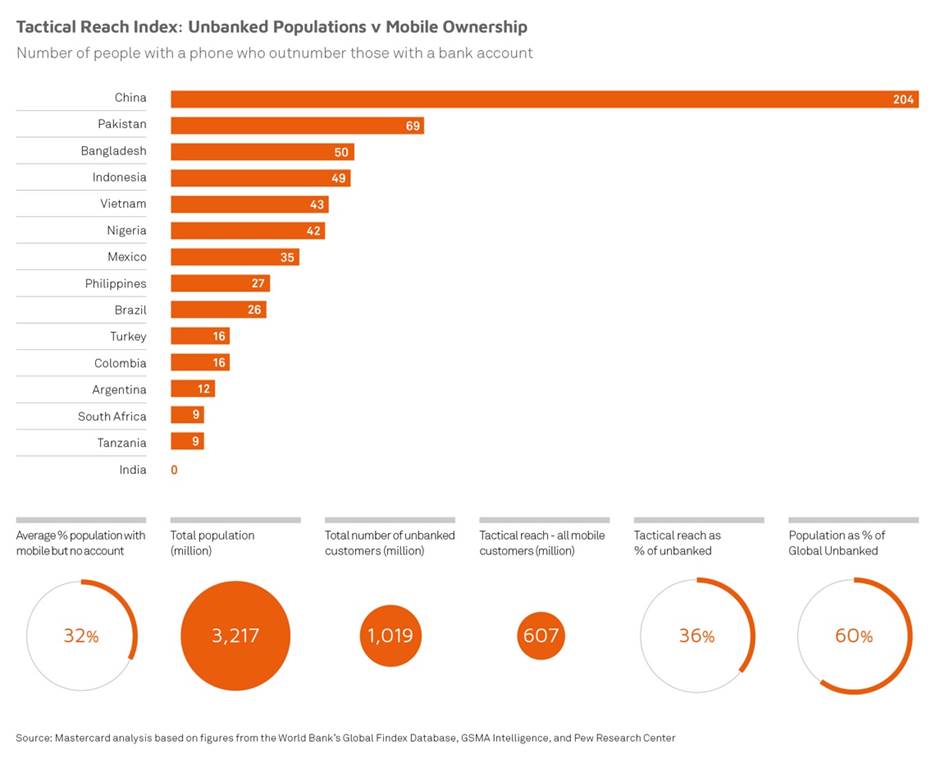
Source: Mastercard analysis based on figures from the World Bank’s Global Findex Database,
GSMA Intelligence, and Pew Research Center
In the absence of banking services, or if financial products are rarely used, people inevitably turn to informal providers, such as neighbourhood savings clubs, local money lenders, and unlicensed remittance services. Most people on low incomes tend to be experienced users of these informal financial products, and to have intricate and well-ordered financial lives. However, they do not have legal protection, face significant risks, and may pay more for a vastly inferior product.
As the report says, “the battle for inclusion is not about creating completely new behaviours or building entirely new markets. Nor is it about providing simple access to the financial mainstream. It is about how bona fide players and regulated providers can do a better job of out-competing the informal sector.”
Another important consideration is a deep gender gap, which could be exacerbated if mobile and digital technologies were to become the predominant delivery channel for financial services. In developing countries, for example, there is already an eight-percentage-point gap in account ownership (67% or men have an account compared to 59% of women). This gap extends to double-digits in many countries, such as Morocco and Peru, and reaches 30% some countries, like Pakistan and Bangladesh. Women are much less likely to have made or received a digital payment, more likely to have used informal financial products, and less able to come up with emergency funds in the face of an emergency.
The report, Unravelling the Web, was commissioned by Mastercard and launched at the Financial Inclusion Summit in Oslo on 28 March 2019, arranged by Fintech Mundi, a global fintech accelerator. Speakers included Ann Cairns, Vice-Chairman and President International Market of Mastercard, Greta Bull, CEO of CGAP (World Bank) and James Mwangi, CEO of Equity Bank Kenya.
- 03:00 am
Computop, the global payment processor, today announced that Europe's leading online optician, Mister Spex, has selected the company’s highly secure POS terminals for the processing of all card payments across its national network of German stores. The CCV Pad card terminal from Computop is one of a new generation of POS solutions that have been developed to reduce costs and expenditure on PCI security audits while protecting purchasers’ card data. Thanks to PCI Point-to-Point Encryption (P2PE), card data is coded in the device and sent to the payment platform without intermediate storage.
Through its integration to Computop Paygate, Mister Spex is also prepared for modern smartphone payment in its branches: Apple Pay and Google Pay can be accepted at the POS. In the merchant backend, Mister Spex can process and evaluate payments and credit notes quickly and conveniently. Integration with Computop's payment platform also leaves all options open for merging online and stationary transactions as the security offered by Computop’s P2PE POS solutions facilitates integration into an omnichannel environment.
Computop customers can process all payments — via POS, online or mobile through the Computop Paygate. This has a number of benefits: omnichannel reports and statistics allow for analysis of sales across all channels, all branches and all online shops. The accounting team can refer back to settlement files (CTSF) which Computop has standardised for all payment types worldwide so that upon receipt of a previously unpaid statement, the status can be automatically changed to ‘paid’ (reconciliation).
"As an online retailer, it was surprising for us that refunds for POS payments cannot be automatically referenced by all payment service providers in the same way as our webshop payments," says Holger Krause, Product Manager Multichannel at Mister Spex. "Computop Paygate offers us a uniform solution for all transactions. In addition, we have come to know and appreciate Computop as a reliable partner".
In addition to over 500 partner opticians in several European countries, Mister Spex also has its own branches in numerous German cities. As part of its omnichannel strategy, Mister Spex has already opened 10 stores and plans to expand further this year.
Computop Managing Director Stephan Kück commented: "We are delighted to be able to support Mister Spex in expanding its branch network. With the integration of our payment platform, our customer is well prepared for further expansion".
- 03:00 am

Calligo, the global data optimization and privacy specialist, today announced it has acquired Connected Technologies Inc., a Canadian specialist in outsourced IT and cloud services.
The purchase of Connected Technologies, based in Brampton, Ontario, is another significant step in Calligo’s continued growth strategy. The acquisition complements its two previous acquisitions in Canada – cloud services provider, 3 Peaks, in October 2017 and Mico Systems, an outsourced IT services company, in May of last year.
Adding Connected Technologies to the already substantial team makes Calligo one of the largest IT managed services providers serving the Greater Toronto Area by both client numbers and team headcount. The combined client base also gives Calligo the largest concentration of CPA customers in the region and the longest track record in serving the industry’s IT, cloud and data residency needs.
Calligo provides a unique collection of data optimization services that cover the entire data journey, with data privacy embedded at every step. These services include public & hybrid cloud, IT managed services, data analytics, artificial intelligence and archival & erasure services, all supported by ‘privacy-first’ data management consultancy and specific assistance with national, international and industry-specific data protection obligations, particularly GDPR and PIPEDA.
In addition, Calligo also offers CPA-specific services which include the support of industry applications such as Wolters Kluwer CCH Accountants’ Suite and Doc.IT; the provision of extended support hours during predictable peak times such as tax season; and the industry understanding to support CPAs’ specific regulatory and policy requirements in data security, residency and privacy.
“We are very excited about what the acquisition of Connected Technologies means for Calligo in Canada and internationally,” said Calligo Founder and CEO, Julian Box. “We have been very strong in the delivery of cloud and managed services in Toronto for some time now. Adding Connected Technologies’ experience and skills to our own will cement our position as the first choice for Toronto businesses wanting to outsource their IT.”
Box added, “Looking more broadly, we are also anticipating this acquisition strengthening our delivery of public and hybrid Azure services to businesses around the world who are keen to extract the most value from their data, while respecting applicable data privacy laws and data ethics.”
Connected Technologies’ 200+ customers will benefit from now being supported by an established, global service provider and from the wider service portfolio that Calligo offers.
William Shilson, President of Connected Technologies Inc., commented:
“This acquisition was the result of obvious synergies between our two organizations – strong company cultures, a shared focus on customer centricity and a hunger for innovation. We have seen firsthand the interest that our customers have in the wider services that Calligo offers, particularly in data optimization and also in ensuring that their processes and infrastructure meet their data privacy obligations. This acquisition will therefore create a compelling new service proposition for existing clients, while putting Calligo in the strongest possible position to serve the needs of the wider market.”
- 07:00 am

Over one-third of IT decision makers in the UK’s largest financial services companies believe that AI will transform the industry in the next decade, but the same percentage admit that their infrastructure is not prepared for the transformation, a new survey conducted by Digital Realty reveals.
AI’s potential to transform hugely outpaces other much-hyped technologies, with leaders naming blockchain (21%), internet of things (IoT) (11%), application programming interface (API) platforms (10%), and robotic process automation (RPA) (10%) falling behind AI in their potential for the industry.
The financial benefits of these new technologies are potentially huge but the ability of IT leaders to prepare their businesses for these new technologies is restrained by budget (40%) and legacy infrastructure (31%). The survey highlighted that across the UK, businesses need to invest a total of £11.4 billion to be ready for these new technologies, but they will need to do this in order to keep up with the challengers – identified by 20% of IT leaders in the industry as their biggest technological challenge.
AI is going to revolutionise every industry, making businesses faster and cheaper to operate, creating new opportunities and adding an additional estimated £10 trillio to global economic activity by 2030.
Processes already seen as the norm in the financial services industry, such as fraud detection and stock trading, are made possible by AI. Financial institutions are increasingly looking to AI to aid customer communication, predictive analytics, trade processing, and intelligent investment solutions.
To seize these opportunities, businesses will need to meet new processing and interconnectivity demands. The challenge is leading them to look to cloud and data centre partners for the purpose-built infrastructure, rapid low-cost interconnection, and simple management of these complex data environments that can underpin their AI ambitions.
Digital Realty and IDG research predicted that in the next two years, 48% of large financial services businesses will move their workloads to cloud wherever possible and just 27% expect their workloads to remain on-premise.
Val Walsh, Senior Vice President, Portfolio Management at Digital Realty, commented: “The financial services industry is set to see some astonishing technological growth, and our new research demonstrates that companies in the sector are still underprepared for what’s to come. Technology like AI will greatly benefit the industry, but companies can only experience the full benefits of the technological revolution if their infrastructure is able to support these technologies.
“Key decision makers need to put infrastructure investment high on their agenda as the future is becoming increasingly data-led, so whilst there is an initial financial sacrifice, financial services firms can expect to see a healthy return on their investment in the long-term, and they should look to data centres and providers for their infrastructure upgrade.”
- 01:00 am

A survey of business leaders by DXC Technology (NYSE: DXC) and Vanson Bourne, an independent research firm, reveals that 86 percent of IT and business decision makers believe that being able to predict and prevent future challenges with applications could be a “game changer” for their organizations. This could be achieved via automation, artificial intelligence (AI) and lean processes.
Respondents said investing in automation of applications management would have numerous benefits, including improved customer experience (49 percent), higher customer retention (46 percent) and greater customer satisfaction (46 percent). And 78 percent of respondents agree that without systematic automation, achieving zero application downtime would be a “distant dream.”
The findings provide a view of the attitudes, experiences and expectations of 500 IT and business decision makers on the impact of application performance in the digital economy. The survey was completed in four markets — the United Kingdom, Germany, Japan and the United States — and respondents represented sectors including banking, insurance, healthcare, and travel and transportation.
Despite the digital transformation opportunities, only 36 percent of senior managers surveyed said their peers are completely accepting of new technologies such as AI and automation to improve applications quality. Additionally, respondents said that the top barriers to investing in automation were security risks (44 percent) and legacy technology hurdles (36 percent).
“Because legacy technologies can require so much of an organization’s resources, it is essential for organizations to establish a plan to simplify their existing IT structures and free up funds for automation and other digital technologies,” said Rick Sullivan, vice president of digital applications and testing, Application Services, DXC Technology. “We are committed to helping our clients optimize applications performance through AI, lean processes and automation to enable great customer experiences today and future growth opportunities.”
While 82 percent of respondents agree that companywide strategies to invest in new AI-driven technologies to transform applications management would provide significant competitive advantages for their organizations, only 29 percent said their organizations actually have such strategies.
The survey also revealed several key findings for specific industries:
- Insurance industry organizations are most likely (45 percent) to have implemented companywide strategies to transform the running and maintaining of legacy and digital applications. And they are increasing investment in new AI-driven technologies to enable the systematic automation of their application portfolios (28 percent).
- Travel and transportation organizations are the most likely to recognize the benefits of investing in systematic automation of applications management, largely for customer retention (59 percent) and improved customer experience (56 percent).
- Banking industry respondents said their organizations’ diverse application portfolios present challenges to implementing systematic application automation (39 percent).
To learn more about DXC Application Service Automation, visit dxc.technology/applications.
- 05:00 am

VERMEG, the banking and insurance software solutions leader, is proud to announce it has received a top mark on the 2019 Corporate Equality Index (CEI). The CEI is recognized as the premier benchmarking survey and report in the United States and abroad on corporate policies and practices related to LGBTQ workplace equality, and is administered by the Human Rights Campaign (HRC) Foundation.
VERMEG joins the ranks of over 560 major U.S. businesses that also earned top marks this year.
“The top-scoring companies of this year’s CEI are not only establishing policies that affirm and include employees here in the United States, they are applying these policies to their global operations and impacting millions of people beyond our shores,” said HRC President Chad Griffin.
Badreddine Ouali, Executive Chairman of VERMEG, stated, “We are very proud to be one of the Best Places to Work for LGBTQ Equality, as inclusion is the pillar of our equal Employment Opportunities strategy and employee well-being. Vermeg Group’s CSR commitment, which has been embedded in the company’s DNA since its foundation.”
The 2019 CEI evaluates LGBTQ-related policies and practices including non-discrimination workplace protections, domestic partner benefits, transgender-inclusive health care benefits, competency programs, and public engagement with the LGBTQ community.
VERMEG’s efforts in satisfying all of the CEI’s criteria results in a 100 percent ranking and the designation as a Best Place to Work for LGBTQ Equality.
For more information on the 2019 Corporate Equality Index, or to download a free copy of the report, visit www.hrc.org/cei.
The HRC Foundation is the educational arm of America's largest civil rights organization working to achieve equality for lesbian, gay, bisexual transgender and queer people. HRC envisions a world where LGBTQ people are embraced as full members of society at home, at work and in every community.
VERMEG is a specialised software house covering major market segments in financial services: Banking & Wealth, Insurance and Digital Transformation. Our business solutions are designed to address the challenges linked to the transformation of the financial services industry.
Vermeg has over 1000 employees, with a presence in Australia, Belgium, China, UK, France, Germany, Japan, Hong Kong, Luxembourg, Netherlands, Sao Paulo, Singapore, South Africa, Spain, Tunisia and the United States. The company supports more than 500 clients in 40 countries.








