
Published
- 09:00 am

Facilitating the flow of legal entity and counterparty information between banks and data providers to counteract financial crime, bribery and corruption is critical. Fenergo, the leading provider of digital Client Lifecycle Management (CLM) software solutions, has partnered with Refinitiv, global provider of financial markets data and infrastructure, to enable customers to more efficiently identify risk.
Fenergo’s API integration with Refinitiv’s World-Check One allows financial institutions to streamline know your customer (KYC) verification and anti-money laundering (AML) screening via a user-friendly interface. According to a Fenergo survey, 81% of C-suite executives at banks agree that information gathering and managing increasing volumes of client data lengthens compliance and onboarding, negatively effecting customer experience[1]. Just 15%[2] have automated the collection of data. Addressing this burden, Fenergo and Refinitiv’s combined offering reduces the need for repeated customer outreaches for information, enabling financial firms to streamline customer due diligence (CDD) and focus on optimising customer experiences.
Fenergo’s integration of World-Check One allows customers to quickly identify potential risks and respond to threats across the entire enterprise. It also allows users to create and maintain a model inventory and a clear evidence trail of the acceptance or rejection of changes, report on governance status, sign-offs, supporting attachments and related issues all from a single platform.
“Financial institutions face increasingly stringent global regulatory obligations, which demand the collection, processing and remittance of more client and counterparty data than ever before. Through the combination of Fenergo’s market-leading CLM solution and Refinitiv’s World-Check One, financial institutions can better manage increasing amounts of regulation that require them to collect more data and documentation from clients,” said Phil Cotter, Managing Director of Risk at Refinitiv.
Marc Murphy, CEO of Fenergo, said: “In partnering with Refinitiv, we can automate data collection bringing huge efficiencies to client onboarding and account opening processes, increasing time to revenue and reducing client outreaches. Our complimentary solutions enable the shift from time-based client KYC reviews to a perpetual and continuous KYC review model.”
“Our clients require robust onboarding systems that help them become disruptive. Refinitiv is a key addition to our partner ecosystem, ensuring we can create a seamless solution that will drive operational efficiencies and improve customer experiences,” said Julian Clarke, Global Head of Partnerships at Fenergo.
[1]Fenergo, The Cost of Poor CX

Kim Fournais
Founder & CEO at Saxo Bank
The downfall of banks has been predicted several times throughout history. see more
- 01:00 am

Finastra has announced the appointment of Mark Miller as Chief Financial Officer (CFO) effective May 13, 2019.
Mark is a seasoned finance executive, with nearly 25 years of global technology, finance and operational experience. He has worked at several industry-leading companies including, most recently, Marketo, where he was CFO and travel technology firm Sabre Corporation, where he spent 18 years in a number of leadership and executive roles including CFO. He also has valuable previous experience working with Vista Equity Partners and the software company Active Network. Over the course of his career, Mark has consistently driven operational and financial excellence.
Based out of Paddington, London, he will be a member of the Finastra Executive Leadership team and will report directly to the CEO, Simon Paris.
Mark has an undergraduate degree from Texas Tech University, and an MBA in Finance from Rice University, Houston, Texas. He is also a Certified Public Accountant.
CEO Simon Paris said, “On behalf of the Executive Team, I would like to welcome Mark to Finastra. We are extremely pleased to have him join us, to help build on our vision for the future of banking. He brings extensive financial and strategic planning experience, which will provide significant value to us as we continue to build and deploy our next-generation technology. I’d also like to extend my thanks to Rob Binns for his outstanding service. We wish him all the best for the future.”
Mark Miller commented, “I am delighted to be joining Finastra at this exciting time for the business. As one of the world’s largest financial services software and platform businesses, it is one of the leading forces in the transformation of the banking industry towards a more open future. I look forward to working with the team as the company enters the next stage of its development.”
Mark replaces Rob Binns, who has decided to step down from his role. Rob served as CFO of Finastra (formerly Misys) for three years, leading the Company’s General & Administrative organizations including Finance, Risk, IT, Legal and Procurement since 2016.
- 07:00 am

While British consumers expect their banks to ensure that the latest technology is available, consumers’ rate of adoption does not necessarily meet the rate of innovation. Nearly a third (30 percent) of Brits say their bank is over-ambitious introducing additional services on different devices, saying they do not need or want more ways to interact. At the same time, over two-thirds (69 percent) expect their bank to be delivering the latest technology to them and a third (34 percent) say that since they started using devices to manage their money, their financial goals are clearer.
These are the findings of global bank ING, which published its seventh ING International Survey on ‘New Technologies’ today. The study of 14,824 respondents in 15 countries, including 13 across Europe, suggests that while Brits are optimistic about having the latest financial technology available to them, they are not necessarily adopting it as fast as it is becoming available.
For those who are using devices (i.e. tablets, phones or wearables) to manage their money, many agree they are keeping a closer track of their finances. Since they started using devices to manage their money, 67 percent say they view their account balance more frequently, 32 percent say they take less risk with their money and 41 percent say they now think about money more.
The conflicting views on expectation vs adoption may be due, in part, to a lack of trust in technology and concerns over the security of how we interact with tools. Only half of Brits (52 percent) rate facial recognition as a secure tool. This coupled with two in ten (22 percent) who believe voice recognition is not secure, indicates a gap between services provided and accepted amongst consumers.
Further to this, 62 percent of people in the UK aren’t comfortable with a computer programme making investment decisions on their behalf and 41 percent say no to receiving recommended improvements to their spending habits from robo-advisers. In fact, 70 percent say they maintain the use of their local bank branch, in most cases in addition to the use of technology to access banking services.
When it comes to awareness around financial data sharing innovations, such as the Second Payment Services Directive (PSD2), many are in the dark. 52 percent of Brits say they are not aware that in some countries, providing consent is given, financial providers can access information held by other companies (i.e. your bank). Similarly, 64 percent say they would not be happy to use this and only 23 percent say it would be useful, signifying that more can be done to alert consumers to the potential benefits of these latest banking developments.
Jessica Exton, Behavioural Scientist at ING, said:
“Many people are now mobile bankers, using multiple devices to manage their money on the go and across different platforms. Yet while a large majority agree that the latest financial technologies should be available to them, when it comes to newer digital ways of managing money, we see some hesitance around adoption. Concerns about security, privacy and maintaining control of finances appear to be key barriers.
Over time and if new digital approaches are shown to be reliable, useful and socially accepted, it is possible that the uptake of services such as automatically generated advice for budgeting and even investing could be rapid. That was the experience with the uptake of mobile banking. Consumers indicate that they want banks and other financial institutions to stay in the lead by developing new ways to help them manage their money despite any reluctance to accept them immediately.”
- 06:00 am

- Sixty million Americans consider their mobile phone number and email a greater part of their identity than where they work or their family information. According to the study, 51% of consumers identified their mobile phone number as a key part of their identity, a 21% increase over last year.
- Americans opened new accounts on mobile devices more than on computers. For the first time, Americans opened more new accounts online with their mobile devices (61%) than on a computer (56%) in the past twelve months.
- Friction is still one of the biggest barriers between businesses and consumers. The one-click simplicity of the mobile age has conditioned consumers for instant gratification. The study found that in the past year, 83 million Americans abandoned account signup because of friction.
- Increasing trust and addressing consumer concerns help drive new business. The importance of trust has top-line implications for businesses, particularly financial services companies. This year, more than two-thirds of U.S. consumers surveyed (71%) reported that knowing a financial institution was using more advanced identity verification methods would positively affect their decision to do business with that institution.

Daniel Follenfant
Senior Manager at NTT Security
The hacking of WhatsApp’s messaging service is a classic example of a Buffer overflow attack. see more
- 04:00 am

Adyen (AMS: ADYEN), the payments platform of choice for many of the world’s leading companies, announced today that it has been selected by Uber to be its initial solutions provider for3D Secure (3DS).
“Uber is excited to be expanding our payments platform with Adyen. We are focused on maintaining a seamless and rewarding payments experience for our consumers, and we chose Adyen’s 3DS solution based on the innovative product features, the ease of implementation, and the expertise of their team," said Marco Mahrus, Head of Payments Partnerships, Uber.
“We look forward to expanding our partnership with Uber and becoming their first global partner for 3DS. 3DS authentication has become a top priority for all of our merchants. We have made a significant technology investment in our 3DS solution and merchants like Uber are leveraging our full-service capabilities to be prepared for evolving regulatory demands without sacrificing their customer experiences.” said Sam Halse, COO, Adyen.
3D Secure 2 (3DS 2) is a new technology standard developed by EMVCo that enables strong customer authentication to comply with regulations like PSD2 in Europe. It introduces a new approach to authentication through secure data sharing, biometric identification, and an improved mobile-friendly customer experience. Adyen's market leading solution supports the widest coverage of card networks for 3DS 2 and legacy versions of 3DS at global scale through a single platform.
For more information, visit https://www.adyen.com/risk-management/3d-secure-2-0
- 03:00 am

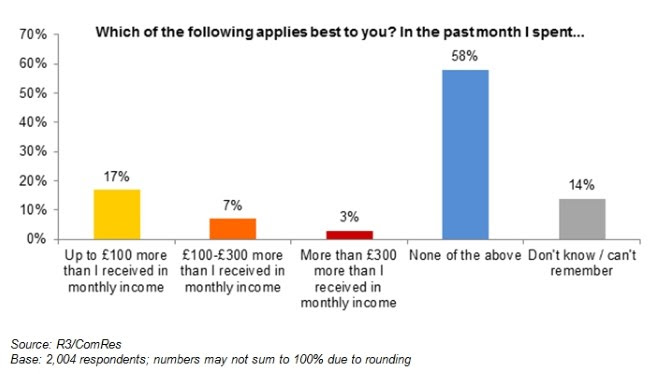
Three in ten (28%) British adults ran a ‘deficit budget’ in the past month, spending more during the month than they received in income, according to new research from R3, the insolvency trade body, and ComRes.
One in six British adults (17%) spent up to £100 more than they received in income over the past month; 7% spent between £100 to £300 more; and 3% spent over £300 more.
R3’s research follows statistics from the ONS which show that households have been in a budget deficit for a record nine consecutive quarters (Oct 2016-Dec 2018), while the average UK household spent £900 more than it received in income in 2017.
Nearly a quarter (22%) of respondents to R3’s research said they do not have any savings at all at the moment, showing that levels of financial resilience are low for many people.
Mark Sands, Chair of the Personal Insolvency Committee at R3, commented: “This is a worrying snapshot of British adults’ personal finances.
“For some people, a month of deficit won’t be an issue, as it may be a one-off, and they may be able to cover the overhang through using savings, or borrowing. However, for others, these options will be less readily available, leading to potential problems ahead if the deficit persists.
“With our research finding that a large minority of British adults don’t have any level of savings at all at the moment, it’s worth sounding the alarm about people’s ability – or otherwise – to cope with unexpected hits to their finances. Debt issues can suddenly spiral due to changes in circumstances, and overspending each month does not leave any room for saving for a significant proportion of people.
“For some, a monthly overspend is a more regular occurrence, and this group should seek advice on personal finances as soon as possible: Even a relatively small amount spent over budget in a month can add up to a much larger problem over the course of a year.”
Age and housing situation
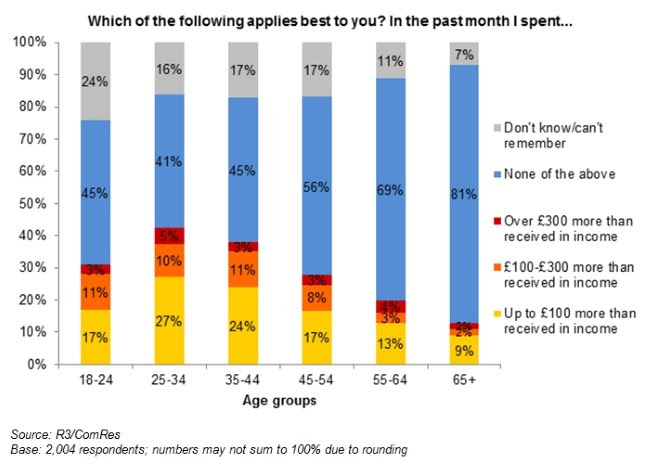
Those aged 25-34 years were likeliest of all age groups to report spending more than they received in monthly income (43%). By contrast, the corresponding figure for those 65+ was only 12%.
People’s housing situation also made a difference: A third of renters (35%) said in the past month they spent more than they received in monthly income, compared to a quarter of homeowners (24%). Renters (24%) were more likely than homeowners (14%) to have overspent by up to £100 in the last month. For amounts between £100 to £300 (8% of renters v 6% of homeowners) and over £300 (renters 3% v homeowners 4%), respondents’ housing situation made relatively little difference.
Mark Sands added: “Young people’s incomes are generally lower, while the costs they pay for expenses like housing and transport have risen on average, leaving holes in their budgets. It’s no shock either that renters are more likely to have reported spending more than they received in income in the last month than homeowners, and with the number of people renting having grown significantly in the last decade, more people will be experiencing precarious finances.”
The research found that 7% of British adults reported that they have borrowed £100 or more from family or friends in the last month.
Mark Sands continued: “Whether the overspending is funded through using existing savings or through formal or informal loans, it is a sign that all is not well, despite record levels of employment. A single month of a deficit budget isn’t necessarily a cause for panic, but if they’re happening with regularity or increasing in frequency, talking to a qualified and professional debt expert is a must. Taking no action will only see problems snowball.”
- 09:00 am

Cascavel and Paranaguá are the cities chosen to begin the expansion in the Brazilian state of Paraná of Cities of the Future (Cidades do Futuro in Portuguese), a Visa program in Brazil whose objective is to encourage the use of electronic payments in places where the use of paper money still predominates, seeking local development. In a partnership with EBANX – Latin American fintech company with a global presence – Visa will promote initiatives that will help to promote the migration of payments in the two cities, reinforcing benefits such as security and greater formalization of the economy in the municipality.
"With the inclusion of Cascavel and Paranaguá among the municipalities that are part of the Cities of the Future program, we want to help the regions leverage their development, reinforcing all the benefits that electronic payments can bring to consumers, commerce and government", explained Marcos Marins, Director of Acceptance Expansion of Visa of Brazil. "The partnership with EBANX is fundamental so that we can develop and implement initiatives according to local needs", the executive added.
In order to expand the program through Paraná state, initially Visa and EBANX will install 180 POSs in local businesses of the two cities. Over the next few months, the intention is to have installed over 3,000 POSs.
"EBANX was born with the purpose of creating access. First in an online format, so that Brazilians and other Latin Americans could access global products and services. Now, the EBANX Group comes with a new business, in a local format in Brazil, with the same purpose", said Wagner Ruiz, Co-Founder and CFO of EBANX. "With this program and our partnership with Visa, we have the opportunity to apply our deep knowledge of payments to create more solutions that increase access, starting in Paraná state, so that more people can buy the way they want to, in both online and physical environments", added Ruiz.
Benefits
In order to understand the magnitude of the benefits that the wider use of electronic payments would bring to both cities, the Visa study "Cities without paper money: Understanding the benefits of digital payments" (“Cidades sem dinheiro em espécie: Compreendendo os benefícios dos pagamentos digitais” in Portuguese) was applied. Results show that gains would be transformative in both cities, totaling about BRL 743 million per year for Cascavel and BRL 501 million per year for Paranaguá, divided into:
Approximately BRL 62 million and BRL 31 million for consumers in Cascavel and Paranaguá, respectively, considering time-saving with banking and retail transactions, as well as reduction of crimes related to paper money;
Approximately BRL 347 million and BRL 242 million for commercial establishments of Cascavel and Paranaguá, respectively, including time-saving during payment processing, increased revenue from a larger customer base both in brick-and-mortar and online stores;
And finally, BRL 560 million for the government, among others, with the increase of fiscal revenues, economic growth and reduction of operation costs.
In addition, the same study predicts that, by 2032, the estimated long-term impacts resulting from some direct benefits would be: an additional increase of 1.9% and 1.48% in jobs in Cascavel and Paranaguá, respectively, because of enhance of economic activity; 2.7% and 1.93% increase in salaries; and an increase of 0.73% and 0.6% in GDP, in addition to what would be expected, generated by efficiency with the use of digital payments, resulting in additional increases in productivity of 1.8% and 1.29%.
"Cities without paper money: Understanding the benefits of digital payments" (“Cidades sem dinheiro em espécie: Compreendendo os benefícios dos pagamentos digitais” in Portuguese) is an exclusive study that quantifies the potential benefits experienced by cities migrating to a high level of digital payments usage – achieved when the rate of use of digital payments across a city's population equals that of the 10% of people who use this type of payment in the municipality the most. That is, the study does not foresee the total elimination of paper money. On the other hand, it seeks to quantify the potential benefits and costs of increasing the use of digital payments.
Cities of the Future
The program Cities of the Future (Cidades do Futuro in Portuguese) begun in 2018 in the Brazilian cities of Belém, Campina Grande, and Maringá. It was created by Visa together with partners and clients, such as issuers, acquirers and commercial establishments, to encourage the use of electronic payments in places where the use of paper money predominates, seeking local development.
During the first three months in Belém, Campina Grande, and Maringá, there was a 20% growth in the use of Visa cards in the three cities, which is higher than the country's average growth.
For more information on Cities of the Future, watch videos Campina Grande and Maringá.
- 02:00 am

PPRO, the leading global e-payments specialist, has partnered with HighRadius, a fintech enterprise software-as-a-service company, specialising in automating the order-to-cash and treasury management processes, to offer merchant clients a faster and easier way, and more options, to accept payments from their buyers. The integrated offering from HighRadius and PPRO allows for the discovery and support of local payments in key markets.
By combining the HighRadius® Integrated Receivables platform with PPRO's wide array of local payment methods (LPMs), clients receive a completely seamless experience that matches the growing diversity in payment preferences globally.
“We are excited to partner with such an innovative company. HighRadius has developed a great range of B2B solutions and we are proud to be able to provide their merchants with local payment connections from around the world,” said Steve Villegas,vice president of partner management at PPRO. “Together we will offer a unique value proposition to a market that continues to grow and is looking for innovation from its business partners.”
The integrated solution simplifies B2B payments, while also making the process faster and more accurate. Launched throughout the European region, this partnership will broaden the number of payment options available to HighRadius clients, giving businesses access to various LPMs, including Entercash (AT, DE, FI, SE), Giropay, iDEAL, P24, Sofort, Trustly, SEPA, and Bancontact. These non-traditional local payment methods help facilitate the changing, global payment environment. HighRadius customers can now experience the simplicity, convenience, and choice of LPMs.
"As a part of our global expansion and offering of our Integrated receivables platform, we are embracing newer payment methods as they are becoming more relevant to the B2B world," said Sayid Shabeer, chief product officer, at HighRadius. "We believe with PPRO we will be able to provide a variety of Local Payment Methods to our clients and keep bringing new efficiencies to transactions”








