
Published
- 08:00 am

Zuora®, the leading cloud-based subscription management platform provider, has unveiled research about a striking shift in consumer sentiment towards banking services. Nearly half (44%) of consumers would consider switching to banks on a subscription basis in return for personalised service bundles. This is significant in that over one-third (35%) of all UK consumers have never switched their bank. A standardised package isn’t enough to entice change, instead they want tailored offers and 60% of consumers will allow analysis of their purchasing data to get this.
The UK-wide study of 1,000 consumers, conducted by CitizenMe with Zuora, looked into what people want from their bank. The report found that UK consumers, who are notorious for never switching banks despite offers, showed over half (52%) of respondents would be enticed to switch banks if their subscription included an entertainment bundle. This was followed by smart phone insurance (33%) and utility services (31%).
The report found that there is a clear appetite for subscription services amongst consumers. Results showed 70% subscribed to entertainment (video and music) services, followed by insurance (52%) and grocery services (29%). Now the demand is on for a shift to subscription banking.
Consumers are looking for more than just financial incentives from their banks, rather they want personalised services that add value to their lives beyond a transactional level. The survey found that consumers want tailored over the top services based on their spending habits, with the majority (68%) open to paying a recurring fee to access these additional personalised services.
“Just like Netflix created new ways to consume television, the time is now for the financial services industry to shift to a subscription-based model. As younger fintech companies continue to disrupt the financial services industry banks need to re-establish their roles as trusted financial advisors. It’s clear the tides are turning and the survey results are evidence that banks will have to do more to earn loyalty now,” said Zuora Managing Director for EMEA, John Phillips.
Additional report findings include:
· Nearly 6 in 10 consumers would be willing to share their transaction details in return for services that bundled their subscription payments and regular outgoings
· A quarter of respondents (26%) would be willing to pay £5-10 per month for their bank account if it included these services
“The interest from respondents in additional services shows the opportunity for these banks to invest in subscription services to secure recurring revenue stream, which serve not only to retain existing customers but also draw in those willing to switch. In return for loyalty, customers expect more value added services that are delivered in a personalised way, and the research shows they’re willing to pay for it,” said Phillips.
Earlier this year Zuora launched its Subscription Economy Index report, which shows that an average subscription-based company increased its revenue by 321% compared to 2012. Importantly for the banking industry, this growth was driven by subscriber acquisition over average revenue by account
- 03:00 am

Envestnet | Yodlee (NYSE: ENV), a leading data aggregation and data analytics platform for digital financial services, today unveiled new intelligent APIs and an enhanced developer experience which builds upon the platform’s industry-leading data to supercharge the creation of hyper-personalized financial wellness solutions. Available through the enhanced Envestnet | Yodlee developer experience, these intelligent APIs make it easy for developers to deliver personalized, actionable insights via their applications. This offering will be available to customers in the United States starting Q1 2020.
“Our intelligent APIs leverage our data science and machine learning capabilities to reduce the related expertise required to build hyper-personalized solutions,” said Brandon Rembe, senior vice president of product at Envestnet | Yodlee. “The enhancements to our developer experience will enable developers to combine the world’s most comprehensive and accurate financial data with intelligent APIs to easily create these personalized experiences unseen in the industry to date.”
The updated experience is designed specifically to solve development pain points felt by those working with data aggregation and analytics platforms. Envestnet | Yodlee’s market-leading financial data aggregation platform, which powers the intelligent APIs, is enabled by more than 21,000 global sources and drives use cases across the fintech and financial services landscape. Easy-to-use tools, like a growing library of samples codes and apps, allow developers to rapidly test, integrate, onboard clients and get to market quickly.
The innovative new experience and intelligent APIs are being presented in the Envestnet | Yodlee booth at Money 20/20 during the week of October 28, 2019 in Las Vegas, Nevada.
- 07:00 am

Banks must collaborate with start-ups to remain relevant as the financial ecosystem evolves from Open Banking1 [1]to ‘Open X[2]’
Retail banks are struggling to deliver a positive last-mile experience[3]2 as customers demand more comprehensive and personalized banking, according to the World Retail Banking Report (WRBR) published today by Capgemini and Efma.
“In an era of rising consumer expectations, banks are challenged to offer their customers a consistent engaging experience across all channels – branch, web and mobile – and evolve from the Open Banking approach towards an Open X mindset, where banks and new non-traditional players join forces to deliver banking services that integrate with digital experiences,” said Anirban Bose, CEO of Capgemini’s Financial Services Strategic Business Unit and Group Executive Board member. “Banks that identify their top capabilities and then seek partnerships with FinTechs and other business sectors to enhance their offerings in other areas will be the most successful.”
The World Retail Banking Report 2019 outlines where banks are falling behind customer expectations and the steps they need to take to become inventive banks.
Key findings include:
· 75% of tech-savvy customers are currently using at least one financial product from a BigTech[4].
· The top three reasons customers say they turn to financial products from non-traditional players are lower costs (70%), ease of use (68%), and faster service (54%).
· Of customers likely to switch their primary bank in the next 12 months, more than 80% are currently using payments, cards, or banking account products from BigTechs and challenger banks or are likely to do so in 3 years.
· Adoption of Open Banking has been sluggish with only 33% of banking executives saying they have effectively implemented it.
· Open Banking is evolving to become Open X, where banks and new non-traditional players join forces to deliver banking services that integrate with digital experiences in other parts of customers’ lives.
“Even though open banking adoption has been somewhat slow, it and its evolution to Open X, are the best ways forward for banks to compete in the increasingly crowded and diverse financial services landscape,” said Vincent Bastid, Secretary General of Efma. “Open X is how banks will provide customer experience in the future and not preparing for it now will result in missed opportunities and lower market share.”
Poor customer experience can lead to missed revenue opportunities
Customers are reporting low positive experiences across many banking interactions, with loan and mortgage applications and problem resolution identified as the highest friction (69.3% for mortgage applications and 63.7% for problem resolution) and lowest positive experiences (37.7% for mortgage applications and 40.3% for problem resolution.) Customers reported lower friction but also lower positive experience in the initial stages of the banking relationship such as account opening and information gathering, likely due to lack omnichannel solutions. For example, a majority of Gen Y customers (71.9%) consider mobile apps as an important banking channel but only a few (32.9%) report a positive experience in this channel. Poor experience at both the initial touchpoints and more complex transactions in a customer’s journey, especially in the last mile, can lead to missed revenue opportunities and call for creation of a robust omnichannel strategy cites the report.
Banks can improve the last-mile experience by addressing customers’ overall financial wellness
According to the report, banks are failing to deliver the experience customers are accustomed to from BigTechs and FinTechs. They cannot ignore raised expectations from younger generations and tech-savvy customers any longer: less than a third of customers believe their bank offers a variety of useful financial apps or timely and relevant product recommendations. While banks are delivering a higher positive experience in more mature channels such as the branch and website, the report advocates that they must ensure a better experience at increasingly popular digital channels such as mobile and chatbots/voice assistants. As non-traditional firms prioritize customer pain points, payments, cards, and banking accounts are the most vulnerable to losing customers to these new-age entrants. The WRBR says banks can address these challenges by focusing on the customer overall financial wellness, rather than discrete banking products.
By building a foundation of strong collaboration, banks can achieve Open X
Open Banking helps firms create a more seamless and integrated customer experience which will be vital to retaining and satisfying customers. However, as Open Banking faces false starts, the WRBR states that it will be critical for banks to take a step further into the future by moving into the Open X state which focuses on experience.
Moving into Open X means banks will need to change how they approach the fundamentals of their business. The WRBR advocates that banks need to move away from thinking about discrete products to focus on delivering a great overall experience to their customers. Banks need to approach the shared marketplace seeking partnerships, rather than focusing on their own siloed and internal innovation. In the report, the Open X Readiness Index is a method to measure bank’s status to collaborate across the four pillars of people, finance, business and technology. The WRBR also advocates that banks need to move from a compliance-only mindset to a data-driven approach to push the industry to Open X, which will drive data-use excellence that fosters a seamless exchange of resources, improved experience for customers, and expedited product innovation.
To become an efficient experience-led service provider in the Open X era, the report further recommends that banks need to become inventive banks by effectively collaborating with FinTechs. Banks need to strategically choose partners that complement product portfolios, enhance service delivery, boost sales – and work collaboratively. By leveraging effective collaboration while also maximizing traditional strongholds, banks can create a powerful advantage in the Open X era.
Report methodology
This year’s World Retail Banking Report charts the current perspectives and potential evolution of traditional banks amid the continued emergence of BigTech players and challenger banks. It features data from a global survey of more than 7,900 retail banking customers in 20 countries, and data from an executive survey from more than 50 senior banking executives across 30+ markets.
For more information, please visit www.worldretailbankingreport.com.
- 02:00 am

Salt Edge presents to the open source community its new project – Salt Edge Authenticator. It is a solution for strong customer authentication (SCA) and dynamic linking developed to bring safety and innovation to the payments market and its end-users.
After the EBA published on 21 June 2019 its opinion on the SCA elements under PSD2, addressing the concerns about the industry readiness to implement SCA into practice, it became obvious that many financial institutions were not prepared to meet the requirements. To assist institutions with it, Salt Edge introduces its latest contribution to open source with the code of Salt Edge Authenticator, created to make online commerce safer and increase customer protection in the new world of open banking. Salt Edge Authenticator securely handles all the actions where SCA should be applied: remote payment transactions, accessing payment accounts, and other types of authorization. Any member of the open source community is welcome and encouraged to ask questions and make contributions to the code: iOS App and Android App, and an example of server implementation.
The security of a solution can only be guaranteed when it is easily accessible for audit and formal verification. Open banking and open source have the word “open” in common, meaning both are part of a shared reality with transparency as the main value. And this is exactly what Salt Edge contributes to – greater financial transparency and security for end-users, and innovation in the payments industry.
In the era of open banking, data exchange involves so many participants that it inevitably increases the security breach risk. This is why Salt Edge chose the safest approach: no confidential data is processed by Salt Edge during customer journey, as end-users are connected straight to the bank. This way, users of the Authenticator app can be sure that their personal data is handled by their financial institution only.
Salt Edge Authenticator does not replace the bank’s existing authentication solutions, it actually adds one more security layer as mandated by PSD2. Salt Edge has developed the technology taking into consideration the already available in banks authentication solutions so its implementation requires minimal adjustments on the bank’s side to meet the SCA and dynamic linking requirements. An example of server implementation is presented to show Authenticator’s integration with the bank’s infrastructure. In addition to the open source project, Salt Edge also provides support & consulting services. These services include full maintenance and proactive monitoring.
“Since SCA plays such a crucial role in the user journey for open banking, Salt Edge believes that in order to push the open banking movement forward, it’s paramount to have a good, secure and easily accessible solution – Salt Edge Authenticator. This solution can be quickly customized for different regulatory standards in different countries, for different banking systems. As the official requirements change, we can adapt the Authenticator user flow in real-time to keep it frictionless and user-friendly,” said Dmitrii Barbasura, CEO at Salt Edge. “We are especially proud to make this project open-sourced since it is developed to protect customers. After all, each of us is a customer and needs to pay online more and more often – it’s nice to know we did a very important job of making this process safer.”
- 06:00 am

Lumi Wallet is expanding its EOS tokens collection – now the EOSDT stablecoin, the price of which is linked to the US Dollar, and the Native Utility Token (NUT) are available in the wallet. These are the first of many popular EOS tokens that are going to be added to the wallet’s portfolio.
Lumi EOS integration
During 2019, Lumi has been integrating EOS functionality to its platform and expanding the number of currencies available. After the integration of EOS accounts and the option to buy crypto with a credit card, the company has decided to expand the list of available currencies.
Lumi Wallet has started with EOSDT and NUT, the core assets of Equilibrium, a multichain framework for building decentralized finance products.
EOSDT
It is a stablecoin for the Equilibrium framework linked to the US dollar. It has a wide spectrum of options for use, including being staked on the EOS REX for passive income.
NUT
It is a utility token that gives users access to a number of the framework’s functionalities such as decentralized government (NUT holders are able to vote for the system’s global parameters), paying fees, voting for block producers, and REX staking.
Now Lumi Wallet users can hold, send, and receive those tokens in-wallet and participate in other activities available for EOS account holders.
EOS accounts giveaway
Lumi usually celebrates new integrations and features by giving away EOS accounts for free, and this time is no exception - Lumi Wallet is giving away 100 EOS accounts for free! To claim an EOS account, you have to be in first 100 to enter Lumi Wallet and use the promocode EOSDT100.
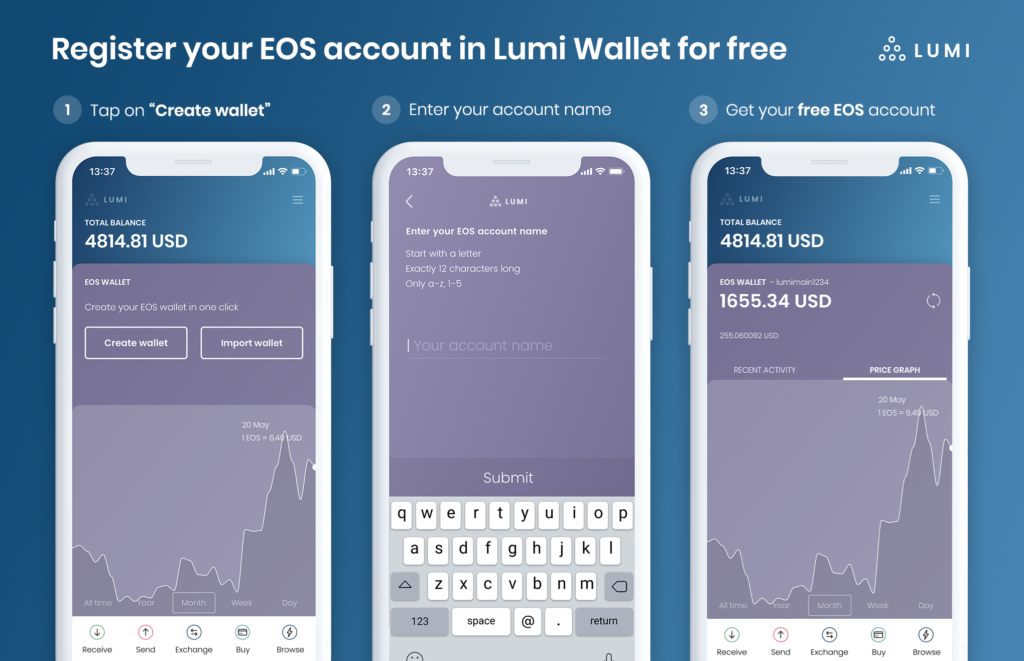
How to create an EOS account
Important notice: currently Lumi Web Wallet has no option to create free EOS accounts, you’ll have to use the app for that. It is possible to create only one account per device.
- Download Lumi Wallet
- Set up a PIN code and don’t forget to write down the mnemonic phrase!
- Select the ‘Wallets’ section and tap on ‘Get your EOS wallet’
- Tap on the ‘Create EOS wallet’ button
- Fill in the fields and create a name for your new account
How to add EOSDT and NUT in Lumi Wallet
Now when your new EOS account is ready, you can easily add EOSDT or NUT wallets to Lumi.
- Go back to the ‘Wallets’ tab and tap on ‘Manage wallets’
- Choose the ‘EOS token’ section, tick the ones you need, and confirm.
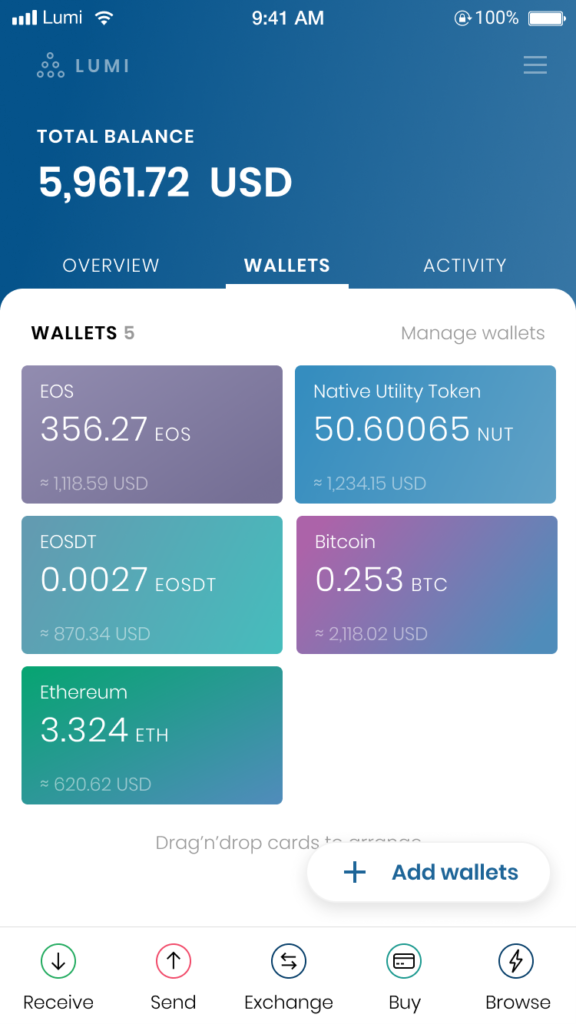
Now you can hold, send, and receive these tokens using Lumi Wallet.
More tokens ahead
Lumi’s team has received a lot of requests for token integration, so these are only the first EOS tokens to be added. Follow Lumi’s twitter and blog to get the news about fresh updates, and if you have any requests or questions - don’t hesitate to contact the development team at hello@lumiwallet.com
- 08:00 am

Confluence Technologies, a global leader in investment data management automation for regulatory, financial and investor reporting, announced today that it has acquired StatPro Group plc (StatPro), a highly respected global provider of cloud-based portfolio analytics, asset data services and data management tools for the global asset management industry and asset management service providers.
Confluence has acquired the entire issued and to be issued ordinary share capital of StatPro in an all-cash offer of approximately £161.1 million (over $207 million USD). The transaction brings together two highly complementary businesses to create a leading supplier of front, middle and back-office
solutions to asset managers and administrators.
Mark Evans, Confluence Founder and CEO commented, “We, at Confluence, have long respected the spirit of innovation and reputation of excellence that is StatPro. StatPro’s performance and attribution, portfolio analysis and other data and risk support services are deeply complementary to Confluence’s offerings and will allow us to better help our clients achieve their goals. By acquiring StatPro, we will accelerate our plans to migrate Confluence’s performance solutions into the cloud, and continue both organizations’ history of creating truly innovative, transformative products that our industry has come to value.”
He continued, “Both companies are founder-led with cultures of innovation, integrity, imagination, discipline and service and we are pleased to welcome the employees of StatPro to the Confluence team.”
Founded in 1994, StatPro offers award-winning technology that makes advanced portfolio analytics simple and more cost-effective for investment managers of any size. StatPro has 10 global offices servicing over 450 clients in 37 countries, and its reach will enable Confluence to expand its market presence in the United Kingdom, continental Europe, Asia and South Africa.
StatPro Founder Justin Wheatley commented: “From its launch in 1994, we have built StatPro by always placing experience and expertise at the center of everything we do, and we couldn’t be happier to be joining a like-minded firm in order to provide asset managers and fund administrators with an even greater range of support services and analytics.”
Finally, Confluence would like to thank its private equity backer, TA Associates, for its continued support. In addition, for their fantastic efforts in helping complete this deal in an accelerated timeframe, Confluence would like to send gratitude to its advisory team, Chris Godsmark and Marc Jones of Oakley Advisory, as well as Paul Tetlow and Tom Wallace of K&L Gates.
- 03:00 am
AccountScore and Equifax have today announced the release of a new credit risk index for the consumer lending sector which allows financial institutions to more effectively understand consumers applying for credit products.
The index is based upon the transactional information found within a consumer’s bank account and takes advantages of the opportunities provided by Open Banking to develop new products in order to better understand consumers. The index can be taken as a standalone product or combined with traditional credit risk metrics to provide a fully-rounded understanding of a customer’s affordability and creditworthiness.
The index is the result of over two years of collaboration and analysis by the AccountScore and Equifax analytical teams. It combines AccountScore’s custom built and market leading transaction categorisation engine with the Equifax transaction data behavioural characteristics - identified as being leading predictors of creditworthiness and affordability.
As well as providing financial institutions with more granular insight, the index also outputs 26 indicators which can be displayed back to a consumer to give them an understanding of their rating within the index and the different factors which effect this. This means the index is provided with full transparency and allows lenders to explain their decisions effectively to their end customers.
Emma Steeley, CEO of AccountScore, said: “We are very pleased to release the Financial Health Index to the market. It’s a truly revolutionary product that capitalises on the opportunities provided by Open Banking, both for lenders to gain more insight into their applications but also in allowing consumers to more effectively demonstrate their eligibility for financial products.”
Dan Weaver, Head of Innovation at Equifax, said: “The Financial Health Index is a simple way for lenders to factor into their credit decisions the common payments made by consumers which are not found, or are not always present in a credit report, such as commitments in relation to rent, council tax, utilities and insurance as well as evidencing their income, which will help consumers better demonstrate their affordability and creditworthiness and hopefully lead to more suitable financial products being offered.”
- 05:00 am

Jumio, the leading AI-powered trusted identity as a service provider, today announced the beta release of Jumio Go, the company’s first real-time, fully automated identity verification solution. It is designed to remove friction from the user onboarding process, while still fighting online identity fraud and meeting AML and KYC compliance mandates.
Modern organizations need to implement the requisite safeguards to prevent bad actors from creating online accounts. Given the growth of deepfakes, bots and sophisticated spoofing attacks, Jumio has integrated certified liveness detection to detect when photos, videos or even realistic 3D masks are used instead of actual selfies to create online accounts. Jumio is the first automated identity verification solution to integrate NIST/iBeta-certified liveness detection via FaceTec ZoOm which serves as a powerful chilling effect on would-be cybercriminals hoping to impersonate legitimate users.
Powered by AI, Jumio Go provides enterprises with a real-time, secure and reliable way to verify remote users, ensuring the person enrolling or logging in is who they claim to be online. Across a number of important use cases (e.g., renting e-scooters), verification speed is critical. One industry study showed that 40% of consumers abandon onboarding applications after initiating a process, citing the length of time taken as one of the primary reasons for not completing the application process.
“Given Jumio’s AI expertise, machine learning models and massive verification datasets, launching a fully automated solution was always a question of when, rather than if,” said Robert Prigge, Jumio president. “Jumio Go leverages the power of big data and big AI to equip modern enterprises with instant online identity verification that delivers a simple and intuitive experience for good customers. Just as importantly, Jumio Go prevents bad actors and bots from creating fake accounts thanks to our embedded liveness detection, which is a powerful deterrent for fraudsters and cybercriminals.”
The key benefits of Jumio Go include:
- Unrivaled Speed: Employs state-of-the-art AI, OCR and biometrics to deliver our fastest identity verification solution ever.
- Data Driven AI: Exploits the power of massive production data sets, which include over 200 million historic identity verifications, and machine learning to spot patterns and better detect when an ID has been manipulated or altered in any way.
- Certified Liveness Detection: Detects and deters advanced spoofing attacks including deepfakes with FaceTec’s embedded NIST-certified liveness detection.
- Global Coverage: Supports more than 500 ID types across the globe, helping enterprises scale to serve an increasingly international customer base.
- Omnichannel Support: Supports a wide range of customer implementations, including mobile SDK (iOS & Android), mobile web, desktop and cloud API service options.
Jumio Go is being launched as a beta to give its customers an early look at the fully automated identity verification solution. The beta is available across a broad range of geographies and will expand to other geographies in the near future. Jumio will use the beta period to capture important feedback from customers and partners to better refine the experience and deliver the best fully automated identity verification solution on the market.
Jumio Go complements Jumio’s other leading-edge identity verification solutions that empower organizations to increase conversions during the onboarding process, reduce online abandonment (often associated with time-consuming verification processes), and meet evolving KYC and AML regulatory mandates.
Jumio’s full suite of identity verification solutions will benefit from and inherit the technology enhancements that have been integrated into Jumio Go. This provides another benefit to Jumio’s business customers — they can now choose between a 100% automated solution or opt for Jumio Identity Verification, a hybrid solution that leverages a combination of AI, computer vision and human review to deliver the most accurate solution in the market.
Over the past two years, Jumio has experienced dramatic sales growth which speaks to significant market opportunity and demand for biometric-based identity verification. Earlier this year, the company was named to Fast Company’s prestigious annual list of the World’s Most Innovative Companies for 2019, ranking 29th globally and the second in the Security category.
For a sneak peek of Jumio Go, please visit Jumio at Money20/20 USA in Las Vegas, booth 2520. Sign up for the beta waitlist at jumio.com/go.
- 04:00 am

TIBCO Software Inc., a global leader in integration, API management, and analytics, has been recognised as a Market Leader in the Ovum Decision Matrix: Cloud Platforms for Hybrid Integration. TIBCO surpassed Ovum’s criteria for market impact, scalability and enterprise fit, cohesiveness and innovation, B2B and mobile/backend integration, API platform, and cloud integration/iPaaS. Placing in the top four in five out of six categories, TIBCO sees its placement in this and other industry sources as further validation for its robust hybrid cloud integration and API offerings, including TIBCO Cloud™ Integration.
TIBCO Cloud Integration accelerates the integration process by empowering people outside of the IT department to integrate applications and data rapidly no matter where the information is hosted, freeing the IT department to focus on higher-value activities. By using an API-led approach that simplifies integration, TIBCO provides hundreds of feature and security-rich, performance-optimised, and thoroughly tested connectors and technologies to empower organisations to connect anything easier and faster. This solution is highly flexible and provides true vendor independence, allowing users to customise how they consume, run, and scale hybrid integrations to meet their unique demands.
"The demand for hybrid cloud architecture has significantly increased as more enterprises are leveraging emerging cloud-native technologies to create applications that speed up operations, offer greater adaptability, automate decision-making, and create game-changing user experiences for customers,” said Randy Menon, senior vice president and general manager, connect and cloud, TIBCO. “We are thrilled to be recognised by Ovum for our solution’s impactful achievements in empowering our customers to address modern hybrid cloud integration needs. Our positioning in this report is a testament to our efforts in providing the best business value in strategic iPaaS and hybrid integration.”
According to the 2018 TIBCO CXO Innovation Survey that polled more than 600 respondents around the world, including senior vice presidents, CXOs, vice presidents, senior directors, and directors from business and IT functional areas, 60% of respondents indicated that they include cloud, business intelligence, analytics, and application and data integration technologies in their innovation strategy. Further, a majority of respondents believe cloud, data and application integration, and business intelligence are core to companies that are leading and competing at the highest levels.
- 04:00 am

Deloitte's Center for Financial Services today reports that consumers are looking toward the broader ‘ecosystem’ to simplify their payments experience as innovative payment instruments become more prevalent.
Nearly half of US consumers surveyed expect to use credit cards more than any other payment instrument in the next two years, Deloitte finds. This is primarily driven by the attractive rewards, discounts, and cashbacks that accompany credit card spending.
Despite this, consumer loyalty toward credit card usage appears fragile, with two-thirds (approx. 66%) of consumers surveyed likely to switch alternative payment instruments if they receive similar, credit-card-type rewards in return.
Credit cards with device-based wallets such as Samsung Pay or Apply Pay are currently the most popular option for payments, and as they only comprise around 40% of transactions, Deloitte argues that issuers should target this area to capitalise on the trend and increase market share.
Interestingly, the report found that a majority of respondents were interested in using a financial superstore app to streamline their day-to-day transaction activity. Such an app would allow consumers to access financial products such as a personal loan from the same bank or other institutions, buy products and services, and manage personal finances from a single app.
More than three in four respondents believe banks or credit card issuers are best positioned to deliver such a product and would be well served by achieving first-mover advantage.








