
Published
- 07:00 am

Path Solutions, a global banking software provider, was announced by IBS Intelligence as the leader in the Islamic financial services sector in IBS Islamic Sales League Table (SLT) 2020.
For the eighth year in a row, Path Solutions was recognized the undisputed leader in Islamic Banking with more new Islamic deals signed in 2019 than any of its industry peers. The company is part of the iconic IBSI Leadership Club 2020 for back office systems, topping the Islamic Banking category since 2017.
Separately, Path Solutions was recognized as the World’s 4th Universal Banking System Provider for the fifth consecutive year in IBS Global SLT. The dual recognition demonstrates Path Solutions’ cementing leadership position across the breadth of the financial services space.
In IBS SLT 2020, Path Solutions featured in four other categories; the Compliance, Digital Banking & Channels, Risk Management, and the Lending category, making it one of the preferred software vendors in these segments, expanding its solution footprint globally.
The annual IBS SLT is the global barometer for sales performance of Universal Banking, Islamic Banking, Wholesale Banking, Retail Banking, Private Banking, Lending, Digital Banking, CRM, Payments, Compliance & Risk Management, Investment & Fund Management-related technology market.
Mohammed Kateeb, Group Chairman & CEO of Path Solutions, commented, “These recognitions attest to our continued vigorous commitment and rigorous execution, seeing the pace and scale in the adoption of our flagship iMAL platform. It makes us incredibly proud to be serving our valued clients with a comprehensive open banking platform, innovative and state-of-the-art digital solutions complemented by deep intelligence built into all major business segments”.
Kateeb added, “Being recognized as the leader in Islamic SLT for the eighth year running demonstrates our company’s overall ability to meet the continuously emerging complex client requirements, emphasizing the breadth and depth of our suite of solutions, as well as our ability to accelerate time to market for products and services. As our clients look at rethinking the playbook, we will continue to make industry leading R&D in intelligence and digital, to help them embrace the opportunities created by Industry 4.0 technologies and be more efficient and competitive”.
IBS ISLT spokesperson stated, “Islamic financing in recent years has seen tremendous growth spurred by more awareness, strong investments, digitalization and increasing financial inclusion in predominantly Islamic countries in the Middle East and Africa. This year’s ISLT saw close competition between top players, where Path Solutions emerged as the winner for its iMAL platform. Many congratulations once again for being at the leadership position in the Islamic Banking category”.
Path Solutions is a market-leading provider of AAOIFI-certified core banking platforms with world-class development, implementation, consulting, support, training, and outsourcing services. Its new age initiatives - Digital & Social Banking, Mobility, Business Analytics, Risk Management & Compliance solutions cater to the evolving need for speed, reach and predictability.
Path Solutions heavily focuses on innovation with significant investment in R&D. Innovation is a core value to which Path Solutions is relentlessly committed to drive digital transformations and proposes to today’s financial institutions ground-breaking solutions empowering them to efficiently deliver the capabilities customers expect.
The company’s global R&D centers are located in Kuwait, Lebanon, Egypt, India and Pakistan, in addition to near-shore support offices spread across the UK, Malaysia, KSA, UAE, Morocco and Bahrain, and a global business partner network stretching over four continents.
- 05:00 am

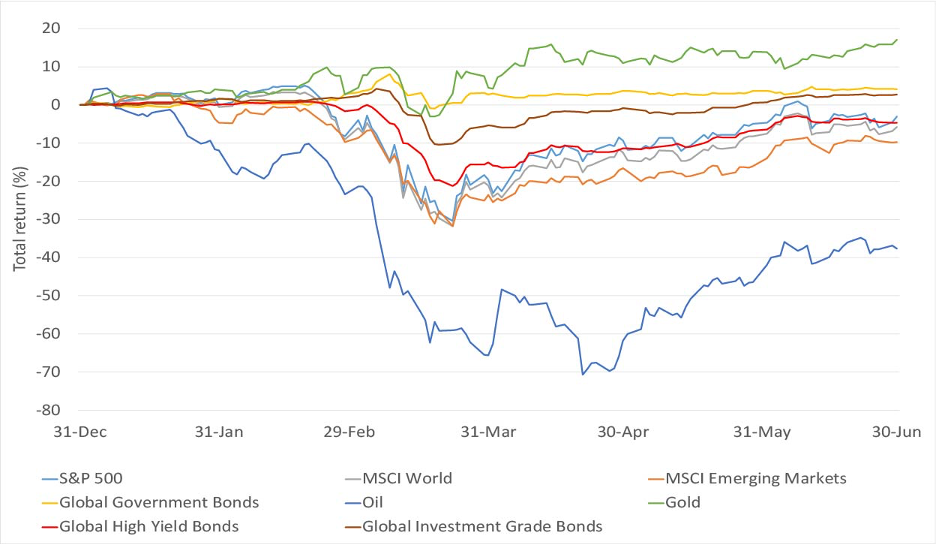
It has been an extraordinary six months, not just from a social perspective but also from an economic and financial market perspective. This week we pause for reflection and show the year to date performance of several major asset classes. The data runs from 31st December 2019 to 30th June 2020, showing total returns in US dollars.
Of the asset classes listed, the strongest performing over the year so far has been gold. Heightened uncertainty has served to push down real (after inflation) yields and boosted gold, which has historically been negatively correlated to such a move.
The weakest performer was oil, pummelled by the double whammy of demand and supply shocks, the former due to the collapse in demand as large parts of the world entered lockdown and the latter as Saudi Arabia - Russia tensions escalated which saw Saudi Arabia initially flood the market and fears mounted there was nowhere to store oil as demand dried up.
For most asset classes the last six months was a game of two halves: the first up to and including the 23rd March as coronavirus roiled markets and the second after central banks intervened on a massive scale. The first episode saw equity markets suffer their fastest drop in history; the second saw one of the quickest rallies ever (particularly so in the US where Q2 returns were the highest since 1998).
Why this chart is relevant
Thinking ahead we would expect risk assets, principally equities, to suffer from any realization that the economic recovery will not materialize as quickly as currently expected, perhaps following a second wave or as observed through weaker than expected economic data releases; neither being mutually exclusive. As investors have come to see through the shock of the more immediate and heavy knock to earnings, share prices have risen and valuations have thus rebounded.
At these higher levels (acknowledging regional variation) markets will be very sensitive to any news which challenges the increasing consensus view of a V-shaped recovery from coronavirus. Another key point to discuss is the portfolio role of government bonds, which have historically benefitted multi-asset investors when equities have fallen sharply.
However, with yields so low today (currently lending money to the US government will grant you a measly 0.7% per year if you hold the benchmark ten-year bond until maturity), it is hard to see government bonds providing as much protection as they have done in the past (unless you believe bond yields could move significantly negative). Let’s see what the next six months bring. After the last, perhaps we all need an unextraordinary six months.
About Mondial Dubai:
Mondial Dubai is the first Financial Consultancy firm to be licensed by the Emirates Securities Commodity Authority in 1989. after a merger of 14 financial firms that led the way in advice, offshore compliance, reduced costs, and better client outcomes.
For over 30 years Mondial has been the best international financial consulting firm offering expert financial advice and international financial solutions to a growing number of globally expatriated clients acting as the guiding light in the offshore financial services arena.- 06:00 am

Nostra, an independent, Irish owned and managed MSP company headquartered in Lucan, Co. Dublin has acquired Brandon Global IT for an undisclosed sum. The deal was funded by Bank of Ireland together with Nostra funds. Nostra reported an EBITDA of €880,000 for year end, 2019. The acquisition of Brandon Global will now see the company’s turnover expected to rise from €14 million to €18 million.
Nostra was established in 2006 by brothers Kevin and Barry O’Loughlin along with Gary Byrne and Senan Finucane and has grown rapidly in the last number of years.
Kevin O’Loughlin, CEO of Nostra said, “We have worked with Brandon Global on many projects over the years. The company has extensive experience and expertise in cyber security, a specialty that we wanted to include in our own offering. This acquisition now brings our employee number to 130 and allows us to offer our customers even more expertise and specialist services. In addition to our offices in Lucan and Laois we will now have an office in Galway and Dublin City Centre. Nostra and Brandon boast a 97% client retention rate and this was a key factor for us when we were considering the purchase in the first instance. We expect to complete another acquisition within the next 12 months, it’s a good time to expand and there are opportunities out there.”
20 new jobs will be created by Nostra over the next 12 months as the company continues to add new customers and broaden its range of services. “Our business has continued to grow at a rapid pace,” said Kevin O’Loughlin. “We expect to fill new positions in cyber security, managed services, helpdesk and multiple IT engineering positions. Our medium-term plan is to grow to annual revenues of €50 million, which will see our team grow to 300 people over the next 5 years.
The deal with Brandon Global is the third acquisition Nostra has made in the last five years. It previously purchased, The Tech Department, Emit and Rocklan Technologies. The latest acquisition sees the firm continue on its ambitious journey to become Ireland’s largest IT Managed Service Provider.
Nostra has been a cloud first IT provider since 2008, as a very early adopter, every one of its clients has now a significant portion of their business in the cloud. This model has proven to be the perfect fit for home workers as Nostra clients moved to remote working with ease.
The company supports well-known brands including BoyleSports and Dawn Farm Foods. It has over 200 customers and provides full IT services to them in the UK, the Benelux region, Germany, Poland, South Africa, Australia, and North America.
With the skills of a dedicated technical, sales, support, and administrative staff, it helps organisations of every size and industry to integrate technology with their business.
- 02:00 am

B2C2, the trading firm of choice in the institutional crypto markets, announced that SBI Financial Services (a subsidiary of SBI Holdings, "SBI") has agreed to acquire a $30 million minority stake in the firm.
The investment marks the start of a strategic partnership between one of the largest institutions to have ventured into the crypto market and a veteran digital asset trading firm. SBI, owner of Japan’s first digital bank and largest online brokerage, is listed on the Tokyo Stock Exchange and is a member of the TOPIX stock index.
B2C2 will become SBI’s main liquidity provider as SBI expands its crypto offering to millions of existing customers. B2C2 will also benefit from SBI’s distribution network and financial firepower as it launches an electronic prime brokerage built upon its highly successful single dealer platform.
This month, the firm will release a fully automated facility to provide the most competitive two-way prices in the funding market. This capability expands B2C2’s existing secured financing operation, already lending hundreds of millions of dollars. B2C2 will continue to develop its offering until it constitutes a complete cross-asset prime brokerage business.
Yoshitaka Kitao, President and CEO of SBI Holdings, said: “We expect a lot of synergies with B2C2, a firm which has a large number of clients globally and offers abundant liquidity, excellent price competitiveness, and a diverse suite of products for their customers. We will work to develop innovative new crypto products and deepen synergies across our group of companies.”
Max Boonen, Founder of B2C2, said: “Deal with SBI takes B2C2 a big step forward. Having claimed the top spot in our segment thanks to the technological edge of our single dealer platform, we found in SBI the right partner to unlock the next drivers of our growth. B2C2 will benefit from SBI’s balance sheet, which is far larger than anything committed to the crypto market to date. It will complement our asset liability management framework - the most sophisticated in the market - to deliver an execution platform that will not only be a game changer in crypto, but also positions us to expand across asset classes as we set our sights on the $20bn-a-year prime brokerage market.”
B2C2 is a veteran digital asset trading group with a world-class team drawn from global investment banks and buy-side firms. Headquartered in the UK, with offices in London, Tokyo and Jersey City, B2C2 is trusted by banks, brokerages, exchanges and fund managers globally to provide 24/7 liquidity.
Continuously innovative, B2C2 launched the first crypto-native single dealer platform in 2016 and was the first foreign dealer to succeed in the Japanese market. In 2019, the firm launched the first OTC streaming price feed and was the first crypto company in the EU to secure a MiFID investment firm licence. B2C2 OTC Ltd. is authorised and regulated by the UK’s Financial Conduct Authority (FRN 810834).

Shuvo G. Roy
Vice President & Head – Banking Solutions (EMEA) at Mphasis
Ground control and Captain Tom see more
- 09:00 am

Internet and Mobile Association of India [IAMAI], and its sister organisations, Payments Council of India, [PCI] and Fintech Convergence Council [FCC] are jointly organising the two-day virtual Global FinTech Festival on 22-23 July 2020.
The Department of Economic Affairs (DEA), Ministry of Finance, Government of India is the presenting partner of the event. The event is also supported by the World Bank and the United Nations Capital Development Fund (UNCDF).
The key aim of the Global Fintech Fest is to restate India’s leadership in financial technologies in the post COVID19 world. Organising a mega global event virtually, would also be a landmark in India’s digital transformation.
The two-day virtual fest is themed around "Fintech: With and Beyond COVID" and is scheduled to be organized in 22nd and 23rd July 2020. The fest is being organized with a mandate to strengthen the key pillars for boosting the sector and have a global market research access especially in the wake of COVID.
The fest will witness discussions around various facets of topics including Digital Payments, Digital Lending, Digital Insurance, Data Management, Financial Inclusion, Digital Transformation, Crypto & Blockchain etc.
About 5000 + delegates across with nearly 150+ speakers globally from 20+ countries comprising of Fintech start-ups are expected to attend the event along with regulators, key financial institutions, tech companies, governments, industry bodies, corporates and students.
“It is important to understand the challenges, opportunities and future outlook implications posed by COVID19 across the BFSI/Fintech sector across all continents. GFF would be the platform for all stakeholders to provide that shared knowledge and leverage across the globe for the entire sector”, said, Naveen Surya, Chairman, Fintech Convergence Council & Chairman Emeritus, Payments Council of India.
“Global Fintech fest is shaping out to be the go-to Global FinTech conference in 2020. Festival brings together the entire FinTech ecosystem, with 5000+ participants from more than 20+ countries. It is also an opportunity for companies to show case their innovations in a dedicated virtual space”, said, Srinivas Jain, Executive Director - Chief of Strategy, Digital & Technology, SBI Funds Management and Co-Chair, Fintech Convergence Council
“One of the lasting behaviour changes due to the pandemic is acceleration of digitalisation. Global Fintech Fest leverages this new normal and provides a unique platform for stimulating conversations on fintech. I am excited by its ability to bring together fintech experts and foster collaboration across countries”, said, Smita Aggarwal, Global Investments Advisor, Flourish Ventures.
The Festival’s organising committee comprises G Padmanabhan, Ex-RBI Executive Director, Current Non- Executive Chairman at Bank of India; Rajan Anandan, Managing Director, Sequoia Capital; Dilip Asbe, Managing Director & CEO at National Payments Corporation of India; Naveen Surya, Chairman, Fintech Convergence Council & Chairman Emeritus, Payments Council of India; Srinivas Jain, Executive Director and Chief Marketing Officer, SBI Mutual Fund; Smita Aggarwal , Global Investments, Flourish Ventures; Suniti Nanda, Fintech Officer, Government of Maharashtra; Gaurav Chopra, Vice-President IAMAI & Executive Director, Payments Council of India.
- 07:00 am

Lemonade, which is backed by SoftBank Group Corp, is set to raise $319 million in its U.S. initial public offering and Lemonade, Inc. (“Lemonade”) today announced the pricing of its initial public offering of 11,000,000 shares of its common stock at a price of $29.00 per share. Lemonade has granted the underwriters a 30-day option to purchase up to an additional 1,650,000 shares of its common stock at the initial public offering price. The shares are expected to begin trading on the New York Stock Exchange on July 2, 2020 under the ticker symbol “LMND,” and the offering is expected to close on July 7, 2020, subject to customary closing conditions.
Goldman Sachs & Co. LLC, Morgan Stanley and Allen & Company LLC are acting as the managing bookrunners for the offering. Barclays is acting as a bookrunner. JMP Securities, Oppenheimer & Co., William Blair and LionTree are acting as co-managers for the offering.
A registration statement relating to this offering was declared effective by the Securities and Exchange Commission on July 1, 2020. T
"Lemonade had previously targeted the offering to be priced between $23 and $26 per share; however, the price range was increased to between $26 and $28 per share. The company then announced they will sell 11 million shares at $29 each," said Oliver Wright, Director of Corporate Equities at Akita Michinoku Capital.
At $29, Lemonade would have a market valuation of $1.6 billion, determined by the number of outstanding shares listed on its IPO filings.
According to data collected by Akita Michinoku Capital, SoftBank conducted a $300 million funding round for Lemonade last year, which at the time valued the business at $2.1 billion. The filing shows, SoftBank will own a 21.8% stake in the company upon the IPO. Sequoia Capital Israel and General Catalyst are also among the investors.
Head of Corporate Trading at Akita Michinoku Capital, Martin Thornton, said "Lemonade has not turned a profit since its launch in 2015. It revealed a net loss of $36.5 million in the three months ending March, compared with a $21.6 million net loss during the same period last year. The company's sales have now more than doubled in that period."
The company enables customers to purchase insurance policies on a mobile app after answering a number of questions. It also promises to donate the remaining funds, after expenses, to a charitable organisation in order to prevent fraudulent claims.
Although the company is headquartered in New York, it has origins in Israel with 123 full-time workers employed there, its filing revealed.
The offering is being led by Goldman Sachs Group Inc., Morgan Stanley, Allen & Co. and Barclays Plc. The designated market maker for the listing is Citadel Securities.
On Thursday, Lemonade listed its shares on the New York Stock Exchange under the symbol "LMND".
- 06:00 am
Analysis from global consultancy partnership Kearney predicts a rise in mergers and acquisitions over the next few years as banks seek to reduce costs in the short-term, re-focus the core business for the long-term, and transform operating models.
Now in its 11th year, Kearney’s European Retail Banking Radar is an annual analysis of the pan-European banking market, tracking 92 retail banks in 22 European markets, comprised of 50 banks in Western Europe and 42 banks in Eastern Europe.
While the COVID-19 limitations and border closures have stopped cross-border activities in the short term, Kearney predicts an increase in domestic transactions. Looking at previous trends in the market, the research reveals that domestic mergers and acquisitions are often driven by the need for scale and cost reduction. Post-crisis, banks will likely find M&A as the most efficient means to radically reshape their business portfolio – for both buyers and sellers – to achieve the required amount of cost reduction and transformation to stay afloat.
In fact, the analysis showed that 80% of banks which had undertaken domestic M&A transactions after the 2008 financial crash outperformed other local banks who hadn’t within just three years.
The market is likely to also see change in operating models, across the board, with banks refocusing their core business offering. Some might seek to divest non-essential assets where they are not able to maintain competitive edge in the mid-term, whilst others might opt to source new capabilities, such as analytics and AI – further bolstering and scaling up their core business.
In addition to a rise in M&A, Kearney also predict a rise in strategic partnerships, particularly across smaller banks and fintechs, as they look to gain reach quickly and efficiently. Many fintech start-ups have struggled during the lockdown, with several not qualifying for government subsidies. Positive collaborations with these smaller enterprises will also allow larger legacy banks to leverage capabilities off others, either through back-end operations, technology platforms, or shared supplier networks.
Simon Kent, Partner and Global Head of Financial Services at Kearney, comments:
“Retail banks will be feeling the effects of this current crisis for the next 2-3 years, so never has there been a better opportunity for banks to reshape their cost base and revise their long-term outlook.
Our research and analysis of previous market crashes indicate that change will be needed for most European retail banks, requiring bold decisions and quick action. After the 2008 crash, domestic M&A was a route to success, with 80% of banks outperforming their peers after such a transaction.
For a successful merger, banks will need to ensure strong due diligence and realistic expectations – setting out a good plan for integrating both entities. They’ll need to take extra care in communication to all stakeholders, such as clients, employees and investors ensuring cultures are aligned and employee motivation and retention remains strong.
While the COVID crisis in Europe has subsided, it is far from over, but the resulting surge in M&A activity will present a multitude of opportunities for the years ahead creating a better and strong market in the long run.”
- 09:00 am

The Compliance Program Management (CPM) business of Wolters Kluwer Compliance Solutions has won two prestigious awards celebrating excellence and innovation in operational risk. Financial Technologies Forum (FTF) News has named OneSumX its Best Operational Risk Management solution in its hotly contested 2020 Technology Innovation Awards. RegTech Insights, meanwhile, has named the solution its Best Vendor Solution for Managing Operational Risk in its highly competitive 2020 awards for a second year running.
Wolters Kluwer Compliance Program Management offers solutions that enable chief compliance officers at banks, securities, and insurance companies to stay on top of compliance with a myriad of financial and non-financial regulations. OneSumX for Operational Risk enables financial services organizations to meet and adapt to internal operational risk requirements by automating and simplifying the process of collecting, storing, analyzing, tracking and reporting on information relevant to operational losses and risk and control assessments.
The RegTech Insight awards are organized by A Team Group, the financial technology news service and content consultancy firm founded by ex-Wall Street Journal, Risk and Waters magazine journalists in 2001. The RegTech Insight Advisory Board, tasked with choosing the shortlist for the awards, includes senior representatives from major banking groups including Barclays, BNY Mellon, Credit Suisse, Deutsche Bank, JP Morgan Chase, Société Générale and Standard Chartered.
FTF News was founded in 2006 by an experienced team of publishers and journalists, with backgrounds at Dow Jones, Trading Technology Week and other leading financial news services. Its U.S.-based team is highly-respected and its annual awards are regarded as being among the preeminent accolades celebrating excellence and innovation in financial technology.
“On behalf of Wolters Kluwer I would like to thank the A Team Group and FTF News for recognizing the superior technology and user functionality of OneSumX for Operational Risk. Independent recognition of our market leading position in this important area for us is always welcome news,” said Steven Meirink, Executive Vice President and General Manager of Wolters Kluwer’s Compliance Solutions business. “Our customers in Europe and the U.S. are faced with ever mounting operational risk pressures, now more than ever, and we continue to address customer requirements through OneSumX for Operational Risk.”
Wolters Kluwer Compliance Solutions is a market leader and trusted provider of risk management and regulatory compliance solutions and services to U.S. banks and credit unions, insurers and securities firms. The business, which sits within Wolters Kluwer’s Governance, Risk & Compliance (GRC) division, helps these financial institutions efficiently manage compliance obligations tied to loan and deposit origination transactions and workflows, manage risk and other regulatory compliance obligations, and gain the insights needed to focus on better serving their customers and growing their business.
Wolters Kluwer’s GRC division offers a range of expert solutions to help the financial services industry respond to the COVID-19 pandemic. Its Compliance Solutions business, for example, offers Paycheck Protection Program Supported by TSoftPlus™ to support stimulus loan applications and loan forgiveness processes under the Coronavirus Aid, Relief, and Economic Security Act or U.S. CARES Act. Wolters Kluwer Lien Solutions, meanwhile, has also recently established a technology solution specifically designed to help U.S. lenders navigate Paycheck Protection Program loan applications, and associated compliance and risk mitigation requirements, resulting from the CARES Act. The Business Entity Search for CARES Act solution conducts bulk/batch corporate identity searches to verify the business status of potential borrowers.
- 03:00 am

Reuters Events will be hosting a free online webinar series focused on commodity trading and commodity value chains.
The energy industry has never seen a year like it. Demand dips, supply cuts, negative oil price, volatility, disrupted trade flows, bankruptcies, debt all over, green investment and through it all... opportunity.
That’s why, on Wednesday 8 July, Reuters Events are hosting a webinar “How Resilient is the Energy Market Through Volatility?” to help energy trading stakeholders understand the recent events and ongoing volatility and prepare for the journey to recovery ahead.
Sign up to tune in live or get the recordings
Experts joining the live webinar panel:
- Stuart Williams, President, ICE Futures Europe, Intercontinental Exchange
- Alessandro Liberati, Global Head of Crude Oil Trading, BB Energy Trading
Key discussion points, providing you with unrivalled market insights:
- Hear about the short and long-term impacts of negative oil price trading, retro-active pricing and future pricing on energy producers, traders and buyers
- Debate current challenges and opportunities for energy market stakeholders and traders
- Learn how price discovery and transparency are affecting the market
- Hear insights on how the energy market be reshaped in 2020 and beyond
Can't join live? Register now to get access to the recordings
Furthermore, all webinar registrants will be eligible for a free pass to the inaugural Reuters Events Commodity Trading Summit (November 9 - 10, Online).
Reuters Events exists to deliver the intelligence and foster the relationships that shape strategy and safeguard success at leading companies worldwide.








