
Published
- 07:00 am

Baton Systems (“Baton”), a provider of post-trade solutions for capital markets, has appointed Jerome Kemp, global futures industry leader and former Global Head of Futures, OTC Clearing, and FX Prime Brokerage at Citi as Senior Advisor. Kemp will bring his deep expertise in cleared derivatives and OTC clearing to Baton as the company accelerates its position to deliver a fully end-to-end FX settlement ecosystem.
Kemp brings 30 plus years of experience in the futures industry where he held various leadership roles in Paris, Tokyo and London. He recently announced his retirement from Citi after spending nine years as Managing Director, where he drove the growth of the cleared derivatives business to a position of global industry leadership, along with his expanded responsibilities in the bank’s FX prime brokerage business.
Before joining Citi in 2011, Kemp spent 18 years at J.P. Morgan, where he was the Global Co-Head of the Futures and Options and OTC clearing business. Prior to that, he worked in fixed income sales at Oddo & Cie, an independent Franco-German financial services group.
“Jerome is a pioneer in the futures and cleared derivatives industry,” said Arjun Jayaram, CEO and Founder of Baton Systems. “We are thrilled to welcome his expertise after paving the way for many firms to drive innovation and excellence in the financial markets. We look forward to capitalizing on his leadership as a valuable input to Baton’s continued success.”
“Over the past 12 months, Baton has formed key partnerships and integrations with major global banks and CCPs, which further solidifies its position as a leader in the revolution of the payments and settlement ecosystem,” said Kemp. "I’m looking forward to bringing my expertise and working with the industry’s top innovators to enhance and accelerate the digital transformation happening across the industry.”
Kemp recently stepped down as the Chairman of the Board of FIA, a global financial industry trade group, which he has held since 2018. Before that, Kemp served on the FIA board for seven years and was on the Group Board of LCH.Clearnet Ltd.
- 09:00 am

In a bid to help novel investors adopt cryptocurrency as a potential asset class, CoinDCX - India’s largest and safest cryptocurrency exchange has launched CoinDCX Go - the simplest and the most secure place to buy and sell bitcoin and cryptocurrencies. The exchange eyes mass adoption among beginner investors in crypto especially millennial and Gen Z and aims to onboard 50 million Indians.
Powered by multiple features and a simple user interface, CoinDCX Go, specially designed for novel crypto investors, offers quick check-in and check-out crypto trading experience. It enables users to operate on the cryptocurrency market with absolute ease and at one’s own convenience. CoinDCX Go was conceptualized following a joint survey we conducted the Mood of the Nation survey, which revealed nearly 60% of the Indian population found it extremely challenging to invest in crypto. The reasons cited in particular were lack of a conducive environment and a digital barrier to getting on board.
The User Interface (UI) has been designed to induct a new breed of first time users in mind. The systems of the platform are secured, with AI-ML algorithms, which is backed by a dedicated and efficient team to overview operations. Additionally, to bring a safety net for users, all the funds are insured by one of the best and well established global custodians operating in the market.
Sumit Gupta, CEO & co-founder, CoinDCX, said: “The app will allow users to trade on smaller denominations for some of the best crypto assets. 14 tokens such as Bitcoin, Ethereum, Ripple, Litecoin are part of this parcel. Users will be able to buy these cryptos within the time they finish a cup of tea or coffee. The focus is to make users see merits in the industry by attention to details paid by operators like us by taking the simple steps of developing this app to address their pain points. Technical and Issue related resolution support will be provided round the clock for their users.”
Currently CoinDCX Go offers a range of tokens in INR pairs such as, Bitcoin (BTC), Ethereum (ETH), Bitcoin Cash (BCH), Litecoin (LTC), Binance Coin (BNB), Chainlink (LINK), EOS (EOS), Tether (USDT), Cardano (ADA), Stellar Lumens (XLM), Ripple (XRP), Basic Attention Token (BAT), Matic Network (MATIC), Tron (TRX) etc.
These tokens have been vetted by CoinDCX to ensure users are dealing only on the more stable and secured currencies while buying their first cryptocurrency. CoinDCX Go will offer round the clock support services.
Speaking from a development perspective of the app, Neeraj Khandelwal, Co-founder, CoinDCX, said: “Most of the app users are in the age group 22 to 45. This app has been introduced to serve a simple purpose; remove the fear of technology, make the market numbers more understandable and provide the ability to make informed decisions in the crypto universe. A smart investor will regularly invest at least 1 percent of his disposable income for Bitcoins in his investment portfolio. People having faith in the future of technology should do the same. The app just makes the induction easy. Buying Bitcoin on CoinDCX Go will be as easy as using any of the popular apps such as WhatsApp, Instagram, Amazon, or booking your cab through Uber.”
"The product is sturdy and has a lot of security features, backed by a robust system architecture. ‘Since our focus is on the newcomers of the crypto universe, a special emphasis has been placed on ensuring proper inputs are provided at every step, with users being updated about the industry on a regular basis,” adds Neeraj.
Currently, there are about 6 million Indians in crypto which is close to 0.5% of the total Indian population. CoinDCX Go allows first time crypto buyers to own cryptocurrency instantly without having to wait for orders to process and will charge 0 fee for deposit and withdrawals.
In yet another initiative to drive mass adoption of cryptocurrencies, the company invested $1.3 million in TryCrypto, its own initiative, which is working to make blockchain and cryptocurrency more accessible to mainstream users.
CoinDCX Go: https://go.coindcx.com/.
- 01:00 am

Temenos (SIX: TEMN), the banking software company, announces its next-generation Temenos Enterprise Pricing solution, which enables banks to design, manage and price innovative products, services and product bundles using their own and third-party products. Temenos Enterprise Pricing can be deployed on Temenos Transact or on any third-party core, helping larger banks burdened with complex, siloed legacy systems gain faster time to value as they start their modernization program. The powerful, enterprise-wide pricing engine supports hyper-personalization of products and services, and accelerates time to market for all products, increasing the bank’s profitability.
Larger banks are typically operating on large legacy technology stacks often with multiple core capabilities and disparate systems or product silos. These banks are struggling to compete with fintechs and neobanks, whose agility allows them to rapidly launch differentiated products and attract new customers. Developing and taking-to-market new products and pricing bundles across geographies, business lines and multiple, core banking systems requires a transformation program that banks cannot solve in-house. With Temenos Enterprise Pricing banks can address their immediate operational efficiency needs and start an incremental modernization journey.
With Temenos Enterprise Pricing banks can deliver innovative products and pricing bundles with competitive pricing based on the customers’ or entire households’ relationships with the bank and their behaviors to provide tailored rewards and promotions. Temenos enables banks to create products and pricing structures both across digital channels and within the banking core, making it the only technology provider capable of helping banks implement this approach through the entire value chain.
Temenos Enterprise Pricing also gives banks greater control over the fees they apply, centralizing product data from multiple legacy systems and disconnected applications. Banks gain better visibility of the product and pricing portfolio across the enterprise, which in turn reduces revenue leakage and optimizes profitability. This transparent pricing across products and services benefits the customer and the bank.
Christine Barry, Research Director, Aite Group, said: “In the commoditized world of banking, loyalty to a brand will be harder to create without delivering genuine advantages to customers who display loyal behaviors. Temenos Enterprise Pricing enables banks to manage products and pricing effectively delivering to their customers transparent, relationship-based pricing, innovative services and rewards schemes to delight them and create deeper relationships.”
Max Chuard, Chief Executive Officer, Temenos, commented: “With Temenos Enterprise Pricing, we give larger banks with legacy IT landscapes, burdened by multiple cores and disparate, siloed systems, the opportunity to solve their operational efficiency needs and start their modernization program, gaining faster time to value. This solution enhances our ability to meet the needs of larger banks, which represent approximately 60% of the total third-party market spend. Our next-generation SaaS solution enables banks to create new revenue streams by launching new compelling offerings and to apply dynamic pricing strategies to maximize profitability, increasing customer retention and boosting wallet share.”
Temenos Enterprise Pricing provides an enterprise-wide product repository, a ‘one-stop shop’ of all products and services. This enables banks to overcome the limitations of their legacy core banking or other, peripheral systems. It gives banks the agility to launch compelling products and services as well as product bundles by packaging their own and third-party products, crucially enabling them to price them appropriately. Banks can deliver benefits to customers through:
- value-based pricing determined by the overall customer relationship with the bank across business line silos;
- aggregation of financial products on a single platform;
- creation of new services that help people better manage their finances;
- providing insight into spending and saving habits; and
- widening access to products and services.
The microservices-based solution will be pre-integrated with Temenos Infinity Origination to originate products and pricing structures digitally through multiple channels and will provide AI-generated pricing propositions. Temenos Enterprise Pricing can also integrate with any front-office digital banking system. It is hyper-efficient, highly configurable and its open-API architecture allows for faster and simpler implementations. The solution is available as Software-as-a-Service managed by Temenos, or in the public cloud and on-premise run by the bank.
- 09:00 am

The need for safer and more touchless ways to pay has escalated and consumers are embracing contactless cards as the preferred means of payment, with 77% using them regularly in-store. However, in parallel with the increased use of contactless are rising security and usability concerns.
The pandemic has rapidly changed the way we pay and our attitudes towards how we want to pay in the future.
“PIN codes have been annoying for a long time, but who would have thought a year ago that one in three consumers would fear touching the PIN-pad when paying in-store?” comments Lina Andolf-Orup, Head of Marketing at Fingerprints.
Nevertheless, today that is the ‘new normal’ and the PIN-pad concern now equals concern levels around handling cash due to fear of contracting viruses, according to a new global study by Fingerprints and conducted by Kantar across five global markets1.
The need for safe and touchless ways to pay has risen
Consumers have continued to move away from using cash (22%), and the bank card is now the dominant way consumers make in-store payments (73%), with very few claiming to use mobile wallets (2%).
On average, one in two are using their contactless card as the main method when paying in stores. France (60%) and the UK (57%) are the countries with the highest penetration, but contactless has also gained adoption in the famously cash-heavy Germany (38%). The contactless card is also used frequently, with over three quarters (77%) using it at least weekly.
The majority of consumers (63%) think they will use contactless cards even more in future. Mobile payments will likely grow too but is a polarized method, with one in four thinking they will use it more than today, but 32% still think they won’t make mobile payments at all in-store in future. There are some differences across markets and segments, but the overall picture remains consistent that consumer usage and fondness for contactless cards is here to stay.
Consumers need a reason to trust contactless
The main reason for consumers’ affection for the card is trust - it is easy to use (78%), it works everywhere (70%), it is secure (68%) – and of course, it can work as a complement to your smartphone, especially for online payments. For ‘real life’, in-store payments however, very few think mobile first.
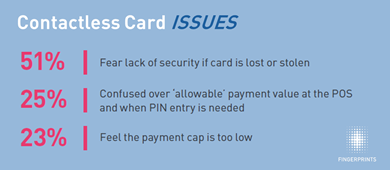
“The contactless card is far from perfect, however. Consumers are worried around its security, and this level of concern has risen since our earlier research, likely fuelled by growing usage and raised payment caps. People are aware and increasingly concerned about anyone being able to use their card if they lose it. On the other hand, there is also an issue with the transaction cap and confusion caused by still often needing to input your PIN - an unwelcome step not only because of hygiene concerns, but as an added point of friction. Consumers truly need a reason to trust contactless, both from a security and usability point of view,” adds Lina.
The biometric payment card = the answer to consumer needs
Biometric payment cards, where you authenticate yourself with your fingerprint on the card instead of entering a PIN code, is a desirable innovation when you ask consumers. It will enable secure, hygienic, convenient contactless payments no matter the amount and also offers consumers a ‘wow’ factor with a technology that’s still somewhat familiar, with many now comfortable with biometrics from use in smartphones. Biometric payment cards directly address consumer needs and concerns, both rational and emotional.
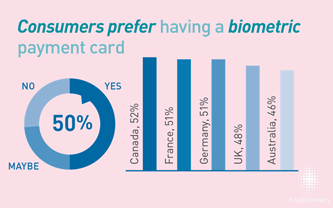
Half of all consumers want a biometric payment card, with a further quarter being open to it.
In fact, they want it so much that over half (51%) would switch bank if they could have one. In Australia and the UK, the interest is even higher, with over six in ten willing to switch bank. And, among the 18-35-year olds, the willingness to switch is the highest (66%), followed by those with higher income (61%).
Beyond this, a significant proportion (43%) would also be willing to pay extra to have the fingerprint feature on their card. This differs across segments, with younger demographics wanting it to a higher degree (55%) and willing to pay for it (61%). Among the consumers that use their contactless cards regularly, 62% want it to be biometric and almost half would be willing to pay for it (49%).
In the two countries included in the earlier survey, conducted ‘pre-Covid’ at the end of 2019, the interest in having a biometric payment card has since increased too, with around half of consumers now citing it as a preference in France (51%) and the UK (48%).
“From our research, it is clear demand for biometric cards has only increased with the pandemic. Behaviors have shifted quickly and adoption of contactless cards has boomed, penetrating new markets and segments while also shining a spotlight on the current issues and constraints of contactless that have now become real consumer pain-points. Banks have an opportunity to bring innovation to consumers’ favorite payment form factor. By offering biometric payment cards, banks can not only show they care for their existing customers, they can also attract new customers and create a potential new revenue stream,” Lina added.
For more details download the global report here.
1 Survey Methodology
Fingerprints commissioned research carried out by Kantar during September-October 2020 among 2,000 adults age 18-65 years old, national representative samples in each country. Online interviews were conducted across: Australia, Germany, France, Canada, the UK.
This is a survey that looks at people’s attitudes, the percentages reflect the perceived use and not based on actual usage statistics.
- 08:00 am

A survey by Market Intelligence specialists, Acuiti, commissioned by Avelacom, the global connectivity and IT infrastructure provider for the financial services industry, has found that in their efforts to stabilise trading revenues, proprietary trading firms are overwhelmingly interested in trading new emerging markets.
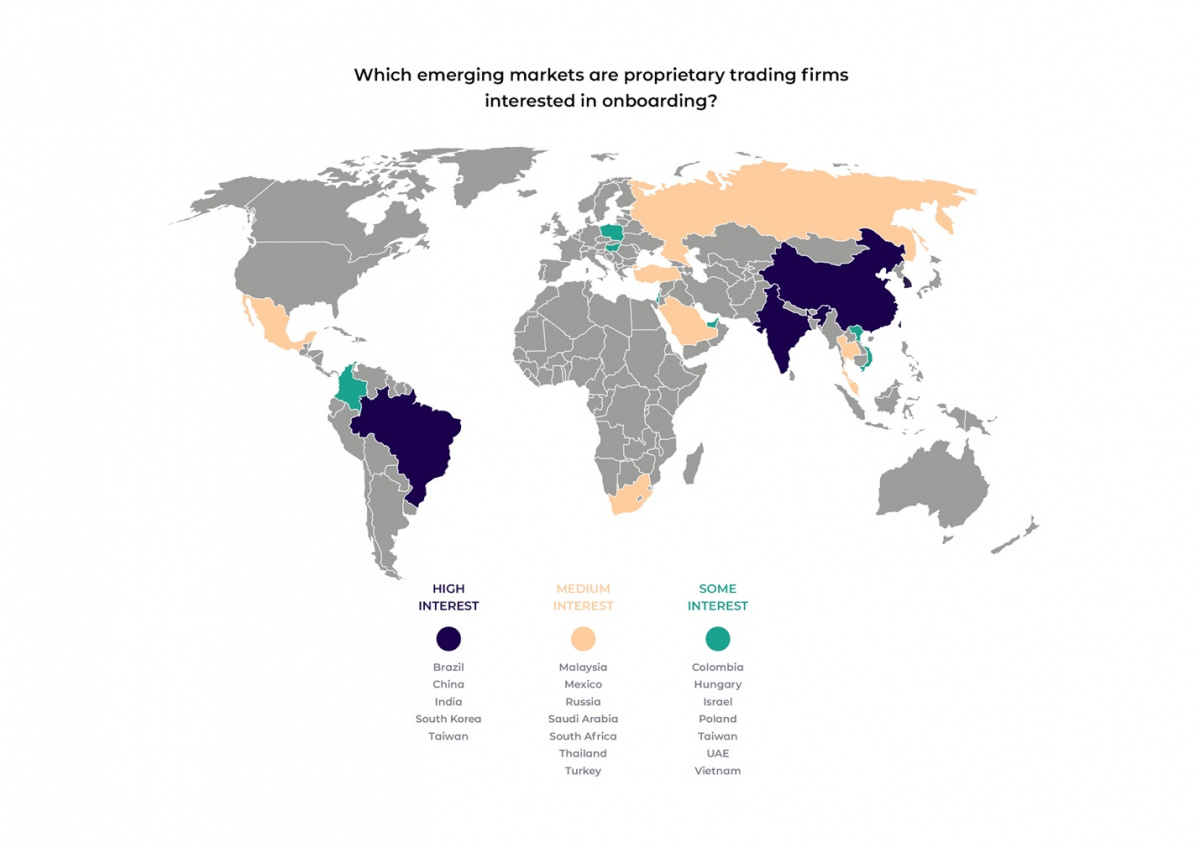
Overall 85% of senior proprietary trading respondents are interested in trading emerging markets and 74% are expecting to start taking market data or begin trading on a new emerging or frontier market over the next 12 months.
Avelacom plans to use this data to ensure that as it increases its Points of Presence (PoPs) and enhances its fiber backbone across Asian, Latin American and Indian markets in line with market requirements, shown in the survey.
China is highlighted as the country of most interest with 56% of respondents planning to connect or take market data from an exchange in China over the next 12 months for the first time. India is also flagged as of particular interest for 52% of respondents, albeit it with additional barriers to entry as a result of difficulties in accessing onshore markets via an international GCM.
Saudi Arabia is also attractive, driven in part by Saudi Arabia’s stock market, Tadawul, launching its derivatives market in August with plans to launch futures and options contracts in the coming 12-24 months. In South America, Brazil and Mexico were highlighted as key markets of interest.
Firms point to two key reasons for considering entering new emerging markets – diversification (65% of respondents) and arbitrage opportunities (62% of respondents).
Both reasons are driven by the tendency of proprietary trading firms to experience significant highs and lows, with months of extreme success followed by very challenging months.
The report highlights that this “polarisation of month-to-month revenues has been exaggerated by the spread of Covid-19 and the associated volatility, but reflects similar patterns in 2019 and presents a challenge to proprietary trading executives running businesses with large fixed costs.”
Emerging markets are the key driver of contract volume growth in derivatives markets, creating natural opportunities for proprietary trading firms.

However, while the benefits are clear, firms also state significant barriers to entry including:
- Lack of provision of access from clearing providers (62% of respondents). This is also the most cited reason a firm has actually been prevented from joining a new market.
- Cost of IT infrastructure deployment at an exchange (59%)
- Uncertain regulations (57%)
- Cost of market data (46%)
- Lack of understanding of market rules (38%)
Commenting on the report, Aleksey Larichev, CEO of Avelacom, said: “Proprietary trading firms have long sought diverse revenue sources and the growth of derivatives markets in emerging market is an opportunity for them to diversify their trading and access arbitrage opportunities, particularly at times when established markets are quieter.
“Avelacom is responding to this demand by providing a ready-built infrastructure, new connectivity options and market data solutions for financial institutions that want to expand geographically.”
Will Mitting, founder and managing director of Acuiti, said: “Our survey found very strong demand from proprietary trading firms to trade emerging and frontier markets. Over the past decade, companies like Avelacom have made it far easier for firms to enter new markets and brought down the cost of access. Such firms are likely to see increased business in the medium and long-term from international proprietary firms as they take advantage of simplified regulations, increased trading hours and a growing technology infrastructure.
“While 18% of respondents said Covid had made them more likely to trade EM, 66% said that their wanted to increase exposures regardless of Covid, demonstrating the fundamental interest in EM. Most of the top 100 fasted growing established contracts are also in emerging markets.”
Methology: latency sensitive proprietary trading firms based in Europe, APAC, North America.
The full survey can be found here.
- 02:00 am

The recent news of criminals gaining access to New Zealand’s reserve bank has again sent a warning to all in the financial sector of the impact of cyber-crime.
The hack was not a direct attack on the bank, but seems to have come through a third-party supplier, Accellion. Accellion, which was used by the bank to share documents with external stakeholders, was hacked on Christmas Day, US time.
Although it released a patch within 72 hours, the time difference between the Californian based company and the New Zealand bank means that the implementation of the patch was not done in time.
This is one of many hacks through third-party suppliers over the past year. Cyber-criminals have been upping their efforts and the levels of the sophistication of their attacks, during the pandemic. Many having been trying to take advantage of new working conditions for employees and searching for any vulnerabilities within third party suppliers to gain access to valuable data and infrastructure.
As a result, companies need to ensure that they have visibility of the potential vulnerabilities across their entire supply chain, not just their own defences. Too many companies are continuing to rely on building increasingly high defensive walls around their internal infrastructure and data. However, with so many of their own employees now sitting outside of those walls, and with third-party suppliers having access to internal infrastructure, these defences are no longer effective. Being proactive and ensuring that all vulnerabilities are closed across internal and external sources is crucial.
Another factor highlighted in the New Zealand reserve bank hack is the fact that the bank was relying on legacy technology. The Accellion software being used has been described as a 20-year-old solution which did not carry the same levels of security as the updated version, Kiteworks.
This brings up another issue that companies have to be more aware of than ever as cyber criminals up their efforts. The use of legacy solutions, that are no longer supported by vendors or no longer have the minimum levels of security, are an open invite for cyber-criminals, as AJ Thompson, CCO at Northdoor, explains.
“This case is a really good example of how two sets of issues, both of which could be easily resolved, have culminated in criminals potentially gaining access to really sensitive, valuable and important data.
“We have seen a huge increase in the amount of attacks coming through third parties. Instead of directly targeting companies, cyber-criminals are coming through the ‘back-door’. This negates any defence in place, as the third party allows criminals direct access into infrastructure and systems.
“This particular case seems to have been exacerbated by the fact that the bank was running legacy software. If it had updated its software the criminals would have had a much harder task in getting in. It is crucial that companies look at the current solutions to ensure that they are running the latest versions which have the highest levels of security. With criminals continually adding sophistication to their attacks, any legacy software is at a real risk of being hacked, particularly if it is 20 years old, as seems to be the case here.
“The bank has since acknowledged that there was under investment in cyber security and other challenges within its IT services. Ensuring that you are running the very latest versions of solutions and that you have visibility over across all of your potential vulnerabilities, both internal and external, are now both crucial steps for companies to take.
“This combination of vulnerabilities through a third-party and running legacy software is a situation that many in the financial sector find themselves in. Both are relatively easy to solve, and with criminals always trying to find the route of least resistance, closing these off will deter them and go some way to securing data,” concluded Thompson.
- 02:00 am

Perenna, the London based fintech, has completed its latest funding round raising $10 million as part of its plans to obtain a banking licence and bring its technology-centric lending proposition of fixed for life mortgages to the UK housing market in summer 2021. The latest investment in Perenna has been raised from a group of investors including former Deutsche Bank Head of Structured Product Syndicate and MD Kevin Flaherty, Capdesk founder Casper Arboll, Star Capital managing partner Tony Mallin MBE, and other notable city investors and family offices.
Perenna is building a mortgage lender which will use long-term covered bonds to finance its products, taking inspiration from the Danish mortgage model. This innovative approach to lending in the UK means that Perenna will be able to issue 30-year fixed-rate mortgages at highly competitive rates, while giving customers the flexibility to port their mortgage should they want to move and offering early repayment charges that only cover the first 5-years of the product.
Perenna’s products will be available to borrowers ranging from first-time buyers, who can take out a mortgage with as little as a 5% deposit, to those who want to move or take out a mortgage in later life. The company is investing heavily in building its proposition around technology to provide a better customer experience for UK borrowers.
Britain’s mortgage market currently has around £1.5 trillion in outstanding loans. Perenna believes that its radically different approach to mortgage lending could help many first time buyers onto the housing ladder and release equity from existing homeowners. This could increase the UK mortgage market by around £500 billion over the next 5 years, fixing the broken housing market and boost GDP.
Arjan Verbeek, CEO and Co-Founder of Perenna, said: “For too long real and meaningful innovation in the UK mortgage market has been limited. This hasn’t just left Britain with a sector that has poor product offerings for customers. In some cases, borrowers have been excluded from the housing market altogether, from first-time buyers struggling to meet affordability criteria, to older homeowners who want to borrow but are restricted simply because of their age.
“This latest investment is a powerful vote of confidence from a high quality investor consortium in Perenna’s proposition. It puts us on target to launch our innovative range of long-term fixed-rate products, which we really believe could transform the UK mortgage market for consumers, allowing them to borrow what they can actually afford and creating a nation of happy homeowners.”
Former Deutsche Bank Head of Structured Product Syndicate and MD, Kevin Flaherty said: “Perenna’s proposition is truly innovative and will transform mortgages in the UK from a product, funding and technology perspective.”
- 01:00 am

Aion Bank, a new full-service digital bank, and Vodeno, a cloud-based banking-as-a-service platform, have partnered with cloud-native payments technology specialists Form3 to implement their next-generation payments platform and deliver real-time payment processing, clearing and settlement for Aion’s European members.
Aion Bank offers an all-inclusive approach to banking, which gives its Premium Members access to a number of money-saving products, very high interest rates on savings accounts, ETF based asset management (without any of the typical management fees), competitive rates for loans and personalised financial advice for a fixed monthly fee of 19 euros.
Form3 has scaled rapidly in the last year and is becoming the platform of choice for banks to outsource their payment infrastructure and operations. The company provides an infinitely scalable, high availability, transparent solution to manage and monitor payments 24/7/365. This allows partners like Aion Bank to focus on building great customer centric products.
Aion Bank utilises Form3’s API-first payments platform to run their real-time payment processing via a simple API integration, common across all payment types. Form3’s first release for Aion enabled the digital bank to be a direct participant in SEPA Instant, SEPA Credit Transfer and SEPA Direct Debit. Additional new markets are planned for launch in the coming months.
Tomasz Motyl, Chief Information Officer, Aion Bank, said: “We built Aion using the Vodeno Cloud Platform which is fully cloud-based and enabled by advanced API technology. In order to build features and services that would make banking digital first and frictionless for our members we chose the best cloud-native partners, like Form3, to deliver our vision.”
Mike Walters, Chief Product Officer at Form3, commented: “Aion Bank’s aspirations to be a digital first bank that puts the needs of their members at the centre is a perfect fit for the Form3 platform. The speed at which Aion has launched and at which they are scaling can only be done with a cloud-native technology provider like ours.”
Aion Bank is powered by the Vodeno Cloud Platform (VCP). Vodeno is transforming the financial services industry, offering instant access to the most comprehensive banking-as-a-service platform available on the market. VCP offers a fast-track solution for newcomers wishing to enter the financial services market, financial institutions looking to migrate from legacy technology and processes, or financial and e-commerce firms wishing to broaden their portfolio of products.
- 07:00 am

InterSystems, one of the world’s most trusted data management platform providers, is teaming up with leading tech analyst firm TechMarketView to find Fintech partners in the UK and Ireland.
InterSystems wants to expand its partner community in the UK and Ireland to offer reliable, innovative and scalable data technology solutions to the financial services industry.
“More so than ever before, financial services organisations need to reduce operational costs to remain competitive yet improve service quality,” said Enzo Brienza, InterSystems Sales Manager, UK & Ireland. “Cloud and hybrid computing environments will be key to enhancing focus on real-time data and processes while managing the burden of regulatory pressures. InterSystems has teamed up with TechMarketView to find more partners who can help the world’s most successful financial services institutions meet these challenges.”
TechMarketView Innovation Partner Programme
Launched in 2018, the TechMarketView Innovation Partner Programme (TIPP) has helped some of the world’s leading enterprise software & IT services companies find exciting new partners to bring innovative and differentiated solutions to their clients.
“We are delighted to be helping InterSystems find new Fintech partners,” said Anthony Miller, TechMarketView Managing Partner. “This is an outstanding opportunity for financial services solutions vendors in the UK and Ireland to team up with a global leader in data management technology and access markets that might otherwise be out of their reach.”
Pitch sessions
TechMarketView will be running online pitch sessions during March 2021 at which successful applicants will be invited to present their solutions to individuals from InterSystems’ management team.
Applications must be submitted by Friday 12th February via the webform on the TechMarketView website.
Further information about this event can be found on the TechMarketView website here.
- 04:00 am

Nutanix (NASDAQ: NTNX), a leader in private cloud, hybrid cloud and multicloud computing, announced today that Auto Europe, a global leader in international car rental services, is implementing Nutanix hyperconverged infrastructure (HCI) software to support a fully remote workforce amid the COVID-19 pandemic, as well as improve system performances, enhance disaster recovery and simplify management of their IT infrastructure.
Auto Europe serves travel agents and brokers at approximately 24,000 car rental locations in 180 countries around the world. Their service enables customers and travel agents to search and compare rates across leading car rental providers. With so many customers and locations, Auto Europe needed a solution that would improve scalability and performance. When the COVID-19 pandemic struck they knew their solution could enable employees to work from home and support their 24/7 call centres. Auto Europe was able to seamlessly transition employees to work from anywhere and allowed them to respond to customers quickly, improving the online experience and increasing customer loyalty.
“Having the virtual desktop and Nutanix infrastructure in place has given us the flexibility to transition seamlessly to a completely remote workforce,” said Karen Schaffer, VP of eCommerce, Auto Europe Group. “Had we not been forced into going 100% remote so quickly because of the pandemic, we probably wouldn’t have done it this soon. We were completely convinced it would be more of a daunting task than it ended up being with Nutanix. The process was seamless, and we were able to switch everyone to remote desktops running on Nutanix in a matter of days.”
In addition to enabling employees to work from anywhere, Auto Europe is now able to easily scale when new projects or contracts are signed. Before Nutanix it could take them upwards of six months to deploy new infrastructure, but now it takes less than two weeks. All Auto Europe enterprise workloads are now running on Nutanix, along with supporting about 660 virtual desktop infrastructure (VDI) users. In addition to Nutanix hyperconverged infrastructure and VDI, Auto Europe also implemented Nutanix Files, a software-defined scale-out file storage solution to support their user data, file shares, profile data, shared systems, web and application servers, system logs and more.
Moving from their 3-tier environment to Nutanix allowed the IT team to increase the ease of management of their infrastructure. In the past, the IT team would have to schedule maintenance windows to complete any upgrade but now with Nutanix the upgrades are transparent and allow employees to work as usual. These maintenance tasks can now be completed without impacting the performance of their critical e-commerce systems.
“Ensuring business continuity during a global pandemic has left many organisations scrambling to find the right solutions. With Nutanix already implemented, Auto Europe was able to quickly and seamlessly enable employees to work from anywhere,” said Nikola Bozinovic, VP/GM, Desktop Services at Nutanix. “By partnering with Nutanix, Auto Europe was able to remain proactive during these unprecedented times and continue to serve their customers without fail.”
Despite the challenges that COVID-19 has presented, Auto Europe has been able to quickly adapt and continue serving customers. Additionally, thanks to Nutanix, the IT team has been able to focus on developing new technology to support the business, rather than simply maintaining the IT infrastructure.








