Published
- 02:00 am
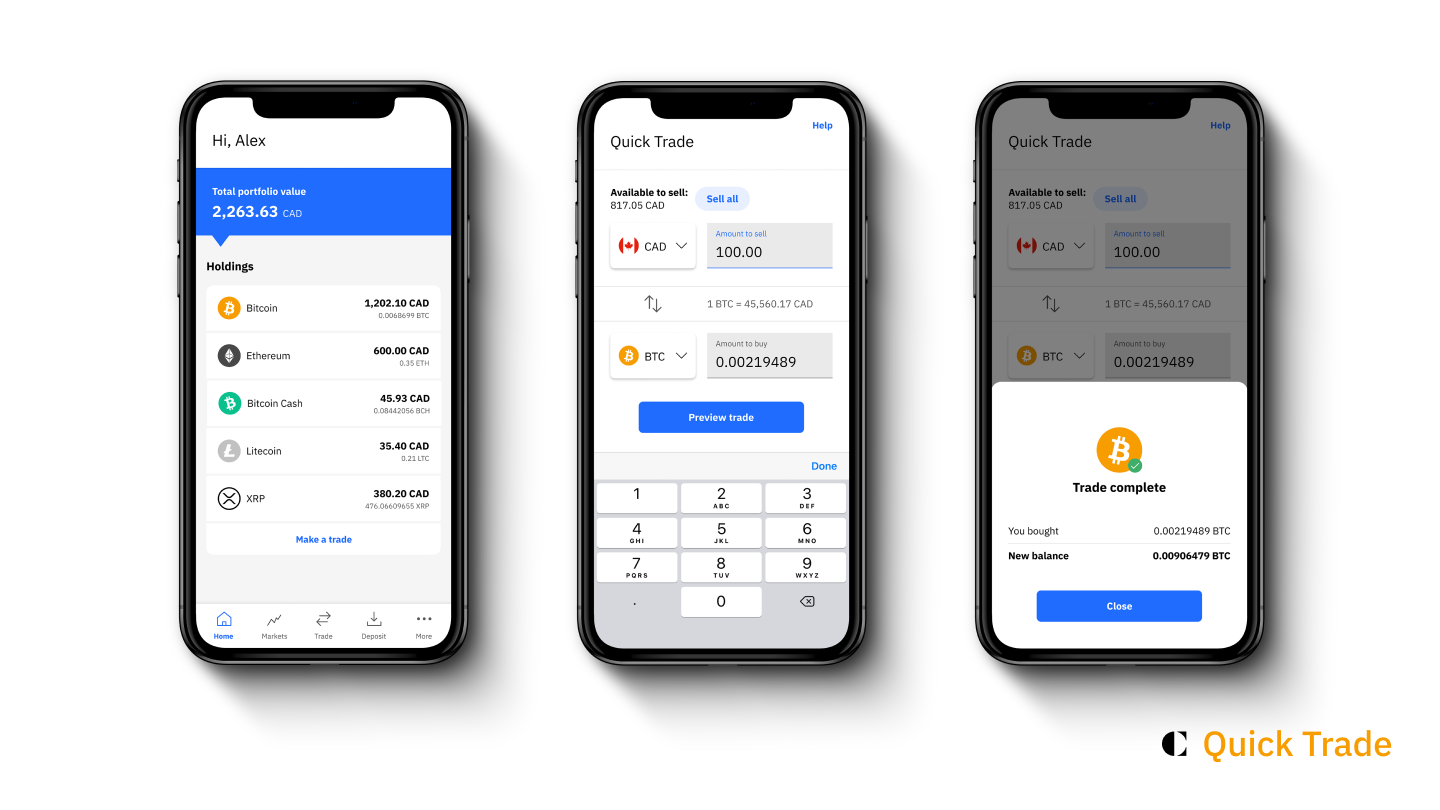
Coinsquare, Canada’s leading digital asset trading platform, has announced the launch of its new Quick Trade mobile app. The simple to use app makes buying and selling digital assets quick and convenient, with customers able to easily manage their portfolio of digital assets.
The launch of Quick Trade represents a new standard for mobile trading, with commission-free transactions and competitive pricing for the most popular digital assets.
The Quick Trade app — available in English and French — offers the following benefits and features:
- Simplified KYC process - get verified to trade within seconds
- Instant account funding via Interac e-Transfer
- No-fee e-Transfer deposits and withdrawals
- Commission free trades
- Easy portfolio management
- Swap between any two assets, with 15 pairings to start and many more to come
At launch, the Quick Trade app will offer Bitcoin (BTC), Ethereum (ETH), Litecoin (LTC), XRP and Bitcoin Cash (BCH), with many more digital assets to be onboarded over the coming months.
“We are thrilled to announce the release of Quick Trade. This is just the first of many exciting new announcements to come. Quick Trade’s simple onboarding and easy-to-use interface offers Canadians a simple and secure way of investing in digital assets,” said Stacey Hoisak, CEO of Coinsquare. “Our new Quick Trade app is part of our commitment to offer Canadians the most user-friendly, comprehensive and secure investing experience.”
Coinsquare recently announced new appointments to its board and executive team. The newly appointed directors and executive team have extensive backgrounds in Canadian securities regulation, investment dealer operations and regulated marketplaces.
Coinsquare Capital Markets Ltd. (CCML) also recently submitted a dealer membership application to the Investment Industry Regulatory Organization of Canada (IIROC) and an application to the Ontario Securities Commission (OSC) to operate a regulated marketplace for digital assets. The proposed marketplace will provide automated trading systems bringing together institutional and retail orders from buyers and sellers of digital assets deemed securities under the Ontario Securities Act.
You can download the Quick Trade app for iOS at the Apple App Store and for Android at Google Play,
- 06:00 am

Finastra today announced that Climate First Bank (In Organization), the nation’s first climate-focused bank, has selected a complete suite of banking software from Finastra. Using Finastra’s Fusion Phoenix core banking system, Fusion Digital Banking, Fusion Total Lending, and other solutions for payments, analytics and more, the de novo bank will be prepared to launch as a full-service community bank in Spring of 2021.
Initially servicing the Tampa/St. Petersburg region, Climate First Bank (I/O) will not only provide world-class, traditional banking services to its customers but will invest in the future by offering climate-focused programs, including an unrivaled solar loan option. The bank’s mission is to elevate the typical banking model by supporting local communities, encouraging green infrastructure and promoting sustainable business practices. Carbon neutral from the day it opens, the bank’s programs will Drawdown levels of atmospheric CO2 to reverse the existential climate crisis that threatens our planet and our lives. By fulfilling a growing demand for more socially responsible institutions, Climate First Bank (I/O) will expand to become the largest and most profitable eco-conscious and values-based institution in the Southeastern United States.
“As a de novo bank committed to fighting the global climate crisis, it is imperative that we not only work with the best providers for our needs, but that their vision aligns with and supports our mission,” said Ken LaRoe, Chairman and CEO, Climate First Bank (I/O). “With Finastra, we found a vendor that delivers on both fronts. We evaluate our vendors through an ESG (Environmental, Social, and Governance) lens, and Finastra stood out for its clear and tangible commitment to redefining finance for good. Its open platform approach and cloud delivery model – which is among the greenest means of technology consumption – ensures we will remain at the forefront of technology as we carry out our mission.”
In addition to the value of Finastra’s complete suite of banking solutions and strong CSR program that aligns with Climate First’s corporate mission and values, Finastra’s strategy and commitment to Open Finance was an important factor in the bank’s decision process. It is vital that the bank has the agility and flexibility to work with fintechs that enhance its ecosystem of customer-facing solutions. Finastra’s FusionFabric.cloud developer platform and marketplace for financial solutions, as well as the Fusion Phoenix core banking system, are built entirely on Microsoft technology with a progressive open API architecture, which fits well with the bank’s vision. As a result, the bank will be able to continue to evolve its product offering, leveraging third-party fintechs that meet the bank’s needs. Climate First has already selected the Allied Bill Payment app from Allied Payment Network, a third-party provider of real-time bill payment, which is available through the FusionFabric.cloud store and integrates seamlessly with Fusion Digital Banking.
“Climate First’s mission to fight the global climate crisis is crucially important and Finastra is honored to work with the bank to further this important cause,” said Chris Zingo, SVP and GM of Americas Field Operations, Finastra. “At Finastra, we are striving to redefine finance for good. As an established fintech, we recognize the responsibility to minimize impact on the environment, and to reduce emissions in the financial services sector. Through the digitization of banking processes or the digitalization of financial services, our solutions can aid the reduction of employee travel, paper consumption or energy, and we are committed to reducing emissions within our sector, in collaboration with our customers and partners.”
- 05:00 am
Sage, the market leader for cloud business management solutions, has teamed up with TikTok to launch the #BOSSIT2021 Challenge. This new UK-wide campaign invites small and medium-sized enterprises (SME) owners and entrepreneurs within the TikTok community to creatively express how they are thriving this year, despite testing times.
As part of its national brand campaign 'Boss It', Sage recognises the opportunity to reach a wider audience by extending the campaign onto TikTok. Backed by a dedicated Branded Hashtag Challenge, In-Feed Ads, bespoke music, and working with a host of UK SME creators, Sage's #BOSSIT2021 Challenge launches today on TikTok, supported by promotion across its other paid and owned channels.
To drive further awareness and engagement, Sage will also take ownership of TikTok in UK for the day on Tuesday 9 February with a premium TopView placement, the first video everyone sees when they open the app. The Branded Hashtag Challenge runs for the next week on TikTok before the most creative #BOSSIT2021 creation is chosen by Sage to win a £5,000 home workspace.
Some of TikTok's SME creators, including illustrator @evamalleyart, ice cream brand @bubba_ice, and small batch, hand poured candle maker @ivyandtwine, have already gotten involved to share how they're bossing it this year. Sage will work with a wide variety of creators across the campaign, tapping in the platform's unique characteristics and community as it seeks to engage and inspire people on TikTok with a playful and joyous campaign.
Kirsty Waller, VP Marketing, Sage UK & Ireland, said: "We are right by the side of the dreamers and small business owners as they continue to Boss It despite one of the most challenging years in our country’s history.
“Anyone can start a business, whether it be a side-hustle, a kitchen table start-up or an opportunity to give back – although we’ve seen that the common thread that exists within them all is an unrelenting fire and gritty determination to succeed. This campaign is a great way for us to put these determined heroes in the spotlight as they continue to grapple with the challenges of 2021.”
Niusha Koucheksarai, Head of Client Partnerships, TikTok, added: "This unique campaign truly speaks to the diversifying depth of content and people on our platform. It also shows the growth of small business owners sharing their unfiltered journeys of building their brands and succeeding against the odds. We're really excited to be launching the #BOSSIT2021 Challenge and heroing our small business creator community - who continue to show such resilience during challenging times. We can't wait for everyone to get involved and show us their creative takes on getting things done this year."
The partnership between Sage and TikTok shows a joint commitment to support SMEs and inspire entrepreneurs. The #BossIt2021 Branded Hashtag Challenge will celebrate the wins and achievements, big and small, of SME owners and all TikTokers that want to participate - from launching a new website or shipping a record order, to DIY, hitting new weekend walk distances or simply learning a new skill.
The TikTok creators featured in the campaign are:
- Illustrator @evamalleyart
- Ice cream brand @bubba_ice
- Small batch, hand poured candle maker @ivyandtwine
- Handcrafted resin pieces producer @forsaintclements
- Mental health journals and planners creator @lovendu
- Accessories business @femmephat
- Food hacks guru @ollie_eats
- Para athlete @millypickles1
- The skills guy @joecharman
As part of the campaign there is £10,000 worth of prizes to be won, including a £5,000 (or the Euro equivalent) Wish List for one lucky winner to create their ultimate home workspace.
- 01:00 am

B-North, the Manchester-based firm building an SME lending bank for the UK, has appointed Nimisha Patel to the board as an Independent Non-Executive Director (NED).
Nimisha brings almost 20 years’ experience in Technology, Transformation and Risk Management for some of the biggest names in professional services to B-North. Last year Computer Weekly named Nimisha as their Chief Information Officer of the year. Nimisha is currently the Chief Digital Information Officer at the Cabinet Office, responsible for helping to shape the technology strategy at the centre of Government. As required by her role, B-North will serve as Nimisha’s only NED position.
Before joining the Cabinet Office, Nimisha was the UK and International Chief Information Officer (CIO) at leading FTSE 100 listed insurer RSA. In this role she was tasked with shaping the region’s IT strategy and services necessary to run the firm’s £3.1 billion portfolio, managing a large global team. Before she was appointed as CIO, Nimisha served as the company’s Director of Technology & Operations Risk Management.
In addition to her experience as a CIO, Nimisha has experience leading IT Audit and Technology Risk practices for Financial Services. At PwC, Nimisha led the IT Internal Audit practice across Insurance and Investment Management. Before this, Nimisha worked at KPMG for 6 years as a Senior Manager, leading a number IT Risk and Consulting engagements in Financial Services.
Nimisha began her career at General Electric, starting on the firm’s leadership program, before rising to IT Programme Manager. Nimisha holds a BS in Decision and Information Science from the University of Florida.
Nimisha said: “As a lifelong technology specialist, I am so pleased to be joining the board of B-North. B-North shares my passion for technology and the way that intelligent use of new solutions can bring significant benefits to customers. I look forward to working with the company as they work to secure their banking licence and move towards delivering lending to the SMEs of the UK.”
Nimisha joins B-North as the firm accelerates towards securing its banking licence and completing its £20 million ‘Series A’ fundraise. The firm aims to disrupt the UK’s £150 billion SME lending market by establishing the first truly regional lending bank in 150 years. Through its network of regional ‘lending pods’ combined with a state-of-the-art cloud-based banking system, B-North aims to deliver loans to business 10x faster than the industry standard.
Ron Emerson CBE, Chair of B-North, added: “I am absolutely delighted that Nimisha is joining the B-North board. At the core of any successful business are its people and Nimisha is another excellent addition to the team, further deepening B-North’s rich pool of talent.
With Nimisha’s extensive expertise in technology, and its role in financial services, she brings a critical complementary set of skills to the business.”
Jonathan Thompson, CEO of B-North, further added: “First and foremost B-North is a people business, yet we rely on market-leading cloud-native technology to unlock our unique regional model and raise the bar in the provision of finance to SMEs. With that in mind, Nimisha’s appointment is perfectly aligned to our strategy and I’m deligh,ted to have someone of her calibre joining our Board at this exciting point in our journey.”
- 06:00 am

Refinitiv and Freedom Seal Global are forming an innovative partnership that will harness risk intelligence data on human trafficking as part of a concerted effort to stamp out modern-day slavery from corporate supply chains around the world.
The international community increasingly expects businesses to focus on supply chain risk, including human rights violations. The European Commission is calling for companies to ensure that environmental and human rights do not affect their operations and supply chains, in keeping with the UN Sustainable Development Goals and other international commitments.
The Freedom Seal, established by CEO Rani Hong, is a global mark of trust awarded to companies that are effectively taking action to eradicate modern-day slavery. The partnership with Refinitiv, enables Freedom Seal to use World-Check Risk Intelligence data to screen suppliers and vendors on behalf of their clients to identify potential connections to human trafficking. This partnership enables the Freedom Seal to use Refinitiv’s data as part of its own independent certification process to assist its clients to determine whether there are any links to modern-day slavery in their supply chains and to help them to put policies in place to minimize such risks.
Rani Hong, CEO of the Freedom Seal was stolen from her family and sold into slavery at the age of seven. As a survivor of child slavery, Rani has dedicated her life to speaking for those without a voice, becoming one of the foremost advocates for combating the crime of human trafficking and modern-day slavery.
The Freedom Seal provides a tangible touchpoint for companies and consumers, highlighting those companies that take seriously their legal, ethical, and moral obligations to eliminate forced labour from their supply chains. Qualifying for the Freedom Seal provides companies the comfort that by signing onto this one initiative, they are also taking the necessary steps towards simultaneously ensuring compliance and alignment with laws and regulations, industry standards, government standards and disclosure regimes.
Refinitiv’s World-Check Risk Intelligence data is collated from reputable, public sources by more than 450 specialist researchers. In addition, the company works with leading non-governmental organisations (NGOs) to incorporate data they have gathered from ground operations in under-reported regions around the world.
“While there are many methods to assess compliance risk at the transactional level, there is no pool of companies that have been independently pre-vetted. This means that supply managers have no objective sourcing filter to pre-select good companies when making purchasing decisions,” said Rani Hong, CEO of Freedom Seal Global. “Our certification program allows companies, which are compliant with or taking the extra steps to help in the fight against modern-day slavery, to display their earned and trusted status to the world.”
“We are supporting the Freedom Seal to help businesses tackle the scourge of modern-day slavery which is estimated to affect over 40 million men, women and children globally,” said David Craig, Group Head Data & Analytics and CEO, Refinitiv at LSEG. “The use of data is critical to uncover links to forced labour in companies’ supply chains and collaboration between the public and private sectors is key to bringing forward more innovative solutions.”
Rani Hong cordially invites corporations to #AdoptTheSeal and become a proud pioneer in this new movement to end forced labour once and for all. To learn more about the Freedom Seal, visit: www.thefreedomseal.com
- 06:00 am

The number of assisted self-service banking terminals installed around the world has been increasing significantly over recent years, allowing banks to migrate transactions away from the teller’s desk and redeploy staff to focus on sales and advisory activities
A compelling alternative to the teller line
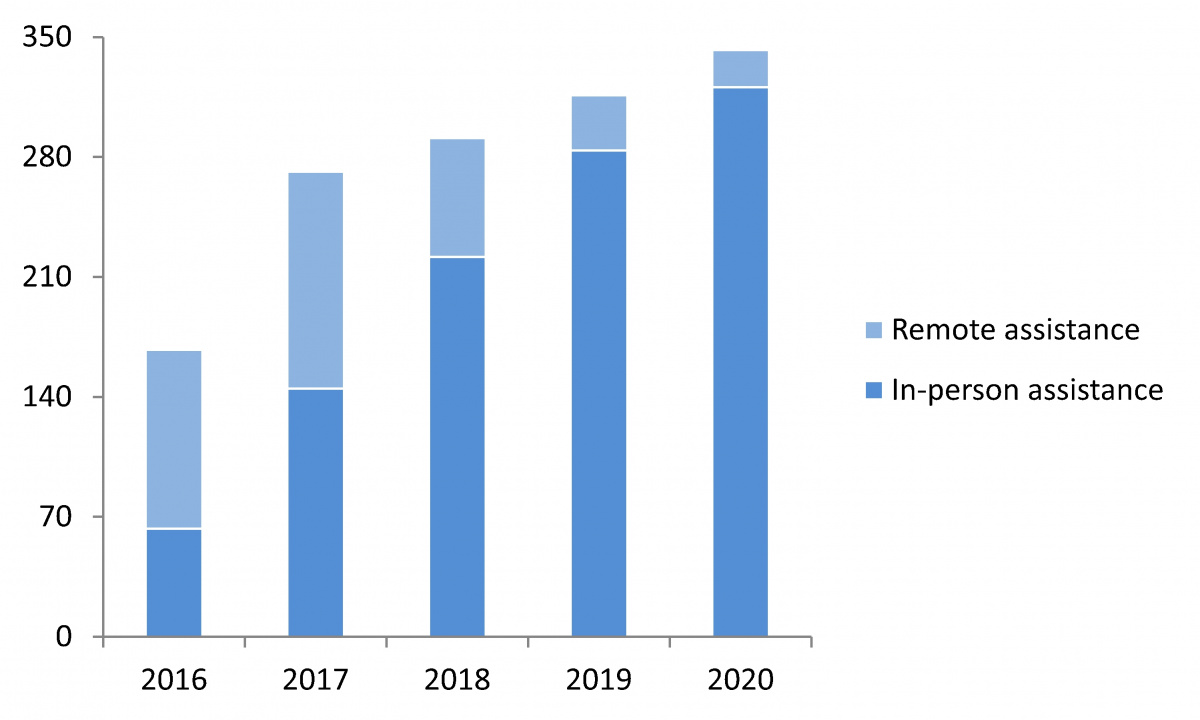
Findings from RBR’s latest study, Branch Transformation 2021, show that there are 340,000 assisted self-service terminals (ASSTs) deployed worldwide, the vast majority of which can be found in China. ASSTs share many features with multi-functional ATMs, the main difference being that certain transactions must be authorised by bank staff. They also typically offer a more complex transaction set than ATMs, making them a compelling alternative to the teller line. For instance, ASSTs in the USA allow customers to specify the bank note denomination when making a withdrawal.
Remote video assistance is common in the USA
While most Chinese ASSTs offered video assistance when they were first introduced, today the majority of the country’s terminals provide an in-person service. This is in response to legislation introduced in 2017 that ID verification must be performed in person, rather than via video. ASSTs in China frequently enable cashless processes, such as account opening and allow branch employees to authorise certain transactions with a tablet. In-person assistance is also the norm in Italy where banks see a benefit in being able to replace the teller line with ASSTs, transforming branches into outlets where staff do not handle cash. This provides an opportunity to redeploy staff to undertake more value-adding activities, such as sales.
The report shows that the USA is the world’s second largest ASST market. Here, it is typical for customers to receive remote video assistance, often from their vehicle in drive-through banking lanes, allowing them to access a wide range of services outside of the core branch opening hours.
Number of assisted self-service terminals worldwide by type, 2016-2020 (thousands)
Source: Branch Transformation 2021 (RBR)
Assisted self-service preserves the human element in banking
There remain some countries where ASST technology is not present, such as Poland and France. RBR found that Polish deployers prefer to limit the number of banking channels rather than overwhelming customers with too much choice. Meanwhile, French banks believe that their customers are already served adequately via a combination of in-branch assistance and telephone banking. In some countries, banks hold back from deploying ASSTs as they are unsure whether demand would be sufficient to justify their relatively high price. This is particularly the case in countries with a strong attachment to face-to-face banking, such as Mexico.
On the whole, however, the reception of ASSTs has been overwhelmingly positive. Emily Beeby, who led RBR’s Branch Transformation 2021 study, noted: “Banks increasingly see ASSTs as the ideal bridge between physical and digital channels, as they encourage greater use of self-service terminals. ASSTs’ strength is that they preserve the human element in banking, which customers continue to value for certain transactions.”
- 08:00 am

The British Business Bank, the UK’s economic development bank, today announces further details of Pay As You Grow, which helps UK smaller businesses that have taken out a Covid-19 emergency Bounce Back Loan to manage their cashflow and have a better chance of getting back to growth.
Originally announced by the Chancellor of the Exchequer in September 2020, Pay As You Grow (PAYG) will enable businesses who have started repaying their Bounce Back Loans to:
- request an extension of their loan term to 10 years from six years, at the same fixed interest rate of 2.5%
- reduce their monthly repayments for six months by paying interest only. This option is available up to three times during the term of their Bounce Back Loan
- take a repayment holiday for up to six months. This option is available once during the term of their Bounce Back Loan.
Borrowers can use these options individually or in combination with each other [1], and remain responsible for repaying their Bounce Back Loan and fully liable for the debt.
Lenders will start to communicate Pay As You Grow (PAYG) options to Bounce Back Loan Scheme borrowers three months before repayments commence. Lenders will inform their customers about PAYG directly, so borrowers should wait until they are contacted by their lender before enquiring about the scheme. Lenders will advise customers about how their payment profiles may change according to their choices under the scheme. Businesses first began to receive BBLS loans in May 2020 and the first repayments will become due from May 2021 onwards.
Richard Bearman, Managing Director, Small Business Lending, British Business Bank, said: “Pay As You Grow will provide tangible benefits to Bounce Back Loan recipients, many of whom may have accessed the Bounce Back Loan Scheme to borrow money for their business for the first time. The scheme offers greater flexibility to businesses who may need flexibility in paying off their Bounce Back Loan and enables them to manage their repayments more effectively.”
Business Secretary Kwasi Kwarteng said: “The comprehensive and generous financial support package we have delivered across the UK has protected jobs, saved businesses and kept local economies on the move.
“While our vaccine rollout is moving at an incredible pace and the end is in sight, we know times are still tough for many companies and extra support is needed.
“These flexible repayment options will give businesses the time they need to recover from the pandemic before paying back loans, giving them the breathing space and confidence to build back better.”
Stephen Pegge, Managing Director of Commercial Finance at UK Finance, said: “The UK’s banking and finance industry is delivering an unprecedented level of support to businesses across the UK to help them navigate the crisis and set them up for recovery. Nearly 1.5 million businesses have received a Bounce Back Loan (BBL) since the scheme launched in May last year.
“As the outlook for many businesses remains challenging, the flexibility of Pay As You Grow will help smaller businesses manage their cash flow and repayments. Lenders will be contacting BBL borrowers in advance of their first payments to outline their options.
“Government-backed loans are just one part of the industry’s wider support for businesses alongside commercial lending, capital repayment holidays, extended overdrafts and asset-based finance – meaning there is a range of help available for any firm that needs it.”
Dr Adam Marshall, Director General of the British Chambers of Commerce, said: “The Bounce Back loan scheme has been an important lifeline for many small businesses during the pandemic.
“With many businesses still facing diminished cashflow, the flexibility provided by Pay As You Grow has a crucial role to play in providing firms who have received a Bounce Back Loan with much-needed headroom to manage their repayments through this continued economic storm.
“Chambers of Commerce across the country will ensure that businesses in their local communities are aware of the Pay As You Grow scheme.”
Chris Wilford, Head of Financial Services Policy, CBI, said: “Pay As You Grow will provide vital support to many businesses who hope to move from survival to recovery mode when the economy gradually reopens.”
“The combination of payment extensions, reductions and holidays gives firms important flexibility as they manage tight cash flows.”
“Businesses have hugely welcomed the Government’s financial support package throughout, with guaranteed loans having provided a lifeline to more than 1.5 million businesses so far.”
FSB National Vice Chair Martin McTague said: “With the first bounce back loan repayments hitting against a backdrop of continued restrictions, it’s critical that small firms are aware of all their options. As such it’s good to see efforts to expand understanding of, and access to, Pay As You Grow plans.
“These should help many small firms to keep debts manageable as they drive our recovery from an incredibly deep recession. Ultimately, bounce back facilities have been made possible by the Government as part of efforts to see us through a national crisis. Lenders must be mindful of this fact, and treat borrowers accordingly over the months ahead.”
The Bounce Back Loan Scheme launched on 4 May 2020. It provides financial support to businesses across the UK that are losing revenue, and seeing their cashflow disrupted, as a result of the Covid-19 pandemic. Since May 2020, the scheme has supported nearly £45bn of loans to 1.5m businesses [2].
Businesses can apply for a loan from £2,000 up to 25% of their business’ turnover, with a fixed interest rate of 2.5% for the duration of the loan, meaning all borrowers benefit from the same, affordable rate of interest. The maximum loan amount is £50,000, and the Government will make a Business Interruption Payment (BIP) to cover the first 12 months of interest payments. The borrower does not have to make any repayments for the first 12 months.
Businesses who have concerns regarding repaying debt should contact their lender, and can find additional links to resources on the British Business Bank’s Finance Hub.
[1] Borrowers should be aware that they will pay more interest overall if they use one or more of these options, and that the length of the loan will increase in line with any repayment holidays taken.
[2] Figures as of 25 January 2021
- 09:00 am
Leading mortgage technology provider, Twenty7Tec, today announces that Reliance Bank has been added to its APPLY module, enabling mortgage intermediaries to submit applications to Reliance from the CloudTwenty7 platform.
APPLY seamlessly and securely connects lender and intermediary systems via a range of sophisticated APIs. Users of APPLY are able to submit either decisions in principle or full mortgage applications to lenders connected to the APPLY system. APPLY streamlines the application submission process by acting as the single point of transmission for all data, documents and communication relating to the application.
Nathan Reilly, Head of Lender Relationships at Twenty7Tec, commented: “Twenty7Tec is committed to working with lenders of all shapes and sizes to deliver on our ambition of making the process of applying for a mortgage simpler, faster and more efficient. We look forward to working with the team at Reliance to help them to deliver the best possible outcomes for intermediaries and their customers.”
Gareth Byrne, Head of Mortgages for Reliance Bank, added: “The roll out of APPLY has been something that Reliance Bank and Twenty7tec have been working on for a while now and I am delighted that we are now officially able to launch this into the intermediary marketplace. The benefits of APPLY will help improve the mortgage broker’s application journey with Reliance Bank whilst still maintaining our high level of personal ownership of applications. This roll out is a further important step in the Bank’s journey in the mortgage intermediary market and further strengthens our ongoing relationship with Twenty7 Tec.”
- 03:00 am

Eighty-five percent of merchants that have adopted a multi-acquiring strategy have seen an improvement in conversion rates, according to a new study by ACI Worldwide (NASDAQ: ACIW), a leading global provider of real-time digital payment software and solutions and Edgar, Dunn & Company, an independent payments consulting firm. The report explores the acquiring strategies adopted by leading global merchants and payment service providers (PSPs) to determine the operational, financial and other benefits derived from a multi-acquiring strategy and an acquirer-agnostic payments gateway.
According to the report, multi-acquiring offers multiple benefits for merchants and PSPs. In addition to increased conversion rates, both merchants and PSPs highlight resilience and a reduction in operational costs as the main benefits. Access to alternative payment methods (APMs) and the ability to support cross-border eCommerce are additional advantages.
The report finds that 57 percent of merchants and 70 percent of PSPs worldwide currently work with multiple acquirers. Forty percent of merchant respondents that use a single acquirer today want to use multiple acquirers in the next 12 months, while 70 percent of PSPs plan to increase the number of acquirers they use within the next 12 months.
“It is clear from our study that the majority of merchants and PSPs globally recognize the benefits from multi-acquiring,” said Benny Tadele, vice president, global merchant solutions, ACI Worldwide. “Merchants working with multiple acquirers express a high level of satisfaction, seeing an improvement in acceptance rates as well as the ability to access a broader range of payment methods. With connections to multiple acquirers, PSPs can tailor their service more precisely to meet the needs of individual merchants. They can provide access to the optimal mix of local and cross-border acquirers, to acquirers best suited to handling transactions of different types, in different verticals, and to those supporting the payment methods most relevant to the merchant’s customer base.”
“This study has found that merchants and PSPs are developing different strategies to address the need to deploy robust payment acceptance solutions,” said Mark Beresford, director, head of the retail practice at Edgar, Dunn & Company. “Payment orchestration that encompasses intelligent routing of payment transactions across geographies for different payment types is now critical for the largest merchants and PSPs.”
Summary of key survey findings for merchants
- The top three reasons why merchants work with more than one acquirer are resilience (21%), to reduce operational costs (18%) and to improve conversion rates (14%).
- 85 percent of merchants that have moved to multiple acquirer relationships have seen an increase in conversion rates, with 23 percent of respondents increasing their conversion rates by more than 10 percent.
- 71 percent of merchants that use a multi-acquiring arrangement are either satisfied or very satisfied with this approach.
- 40 percent of merchant respondents that use a single acquirer wish to swap to a multiple acquiring arrangement in the next 12 months. Reasons given include the desire to gain flexibility and access to APMs (17%), to reduce operational costs (17%) and to build resilience in their acquiring options (15%).
- It is mainly smaller merchants that have single acquiring relationships (30%), primarily due to cost efficiencies or commercial reasons (60%).
Summary of key survey findings for PSPs
- The top reasons PSPs use multiple acquiring relationships are resilience (24%), to reduce operational costs for merchants (21%) and to improve conversion rates (13%).
- 45 percent of PSPs see flexibility as the primary benefit of being acquirer-agnostic.
- 66 percent of PSPs that use a multi-acquiring arrangement are either satisfied or very satisfied with this approach.
For more information, please download the research reports: Multi-Acquiring and the Benefits for Merchants and Multi-Acquiring and the Benefits for PSPs.
- 04:00 am

UK based fintech and issuer payment processor Paymentology, achieves Visa Ready status.
Paymentology, which provides issuer side card processing across four continents and is at the forefront of the card processing space, has been granted Visa Ready certification globally and joins an ecosystem of award-winning technology innovators committed to building tomorrow’s banking technologies. Visa Ready certification allows Paymentology which is a cloud-based payments processor to empower banks to offer tailored products through access to real time data.
Visa Ready certification assures banks and financial institutions globally that third party payment solutions meet Visa’s high security and functional standards.
“The Visa Ready certification further boosts customer confidence in our capabilities. It also enables us to deploy Visa card programs faster for banks around the world. We are of particular appeal to digitising banks who are looking to move away from legacy processors to more economic, more agile and more flexible solutions,” says Shane O’Hara, CEO at Paymentology.
“Visa is delighted to grant Paymentology with Visa Ready certification. Paymentology’s cloud native processing solution, with open API interfacing and live ‘at point of spend’ feed to the banks, makes it easier for digitising banks to migrate away from legacy systems,” said Jonathan Griswold, Head of Partnerships, in Europe at Visa. “We are looking forward to building out the capabilities that we can offer to fintechs and together drive the expansion of a digitally connected payments ecosystem.”
Paymentology is positioned as a cloud-based processor capable of offering dedicated and co-hosted processing across the full retail banking and challenger banking space. Paymentology is the issuer processor of choice by customer-first digital banks, along with other Visa Ready processors leads the drive to provide scalable secure processing for the larger field of digitising retail banks around the world.