
Published
- 02:00 am

Cashflows, the platform that makes it easy for merchants to accept payments, today announces it is strengthening its leadership team with three new hires.
The injection of new talent comes at a time when Cashflows is expanding its solutions to help businesses deliver settlement as fast as possible and maintain a healthy cash flow. Francesco Tirelli joins as Chief Customer Officer and will manage Cashflows’ sales and customer success function.
Additionally, Graham Hiom and Stephen Fowler are joining the team to help boost partnerships as Head of New Business and Head of Account Management respectively. They will work alongside Cashflows’ current Head of Direct Sales, Nick Dobson, who has been instrumental in its growth since his appointment two years ago.
The leadership experience in international payment and fintech businesses of the three new hires complement the technical expertise already present within Cashflows’ team and align with the company’s ethos of customer-centricity.
Francesco Tirelli joins from Boku Identity, where he specialised in payment and fraud solutions and led the creation and delivery of global sales strategies. He has spent over 12 years in the payment industry, including leading successful sales teams at Klarna, Visa and Barclaycard, and as such joins Cashflows with a wealth of relevant knowledge and insight. Francesco will further develop Cashflows’ partnership strategy, which will be underpinned by high quality services such as its recently launched Anytime Settlement capability.
Graham Hiom is joining Cashflows after six years at Elavon as Head of Partnership Management. During the last decade, he has been involved in a number of large scale change programmes involving both the outsourcing of cash management around Europe and value added card payment initiatives at point of sale. Graham brings extensive expertise in developing and implementing industry-leading client services programmes, to Cashflows.
Prior to joining Cashflows, Stephen spent 17 years accruing payments expertise at Barclaycard, Worldpay and Visa, managing large enterprise accounts from planning to launch, including relationship management. He will focus on serving Cashflows’ existing clients as well as exploring new opportunities for growth.
Amanda Mesler, CEO at Cashflows, comments: “We’re growing our leadership team with some of the very best in the field to help us stay ahead of the curve, developing new products and services in line with what our customers will want tomorrow. The needs of our clients are evolving rapidly, and with the aid of Francesco, Graham and Stephen, we’re going to continue to deliver the very best services to help businesses thrive. I’m confident that these are the right people to help Cashflows fulfil our purpose of delivering settlement as fast as possible to help businesses to maintain healthy cash flow.”
- 05:00 am

Leading risk analytics consultancy, 4most, has announced its investment and partnership with innovative fintech, IE Hub, as part of a strategic drive to better serve the millions of people across the country who are currently facing financial difficulty. The collaboration brings together 4most’s extensive risk and analytical expertise and IE Hub’s intelligent platform capabilities, to deliver invaluable benefits to credit providers, while securing the best possible outcome for customers.
IE Hub’s platform is a free online tool, which allows consumers to accurately share their financial situation in three simple steps across multiple organisations from lenders and creditors, to banks, energy suppliers, local councils and more. The app has been designed to save time and alleviate financial anxiety for the customer, while improving accuracy of data for lenders and organisations.
Dylan Jones, CEO at IE Hub explains: “IE Hub allows credit providers to benefit from receiving more accurate data, thereby reducing operational cost, ensuring regulatory compliance and ultimately delivering a friendlier and more effective service to customers. With over nine million people having to borrow more money due to the impact of coronavirus and with the FCA reporting that up to 28 million adults could be vulnerable, engagement methods must be improved to support at-risk customers more effectively. Working together with 4most, we aspire to make life easier for the growing number of people struggling financially in the UK today and to continue to make strides towards achieving our goals.”
Rob McDowell, MD at 4most added, “Helping vulnerable people to gain and secure financial support at a time when they need it most, is a growing issue in our industry. We are delighted to partner with IE Hub and to work alongside the company in its quest to support customers with their data accuracy and in sharing information securely with their lenders. We are also looking forward to using our analytical expertise in risk data and modelling to help IE Hub develop the best solutions and outcomes for customers.”
Links to images are below for media use:
- 01:00 am

Equifax UK, the business and consumer insights expert, has signed an exclusive agreement with UK consumer fintech and payment card app Curve to deliver comprehensive verification and ID solutions to its new personal finance product, Curve Credit. Powered by Open Banking, Curve Credit allows consumers to ‘Go Back in Time’ and pay later via instalments on transactions made with their Curve card.
Rich bureau datasets, as well as leading know your customer (KYC) identity and income verification technology from Equifax, enables robust credit assessments to be carried out while supporting regulatory compliance. The agreement provides Curve Credit with market-specific scores that assess a customer’s credit risk and affordability, helping to make accurate credit decisions at the point of application and allowing new customers to be onboarded quickly.
The partnership gives Curve Credit customers a secure platform, enabling responsible lending and borrowing decisions to be made efficiently, ensuring a seamless user experience.
Gary Brown, Sales Director at Equifax UK, said: "Curve Credit’s unique solution offers customers greater autonomy and flexibility over their personal finance decisions, which is extremely important in the current climate. We’re delighted to be partnering with Curve, providing insightful data and best-in-class technology, to support responsible credit decisions that put consumers in control.”
Paul Harrald, Head of Curve Credit, said: “Curve Credit is focused on empowering consumers to make better financial decisions. Equifax’s world-class data service and technical expertise, combined with their challenger mindset and clear commitment to the Open Banking experience, makes them the best possible partner in this mission.”
This collaboration with Curve sees Equifax which is already a CRA partner to many of the UK’s leading financial services organisations further increase the adoption of its credit services solutions among the UK’s leading fintechs and expands its presence in the online consumer payments space.
For more information about the partnership read our case study here.
- 04:00 am

Fabrick, Italy’s first open banking ecosystem that operates internationally to promote Open Finance, announces the strengthening of its collaboration with Microsoft Italia with the aim of leveraging Cloud Computing and new technologies to continue to develop innovative projects capable of accelerating the digital transformation of the financial world. As part of the partnership, Fabrick’s unique offer will become part of the Microsoft Commercial Marketplace, Microsoft's financial ecosystem that already includes more than 17,000 globally certified apps and services. This collaboration will enable Fabrick to strengthen its presence in the corporate market, both domestically and internationally, allowing for multiple companies across Europe to benefit from the new Open Banking and Open Payment solutions.
The agreement will see Fabrick collaborate with Microsoft Italia to further enhance its approach to financial sector innovation, based on the ability to openly integrate third-party services for the rapid development of digital, personalized and affordable products and services. These services will be centered on the needs of advanced end users and capitalize on the flexibility, scalability and security of the Microsoft Azure cloud platform, as well as the most advanced features of Artificial Intelligence and Integrated Data Analysis.
The Personal Finance Management solution is already available and enables end customers to view and manage their money whether it is in a different bank or bank accounts all from a single app, providing a complete and real-time view of their resources, in line with PSD2 regulations. With this in mind, further Open Finance services will be developed, in order to transfer the benefits and reliability of Azure Cloud to corporate partners. Azure Cloud boasts over 60 Datacenter Regions globally and offers absolute and robust cybersecurity and privacy guarantees with more than 90 compliance standards including GDPR.
Paolo Zaccardi, CEO of Fabrick: “Fabrick is a partner for all those companies that want to pursue innovation projects, while remaining competitive in strategic sectors for their business. In order to do this effectively, we identify market needs and develop a highly modular offer that guarantees the best customer experience. For us, the partnership with Microsoft represents an extraordinary opportunity to grow and strengthen our positioning in the market; we have found a valuable ally who, like us, has seen in technological evolution and Open Finance a new way to innovate the delivery of corporate services for the end user."
Silvia Candiani, CEO of Microsoft Italy: "We are proud of this partnership with Fabrick, a company that is of strategic importance for innovation in the finance world. Fabrick perfectly embodies our thought that 'every organization is a tech company'. This is indeed a very appropriate concept to describe an excellent company that has in its DNA the vocation for innovation as the key to transform the financial services market to enhance openness and sharing. With our Cloud platform we intend to further support the growth journey of this Italian company, helping it to export its innovative solutions abroad. By working as a team, we intend to contribute to the digital transformation of the sector with the aim of helping the many organizations operating in this area to offer increasing value to their customers, allowing them to lead their own financial strategies and to optimize the management of their own resources in safely and securely.”
- 03:00 am

Osu, the payment app for the UK’s self-employed, has today announced the close of a £2.25million seed round, led by early-stage experts Creandum, to fund further growth to reach 10,000 customers this year.
Launched in 2020 by co-founders Noam Nevo, Daniel Scott and Alon Zion, Osu is transforming the way the self-employed accept and manage their payments through its seamless and intuitive app.
Allowing users to accept instant payments from their customers with zero transaction fees, Osu removes the traditional pain points many self-employed individuals experience when getting paid, such as high fees, settlement delays, hidden costs, error-prone bank transfers and late customer payments.
With more than four million self-employed professionals in the UK – almost half of which (47 per cent) operate entirely alone and cite chasing payments as one of their biggest daily frustrations (49 per cent)[1] – Osu spotted a gap in the market for a payment support app that could simplify the day-to-day hassle of getting paid by customers and eliminate transaction fees.
Unlike traditional payment solutions, users can sign up to Osu and get started within two minutes. Users send a payment request by entering their customer's name, phone number, and the amount owed. The customer receives an SMS and pays by clicking a link, selecting their bank, and then approving the payment instantly within their own banking app.
Since launching, Osu has worked with more than 1,000 self-employed professionals, helping them accept hundreds of thousands of pounds worth of payments.
Noam Nevo, co-founder and CEO of Osu, said: “We know from speaking to our users that one of the biggest challenges they face is the ability to manage their payment-related admin tasks effectively and efficiently, whilst also growing their services and attracting more customers. At a time when the self-employed are already taking a hit due to the pandemic, reducing the cost of getting paid and making the process much faster is becoming increasingly important."
“This is where Osu comes in. The app is designed to be the payment PA that the self-employed simply can’t afford to hire – automating tasks such as sending invoices, accepting payments, chasing customers and staying on top of it all. What’s more, we charge no transaction fees meaning Osu users get 100% of every sale they make, and everything is done instantly meaning they aren’t left waiting several days to receive their money.”
Initially focusing on payments and invoicing, Osu will be introducing a host of new business management features over the coming months to further simplify operations for the self-employed – including direct communication with customers, calendar integrations, booking and scheduling, and the creation of mini-sites to help users generate an online presence.
The latest round of funding was led by early-stage specialists Creandum, alongside Ada Ventures, Breega, Firstime, Amelia and Ulysses. Osu has also received backing from a series of prolific Angel investors including Charles Delingpole of ComplyAdvantage, Will Neale of Grabyo and Michael Pennington of Gumtree.
Johann Brenner, Creandum, said: “At Creandum, we like to see companies that are not forcing merchants to radically use a different infrastructure but facilitate more, easier, and faster business and hence becoming an obvious choice for customers. Open banking will enable payment disruption for small merchants much like we saw iZettle do that. With Osu, we have found the Swiss Army knife for sole traders and couldn’t be more excited to support the team on their journey to become the No. 1 payment app for the self-employed.”
Check Warner, Partner Ada Ventures, said: “At Ada, we invest in groundbreaking companies tackling overlooked groups. The self-employed have long been overlooked, despite the fact that there are four million of them in the UK alone. Osu’s technology is built specifically for them, helping them take payments, interact with customers and manage their businesses through their phones. We’re pleased to be backing Osu to deepen their product and help more business owners across the UK and beyond.”
Charles Delingpole, founder and CEO of ComplyAdvantage, said: “Payments technology for many pandemic-afflicted sole traders has been in the dark ages for too long. The Osu platform promises to revolutionise how the back-bone of the economy transact, account for and manage their critical expenses and cash-flow. Osu has built a fantastic product and team and this fundraise will accelerate this growth and ensure their continued success.”
Will Neale, founder of Grabyo, said: "I was impressed with Osu from the outset. Its technology is providing a unique solution to a lot of time consuming and frustrating issues surrounding payment transactions that thousands of self-employed individuals have to navigate every day. The brand also has a clear roadmap for developing other business management solutions that will, no doubt, also prove invaluable to solo business leaders."
The investment will be used to further Osu’s growth and support the development of new product features and services, activate a series of digital and offline marketing campaigns and bolster the Osu team with new hires.
- 01:00 am

LOWES, the leading UK independent financial adviser that champions retail structured financial products, has collaborated with Mariana Capital in conceiving and launching the latest in the series of 8:8 Plans.
Following Investec’s recent withdrawal from the UK Retail Structured Products sector, Lowes Structured Investment Centre, has turned to Mariana Capital for the latest innovative 8:8 Plan utilising Morgan Stanley as counterparty.
The 8:8 Plan April 2021 is a maximum eight-year investment constructed to offer a potential return of 3.25% for each six-month period it runs, with the possibility of early maturity and the full repayment of the initial capital from the end of the Plan’s second year and semi-annually thereafter.
The launch follows the successful maturity of the Investec/Lowes 8:8 Plan Issue 1 on March 8, 2021, which gave investors a gain of 22.5% plus the original capital - this despite the FTSE 100 being down almost 7% over three years.
Applications to invest need to be made before April 23 with the Strike Date of the Plan being April 30, 2021.
Ian Lowes, MD of Lowes, said: “I believe structured products are one of the best kept secrets of the retail financial planning universe. Most people should know about these innovative investment solutions but they’re simply not on their radars. The results have been very impressive - the Investec/Lowes 8:8 Plan Issue one was the 1,001st investment of its type to mature for UK retail investors – all but 8 of those produced attractive gains."
“When Investec announced their withdrawal from the UK structured product market we worked with Mariana Capital to create a new 8:8 Plan. This is potentially ideal for those investors that want to reinvest some, or all their 8:8 maturity proceeds. This could also be a fantastic investment opportunity for other investors who are completely new to the sector.”
The new 8:8 Plan utilises the new FTSE CSDI Index, created specifically for structured products by FTSE Russell, the same organisation that calculates and publishes the FTSE 100 Index. The performance of the CSDI very closely correlates with the FTSE 100, tracking the same shares and the returns that can currently be offered on structured products linked to the CSDI can offer comparatively higher potential.
Some key features of the new 8:8 Plan are:
- Investment start date: April 30, 2021
- First possible maturity on 2nd anniversary and every six months thereafter
- Early maturity triggered by the index being above the initial index level on any of the first four observations or, no more than 8% below the initial index level from the 4th anniversary onwards.
- 13% gain (6.5% per year) payable if maturity triggered on 2nd anniversary
- 3.25% more (not compounded) for each further six months. i.e., maturity at three years & six months pays 22.75%
- 8-year maximum term
- Capital at risk barrier: 65% of the April 30, 2021 FTSE CSDI level
- Capital at risk barrier observation date: April 30, 2029 (only if not matured sooner)
- Minimum investment £5,000
- Counterparty: Morgan Stanley International: ‘A’ (Strong) rated by major credit rating agencies
- Investment method: ISA / ISA transfer, Individual, Joint, SIPP, Trust, Corporate, Partnership
- Individual / Joint gains taxable only if annual gains from all sources exceed £12,300*
- Can be surrendered from month one (but penalties and loss will result)
- Can be bequeathed, transferred under probate, or gifted mid-term.
Lowes has played a significant role in helping to shape the UK retail structured product sector by championing good product development and governance with a focus on investor outcomes for more than 20 years.
- 04:00 am

Organised crime is the biggest compliance-related fear facing firms, but almost half of organisations do not have a fully integrated client monitoring solution as part of their risk management process, according to a new survey by NorthRow.
Effective client monitoring is a key priority in the compliance processes of all organisations, particularly those in regulated business within the banking, financial services and property sectors. Over the past year the pandemic has led many firms to expedite their digital transformation, bringing forward the need for online transaction-based activity rather than in-person face-to-face.
More than 80% of organisations are actively monitoring their client portfolio, according to a survey of 400 attendees, including compliance professionals from banks and financial services firms, to a recent webinar* hosted by compliance solution provider NorthRow. This active ‘Know Your Customer’ monitoring helps firms to comply with regulations and avoid becoming involved in corruption, terrorist financing, and money laundering.
When asked how well client monitoring is integrated into their organisation’s risk processes, only 29% said that monitoring is fully integrated into their CRM, while 31% said it is part of their risk dashboard. 40% said that they use a standalone or point solution for client monitoring, or that they it is not integrated into overall risk processes at all.
More than a third of respondents (35%) said that organised crime is the biggest compliance threat on their radar, while 26% cited regulatory divergence as their number one concern.
Adam Holden, NorthRow CEO, said: “Over the customer lifecycle, there will be continuous changes in your customers’ risk profile, for example, company structures, beneficial ownerships, directorships and more importantly, their financial stability. The pandemic has added to the frequency of these changes at unparalleled speed, including an increase in insolvencies and money laundering activities.
“While it is encouraging that the majority of organisations are actively monitoring their clients, the findings that less than a third of firms have monitoring fully integrated into their CRM is a surprise. The right digital solution, tailored to the individual requirements of a business, enables ongoing monitoring and reduces the risks presented by cumbersome manual systems.”
The benefits of client monitoring are not limited to fighting organised crime and meeting regulatory requirements. Almost half of survey respondents (45%) said monitoring is important for client retention, while a quarter (24%) said that it aids cross-selling.
- 01:00 am
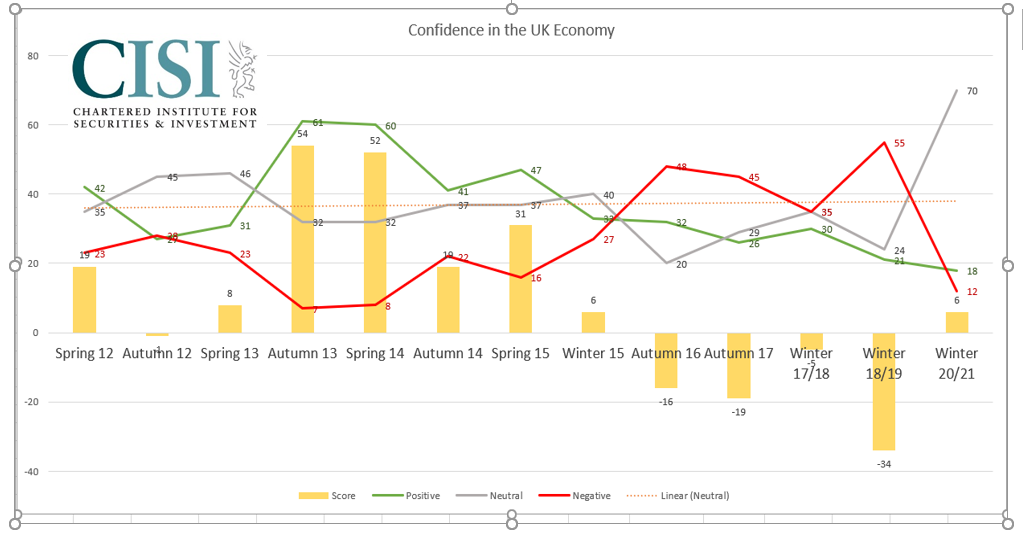
The CISI confidence indicator (the sum of positives less the sum of negatives) is 6, reflecting the same level of positivity recorded for the same survey during winter 2015. The poll has been conducted on average every six-12 months since spring 2012.
Positive respondents’ comments included:
- “Being ahead on vaccines feels like it will provide an economic advantage.”
- “Things are going to take off. Although China has moved into dominant position. Britain has done well through the vaccine distribution but only time will tell regarding the merits of Brexit. Short term it will do well especially as we are not at negative rates like the EU. “
- “If the EU doesn’t knock out London as the financial capital, I think the U.K. could enjoy some enduring growth in 2022-23 and beyond.”
- “A Brexit deal with Europe and our vaccination programme set us up very favourably now to go out into the world and promote our skills as a nation. Need to invest in education and infrastructure, especially [energy] power.”
Negative comments included:
- “Leaving the EU was a ridiculous move that will cause tremendous damage to the Brits. It would have been smarter to go to the EU leadership with 51% support to reduce EU fees, as the EU leadership does drain countries financially with little benefit.”
- “I feel there is an element of make-believe propping up the markets temporarily. Structurally the economy (and not just the UK economy) is severely strained. The next few years are going to be very difficult.”
- “Ballooning public and private debt, falling incomes, rising unemployment, end of furlough, end of property market stamp duty relief, increased post-Brexit export costs, oh, and an on-going pandemic.”
Simon Culhane, Chartered FCSI, CISI CEO said: “The result of our survey matches the recently reported GfK UK consumer confidence index, which showed the highest level since before the first March 2020 lockdown -16 points, the largest monthly jump in almost a decade. Our survey outcome is also in line with the latest IPSOS MORI poll, which reported that economic confidence is the highest since 2015. A deal with Europe on equivalence would provide greater confidence and help to embed the promising recovery.”
- 02:00 am

The Board of Managing Directors of Commerzbank AG has decided to postpone the Annual General Meeting (AGM) originally planned for 5 May 2021. The postponement is due to the ongoing restaffing on the Supervisory Board. The company aims to hold the AGM in short term and publish the necessary election proposals with the invitation.
The Supervisory Board swiftly pushes ahead with the restaffing. There are two positions to be filled. On 16 March, the Chairman of the Supervisory Board, Hans-Jörg Vetter, resigned his mandate for health reasons. In addition, Supervisory Board member Andreas Schmitz resigned his mandate yesterday evening with immediate effect.
Despite the postponement of the AGM, the Board of Managing Directors continues to consistently implement the new strategy and maintains the targeted schedule for the conclusion of the necessary framework agreements for the planned reduction of staff.
- 06:00 am

Today, Creditinfo Group – the leading global credit information and decision analytics provider – announced that is has increased its stake in JSC “Kredītinformācijas Birojs” (KIB) to 51%, becoming the majority shareholder.
Earlier this month, the US private equity fund Levine Leichtman Capital Partners (LLCP) became the majority shareholder of Creditinfo Group. As the result of that transaction, the share capital of the KIB joint stock company was increased, with ABLV Bank selling its shares.
The other shareholders of the company, including the leading Latvian commercial banks; AS Swedbank, AS SEB banka, AS Luminor Bank, and AS Citadele banka will remain unchanged and will continue to support KIB by serving on the Supervisory Board of the joint stock company.
Jānis Timmermanis, Chairman of the Board of KIB: “This investment is an important confirmation of the company’s potential to continue to grow despite being a relatively young entity and offer lenders throughout the Baltic region modern solutions with scoring and decision capabilities while also enabling prevention of money laundering.”
Brynja Baldursdóttir, Director of Global Markets, Creditinfo Nordics: “This announcement marks a significant milestone for Creditinfo and consolidates our presence in the Baltics as a leader in providing Decision-as-a-service solutions – a key component of the Credit Bureau system. With international knowledge and local market support, Creditinfo solutions are setting a high bar wherever they are implemented.”
KIB was founded in May 2013 and is the first licensed credit information bureau in Latvia. KIB helps banks and financial institutions to manage credit risk and apply best practices in risk management and credit operations. Its activities in the field of data processing are licensed and supervised by the State Data Inspectorate.








