
Published
- 07:00 am
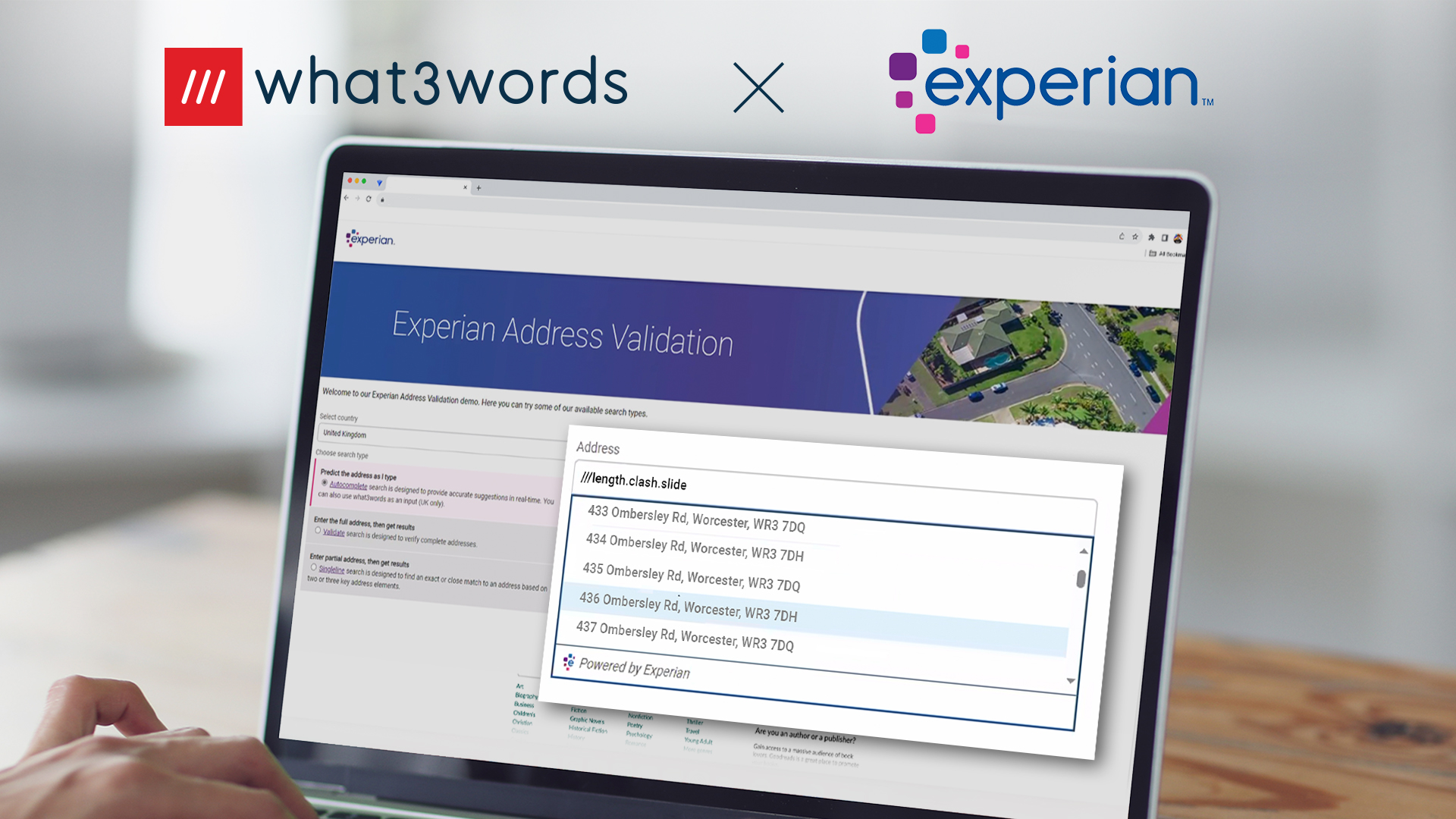
Experian, the world’s leading global information services company, has today announced its partnership with what3words.
Experian’s flagship address validation solution helps businesses worldwide to achieve trusted data and build a more detailed view of customers by validating, formatting and enriching addresses in real time at checkout. Favoured by clients such as New Look, DFS and Yodel, the solution increases delivery success, boosts return on marketing investment, and streamlines check out experiences.
Customers also now have the option to supplement their exact delivery location by typing their what3words address into the search field. This helps retailers and logistics companies with precise location insight from their customers for quick and efficient delivery, even in difficult to find locations.
According to Experian’s Global Data Management Research Report (2022), 85% of organisations indicate that poor quality data for customers negatively impacts their operational processes and efficiency. Some 89% of businesses say that contact data has become more important than ever to reach their customers.
what3words has divided the world into a grid of 3m x 3m squares, and given each square a unique combination of three random words, known as a what3words address. Now, every apartment building entrance, tucked-away side passage and unaddressed new build entrance has its own what3words address. For example, ///filled.count.soap will take you to the precise entrance of what3words’ London HQ. The what3words app is free to download for iOS and Android, and use via the online map.
Co-Founder and CEO of what3words, Chris Sheldrick comments on the partnership: “There is a huge opportunity to improve the delivery experience with more accurate and easy-to-use location information, and our partnership with Experian will do just that. Together, we're enabling retailers to capture valid address and precise location information, enhancing business operations and customer satisfaction.”
Andrew Abraham, Managing Director, Experian Global Data Quality, said: “Inaccurate address and location information can cause serious disruption to both businesses and their customers.
“We recognise the importance of location accuracy for frictionless customer experiences, and partnering with what3words further helps our clients to achieve this. This collaboration gives our customers the exact address and the location information they need in a single, intuitive solution, enabling them to streamline their operations and deliver to the right front door every time.”
- 06:00 am

The Fintech and Payments Advisory Network (TFPA) announce the next stride in its ambitious growth journey with the appointment of a heavy weight executive team.
Gregor Dobbie, ex-CEO of Vocalink (a Mastercard company) who left the business just 12 months ago, becomes the new CEO of TFPA and will lead the organisation in the delivery of its transformative vision. Roger Bracken, founder partner, is promoted to Executive Chair and Steve Wright, previous founder partner, will become Chief Operating Officer.
Gregor has extensive experience from his time at Vocalink including responsibility for UK critical infrastructure and leading projects to deploy real time payment technology globally. Gregor was part of the Management Team leading the sale of Vocalink to Mastercard in 2017. Prior to Vocalink, Gregor held senior positions at Glory, Talaris and De La Rue.
Commenting on his appointment Gregor says: “From firsthand experience I can testify that the advisory market in the Fintech sector is underserved. There are not enough practitioners who have the skills to support CEOs with running complex organisations in a highly regulated market and that’s a big reason why we see so many Fintechs fail. This is a gap that we fill and we have done this by attracting an incredible team of leaders to join TFPA.
“We have all had our fingers burnt in the past with advisors, so we are not about landing expensive consultancy projects and churning out recommendations that came from interviewing the people within the businesses we represent. Our refreshing approach is about de-coding, conceptualising but then crucially delivering strategy alongside the business leaders.”
TFPA is a disruptive advisory firm focused on providing practical commercialisation guidance to fintech firms of all sizes. The network comprises a seasoned group of six partners and over 30 associates, with capability in a wide range of subject matters including all aspects of card payments, account to account payments, open banking, immediate payments and fintech related regulatory issues. TFPA goes one step further than many traditional advisory firms in actively helping organisations execute within the marketplace on recommendations provided. TFPA also provide specialist knowledge of industry verticals.
Speaking about the appointment of Gregor to CEO of the TFPA, Roger Bracken the Executive Chair commented: “Having Gregor as our CEO means with his incredible vision and industry network, we are able to build on the solid principles of delivering pragmatic advice to our clients and drive significant global, growth, moving towards our vision of being the leading trusted advisor in our space.
“Gregor is very focused on extending and developing TFPA Associate network which has already seen an increase of nearly 300% in the past six months with many elite industry leaders being attracted to the organisation. This network provides TFPA with constantly increasing capacity, capability and geographical coverage, and our clients with an unparalleled body of knowledge and experience.”
Gregor added: “The US is a key strategic market for TFPA, reflected by the new US based associates added to the network. We also see strong parallels in our offer and the themes of this year’s Money20/20. We firmly align with the theme of ‘Age of Fundamentals’ as the fintech sector resets itself from the heady valuation days. As such, effective distribution, value proposition articulation and the ability to differentiate become more critical than ever, directly in line with TFPA services.”
In addition to TFPA responsibilities, Gregor is also the Executive Chairman of the digital loyalty provider Loyalzoo and a board member of Onebanx.
One client being assisted by TFPA in their transition to becoming a more market led solution provider is Ciklum, a custom product & software engineering organisation. Mike Hopewell, Ciklum Chief Sales & Marketing Officer said “TFPA have provided us with invaluable insight around our commercial strategies and market positioning enabling us to move up the value chain with our clients. We look forward to continuing this partnership with TFPA and maximising our potential”.
Of the other key appointments, Roger Bracken has held leadership positions in several international payments technology businesses; NCR, First Data and software with embedded payments scale-up, TSG. He is currently a Special Advisor at Vitruvian Partners, an investment firm, as well as advising several tech scale-up CEOs. He is chair of an early stage fintech company, WyzePay.
Steve Wright has a long record of sales leadership in payments technology, having led divisions at Xerox, ACI, Fujitsu and NCR. Steve has spent the last decade shaping payments start-ups and scale-ups, including Lusis and Alaric.
- 09:00 am

Jumio, the leading provider of automated, end-to-end identity verification, risk assessment and compliance solutions, today unveiled at Money20/20 USA Jumio 360° Fraud Analytics, its new fraud-fighting technology that uses AI-driven predictive analytics to identify fraud patterns with more sophistication and accuracy than ever before.
According to Jumio’s analysis, 25% of fraud is interconnected — either perpetrated by fraud rings or by individuals using the same information or credentials to open new accounts on banking sites, ecommerce platforms, sharing economy sites and more. A single organized crime operation or fraud ring can cause damage into the hundreds of millions of dollars. And with rapidly evolving AI at their disposal, fraudsters are becoming more sophisticated than ever before, leaving businesses scrambling to stay ahead.
Jumio 360° Fraud Analytics tackles this problem with a whole new approach to stopping fraud. It looks beyond simple linkages, such as flagging someone because they are connected to a known fraudster. Instead, it looks at billions of data points across Jumio’s cross-industry network to identify patterns based on behavioral similarities and other indicators. Using graph database technology with a layer of machine learning, it groups identity transactions into clusters across the network and determines the fraud risk of each cluster. This provides a multi-dimensional view of each transaction and the cross-customer ecosystem as a whole.
“Jumio revolutionized online identity verification when it pioneered the ID + selfie approach,” said Robert Prigge, Jumio CEO. “Today we are pushing the industry to evolve once again by harnessing the power of predictive analytics to identify fraud patterns across our vast network. This will allow us to identify and stop fraud rings and other coordinated attacks with more accuracy than ever before.”
Today, when a user goes through the ID verification process, Jumio performs a wide variety of advanced fraud checks. With the addition of Jumio 360° Fraud Analytics, the identity transaction will also be compared to the clusters and generate a predictive fraud score that can be used to automatically reject the transaction if it exceeds a certain threshold. Jumio’s initial studies show that this approach improves its existing, highly accurate fraud detection rate by at least 30% — without increasing the false rejection rate. Business users can audit the reasons behind the decision in the Jumio Portal or via APIs.
“Because explainability is a key requirement when using automation, we provide insights on why the identity transaction was rejected,” said Philipp Pointner, Jumio chief of digital identity. “We also provide a graphical representation of the high-level linkages we found, which makes it easy to see connections between people, documents, devices and more. The combination of sophisticated analytics and easily consumable insights makes this new technology a game-changer for fighting fraud.”
Key features include:
Graph database technology and machine learning classify identity transactions into clusters based on behavioral similarities, which is especially powerful for identifying fraud rings
AI-driven predictive analytics determine the likelihood of fraud risk for each identity transaction based on its cluster association
The predictive fraud score can be used to automatically reject identity transactions, stopping fraudsters from accessing your platform in real time
Dashboards provide transparency and help you visualize connected data
Jumio 360° Fraud Analytics is currently available in early release to select customers and will be generally available in early 2024.
To learn more, visit Jumio at Money20/20 USA, booth #5001. To schedule a meeting, click here.
- 06:00 am

The private market investment landscape is rapidly evolving, with new platforms and technologies driving change. These platforms play a crucial role in helping businesses and investors make informed decisions. Here, we explore five platforms that are at the forefront of shaping private market investment strategies.
Oxane Partners: Oxane Partners is a specialized financial services and technology firm that focuses on private markets. They offer a comprehensive suite of services, including technology platforms and advisory services, to help clients manage investments, valuations, and data analytics. Oxane Partners has evolved from a transaction advisory firm to a comprehensive private market solutions provider.
KPMG: KPMG is one of the Big Four accounting firms, offering a wide range of services to businesses worldwide. When it comes to private market investment strategies, KPMG provides invaluable insights, advisory services, and due diligence to help clients navigate the complex landscape. They offer a holistic approach to private markets, integrating their expertise in auditing, tax, and advisory services.
EY: Ernst & Young (EY) is another major player in the professional services industry. EY helps clients with their private market investments by providing comprehensive services like market analysis, risk management, and transaction support. EY leverages its extensive global network and cutting-edge technologies to enable clients to make data-driven investment decisions, ensuring that they stay competitive in the dynamic private market environment.
CAPCO: Capco is a leading management and technology consulting firm, specializing in financial services. For private market investment strategies, Capco brings its extensive experience in digital transformation, regulatory compliance, and risk management. By integrating technology and strategy,
FRACTAL: Fractal Analytics is a data analytics company that provides AI-driven solutions to clients across various industries, including finance. In the context of private market investments, Fractal leverages artificial intelligence, machine learning, and predictive analytics to help clients make informed decisions. Their advanced analytics and modeling capabilities allow clients to uncover hidden insights and trends within their investment portfolios, thereby optimizing their strategies and increasing returns.
In summary, these platforms, including KPMG, EY, Capco, Fractal, and Oxane Partners, are playing a pivotal role in shaping private market investment strategies. They provide a wide range of services, from advisory and due diligence to advanced analytics and technology solutions. These platforms empower clients to stay competitive and make informed decisions in an ever-changing private market landscape, ensuring that they can achieve their investment goals successfully.
- 09:00 am

PaySprint, a leading innovator in the digital finance sector, is proud to introduce its revolutionary product, the PaySprint Quick Dhan API. In an era of digitalization, where financial access and convenience are paramount, PaySprint's new API is set to bridge the urban-rural financial divide and bring banking services to the fingertips of all individuals.
The adoption of the Unified Payments Interface (UPI) in India has seen significant growth over the last decade, providing access to banking and financial services for countless individuals. In the first half of 2023, the volume of UPI transactions in India increased by a remarkable 62% compared to the same period in the previous year. Notably, in September, the National Payments Corporation of India (NPCI) reported that the volume of UPI transactions crossed 10.5 billion. This widespread adoption has created a demand for innovative solutions harnessing this technology, and that's precisely where PaySprint's UPI Cashout API, known as Quick Dhan API, comes into play.
The PaySprint Quick Dhan API is a one-stop solution that empowers people to access cash seamlessly, effectively bridging the urban-rural financial divide and ensuring that banking services are accessible to everyone.
Addressing Rural and Urban Needs
As the adoption of UPI and digital payment methods continues to grow across India, it's crucial to ensure that even remote and rural areas have access to essential banking services. PaySprint's Quick Dhan API was introduced with this mission in mind, designed to bridge the financial accessibility gap between urban and rural communities.
S. Anand, Founder and CEO of PaySprint, shared, "PaySprint's Quick Dhan API is a visionary leap towards democratising finance in the digital era. With this revolutionary solution, we endeavor to bridge the urban-rural access gap, placing financial empowerment within reach for all, anytime, anywhere."
Goals of PaySprint Quick Dhan API
With PaySprint's Quick Dhan API, the goals are clear and customer-centric:
- Withdraw cash without visiting a physical bank, making banking accessible in even the most remote areas
- Access cash anytime, anywhere, 24x7x365, ensuring you're never left without cash, whether it's day or night, weekends, or holidays
Specifications of PaySprint Quick Dhan API
PaySprint's Quick Dhan API is designed to be safe, secure, and instant, offering key specifications:
- Safe and Secure: UPI is a trusted and secure method of transferring money between two parties, ensuring the safety of transactions
- QR Code Convenience: Users can visit a merchant outlet and withdraw the desired amount by simply scanning a QR code, making it an intuitive and user-friendly process
How PaySprint’s Quick Dhan API Works
- Users visit a merchant outlet to initiate the cash withdrawal process
- Users choose the desired amount they wish to withdraw
- A single-use QR code is displayed on the screen, ready for scanning
- Users take out their smartphones, open any UPI app, and scan the QR code displayed on the screen
- After scanning the QR code, users input their UPI PIN on the app for authentication
- Once the PIN is confirmed, the merchant provides the requested cash amount to the user
The entire process is seamless, ensuring users receive their cash quickly and conveniently. With PaySprint's UPI Cash Withdrawal, accessing cash has never been easier, eliminating the hassle of physical cards.
In conclusion, PaySprint's Quick Dhan API is a game-changer, making quick and convenient access to cash a reality. By addressing the needs of both urban and rural communities, PaySprint aims to make cash and basic banking facilities accessible to everyone. Simply scan a QR code and enjoy immediate access to your money.
- 01:00 am

Consumers are looking to new tools and brands to access credit and other financial services, according to a new survey published today by Marqeta, the global modern card issuing platform that enables some of the world’s most innovative embedded finance use cases. The company released its 2023 State of Credit report which surveyed 3,000 consumers globally – including 1,000 in the United Kingdom – highlighting that 38% of UK respondents have used Buy Now, Pay Later (BNPL) services to make ends meet during the last 12 months, increasing to 61% amongst 26-34 year olds.
Consumers are interested in using BNPL to build out their credit profile
Over the last 12 months, consumers have been increasingly reliant on credit, with 53% of U.K. respondents reporting that they are now routinely using credit cards to make ends meet. Exacerbated by the current economic situation, respondents also reported concerns with traditional credit options due to inflation or the increased cost of living making it harder to make minimum monthly payments on their credit cards (46%). They also reported accessibility issues, and 46% of UK respondents who have applied for a credit card in the past 12 months had their applications denied.
As a result, consumers are turning to new credit options and, according to Marqeta’s report, they are using BNPL services as a tool to help build credit and secure access to additional credit services. Nearly half of UK respondents (47%) reported that they are looking to build a credit history or improve their credit score and 61% of them confirmed they were interested in using BNPL to further improve credit scores and eventually get a credit card. Forty percent of consumers are very interested or somewhat interested in being offered the opportunity to use BNPL services by their current credit card provider, where they would be able to pay back a purchase over time for a small fee, rather than being charged interest.
Amongst BNPL users, the most popular feature was lack of interest fees, and 47% of people who had used BNPL services in the last 12 months said they chose to use these services due to zero interest being charged. Other reasons for why consumers chose to use BNPL included convenience (46%), flexibility (42%) and help with budgeting (45%). Interestingly, 15% of consumers surveyed chose to use it because they had no other access to credit.
“BNPL appeared on the market as a strong challenger to the credit card giants, and was even termed a ‘credit card killer’, said Todd Pollak, Chief Revenue Officer at Marqeta. “However, during this period of economic uncertainty, consumers are becoming more savvy about the different ways to access credit and are doing so in the ways that best suit them. As a result we are seeing both pressure for traditional credit providers to offer more flexible credit services, and consumers using BNPL to access and build credit, sustain a good credit score and get access to credit cards.”
When using BNPL, consumers spend in similar patterns to how they use a credit card, and for both payment methods, the majority of people reported purchasing items that have an average cost of between £51-£100 (31% for BNPL, 35% for credit cards).
Consumers are looking to brands for embedded credit card services
UK consumers are becoming more reliant on their favourite brands to provide credit products with 31% of respondents looking for a recognisable brand they trust when choosing to apply for a new credit card, compared to 21% of US respondents.
Nearly one-in-four UK respondents (24%) own a credit card affiliated with a brand (e.g. British Airways or Tesco credit card), and 54% consider themselves a customer of the brand or store, instead of the bank that provides the physical card, and 47% consider the brand to be responsible for customer service.
The report shows that payment cards and credit cards are the gateway to additional financial products, with 25% of respondents reporting that they have more than one financial product from their credit card provider and 42% confirming they had a credit card first and added additional financial products over time.
“Payment cards in general, and credit cards in particular have become the new front door to the banking industry,” said Pollak. “Brands and banks can offer these to deepen their relationship with customers and increase revenue. Going forward, we are likely to increasingly see integration of financial services into non- financial products, giving consumers more seamless access to credit and the embedded finance experiences they require.”
To download the full report, please click here.
- 03:00 am

Tokyo Stock Exchange, Inc. and global Fintech leader, Broadridge Financial Solutions, Inc. are pleased to announce the launch of the direct connection between CONNEQTOR, TSE’s platform for trading exchange traded funds (ETFs) and Xilix, Broadridge’s execution management system (EMS). This direct connection will enable asset management companies, such as Sumitomo Mitsui DS Asset Management Co., Ltd., to use CONNEQTOR directly from Xilix, providing more advanced and efficient processes.
“CONNEQTOR was developed as a platform to enable investors to trade ETFs ‘faster and better priced’ and this launch of a direct connection with Xilix, Broadridge’s EMS, will allow institutional investors to trade with even greater convenience,” said Hiroki Kawai, Senior Executive Officer, TSE. “We will continue our efforts to further develop an even more highly convenient market environment that enables smoother execution and better pricing for investors.”
“We are thrilled to strengthen our partnership with Tokyo Stock Exchange and jointly deliver our Xilix platform for trading ETFs using CONNEQTOR,” said Raymond Tierney, President, Broadridge Trading and Connectivity Solutions. “In today's complex global markets, businesses require solutions that enable automated workflow, capture growth opportunities, integrate seamlessly with internal and external systems, meet regulatory obligations, and streamline operations and we will continue our efforts to solve the issues faced by institutional investors.”
Broadridge’s EMS solution empowers firms to navigate these challenges successfully by allowing Request For Quote (RFQ) functionality that enables institutional investors who want to trade a particular ETF at a particular quantity to send out a request for a quote to a large number of market makers.
- 01:00 am

Fintech Hub LT, the largest association of licensed Fintech companies in Lithuania, will be headed by Ms Greta Ranonyte. She replaced Vaiva Amule, who had led the association for almost three years.
Before this position Ms Ranonyte worked at the Ministry of Finance of the Republic of Lithuania as an advisor to the credit and payment markets division of the financial market policy department. She was also responsible for drafting the national Fintech strategy of Lithuania for 2023-2028.
According to Asta Grigaityte, chairwoman of the board of Fintech Hub LT, Ms Ranonyte's experience will further strengthen the importance of the association and the fintech sector in Lithuania.
"We greatly appreciate the fact that Greta Ranonyte has joined us with her wealth of professional experience. Our association is the axis that connects the ecosystem. I am confident that Ms Ranonyte's knowledge in drafting the latest Lithuanian fintech guidelines and her overall professional experience will help the association's members, the Bank of Lithuania and government representatives to more quickly achieve the goals set for the sector: becoming a globally recognised high-value added European fintech hub. Greta Ranonyte is well known in the fintech community and has an excellent understanding of what is happening in the fintech sector and what is needed for the market to continue to grow successfully," said Ms Grigaityte.
"I am delighted to have taken on the role of Head of the association. My goal is to strengthen the ecosystem by focusing on the needs and challenges our members face, thus contributing to the goal of qualitative development of the sector set out in the national Fintech strategy. We also plan to expand the association's activities by attracting new members, thus maintaining our role as the leading fintech association in the Baltic states," says Ms Ranonyte.
The association was established in 2017 and currently brings together 62 licensed fintech companies, as well as 20 unlicensed players in the fintech ecosystem. The association's members include well-known companies such as Vinted, Paysera, SumUp, Nium, Nuvei and Curve.
- 07:00 am

Viva.com, a leading European cloud-based neobank, today launches two new product features designed to simplify business operations across the continent.
The first new feature, Real-Time Settlement, allows the Viva.com merchant community near-instant access to funds. Transactions are now settled in up to 60 minutes, compared to the previous next-day settlement scheme.
The second new feature, Offline Payments, ensures that Viva.com merchants minimise chances of losing a sale resulting from network connectivity issues or disruptions. Offline Payments automatically allows card-present transaction acceptance, even if a merchant is unable to connect to a network at the point of sale.
Viva.com's payment solutions empower businesses of all sizes with innovative tools to streamline operations and boost sales. The viva.com | Terminal app transforms smart devices into card terminals, while the viva.com | Smart Checkout payment gateway increases conversion rates by up to 21%; both featuring over 30 payment methods. From freelancers, taxis, hotels, and restaurants, to Europe-wide marketplaces, Viva.com’s online and in-store payments platform caters to all businesses.
The two new features will be initially activated for businesses that hold a viva.com | Account, optimising cash flow and expenses management. Real-Time Settlement and Offline Payments join Viva.com’s expanding innovative product suite for merchants, including the business debit card to manage, automate and monitor corporate expenses, while decreasing transaction fees to as low as 0%.
Kostas Xiradakis, VP Product and Growth at Viva.com said: “The last thing a business wants is to be waiting for funds to come through on a sale that’s already been completed, or worse yet, missing out on a sale due to network connectivity issues. With Real-Time Settlement and Offline Payments, those issues are a thing of the past. Near-instant payments, 0% transaction fee options and the possibility to complete sales under even the most challenging connectivity conditions are in-house-created features specifically designed to support our merchants, no matter their size or location.”
These latest product innovations follow a successful few months for Viva.com which include offering Tap to Pay on iPhone with its viva.com | Terminal app, enabling UK merchants to benefit from an easy, secure and private way to accept contactless payments with their iPhone - no additional hardware needed.
- 01:00 am

Ebury, the global financial technology firm headquartered in London, has unveiled its new office with a global training centre in Malaga, Spain, to support the growing demand for its international trade solutions and services.
With over €1.2 million spent on its renovation, the new facility will act as a hub for Ebury’s global operations as well as provide an attractive centre for technical training opportunities.
The new office is located in the Indocar Building, covering a total of 2,400 square metres and accommodates 300 workstations as well as an auditorium for training and events. Currently, 260 Ebury employees operate out of its current Malaga base, comprising 31 different nationalities, with 52% of them being women.
In 2024, it is expected that over 500 people from across Ebury’s 38 global offices worldwide will visit the Malaga office for training and development programmes..
Ebury offers financial solutions to help SMEs and midcaps trade internationally. It specialises in international payments and collections, offers FX in over 130 currencies for both major and emerging markets, as well as cash management strategy, trade finance, and FX risk management. It also offers cutting-edge technology, including its online platform and APIs that allows businesses to integrate Ebury’s capabilities within their existing ecosystem.
Demand for Ebury’s services has driven significant international growth, with over 1,700 employees operating from 38 offices in 23 countries and annual transaction volumes of over $27 billion.
Juan Lobato, Co-Founder and Co-CEO at Ebury, commented: “We’re delighted to unveil this brilliant facility in the heart of Malaga. Ebury has a deep-rooted connection to Spain and we are delighted to be investing further into this geography through an office which will provide invaluable opportunities both for employees based out of Malaga and those visiting to take advantage of our new training capabilities.
“Malaga is an attractive location for this flagship facility due to the prominence of tech talent in the region, vibrant culture, fantastic climate and, last but not least, global and local connectivity. We are deeply proud of our extremely passionate and knowledgeable colleagues that work so hard to drive our success at Ebury and so it is only right that we invest in their future too. I look forward to welcoming Eburians to Malaga from all over the world to see first-hand this exciting new office space.”








