
Published
- 02:00 am
Linedata, a global provider of asset management and credit technology, data and services, today announced Baillie Gifford, the global independent investment firm, has extended its partnership with a new five-year agreement to deploy Linedata Icon, Linedata’s flagship fund accounting platform. Baillie Gifford will additionally be introducing Linedata Icon ASP for a three-year contract.
The new agreement will allow Baillie Gifford to continue to leverage the platform as its primary accounting book of record solution for ABOR activities, along with NAV calculation. The inclusion of Linedata Icon ASP will introduce new resource capabilities for Baillie Gifford through outsourcing of daily support tasks.
Aldric Dupaïs, Linedata’s Global Head of Fund Services said: “Linedata Icon’s extended capabilities will enable Baillie Gifford to continue developing its fund accounting processes. We always aim to be a strategic partner for our clients, supporting them in digital transformation.”
The two companies have a longstanding relationship that has grown over time, with Baillie Gifford having used Linedata’s Icon fund administration service for over two decades as well as recently introducing Linedata Navquest, the Linedata NAV validation and price dissemination solution.
Linedata Icon has enabled Baillie Gifford teams to manage funds on a single platform, with automation of back-office processes, including NAV checks and reporting and repetitive tasks– which has proved especially useful with remote working due to Covid-19.
Linedata Icon’s scalability and flexibility make it easy to integrate with other systems, facilitates data provisioning and delivers performance enhancements, while ensuring business continuity.
- 05:00 am
Commenting on UK CPI beating expectations, Mike Owens, Global Sales Trader at Saxo Markets, said: “A strong reading from UK CPI, +2.1% CPI YoY and the first time in almost two years the number has beaten the Bank of England’s 2% target. On its own, the CPU pickup reflects higher prices as the economy emerges from lockdown and therefore supports the central bank’s current view that the inflation surge will be temporary. Separately, Input data from the Producer Price Index recorded a +10.7% YoY rise in May showing clear pressure on prices of raw materials, fuel and transport pushing up the cost of goods for producers. This is pretty ominous and echo’s last week’s comments from Andy Haldane that further high street inflation can’t be far behind.”
- 07:00 am
State Street Corporation today announced new research,[1] which reveals that with increasing pressures and demands on returns and reporting, alternative asset managers have work to do to meet the growing needs of institutional investors. The survey found that just 57 percent of the alternative asset managers interviewed said their investment operations are built to scale to deal with increasing volume and complexity. 70 percent believe they will need to increase the amount they invest in data storage, management and analysis; and only 24 percent have already done so.
Despite market instability, shifting business models and pressure on asset valuations, the vast majority (82 percent) of alternative managers surveyed believe their organization has been effective at responding to increasing investor demand for transparency and additional types of data. However, when highlighting areas for improvement, 57 percent positively rated their companies data management, but less than half (48 percent) said they have a good level of efficiency and effectiveness in their business’ technology systems, which underpins their use and management of data.
When it comes to how alternative fund managers feel current increased uncertainty and risk has impacted confidence in their sector; 44 percent believe it has increased, 27 percent think it has fallen and the remainder (29 percent) feel there has been no change.
“To avoid falling behind competitors due to data inefficiency, alternative fund managers must develop agile and nimble strategies, while stripping out complexities,” said Vincent Georgel-O’Reilly, head of the Alternatives segment, Europe, Middle East and Africa at State Street. “The firms that take a strong technology led approach to meeting the evolving needs of their clients will set themselves apart from competitors. As a result, we expect outsourcing to gain momentum as firms will turn to external service providers to make the best use of their data.”
Throughout 2020 State Street announced a series of strategic partnerships to bolster its alternatives offering for clients. Specific to Hedge Funds, State Street partnered with Coremont to bring clients a fully-integrated outsourcing service that allows them to enjoy greater transparency and reduction of errors. For private markets, State Street forged unique alliances with the likes of iCapital Network and Virtus to provide data management platforms that help clients accelerate launches, establish scaled access to wealth management channels, automate administrative processes and monitor performance.
ESG data management
While many alternative managers are at very early stages of planning for ESG implementation, their clients will place a greater focus on their ability to provide transparency and detailed reporting on their actions in this area. According to the survey, more than three quarters (76 percent) of alternative managers expect analysing and reporting ESG data to be important for their firm’s future success, with 21 percent saying it will be extremely important. When it comes to individual alternative asset classes, three out of four (75 percent) believe ESG will be of increased importance to private equity. This was followed by infrastructure (68 percent), hedge funds (61 percent) and private debt (58 percent).
“The global pandemic has accelerated not only ESG integration among alternative managers in EMEA, but also investors’ demand on transparency around the ESG profiles of their portfolios,” added Georgel-O’Reilly. “European regulation, such as the ‘disclosure regulations’ related to sustainability, and the climate-friendly expenditure in the EU’s COVID-19 recovery plan, is set to positively influence European firms ESG investing behaviour in the long-term.”
Misaligned views amongst insurers and fund managers
The pandemic has fueled the appetite of insurers for alternative asset classes, with 63 percent of alternative managers anticipating an increase in insurers’ allocations to infrastructure, with private equity (62 percent) and private debt (60 percent) closely behind. However, State Street’s survey identifies that a significant misalignment exists among allocation expectations of alternative asset managers and insurers. For example, 75 percent of insurers say they plan to increase their exposure to digital assets (e.g., bitcoin futures), while just 36 percent of alternative asset managers expect the increase. Similar gaps exist for other alternative asset classes – the corresponding figures for hedge funds and commercial real estate are 61 percent and 36 percent, and 55 percent and 25 percent respectively.
View the full research report, here.
- 04:00 am
Analytics software firm FICO today announced that Switzerland’s PostFinance will protect nearly 3 million debit cards with the FICO® Falcon® Platform, the world’s leading AI-powered payments card protection system. PostFinance, the financial institution of Swiss Post and a systemically important bank, will use the Falcon Platform to manage suspicious behavior on customers’ accounts, including activity that may be the result of scams, which are increasing across Europe during the pandemic.
More information: https://www.fico.com/en/products/fico-falcon-platform
An estimated one-third of debit card transactions in Switzerland are made using PostFinance debit cards. PostFinance has also recently partnered with MasterCard to cobrand its debit cards, which can be used as MasterCard cards both internationally and domestically.
“Our goal is to be the leading digital bank in Switzerland,” said Christoph Stettler, senior security officer at PostFinance. “Trust is critical as we strive to give customers the best banking experience. This is why we selected the FICO Falcon Platform, which is known worldwide as the gold standard in payments fraud protection. Security is our main goal, but we also will ensure more frictionless transactions.”
“Debit cards in many countries lack the strong level of protection that credit cards have long had,” said Steve Hadaway, vice president and general manager of FICO in Europe, the Middle East and Africa. “With the FICO Falcon Platform, PostFinance customers will enjoy the strongest protection possible, powered by more than 120 patents in the area of artificial intelligence for fraud detection.”
The FICO® Falcon® Platform is designed to adapt fraud defenses in real time, across all channels and payment types, with each transaction. Around two-thirds of the world’s card accounts are protected by the Falcon Platform, and more than 2.6 billion global payment accounts are in the FICO® Falcon® Intelligence Network. FICO was named the Category Leader for enterprise fraud solutions in the 2021 Chartis Enterprise Fraud Report.
- 06:00 am
- The Diversity & Inclusion Toolkit is a guide for tech founders and their employees to help them build more diverse and inclusive businesses, and provide equal opportunities for everyone aspiring to work in UK tech.
- Created from interviews conducted with UK tech leaders, each section of the toolkit contains checklists, links to tools and resources, and case studies highlighting examples of companies who have enacted positive change.
- Continually updated, it will reflect the changing tech landscape, new D&I initiatives and companies which have already implemented successful D&I frameworks.
- The toolkit comes at a pivotal stage of growth for UK tech, as it is now in a prime position to boost job creation, strengthen the economy and close gender and ethnicity diversity gaps.
- The tech sector is responsible for 1 in 10 UK job vacancies, and reached record investment heights this year ($7.6bn by Q1 2021).
- However, data shows continued disparity in representation and venture capital investment for underrepresented groups, illustrating the need for practical Diversity and Inclusion guidance for tech businesses.
Tech Nation launches the Diversity & Inclusion Toolkit; a comprehensive guide to address diversity challenges in tech companies and the UK tech sector, in order to help build a strong, diverse and inclusive tech sector.
Many UK tech companies have taken significant steps in implementing diversity & inclusion strategies, and are now seeing positive results in not only the makeup of their workforce, but in the productivity and success of their companies. With a growing number of UK examples, this toolkit aims to celebrate success already achieved in tackling diversity and inclusion, while providing the resources for others to do the same.
Diversity and inclusion cuts across every part of a tech company, ranging from gathering diversity data, hiring for diversity, setting a D&I budget, creating an inclusive culture and minimising bias in product development. There are many examples of what it looks like if companies, and if the tech sector at large, fail to take these important steps. Data also shows just how far the sector has to go. For instance, data from Extend Ventures shows that in 2019, entrepreneurs from Black, South Asian, East Asian and Middle Eastern backgrounds received just 1.7% of UK VC investment, while over the past decade, only 3% of VC funding went to all female teams.
To achieve maximum impact, diversity and inclusion strategies must be implemented as early as possible in a company’s growth journey. But for founders scaling their businesses, it may seem like a daunting challenge. This is why we have created the Diversity & Inclusion Toolkit. In our work at Tech Nation, we heard from large numbers of founders, asking for resources and a guide to successfully implement these changes in their businesses. Created from interviews conducted with UK tech leaders, the toolkit offers insights and guidance to help founders scale diverse and inclusive companies. Each section of the toolkit contains checklists, links to tools and resources, and case studies highlighting examples of companies who have enacted positive change. Continually updated, it will reflect the changing tech landscape, new D&I initiatives and companies which have already implemented successful D&I frameworks.
As the nation looks to rebuild a stronger economy and society, equal opportunity and representation within the tech sector has never been more important. The tech sector is driving growth in jobs and investment across the UK, scaling rapidly over the past year. VC investment in tech broke new records in the first quarter of 2021, reaching $7.6bn (Dealroom, 2021), while today almost 10% (2.89mn) of all UK jobs are now in tech (Tech Nation, ONS, 2020), demonstrating the tech sector’s opportunity and responsibility to boost diversity in the UK.
The toolkit was created in partnership with The Unmistakables, an award-winning Diversity & Inclusion consultancy, and is supported by talent and training partner Futureproof. Alongside the toolkit, we are also partnering with the All In Commitment & Community for diversity & inclusion. All In is a cross-industry effort to encourage startup founders to pledge their commitment to creating diverse and inclusive work environments, whilst building a community of committed peers who can share questions and advice in a safe space.
Quotes:
Digital Infrastructure Minister Matt Warman said: "With one in 10 UK job vacancies in the country's booming tech sector, firms have a golden opportunity to bring about real change by closing gender and ethnic diversity gaps through their hiring.
"A diverse workforce is not only good for society, but it also makes good business sense. I urge businesses to use these insights and guidance to lead the charge in creating a fairer, stronger and more diverse tech industry."
Rowena Knapp, COO at Tech Nation, commented: “When it comes to achieving equality in the UK’s tech sector, we still have a long way to go. Tech companies and their founders need to have a comprehensive toolkit they can turn to to help them address diversity issues head-on. As we look to rebuild a stronger economy and society, equal opportunity and representation within the tech sector has never been more important.
“This is why I am pleased to launch the Diversity & Inclusion Toolkit today, which we will continue to refine and build on over the months and years to come. Creating a truly diverse and inclusive tech business is an ongoing and iterative process, and the D&I Toolkit is a fantastic place to start.”
Asad Dhunna, Founder and CEO of The Unmistakables, commented: “Building organisations that are inclusive from the inside out takes concerted time, energy and effort. It’s important we continue to iterate and refine this toolkit as language and society evolves and as founders continue to provide examples of the systems, structures and processes they are putting in place to grow their businesses inclusively.”
Nikhil Shah, Co-Founder of Mixcloud and the All In Commitment & Community, commented: “As a founder and advisor to startups, I have witnessed first-hand the importance of being an empathetic leader: building inclusive cultures and diverse teams is a social responsibility but also better for business. Now is the time to provide founders with the support they need to achieve this in their own companies. That’s why we're building All In, and we're delighted to be partnering with Tech Nation on their practical toolkit to empower positive change across our industry.”
Graham Mills, Co-founder and Managing Director at techspert.io, comments: "It's vital that D&I is incorporated into everything we do as a business and not factored in as an afterthought. Last year we introduced a D&I committee to ensure we achieve this, which has resulted in companywide sessions on unconscious bias and an introduction to LGBTQIA+, an equal pay review, and improvements to our recruitment process. What encourages me the most is that techspertians are passionate about creating and being a part of a diverse and inclusive team, it's part of our ethos. This has meant a more engaged team through times of societal uncertainty, and a group laser-focused on our company vision to democratize access top global knowledge."
Izzy Obeng, Managing Director at Foundervine, commented: “In June last year, the world changed. Institutions of all kinds voiced their support for the Black community, the Black Lives Matter movement, and were denouncing racial injustices. As Managing Director of Foundervine, I’ve found myself committed to addressing the complex challenges that make UK tech feel disconnected from diverse communities, many of whom are often excluded from the growth taking place around them. I’m very excited to see the launch of this new D&I toolkit from Tech Nation and hope it will contribute to new, actionable steps forward in our sector.”
David Roberts, Director of futureproof, commented: “Diversity and inclusion is the starting point for welcoming new perspectives and experiences; it’s the backbone of an innovative, caring, and high-performing business culture. The UK needs to lead the world in setting the pace of change. futureproof is really excited to be partnering with Tech Nation on their D&I toolkit, as we are both committed to democratising access to tech careers and want to build a technology ecosystem that reflects the extraordinary diversity of the UK.”
- 03:00 am

Worldline, European market leader and number four worldwide in payment and transactional services, is unveiling TRUST 2025, its new five-year CSR roadmap, building on the success of TRUST 2020, its previous programme.
Corporate Social Responsibility (CSR), a key driver of transformation and a catalyst for sustainable change, lies at the heart of the Group’s strategy.
A commitment to excellence in CSR reaffirmed via its TRUST 2025 programme
Since 2015, Worldline has been actively pursuing a bold CSR policy, and this approach was bolstered by the adoption in 2020 of its Company Purpose[1]. Today Worldline is announcing the main axes of its TRUST 2025 programme, the start of a whole new chapter in its CSR strategy. Its CSR approach, fully integrated into the Group’s overall strategy, is built around five major challenges — established through a materiality analysis—in the following areas: business, employees, ethics, value chain & environment. Within this framework, 19 specific and measurable objectives to be achieved by 2025 have been defined and their progress will be monitored through associated key performance indicators for each of them. These indicators and performance monitoring reports also meet the most stringent standards laid down in the principal non-financial reporting guidelines.
The new five-year plan represents a practical implementation of Worldline’s Company Purpose. Building on the progress achieved by the TRUST 2020 transformation programme, it factors in and plans ahead for the latest market trends, risks and opportunities, as well as regulatory changes over the next few years. It is underpinned by the 9 following main ambitions:
· Guarantee delivery excellence and utmost quality of services
· Enhance customer experience through positive impact solutions
· Foster people development, well-being and engagement
· Promote fairness, diversity and inclusion for more equality & performance
· Rise up Sustainable procurement practices within our value chain
· Endorse ethics and confidence in all our activities
· Contribute to carbon neutrality
· Offer eco-designed payment terminals aligned with circular economy
· Help our local communities
Main monitoring indicators out to 2025
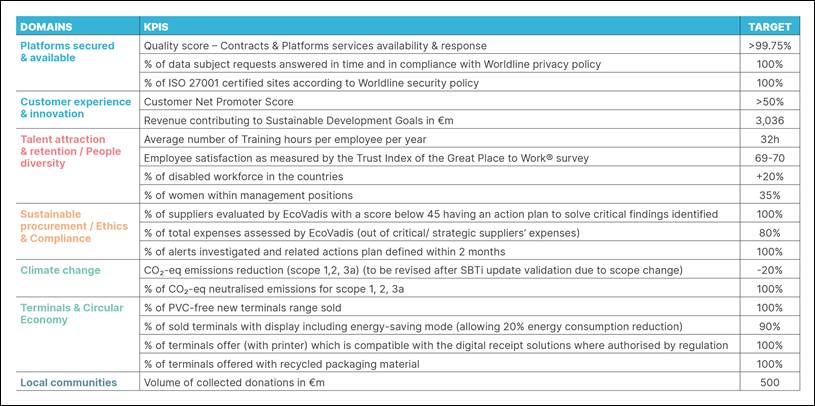
An ambitious roadmap, building on the success of the TRUST 2020 programme
In 2015, Worldline decided to launch its TRUST 2020 programme[2] with the aim of putting its CSR approach into practice even more extensively, while providing greater transparency and rigor reflecting the Group’s major long-term ambition of embracing sustainable development. TRUST 2020 genuinely took the organization’s transformation to the next level, focusing attention on 13 objectives for 2020, of which 11 were fully achieved or exceeded, and one partially achieved.
The success of the TRUST 2020 programme has also been recognized by the top non-financial rating agencies.
“Following on from the success of TRUST 2020, we intend to scale up our commitment to excellence in CSR so we can meet the ambitious targets in our TRUST 2025 programme”, commented Gilles Grapinet, Chairman and CEO of Worldline. “It calls for us to hold ourselves to the highest standards and deliver a far-reaching transformation over the next five years. It aims to introduce best practice so we can live up to our desire to lead the way forward and roll back the frontiers in CSR. We want to make Worldline a business that confidently takes a very long-term approach to its development. That is perfectly aligned with the intrinsic nature of our industry and with our unwavering goal of enabling all our stakeholders to share in the substantial value created by our Group.”
“TRUST 2025 will lay the foundations for further advances over the next five years across our entire organization, as we pursue a coherent and exciting project and, more broadly, work together with our ecosystem of partners to achieve multiple objectives”, added Sébastien Mandron, Worldline’s Corporate Social Responsibility Director. “While integrating Ingenico, Worldline is aiming even higher with its CSR roadmap and has set more ambitious goals for the Group’s future. We aim to maintain the same degree of rigor and demands as over the past five years and continue to apply the highest standards in the market.”
The integrated report reflects the Group's integrated vision for sustainable performance
In line with its two main corporate objectives—fostering sustainable economic growth and reinforcing trust and security within societies—Worldline has recently published its 2020 Integrated Report. The goal is to offer stakeholders a comprehensive overview of the Group’s financial and non-financial performance and commitments in 2020.
This is the third integrated report published by Worldline. It covers the 2020 financial year and is based on data contained in the 2020 Universal Registration Document. Worldline has undertaken to adopt an integrated approach to reporting inspired by the IIRC’s (International Integrated Reporting Council) reference framework.
The integrated report is available from the dedicated website: reports.worldline.com/en
- 06:00 am

It’s already 2021 and the right time to start planning for your income tax payments. At this time, it crucial to implement a positive strategy that will be lucrative in aiding in the payment of the taxed amount. Even if you haven’t thought about the payment of your income tax this year yet, it’s time you start planning. The earlier you start working so hard about saving income tax, the better you won’t end up panicking when the time comes for payment. There are different investment options to choose from for a stable income. You can read more on fxtm here to get started with investing in stocks, bonds, and trading of forex.
You can make a series of potential plans that will help you reduce the amount you are taxed each year. With a lucrative way of saving income tax, you won’t have to pay a wholesome amount every year. You can also avoid the stress involved in working so hard to save money.
Here are the top 6 ways of saving income tax:
1. Insurance Cover
Getting an insurance cover is a better way for saving income tax. And the most interesting thing is that you are not the only one going to this benefit alone because it’s for your whole family. There are series of insurance plans and each of them differs extensively. You can invest in the premium insurance policy to reduce your expenses.
2. Trade Forex
It might not sound so interesting to you, but the trading of forex can be a lucrative way to save for income tax. Trading of forex is very popular among investors nowadays. Even if you are a beginner, you can read the vantage fx review here to learn about forex trading.
3. Investing in Investments
Investing in investment offers is a good way to make a quick income that will be helpful in saving income tax. Don’t spend your money on unreliable investment offers while you could easily invest in short-term lucrative investments to make quick returns. You can take a look at short-term investment offers like mutual funds that takes less than 5 years to mature.
4. Make use of education loan
Making use of education loans as a student can be beneficial in saving income tax. Education loan grants most students access to claiming interest deductions on taxes. With this method, you won’t be able to pay a massive amount of taxes while paying off your student loan. So, if you are a student on an education loan, now is your time to claim deductions of saving income tax.
5. Making Charity Donations
Making charity donations is a way of saving income tax, as you can claim a deduction on tax. With the evidence of payment used in making donations, you can file for income tax deductions.
6. Home Loan
Have you been planning of taking a home loan? With a home loan, you can easily reduce your income tax payment. How do you achieve this? Taking a home loan will leave you owing a certain amount of money that will be paid each year. With the interest associated with this repayment, you can file for a deduction on your income tax payment. However, you should get your hopes high because you can only claim is little amount off your tax payment.
You should also endeavor to find a tax-friendly loan option when investing in home loans. Apart from that, you can also take a look at investing in bonds, stocks, and others. You can check out a full review on exness to get started.
Conclusion
It’s already 2021 and the right time to start planning for your income tax payments. At this time, it crucial to implement a positive strategy that will be lucrative in aiding in the payment of the taxed amount.
- 06:00 am
Commenting on UK CPI rising to 2.1% Ian Warwick, Managing Partner at Deepbridge Capital, said: “Today’s inflation data serves as further evidence that that the UK economy is moving in the right direction at a significant pace. For many early-stage businesses however, the significant rise in inflation may trigger fears of a subsequent rise in interest rates, directly impacting how much they are able to borrow at a crucial time, when many expected the economy to full reopen again. Therefore, the biggest problem for growing early-stage companies may be access to funding and as we focus on economic recovery, it remains critically important that scale-up businesses, particularly in high-growth sectors such as digital technologies and life sciences are supported; as they will be at the very heart of economic growth as we create an economy fit for the twenty-first century.
“Government initiatives such as the Enterprise Investment Scheme (EIS) have never been more important for helping entrepreneurs and innovators source the funding they require, whilst also offering private investors with tax incentives to develop UK-supporting private equity portfolios. With our EIS funds reaching record levels of funding in 2020/21 it is evident that there is considerable demand from investors and financial advisers alike to invest in early-stage UK companies which we believe will be at the forefront of our economic recovery.”
- 02:00 am
· Temenos will provide Societe Generale Payment and Cash management activities with a unified, cloud-native platform for account management in Europe and Asia, and payment services for corporate and financial institution customers in Asia
· Next-generation platform enables Societe Generale to innovate fast and deliver differentiating services to meet the evolving needs of its global corporate customers
· With Temenos, Societe Generale will adopt ISO 20022 for payments messaging and comply with international payment schemes across multiple jurisdictions
Temenos, the banking software company, today announced that Societe Generale, one of the largest banks in Europe by total assets, has selected Temenos to modernize the account management and payment systems for its Global Transaction Banking activities in Europe and Asia.
Global Transaction Banking is big business. According to McKinsey, the sector generates $1 trillion in revenues each year and represents 40% of all global banking revenues.
Societe Generale is a global leader in the sector, providing a comprehensive and integrated range of services to address the operational and day-to-day transaction needs of its corporate and institutional clients.
In the face of a technology revolution reshaping customer expectations and the competitive landscape, Temenos agile technology platform will enable Societe Generale to deliver sophisticated corporate banking products and services with digital-first experiences to stay ahead of the curve.
Societe Generale will replace existing legacy systems with Temenos’ cloud-native banking platform in 13 countries across Europe and Asia as part of a strategic transformation plan to offer new and differentiating global transaction banking services and drive growth.
Leveraging Temenos Transact’s rich corporate banking functionality, Societe Generale aims to bolster its products and services offering with additional ones, seeking to both better meet the needs of its clients and support a segment identified as a key growth area in the future.
Temenos Payments will provide the payments engine for financial transactions across all Asian countries. With this next-generation platform, the bank’s international entities will be ISO20022-ready domestically and internationally. And the bank will benefit from the agility and flexibility to process payments from any channel, external or internal, with different message or file formats, all in real-time.
Temenos cloud-native technology will enable Societe Generale to adopt a hybrid implementation with Temenos software in its datacenters or in the cloud - all running from the same source code. Operating on a unified platform for account management and payments across geographies is expected to significantly increase operational efficiency and agility while reducing cost and risk.
Philippe Morère, Global CIO and deputy COO, Societe Generale Global Business & Investor Solutions, said: “Temenos is a proven solution that offers the functionality and agility to deliver a better banking experience to our customers with the scalability and performance to support future growth.
“A big advantage of Temenos is the ability to operate a unified platform on-premise or on the cloud, providing services that can be easily integrated with our digital B2B Platform SG Markets. As for Asia, Temenos’ unified platform for core banking and payments across geographies will help us to optimize processing efficiencies and enhance service innovations for our transaction banking clients.”
Max Chuard, CEO, Temenos, added: “We are proud to partner with such a prestigious Tier 1 bank to accelerate their digital transformation. With Temenos’ cloud-native, API-first technology, the bank can innovate with speed, ease, and efficiency to meet the evolving needs of its global transaction banking clients. This strategic modernization will future-proof the bank’s technology infrastructure, allowing it to transition to the cloud at its own pace. To be selected by Societe Generale for this important project demonstrates our technology leadership and our shared vision to make banking better.”
Temenos’ architecture is open-API based. It allows data to flow across the functional business lines of a corporate bank from payments to cash management, enabling efficiencies and lower total cost of ownership from the consolidation of systems and new business models. Forrester has recognized Temenos’ investment and innovation, and the platform was named a leader in The Forrester Wave™: Digital Banking Processing Platforms (Corporate Banking), Q3 2020. Temenos Payments is also recognized as a Leader in the IDC MarketScape for Worldwide Integrated Payment Platforms and ranked #1 best-selling payments system in the IBS Intelligence Sales League Table for the past three years.
- 09:00 am
A new study from Juniper Research has found that the global conversational commerce spend over RCS messaging will reach $27 billion by 2025; rising from less than $10 million in 2021. This phenomenal growth will be driven by increasing RCS support from operators and growing interest from enterprises wishing to capitalise on this emerging channel. RCS is a communications protocol that enables rich media messaging services, including chatbots and in-app payments, over cellular networks.
The new report, Conversational Commerce: Market Outlook, Emerging Opportunities & Forecasts 2021-2025 market research, forecasts that RCS will be the fastest-growing conversational commerce channel over the next 5 years. By 2025, the technology is anticipated to account for 10% of conversational commerce spend; rising from less than 1% in 2021.
For more insights, download our free whitepaper: How Conversational Commerce Will Make Its Voice Heard whitepaper
Retail, Media & FMCG Provide Early Opportunities
The report identified 3 markets that will present immediate opportunities via RCS-based conversational commerce to communications platforms:
• Retail
• Media
• FMCG
It predicts that low levels of regulatory restrictions and high levels of user readiness will drive enterprises in these markets to explore RCS as a commerce channel first. As a result, communications platforms must target players in these markets as a matter of priority.
Research author Sam Barker remarked: ‘Enterprises are focused on offering services through as many channels as possible. RCS is well positioned to handle the migration of commerce activities from established channels, such as online or in app.’
Partnerships with Payment Vendors Crucial
In addition to onboarding new service users, the research identified the need for communications platforms to partner with multiple payments providers; owing to the regional differences in payment preferences. It suggests that communications platforms focus on forming partnerships in countries in which there is already a high base of RCS-capable subscribers, such as the US, Brazil and Germany.
The report estimates that only 18% of mobile subscribers will access RCS services in 2021, however, this is anticipated to grow to over 40% by 2025; identifying the Americas as a key growth region over the next 5 years.
Whitepaper download: https://www.juniperresearch.com/whitepapers/how-conversational-commerce-will-make-its-voice
Conversational Commerce market research: https://www.juniperresearch.com/researchstore/operators-providers/conversational-commerce-research-report








