
Published

Arnaud Depaigne
Product Manager at Smart mobility
Transport ticketing has rapidly evolved in the digital age. As recently as the 1990s, closed loop systems based around paper tickets or tokens were the norm. see more
- 06:00 am

South African businesses, already under severe economic strain, are now counting the costs of rapidly increasing internal payments fraud. According to Ryan Mer, Managing Director, eftsure Africa, a Know Your Payee™ (KYP) platform provider, the number of recent high-profile cases before the courts only partly reflects the true scale of the problem.
Estimates suggest that it costs the private sector more than R2 billion every year to combat theft and fraud. According to a PWC report, South Africa was ranked as having one of the worst white-collar crime rates in the world. A similar study conducted by the Association of Certified Fraud Examiners found that a typical organisation loses at least 5 percent of its annual revenue to fraud. The same study also found that once victimised, an organisation is unlikely to recover the losses. “Not only do South African businesses have to contend with the threat of external bad actors, but the relatively high likelihood of payments fraud being committed by an entity’s own staff,” says Mer.
He adds that while the amount of business transactions taking place online is constantly growing and working from home is now commonplace, business controls have not kept pace with digital transformation. This has led to increasing demand for security and anti-fraud solutions.
Positions that involve administering payments to creditors and suppliers, overseeing and processing invoices and electronic payments, and capturing bank statement transactions present a higher risk for businesses. “It’s crucial organisations implement best practice anti-fraud strategies to prevent, detect, investigate and remediate fraudulent activity before it becomes so serious it endangers the very survival of the business.”
Mer points out that a recent case of an East London personal assistant being jailed for 15 years for stealing R11.5 million from her employer highlights that many organisations are too complacent by not implementing enough measures to tackle internal payments fraud. “Often, businesses tighten certain payment approval policies without implementing a longer-term strategy and the necessary technology to truly make an impact. Despite an overwhelming majority of businesses having vendor onboarding, management and payment controls in place, cybercrime and payment fraud is a daily occurrence and a massive challenge for businesses. While the right controls might be in place theoretically, clearly definite gaps that need to be addressed” he says.
Another hurdle organisations face is that those responsible for reviewing and releasing payments, such as CFOs, financial managers, senior managers, and directors, are under huge time constraints and don’t have capacity to check packs of supporting documents in detail on a regular basis or verify all banking details. At its core, eftsure helps protect organisations against financial fraud by automating manual controls, placing less reliance on the manual and human factor, giving those responsible for releasing payments confidence that processes and controls are in place and working effectively prior to releasing payments.
In addition to understanding the risks of internal fraud and boosting existing security, Mer advises businesses to invest in tech solutions with sufficient audit logs built in so that every action performed is recorded and can be traced back to the staff member responsible. “This is where eftsure’s automated check, with the click of a button, gives those responsible comfort in seconds as to the integrity of the payment information, prior to payment release, he says.”
“People combined with technology and sound business processes are at the frontline of fighting fraud and mitigating risk. By building a culture of security within an organisation that ensures cooperation between employees and technology, it is significantly more difficult for bad actors, both external and internal, to commit white-collar crime,” says Mer.
- 07:00 am

Robinhood's IPO could turn the trading platform into a 35 billion dollar concept
- US share and crypto trading platform Robinhood is expected to list on the Nasdaq on 29 July
- The company will trade under the ticker HOOD
- Stock expected to be priced between $38 - $42 per share
- Listing would put a value on the company of around $35 billion
- Robinhood is under the regulatory spotlight following the GameStop craze
- UK investors can’t participate in IPO but can buy shares when trading begins
Susannah Streeter, senior investment and markets analyst, Hargreaves Lansdown
‘’There is likely to be huge interest in Robinhood’s IPO, given the swirling speculation about the company on social media forums and the media coverage the company received as it became a central figure in the GameStop craze earlier in the year.
The company was set up to help further democratise investing in the US and draw more ordinary traders into the Wall Street world. If the stock does list within the range of $38 - $42 per share, this will turn out to be a $35 billion dollar idea. But the company has come under the regulatory spotlight and that could have a big impact on the company’s future potential as an investment.
The app has come under fire for the so called ‘gamification’ of investing with the use of rewards and celebratory notifications to encourage users to trade more. Its strategy is paying off with the number of accounts increasing to 18 million by March this year from 7.2 million in March 2020.
The way that Robinhood makes money has also come under intense scrutiny. Instead of charging investors a dealing commission, it puts clients' trades through certain companies, and in return, these companies pay Robinhood a fee. It’s these charges, called “payment for order flow” that make the company most of its money.
Even though each fee is a tiny fraction of a cent per share traded, it soon adds up. Over the last year Robinhood made $720m from payment for order flow – three quarters of its total revenue. That rose to 81% of revenues in the first 3 months of this year.
But this model is now under review, with the US regulator, the Securities and Exchange Commission (SEC) planning to look again at the stock market trading rules, which could include payment for order flow.
The concern is that it stops investors from getting the best price for their deals and could create a possible conflict of interest between firms like Robinhood and their clients. Firms promise to trade at, or at better than, current market price. But the question remains about whether, under the system, there are even better prices available with other market making companies, which they don’t use. If rules do change this could be a big worry for the firm’s revenues and future investors in the company. It was enough for Robinhood to highlight a potential ban on payment for order flow as a key risk in its prospectus.
This isn’t the first time Robinhood has come under fire from US regulators. In December last year, Massachusetts securities regulator accused Robinhood of gamifying investing. The case included a customer, with no investment experience, who traded 12,700 times in six months. More recently, the Financial Industry Regulatory Authority fined Robinhood a record $70m. It said the company had caused “widespread and significant harm” to investors.
And there could be more storms gathering on the horizon. The Robinhood prospectus named seven US state and federal bodies investigating the company. All this could add up to potential issues down the line, so investors need to take such risks into the equation when they consider investing right from the start of Robinhood’s listed life.
If Robinhood can bat away these issues, or if the SEC decides not to change the current rule book, the groundswell of support among day traders the company has already gathered could potentially accelerate, leading to further growth for the company.’’
How to buy Robinhood shares
UK investors can’t take part in the Robinhood IPO. But HL clients should be able to buy Robinhood shares once they start trading on the US stock market which is expected to be on 29 July. If you believe in the long-term prospects for Robinhood and want to buy the shares, you first need to choose an account to hold the shares in. Once listed on the stock market, you can hold Robinhood shares in a general investment account (Fund and Share Account), ISA or Self-Invested Personal Pension (SIPP). Before you buy your first US share with HL, you’ll also need to complete a W-8BEN form.
On the first day of trading, it can take several hours to get a live market price. During this time, it isn’t possible to buy or sell the shares. Investors will be able to deal the shares through HL once there’s a live market price, and trading and settlement has been confirmed by the UK clearing and settlement service. This could be after the shares have already started trading on the stock exchange.
- 05:00 am

The Venture building arm of the international investment firm Digital Horizon announces the sale of a controlling stake in a blockchain platform Factorin to Mobile TeleSystems PJSC, Russia’s largest mobile operator and a leading provider of media and digital services. Factorin, the two year old blockchain-based trade finance platform, was valued at $23 million.
According to the WTO research, Factorin is one of the leading early stage global blockchain projects for trade and the market leader in trade finance solutions in Russia. Factorin’s innovative platform provides a comprehensive solution for supply chain financing by digitizing financial interactions between buyers, suppliers, and banks. The platform provides factoring and other trade finance services for leading Russian retailers and their suppliers, including Magnit and Dixy Group as well as RTC, MTS’s own retail network. More than 40 banks and factoring providers and over a thousand companies – both suppliers and buyers – are connected to Factorin. Since its launch in 2019, Factorin has facilitated the financing of more than 1.6 million supplies worth over $3 billion.
Alan Vaksman, Co-Founder and Managing Partner at Digital Horizon, states, “The financial infrastructure of the future will be powered by blockchain-based solutions. In the coming years, distributed ledger technologies will provide the secure rails to advance trade finance, settlements, custody, and payments in general. Factorin is one of the pioneers that are helping to bring that future into today’s business. Factorin’s blockchain technology solves real business problems, while processing millions of transactions in a highly secure and confidentiality-focused environment. I am pleased that MTS shares this vision with us and embarked on the strategic journey to support the rapid growth of this asset.” .
Ilya Filatov, MTS VP for Financial Services and MTS Bank CEO, added, “This deal is yet another major step forward in the development of digital products and enhanced services for our B2B customers. Factorin is not only a fast-growing and high-tech trade finance platform, it provides a unique offering that fully leverages all of the advantages of blockchain technology. I am confident that the addition of Factorin into MTS Group will accelerate our growth and further reinforce the company's leading position.”
Andrei Maklin, the Founder of Factorin, comments, "Factorin is leveraging the latest innovations to offer our customers a full spectrum of advanced trade financing solutions. These are fundamentally new products that would be impossible to replicate using traditional technologies. For example, we enable corporate clients to set up their own platforms that provide their suppliers and buyers with attractive offers from a variety of financing providers. In just two years — with the support of Digital Horizon — we have built the largest trade finance platform in Russia. With this deal, we are adding the resources of a powerful partner to help meet the growing market demand as well as unlock additional opportunities and competitive advantages for our users. The combination of MTS’s scale and expertise and Factorin’s blockchain solutions will help us qualitatively transform the entire areas of fintech services for the B2B segment."
- 07:00 am

GoCardless, a global fintech in account-to-account payments, has appointed Alexandra Chiaramonti as General Manager of Southern Europe. Chiaramonti will sustain GoCardless' rapid growth in the region by continuing to hire top talent to strengthen and accelerate the company's presence in its existing French market -- where it has tripled its customer base since opening its Paris office in 2018 -- as well as leading its expansion in the region.
Chiaramonti joins GoCardless after serving as CEO at GoBeep, a platform designed to drive incremental in-store and online revenue for retailers. Prior to this, she held roles as Director of Global Sales Strategy at Criteo and Managing Director at Teemo. Her experience in scaling and expanding businesses internationally places her in an ideal position to lead the company's growth.
Chiaramonti said: "I’m thrilled to join a rapidly growing company with an amazing team of talented people all focused on making a difference in the payments world. We have a top-notch product solving one of the biggest headaches for merchants: getting paid on time, in a fast and efficient way. Southern Europe represents a tremendous opportunity for GoCardless and I want us to seize it as soon as possible, becoming the go-to provider when businesses look for a best-in-class payment solution."
Chiaramonti's appointment comes at a time of broader expansion for GoCardless, which is accelerating its open banking strategy. By combining open banking payments with its global bank debit network, GoCardless is in a unique position to help companies collect one-off and recurring payments through a single platform -- offering merchants a fast, reliable and low-cost alternative to cards by harnessing the power of account-to-account payments.
Even Walser, Chief Revenue Officer at GoCardless, said: “We are opening up significant new market segments with open banking, including B2C subscriptions, which will further strengthen our growth in the region. Now is the time to bring in a leader who can help us scale the organization in this market and Alexandra is the perfect fit.”
- 08:00 am

Partnering with Coins.ph and SBI VC Trade, SBI Remit Will Deliver A Superior Customer Experience With Faster and Cheaper Remittances Starting in the Philippines
Ripple, the leading provider of enterprise blockchain and cryptocurrency solutions for global payments, announced today the launch of RippleNet’s first live On-Demand Liquidity (ODL) service implementation in Japan, in collaboration with SBI Remit Co., Ltd, the largest money transfer provider in Japan and one of the leading mobile wallet services in the Philippines, Coins.ph.
This expanded partnership will see SBI Remit connect with Coins.ph and digital asset exchange platform SBI VC Trade on RippleNet for faster and more affordable cross-border payments from Japan to the Philippines. With ODL now available in Japan, RippleNet customers can leverage the digital asset XRP to eliminate pre-funding and reduce operational costs, unlocking capital and fuel the expansion of their payments businesses.
“The expansion of our relationship with SBI Remit to kickstart RippleNet’s ODL service in Japan marks a major milestone in one of our largest markets. SBI Remit has been a leader when it comes to embracing new technology to deliver the best customer experience,” said Asheesh Birla, General Manager of RippleNet at Ripple. “We are excited to partner with forward looking companies like SBI that see the value in blockchain technology and to support them in preparing for a crypto-enabled future.”
Driven by long-term growth trends of foreign workers and cross-border e-commerce in Japan, there is an expected increase in low-value, high-frequency remittances. The Filipino diaspora is currently the third largest in Japan - in 2020, remittance flows from Japan to Philippines sent by overseas Flipino workers totaled approximately 1.8 billion U.S. dollars. On top of that, Japan has one of the highest cross-border payment fees in the world. According to The World Bank, remitting from Japan incurs an average cost of 10.5%, while the average cost of sending remittances from G8 countries is 5.92%.
“We see tremendous potential in leveraging blockchain technology to transform not only the way payment transactions are made but in how we manage our business by unlocking trapped capital,” said Nobuo Ando, Representative Director of SBI Remit. “The launch of ODL in Japan is just the start, and we look forward to continuing to push into the next frontier of financial innovation, beyond real-time payments in just the Philippines, but to other parts of the region as well.”
The APAC region is exploding with growth and opportunities for RippleNet in response to progressive crypto regulation and innovative companies, such as SBI Remit, looking to lead in the crypto space. Asia Pacific is one of the fastest growing regions for Ripple with transactions growing 130% year-over-year. In this next phase of the partnership, SBI Remit will connect with other established partners on RippleNet and utilize XRP to accelerate their high performance payments business.
“Fintech innovation is the key to achieving quicker and more secure financial transactions,” said Nauman Mustafa, CEO of Coins.ph. “With the support of SBI Remit and Ripple, we look forward to enabling greater customer experiences by bringing faster and cheaper cross-border payments between Japan and the Philippines, taking a step closer towards revolutionising the financial system.”
As more enterprises look towards integrating crypto-enabled services into their offerings, SBI Remit will join existing ODL customers in APAC, such as Novatti and Tranglo, in playing a vital role on RippleNet as fiat on and off-ramps. SBI Holdings is an investor and shareholder of Ripple.
- 02:00 am

Amidst great uncertainty regarding the situation of global markets and their prospects, leading online trading brand InvestingCrypto has announced new benefits and tools open to all its account holders. These surpluses are divided amongst all types of accounts, in a manner which grants advantages to every registered user. All of these changes are effective immediately, making all new features accessible as of today.
"In this turbulent trading reality, we can't afford to offer our clients yesterday's trading conditions," commented Donald Reilly, spokesperson for InvestingCrypto. "That's why we've come up with these new and improved accounts, and I can promise our users that we're not going to stop there. We will keep upgrading and bettering our offer, in order to stay ahead of the game."
Giving traders an edge over the rest
According to the company, the new accounts are a result of months of planning, including thorough global market analysis, in order to figure out what it is that can take trading to the next level under the current conditions. Among the new features is an annual summary with a certified tax specialist, granted to Gold account holders, personal chief portfolio managers, granted to VIP account holders, monthly sessions with certified accountants, granted to Standard account holders, and more.
"For us, it's not just about giving our customers everything that the market has to offer," added Reilly, "it's also about providing them with that extra touch they can't get anywhere else. Whether it's our outstanding support service, our enriching educational tools, or our cutting-edge trading platform, we always want to be one step ahead of the rest. That's the way it has been ever since our foundation, and we see no reason to change this strategy."
- 02:00 am

Workiva Marketplace debuts with both Workiva-built and partner offerings that simplify complex reporting and compliance problems
Workiva Inc, today launched The Workiva Marketplace, filled with more than 140 Workiva-built and partner templates, services and 60 no-code connectors that streamline existing processes and solve new business problems all within the Workiva cloud platform’s connected and secure ecosystem.
The Workiva Marketplace’s offerings include: process checklists, carefully organised and linked reports, style guides, perfectly formatted presentations, and more. Accounting, audit, financial planning & analysis, financial services, and legal teams can easily add templates or connectors directly into an existing Workiva workspace and optimise workflow with process automation, practical examples, and industry best practices.
Comments on the News:
· “There is an enormous opportunity for organizations to scale their business operations efficiently and cost effectively by leveraging Workiva’s connected ecosystem,” said Julie Iskow, COO of Workiva. “The Workiva Marketplace allows users to find tools, templates, connectors and applications that make using our platform faster and easier. It also easily connects customers with our trusted, best-in-industry consulting and technology partners and can extend the value of our platform for our users."
· “For years, corporate accounting and financial reporting teams have operated separately due simply to the nature of data collection and reporting processes, and this can lead to a myriad of complications at the end of the reporting period,” said Mike Whitmire, CEO & Co-founder of FloQast. “Using FloQast’s direct API connector available in The Workiva Marketplace, accounting and finance teams automate and accelerate the financial close and disclosure process, bridging the gap between them, which adds value by providing greater visibility into the close and reconciliation process, and enabling a more accurate and efficient reporting process.”
· “As a partner, Clearview Group is thrilled to join Workiva for the launch of the new Marketplace,” said Scott Freinberg, Director of Advisory Services at Clearview. “Clients and partners will now be able to more efficiently access industry-leading templates and tools to transform their processes and technology. Workiva consistently works to enhance their products and services for their customers, and we could not be more honored to partner with them on this initiative.”
· “I am really impressed with the variety of templates and connectors available in the new Marketplace, especially with SOX, Internal Controls, and Management reporting,” said Trevor Harris, SOX Manager of NXP Semiconductors. “I like that the Marketplace is easy to navigate and that my team can easily incorporate these industry best practices immediately. The time savings alone from not having to start at square one is going to be priceless. This will really let me do more with my data inside the Workiva platform.”
Workiva Marketplace Innovators:
Partners are extending the use of the platform with mutual clients by creating new services and solutions on top of the Workiva platform that solve customers’ unique business challenges.
Argyle, BlackLine, Business Wire, CFO Solutions, Clearview Group, Column5 Consulting, Fastpath Solutions, F.H. Black & Company Inc., FloQast, Keyrus Consulting, OneCloud, Planalytix, PwC, Sentieo, and Trintech are among the Workiva partners that played a crucial role in the launch of the Marketplace by contributing meaningful templates, services and content that is readily available for customers to add to their workspaces and use.
Workiva has a strong partner ecosystem, with over 200 industry-leading business and technology advisory firms that are available to assist customers as they expand their use of the Workiva Platform.
Additional Resources:
· Learn more about the Workiva Marketplace and adding value across organisations with the Workiva platform.
· Browse available Workiva Marketplace Templates.
· Browse available Workiva Marketplace Data Integration Connectors.
· View the full list of Workiva Marketplace Partners.
- 09:00 am

Recognition by FX Markets marks Avelacom’s third industry award in 2021
Avelacom, the low latency connectivity, IT infrastructure, and data solutions provider for global financial markets, has won the FX Markets Award for best connectivity, hosting and co-location services for electronic FX trading.
This latest award recognizes Avelacom’s excellence as a global leader in network services and IT hardware solutions tailored for the financial industry and specifically FX trading firms, one of the largest groups in capital markets.
Avelacom is highly regarded for its continuous commitment to, and investment in the FX industry. Banks and trading firms continue to focus heavily on IT infrastructure efficiency as a key success factor, yet the growth and volatility of the FX markets over the past year led to greater challenges for these firms to compete. As a result, there is a high demand to deploy best-in-class technologies like Avelacom’s ready to-go low latency connectivity, IT infrastructure and data solutions.
Over the past 12 months Avelacom has been expanding its network and IT infrastructure, with 50% of its revenues reinvested in its hardware, capacity building and latency optimisation. As clients have demanded access to trade more EMFX, Avelacom has increased its points-of-presence (PoPs) and enhanced its fiber backbone across Asia, Latin America, India, Eastern Europe, Middle East and Africa, making these new markets easier and more efficient to access.
London <> Tokyo and London <> Singapore ultra-low latency fiber routes are recognized as leaders in Avelacom’s product portfolio, due to significant market demand, driven by increased trading volumes and the rise of new FX matching and pricing engines in Singapore. Unrivaled network performance metrics on these particular routes strongly differentiates Avelacom in the FX space.
With increased global acceptance of cryptocurrency as an asset class Avelacom has adapted its solutions to enable institutions to easily enter digital assets trading. Avelacom’s infrastructure provides low latency access to all major crypto exchanges globally, which is in high demand among institutions with an FX trading background.
Aleksey Larichev, CEO of Avelacom, said: “We are very pleased to receive this latest award. FX is a key asset class for us since we launched our London to Tokyo ultra-low latency route, which helps drive new arbitrage opportunities for institutions. The FX industry is fast growing and dynamic which encourages us to keep improving latency, increase capacity across our network and launch new points of presence to allow access to even more FX markets. This ongoing commitment demonstrates Avelacom’s ambition to remain the leading connectivity, hosting and co-location service in the FX and crypto markets globally.”
- 06:00 am

UK reports £5.7m in cyber crime financial loss so far this year – with one third coming from businesses
From the start of 2021, the UK has reported a total of 14,883 instances of cyber crime, with the total losses of £5.7m
Despite 90% of offences being made against the public, UK businesses have reported £1.9M of losses - a third of the total figure
Offences involving hacking, social media and email account for 6.3k of reported incidents
Primary targets for cyber crime appear to be tech-savvy individuals under 40
British people and businesses have suffered financial losses of £5.7m from a reported 14,883 cyber crime incidents since the start of the year.
The new study from click fraud prevention experts PPC Shield indicates that malicious hacking, fraudulent use of social media accounts and email scams are the most common form of cyber crime so far this year – accounting for 43% of all reported incidents since 1st January. Also in the high-ranking categories are reports of malware/viruses, personal hacking and extortion.
Data compiled from the National Fraud Intelligence Bureau indicates that those under 40 reported the most incidents this year, at a total of 5,000. This suggests that scammers and hackers are predominantly targeting younger, more tech-savvy generations; Those used to juggling multiple social media accounts, email addresses and banking apps.
Though cyber crime against corporate bodies only accounts for 10% of the UK’s reported offenses, their financial losses of £1.9M accounts for a third of the total figure.
Concerning the effects on victims of cyber crime - ONS data from the Crime Survey for England and Wales (CSEW) indicates that 72% of those affected by cyber crime expressed that they had been emotionally affected by their experiences, with almost a third stating a moderate to severe impact as a result of the offense – predominantly annoyance and anger.
A further 1 in 10 individuals experienced emotions such as anxiety, depression, fear or difficulty sleeping.
Despite the personal nature of the crimes, 81% of offences were committed by an individual person (as opposed to a group) that was not known to the victim.
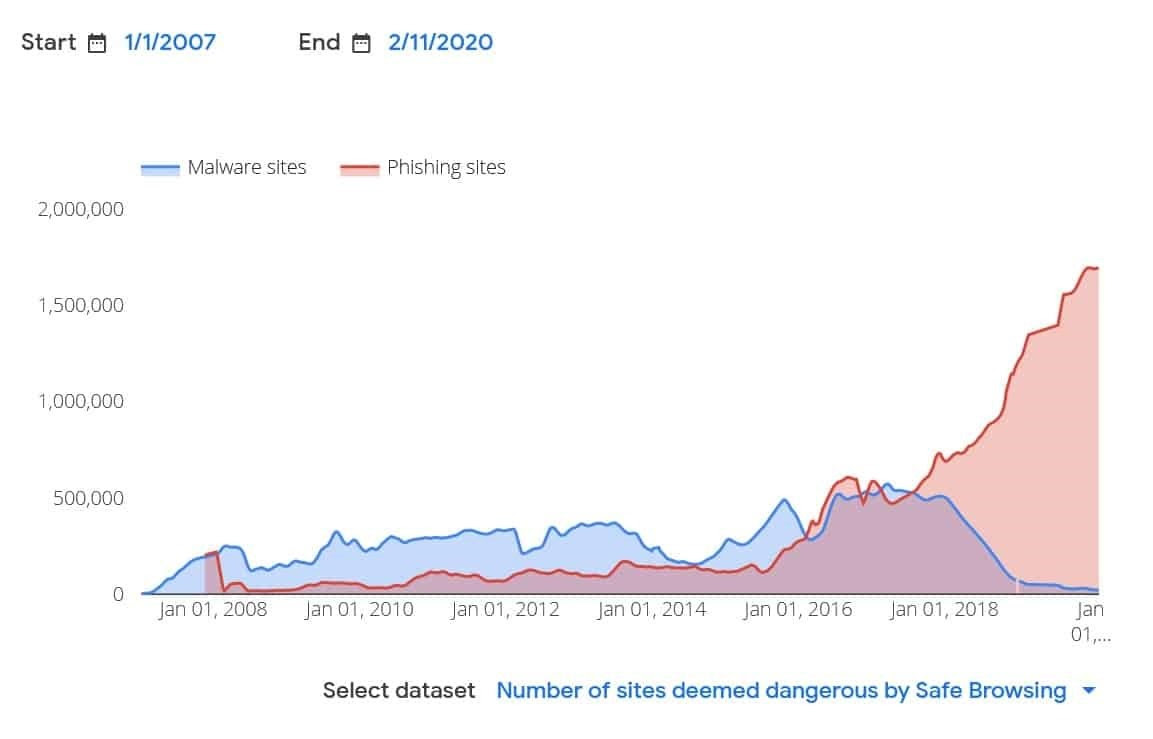
Concerning the tools used to commit cyber crime, malware (software designed to cause damage to a computer, server, client, or network) is at its lowest point since 2007, according to Google’s Transparency Report. In contrast, phishing websites - which seek to gain passwords, credit card numbers and other private information without the use of applications - have seen an increase of more than 750% since 2007.
In all cases of cyber crime that resulted in financial loss, one in three individuals discovered the offence through communications from their bank, building society or other financial institution.
Including non-cyber assisted fraud, the UK has logged 253,736 reports that equate to total financial losses of £1.2bn this year. Health minister Lord Bethell has previously commented on the rise of phishing scams conducted over the course of the COVID-19 pandemic, with an increase in fraudulent text and calls to mobile phones, with individuals posing as bank employees, HMRC and even the NHS charging for fake COVID tests and track & trace.
A spokesperson for PPC Shield comments: “With the internet such an essential part of our daily lives, taking care online and using robust security measures are of utmost importance. Always be aware of what you are clicking on, and be especially wary of phishing sites and emails sent from companies or individuals that you are not familiar with.”
The analysis was conducted by PPC Shield, which enables brands and businesses to optimize their online ad campaigns by filtering out and blocking fraudulent clicks to ensure an advertising budget is not wasted.








